
Sets and Venn Diagrams
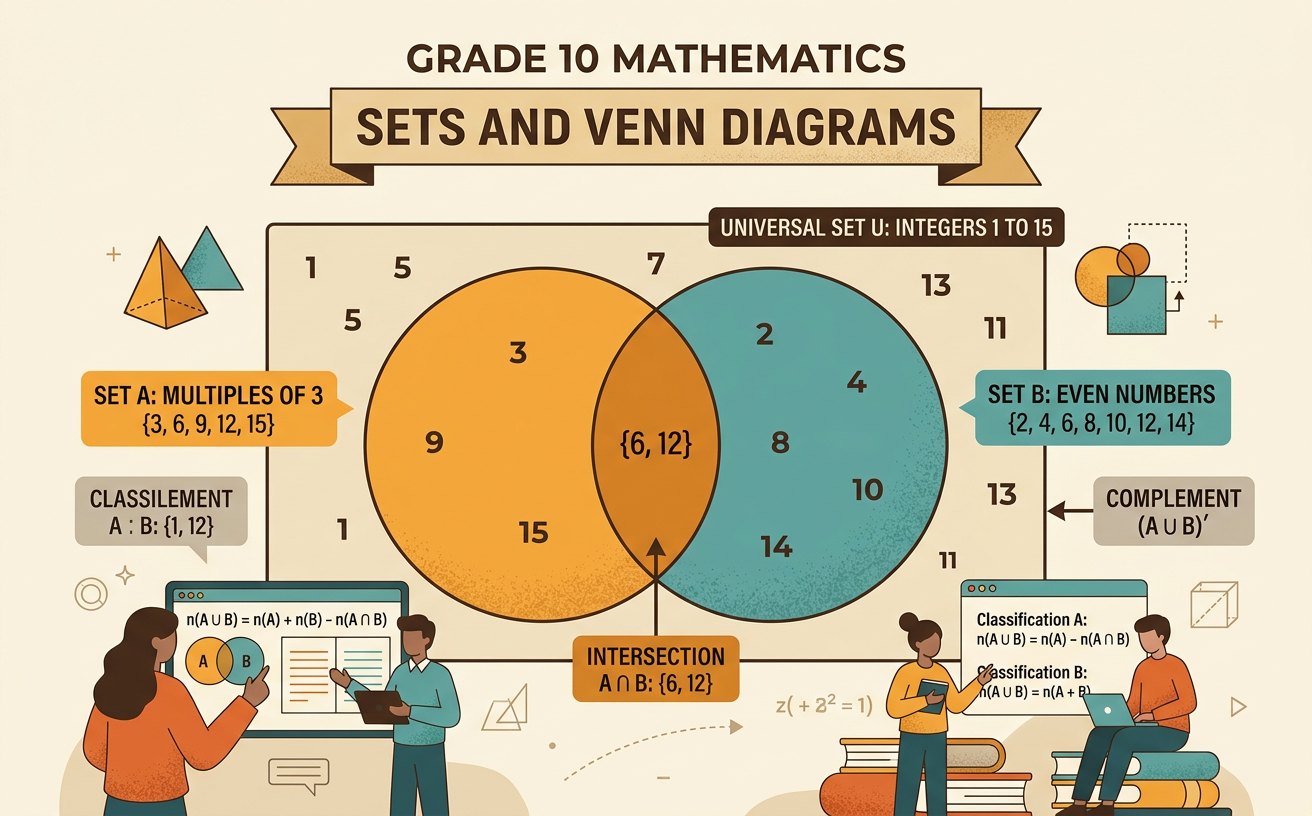
Students use set notation and Venn diagrams to describe relationships and solve classification and survey problems.
Illustrations are auto-generated and may be placeholders. They can be refreshed to match the narration.
Set Language and Notation
A set is a well-defined collection of distinct objects called elements. Capital letters usually name sets, while braces list their elements. For example, A = {2, 4, 6, 8} is the set of positive even numbers less than 10. Write 4 ∈ A to say that 4 belongs to A, and 5 ∉ A to say that 5 does not belong. Repeated entries do not create new elements, and order does not matter, so {2, 4, 4, 6, 8} and {8, 6, 4, 2} both describe A. The number of elements is the cardinality, written n(A) = 4. Set-builder form describes a rule: A = {x : x is a positive even integer and x < 10}. The empty set, written ∅ or {}, has no elements.
Subsets and Universal Sets
A set B is a subset of A if every element of B is also an element of A. This is written B ⊆ A. The universal set, written U, contains every element being considered in a particular problem. For example, let U = {1, 2, 3, 4, 5, 6, 7, 8, 9, 10, 11, 12}. Let A = {2, 4, 6, 8, 10, 12}, the even numbers in U, and B = {4, 8, 12}, the multiples of 4 in U. Every element of B is in A, and every element of A is in U, so B ⊆ A ⊆ U. Every set is a subset of itself, and the empty set is a subset of every set. A proper subset contains some, but not all, elements of another set.
Union and Intersection
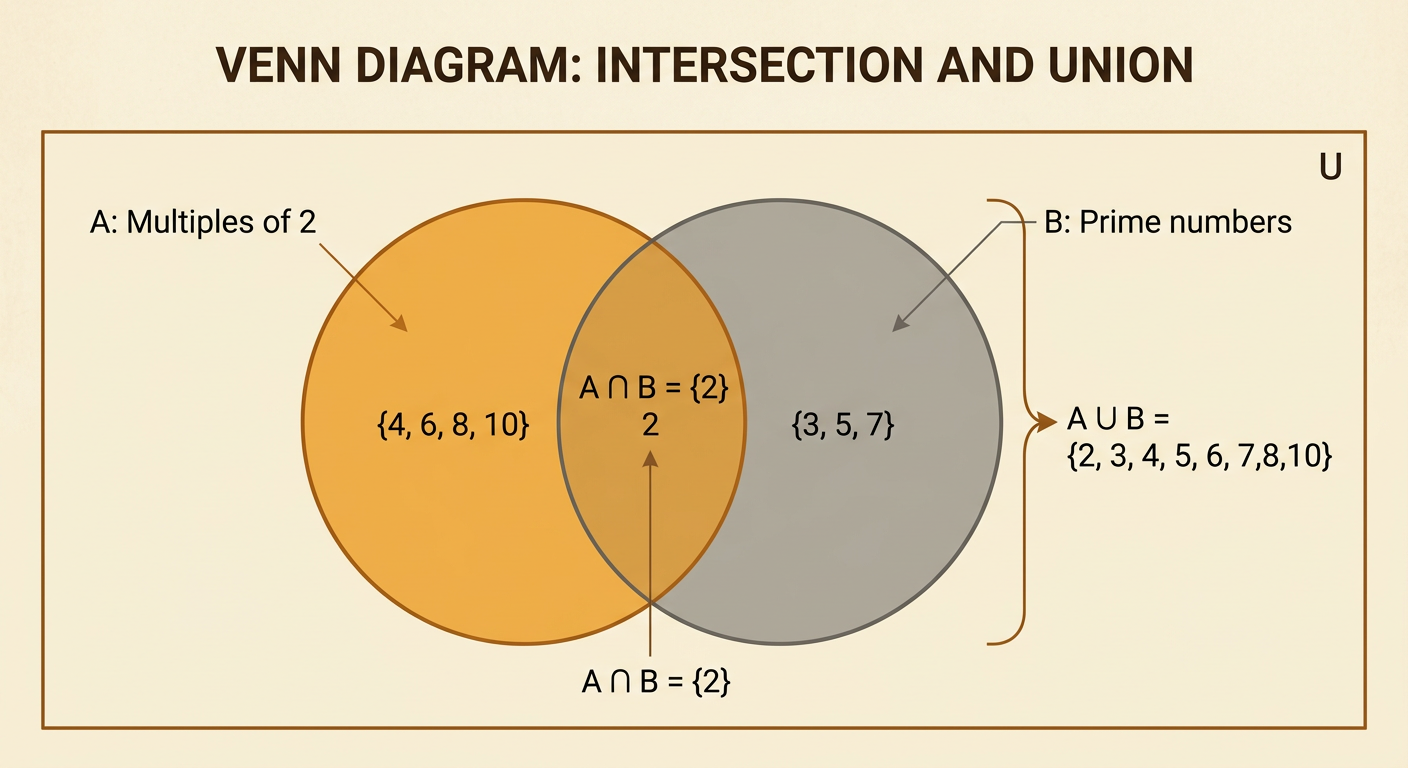
The union of two sets contains every element that belongs to either set or to both sets. It is written A ∪ B. The intersection contains only elements common to both sets and is written A ∩ B. Let U = {1, 2, 3, 4, 5, 6, 7, 8, 9, 10}, A = {2, 4, 6, 8, 10}, and B = {2, 3, 5, 7}. Here, A is the set of multiples of 2, while B is the set of prime numbers. Their intersection is A ∩ B = {2}. Their union is A ∪ B = {2, 3, 4, 5, 6, 7, 8, 10}. In a Venn diagram, the overlap represents the intersection, while the full area covered by both circles represents the union. The word “or” in set problems usually includes the overlap.
Complements
The complement of a set contains every element in the universal set that is not in that set. If A ⊆ U, write the complement as Ac. Thus, Ac = {x ∈ U : x ∉ A}. The universal set must be stated because changing U can change the complement. For example, let U be all 40 students in a class and let F be the 24 students who play football. Then Fc is the set of students in the class who do not play football, so n(Fc) = 40 − 24 = 16. On a Venn diagram, shade the part of the universal rectangle outside circle F. Also, F and Fc do not overlap, their union is U, and (Fc)c = F.
Venn Diagram Problems
In a three-set survey, fill the center first because each reported pairwise intersection usually includes anyone in all three sets. Suppose 40 students join clubs M, S, and D, representing Mathematics, Science, and Debate. The totals are n(M) = 20, n(S) = 18, and n(D) = 15. Also, n(M ∩ S) = 9, n(M ∩ D) = 8, n(S ∩ D) = 7, and 5 students join all three. The pair-only regions are 9 − 5 = 4, 8 − 5 = 3, and 7 − 5 = 2. Subtract these regions and the center from each set total: M only is 8, S only is 7, and D only is 5. Therefore, 8 + 7 + 5 + 4 + 3 + 2 + 5 = 34 students join at least one club. The remaining 40 − 34 = 6 join none.