Shifting Chemical Equilibrium in Ammonia Production
Students apply Le Châtelier’s principle to predict how changes in temperature, pressure, and concentration shift the Haber process and evaluate an industrial production decision.
Illustrations are auto-generated and may be placeholders. They can be refreshed to match the narration.
Dynamic Equilibrium Review
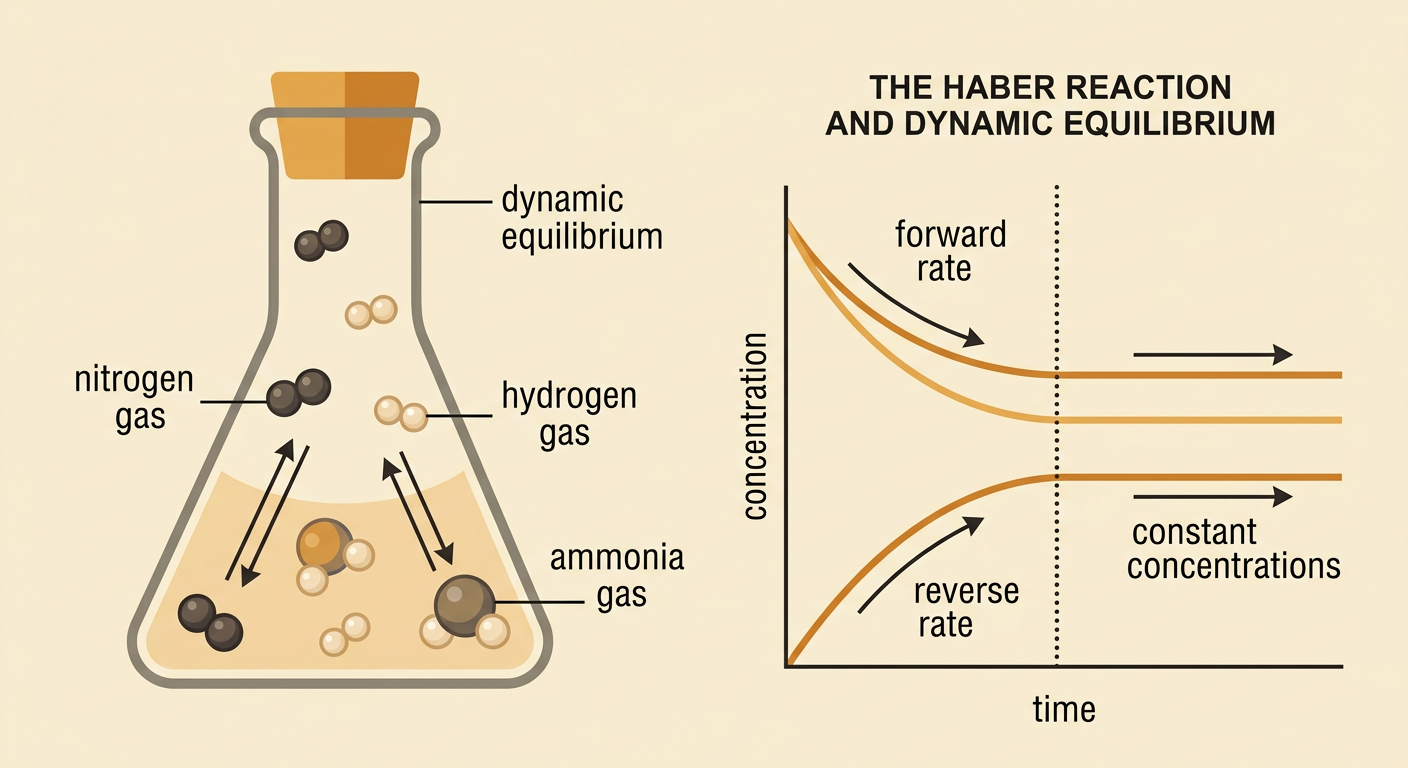
A reversible reaction can proceed in both forward and reverse directions. In a closed system, dynamic equilibrium occurs when the forward and reverse reaction rates become equal. Reactions continue at the particle level, but the concentrations of reactants and products remain constant. Equal rates do not mean equal concentrations. For example, nitrogen and hydrogen form ammonia according to N₂(g) + 3H₂(g) ⇌ 2NH₃(g). Initially, the forward reaction dominates because only nitrogen and hydrogen are present. As ammonia accumulates, the reverse reaction becomes faster. Eventually, ammonia breaks apart at the same rate that new ammonia forms. A graph would then show constant concentrations, although the nitrogen, hydrogen, and ammonia plateaus might be at different levels. Changing the conditions can disturb this equilibrium and establish a new one.
Le Châtelier’s Principle
Le Châtelier’s principle predicts how an equilibrium system responds to a stress. When concentration, pressure, or temperature changes, the system shifts in the direction that partially opposes that change. A shift right favors products, while a shift left favors reactants. Consider A(g) ⇌ 2B(g). Adding A causes the system to consume some of the added reactant, so equilibrium shifts right and produces more B. Removing B also shifts equilibrium right because the system responds by replacing some of the removed product. The response does not completely cancel the original change; instead, a new equilibrium is established. A catalyst is different from an equilibrium stress. It lowers activation energy for both directions and allows equilibrium to be reached faster, but it does not change the equilibrium composition or shift the reaction.

Concentration, Pressure, and Temperature Shifts
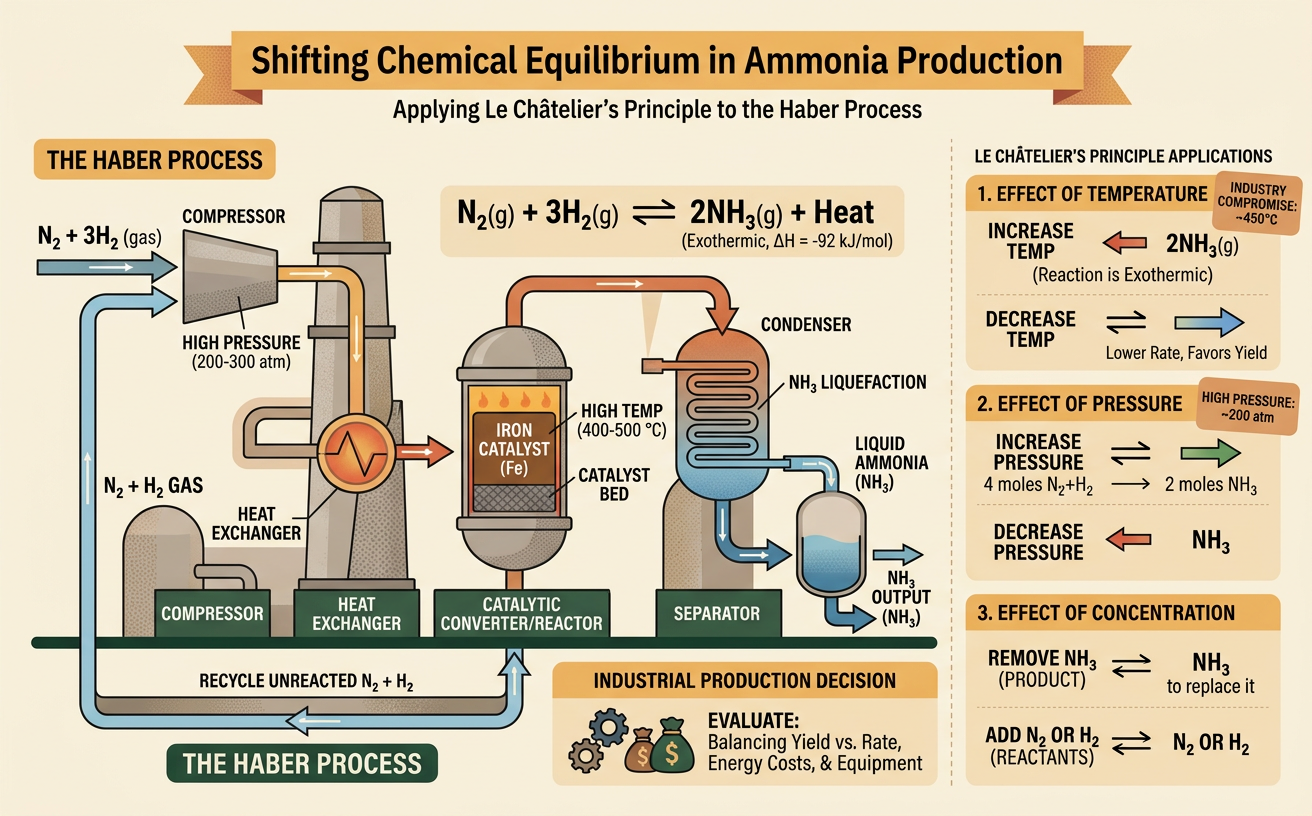
For the Haber reaction, N₂(g) + 3H₂(g) ⇌ 2NH₃(g), adding nitrogen or hydrogen shifts equilibrium right, while adding ammonia shifts it left. Removing ammonia shifts equilibrium right and is commonly used to increase production. Pressure matters because the reactant side has four moles of gas and the product side has two. Decreasing the container volume raises pressure, so equilibrium shifts toward the side with fewer gas particles: the ammonia side. Increasing volume favors the reactants. Ammonia formation is exothermic, with ΔH approximately −92 kJ for the reaction as written. Heat can therefore be treated as a product. Raising temperature shifts equilibrium left, while lowering temperature shifts it right and increases the equilibrium yield of ammonia. For example, compressing the mixture and continuously removing condensed ammonia both favor additional ammonia formation.

Modeling the Haber Process
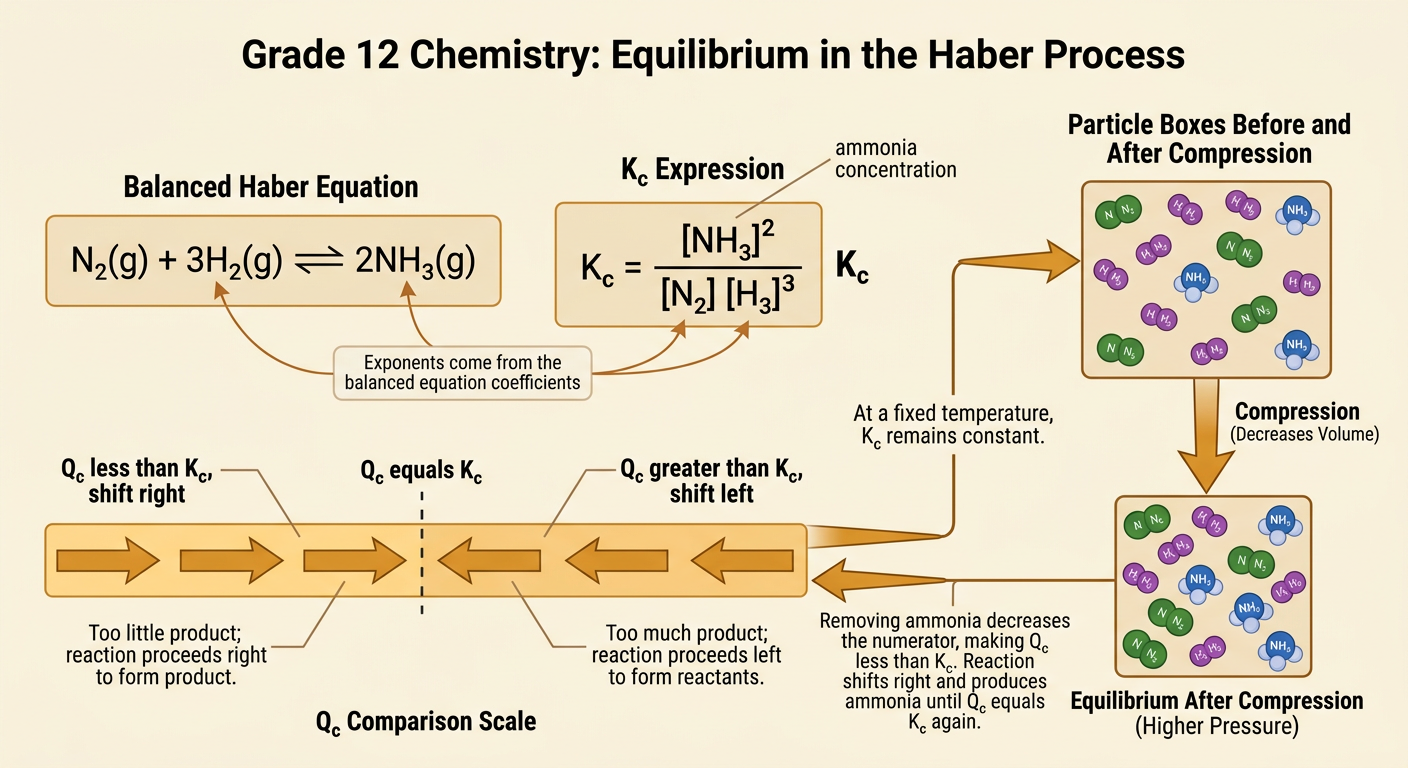
A mathematical model connects particle behavior to measurable concentrations. For N₂(g) + 3H₂(g) ⇌ 2NH₃(g), the equilibrium expression is Kc = [NH₃]² divided by [N₂][H₂]³. The exponents come from the balanced equation. At a fixed temperature, Kc remains constant even when concentrations or pressure change. The reaction quotient, Qc, has the same form but uses current concentrations. If Qc is less than Kc, the reaction proceeds right; if Qc is greater than Kc, it proceeds left. For example, removing ammonia decreases the numerator and makes Qc less than Kc. The system then produces more ammonia until Qc again equals Kc. A particle model also predicts a pressure effect: compressing the container increases collision frequency, and the equilibrium composition changes toward the side containing fewer gas particles.
Industrial Costs and Benefits
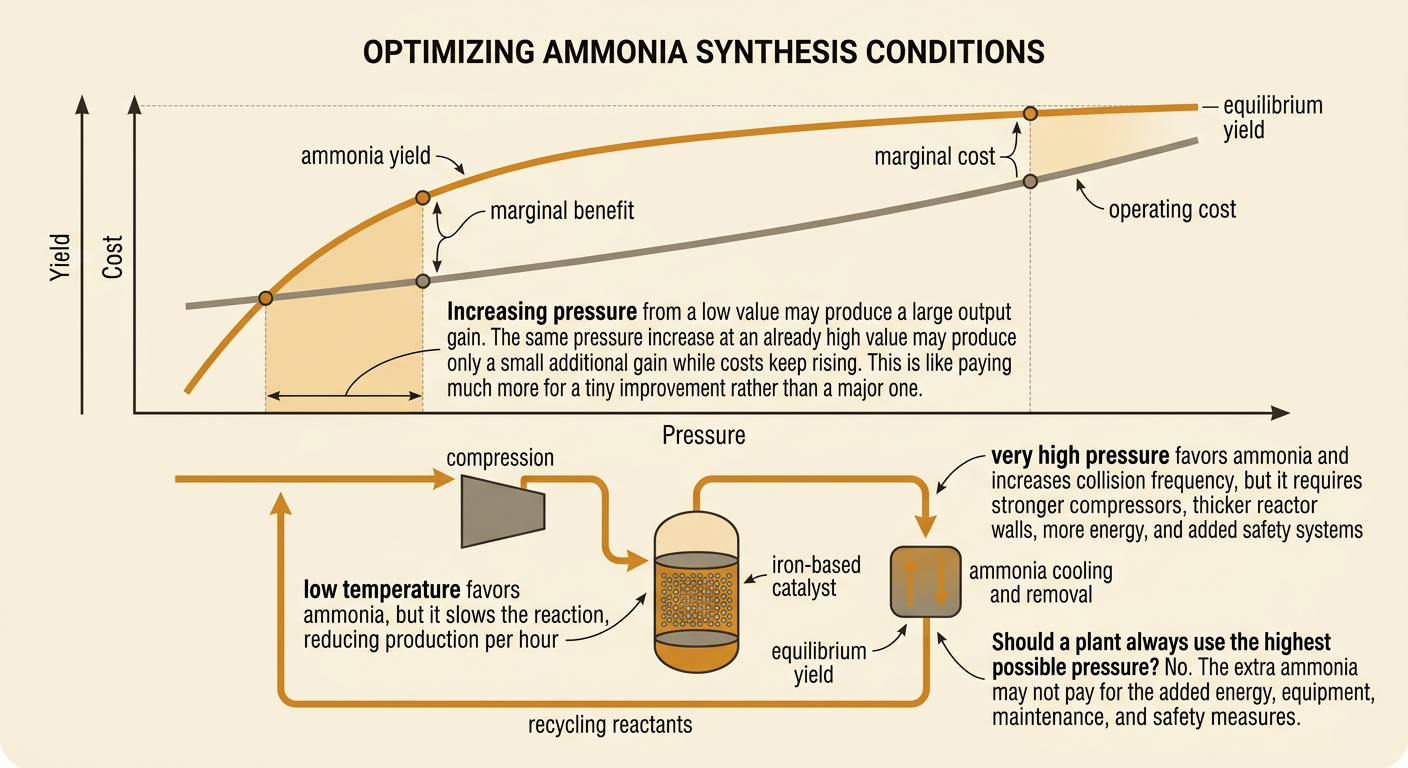
Conditions that maximize equilibrium yield are not automatically the most economical operating conditions. Low temperature favors ammonia, but it also slows the reaction and reduces the amount produced per hour. Very high pressure favors ammonia and increases reaction rates, but stronger compressors, thicker reactor walls, more energy, and additional safety systems are expensive. Industry therefore considers marginal benefits and marginal costs. Raising pressure from a low value may create a large gain in ammonia output, while an equal additional pressure increase at an already high pressure may provide only a small extra gain. That small gain may not justify its energy and equipment costs. An iron-based catalyst improves production rate without changing the equilibrium yield. Recycling unreacted nitrogen and hydrogen and removing ammonia by cooling also improve resource use. The best design balances yield, production speed, energy demand, safety, and financial cost.
Evidence-Based Production Recommendation
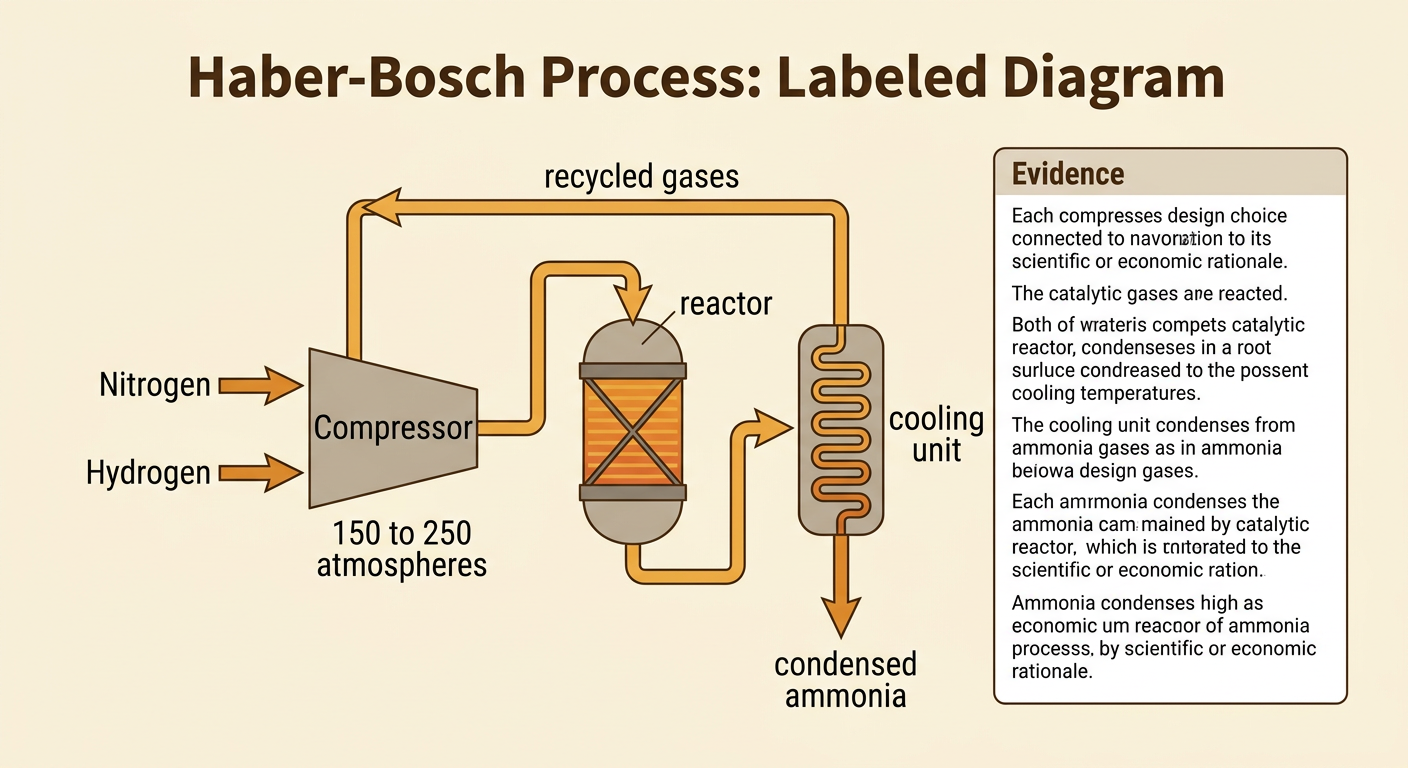
A reasonable production recommendation is to use moderately high temperature, high but manageable pressure, an iron-based catalyst, continuous ammonia removal, and reactant recycling. A typical operating range is about 400 to 500°C and 150 to 250 atmospheres, although a plant’s exact conditions depend on its equipment and energy prices. High pressure increases equilibrium yield because two moles of gaseous ammonia replace four moles of gaseous reactants. A lower temperature would produce a higher equilibrium yield, but the reaction would become too slow for economical output. The selected temperature is therefore a compromise between yield and rate, while the catalyst helps achieve a useful rate. Cooling the outlet mixture condenses ammonia, removing product and encouraging further formation when unreacted gases return to the reactor. This design is justified when the added revenue from ammonia exceeds the marginal energy, maintenance, and safety costs.