
Similarity and Scale
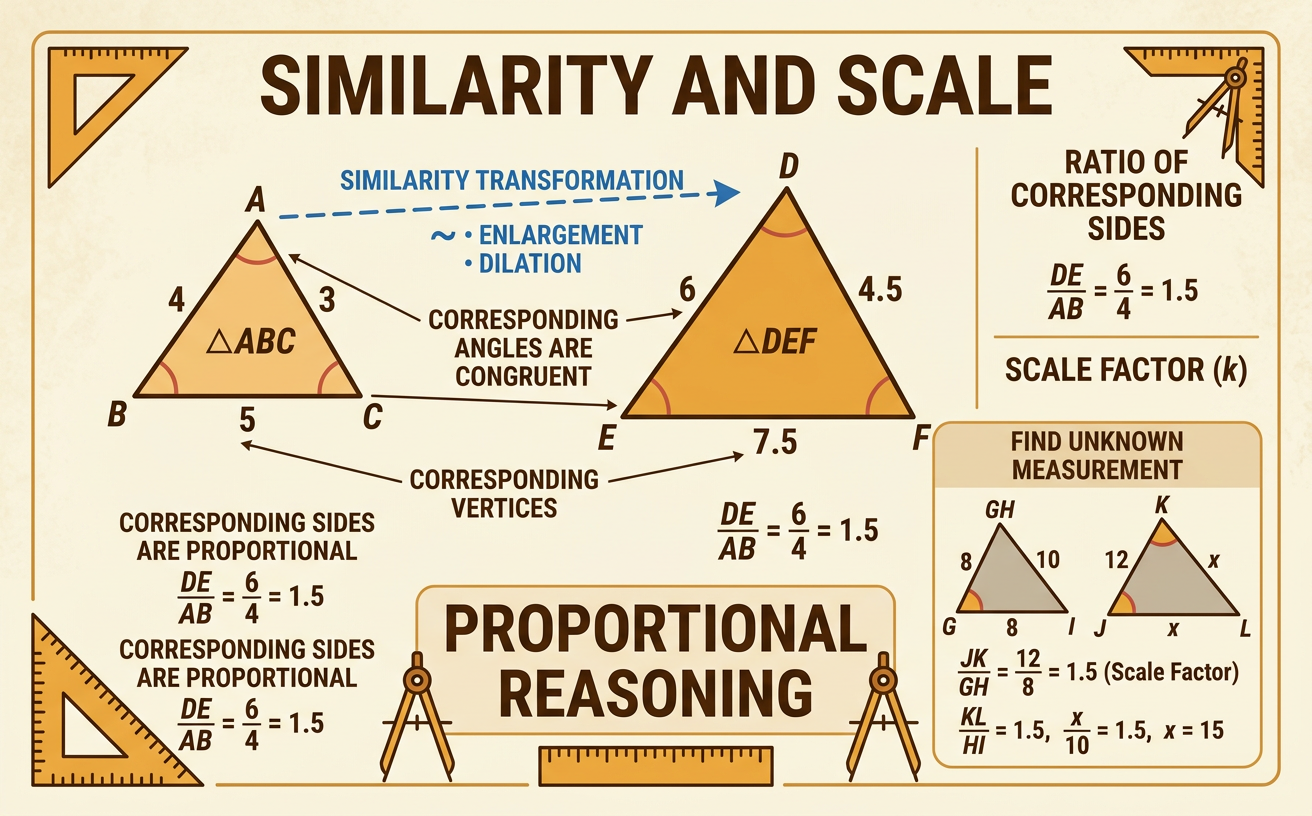
Students use similarity transformations and proportional reasoning to determine whether figures are similar and calculate unknown measurements.
Illustrations are auto-generated and may be placeholders. They can be refreshed to match the narration.
Similarity Versus Congruence
Similar figures have the same shape, but they may have different sizes. One figure can be mapped onto the other by a sequence of rigid motions and a dilation. Corresponding angles are congruent, and corresponding side lengths are proportional. Congruent figures have both the same shape and the same size. They can be mapped onto each other using only rigid motions, such as translations, rotations, and reflections. For example, a triangle with side lengths 3, 4, and 5 is similar to a triangle with side lengths 6, 8, and 10 because every side length is multiplied by 2. The triangles are not congruent because their corresponding side lengths are not equal. All congruent figures are similar with a scale factor of 1, but similar figures are not always congruent.
Dilations as Similarity Transformations
A dilation changes the size of a figure while preserving its shape. Every point moves along a ray that begins at the center of dilation. The distance from the center to each image point equals the original distance multiplied by the scale factor, k. If k is greater than 1, the image is an enlargement. If k is between 0 and 1, the image is a reduction. For example, triangle ABC has vertices A(1, 1), B(3, 1), and C(1, 2). A dilation centered at the origin with scale factor 2 produces A′(2, 2), B′(6, 2), and C′(2, 4). Each coordinate is multiplied by 2. The image has side lengths twice as long as the original, while all corresponding angle measures remain equal, so the triangles are similar.
Corresponding Angles and Sides
Corresponding parts occupy matching positions in similar figures. The order of the vertices in a similarity statement shows the correspondence. If triangle ABC is similar to triangle DEF, then A corresponds to D, B corresponds to E, and C corresponds to F. Therefore, angle A is congruent to angle D, angle B is congruent to angle E, and angle C is congruent to angle F. The corresponding side pairs are AB and DE, BC and EF, and AC and DF. Suppose triangle ABC has side lengths 4, 6, and 8, while the matching sides of triangle DEF have lengths 6, 9, and 12. Each side in triangle DEF is 1.5 times its corresponding side in triangle ABC. Equal corresponding angles and one consistent side-length ratio confirm that the triangles are similar.
Writing Proportions
A proportion compares ratios of corresponding side lengths. Before writing one, identify the vertex correspondence and keep the comparison direction consistent. Suppose triangle XYZ is similar to triangle X′Y′Z′. Let XY = 5, YZ = 7, and XZ = 8. Their corresponding image sides are X′Y′ = 15, Y′Z′ = 21, and X′Z′ = 24. Comparing image lengths to original lengths gives 15/5 = 21/7 = 24/8 = 3. The common value, 3, is the scale factor from triangle XYZ to triangle X′Y′Z′. You could reverse every ratio and obtain 5/15 = 7/21 = 8/24 = 1/3. However, mixing directions, such as comparing one image-to-original ratio with an original-to-image ratio, produces an invalid proportion.
Finding Missing Measures
To find a missing side length in similar figures, match corresponding sides, write a proportion, and solve. Suppose triangle MNP is similar to triangle QRS, with M corresponding to Q, N to R, and P to S. If MN = 6 and QR = 10, the scale factor from triangle MNP to triangle QRS is 10/6, or 5/3. Side NP = 12 corresponds to side RS = x. Multiply the original length by the scale factor: x = 12 times 5/3 = 20. The same result comes from the proportion 10/6 = x/12. Cross-multiplying gives 6x = 120, so x = 20. Check the answer by confirming that 20/12 simplifies to 5/3, the same ratio as 10/6.