Skip-Count by 5s, 10s, and 100s
Students identify and extend number patterns by skip-counting by 5s, 10s, and 100s within 1,000.

Illustrations are auto-generated and may be placeholders. They can be refreshed to match the narration.
Warm-Up Number Patterns
A number pattern follows a rule. When we skip-count, we add the same number each time instead of counting every number. Look at 10, 20, 30, 40, 50. The rule is “add 10.” After 50 comes 60 because 50 + 10 = 60. We can check a pattern by finding the difference between neighboring numbers. In 100, 200, 300, the difference is 100, so the next number is 400. Say each pattern aloud and listen for the steady jump. Try this warm-up: 25, 30, 35, __, __. Each jump adds 5, so the missing numbers are 40 and 45. Circle the starting number, name the rule, and continue the pattern without changing the size of the jump.

Skip-Count by 5s
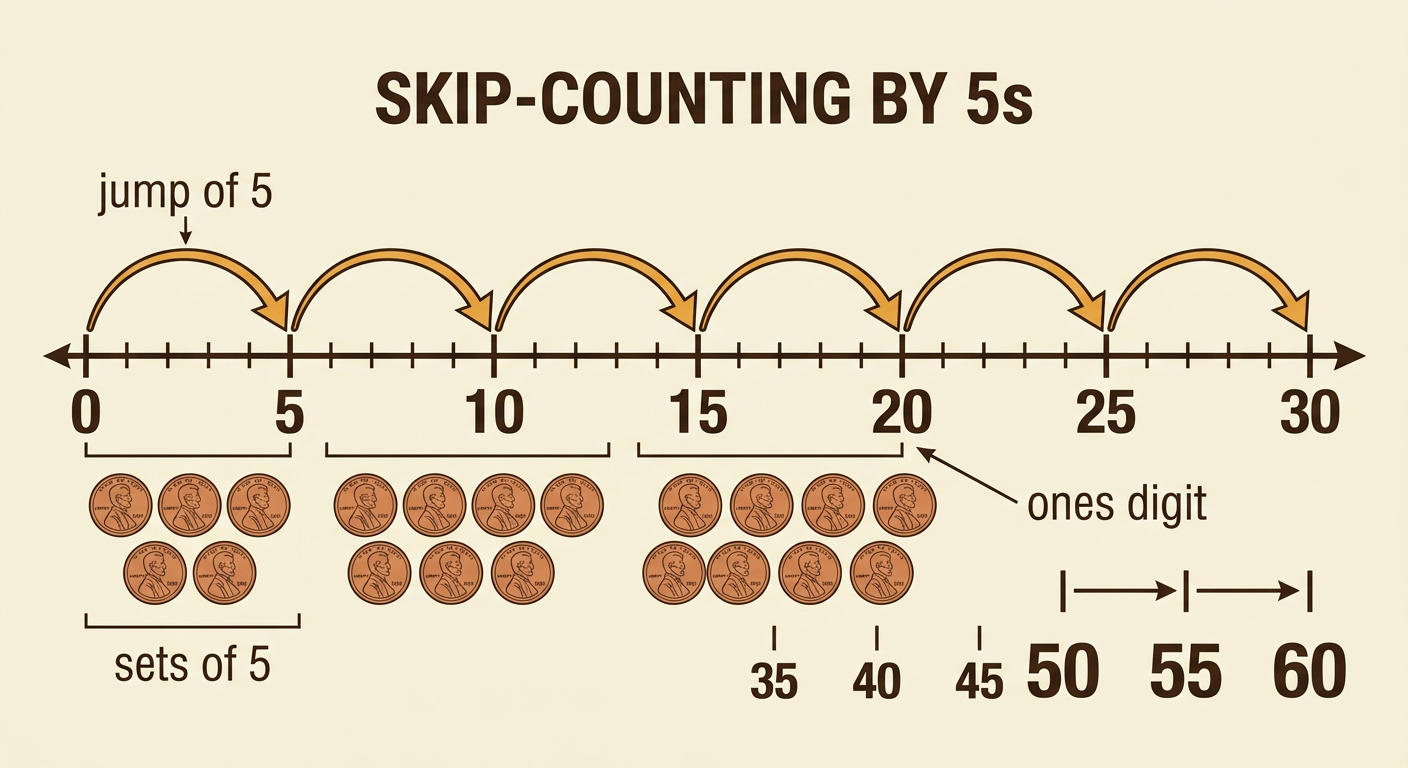
Skip-counting by 5s means adding 5 to find each next number. Begin at 0: 0, 5, 10, 15, 20, 25, 30. Notice that the ones digit alternates between 0 and 5. This clue helps when the pattern starts on a multiple of 5. Picture a number line: moving from 15 to 20 is one jump of 5, and moving from 20 to 25 is another equal jump. Five pennies can also be grouped as one set of 5. Two sets have 10 pennies, and three sets have 15 pennies. To extend 35, 40, 45, add 5 to 45. The next number is 50. Keep adding 5 to get 55 and 60. Every jump must have the same size.
Skip-Count by 10s
Skip-counting by 10s means adding one group of 10 each time. The ones digit stays the same because no extra ones are added. For example, start at 23 and count 23, 33, 43, 53, 63. Each number has 3 in the ones place. You can model this pattern with connecting-cube rods. Begin with two rods of 10 and three single cubes to show 23. Add one rod of 10 to make 33. Add another rod to make 43. You can also start at a multiple of 10: 120, 130, 140, 150. To continue, add 10 to 150. The next number is 160. Say the numbers aloud and check that each step adds exactly 10.

Skip-Count by 100s
Skip-counting by 100s means adding one hundred each time. A hundred can be shown as one large base-ten flat. Start with 200 and add one hundred: 200, 300, 400, 500, 600. The tens and ones digits remain 0 while the hundreds digit increases by 1. You can also begin at a number such as 125. Then the pattern is 125, 225, 325, 425, 525. The last two digits stay 25 because you are adding hundreds, not tens or ones. To continue 600, 700, 800, add 100 to 800. The next number is 900. One more jump reaches 1,000. Check each step by asking, “Is the next number exactly 100 more?”

Complete the Missing Numbers
To complete a number pattern, first study the numbers that are already shown. Decide whether each equal jump adds 5, 10, or 100. In 45, __, 55, the jump from 45 to 55 covers two equal steps. Skip-count by 5s: 45, 50, 55. The missing number is 50. For 260, 270, __, 290, the rule is add 10, so the missing number is 280. For 400, __, 600, the rule is add 100, so the missing number is 500. After filling a blank, read the entire pattern aloud and check every pair of neighboring numbers. If the jump changes size, try again. Use the ones digits and place values as clues, but always confirm the pattern by adding.

Independent Practice and Exit Check
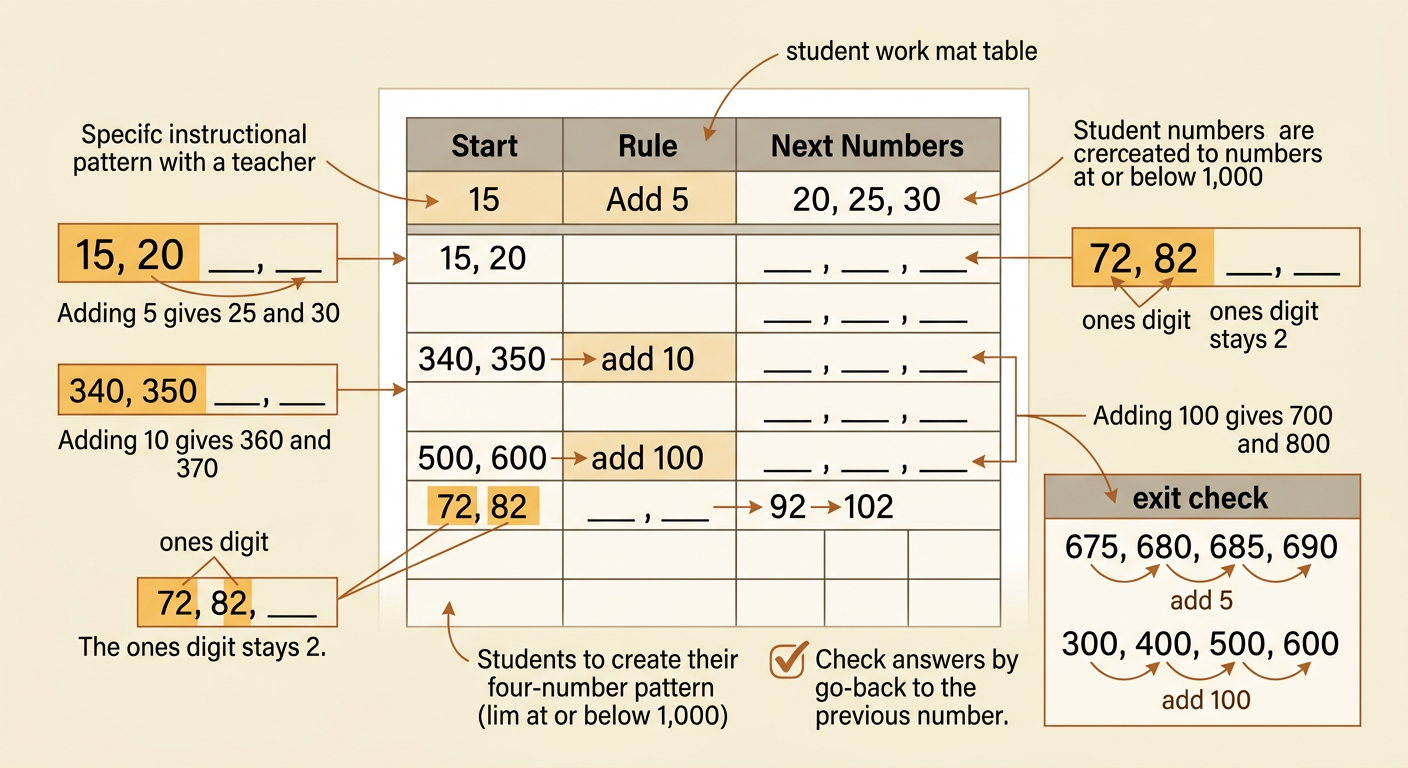
Work carefully and name the rule for each pattern. Complete these: 15, 20, __, __; 340, 350, __, __; 500, 600, __, __; and 72, 82, __, __. Then create your own four-number pattern using jumps of 5, 10, or 100. Keep every number at or below 1,000. For an exit check, solve 675, 680, __, __ and 300, 400, __, __. Explain how you know which rule to use. Check your work by adding the skip-counting amount at every step. The practice answers are 25 and 30; 360 and 370; 700 and 800; 92 and 102. The exit-check answers are 685 and 690; 500 and 600. If an answer does not fit, return to the previous number and add again.