
Soap Changes Water Drops
Students count how many drops of plain and soapy water fit on a penny, then compare the results to observe how soap changes water’s behavior.

Illustrations are auto-generated and may be placeholders. They can be refreshed to match the narration.
Notice a Water Drop
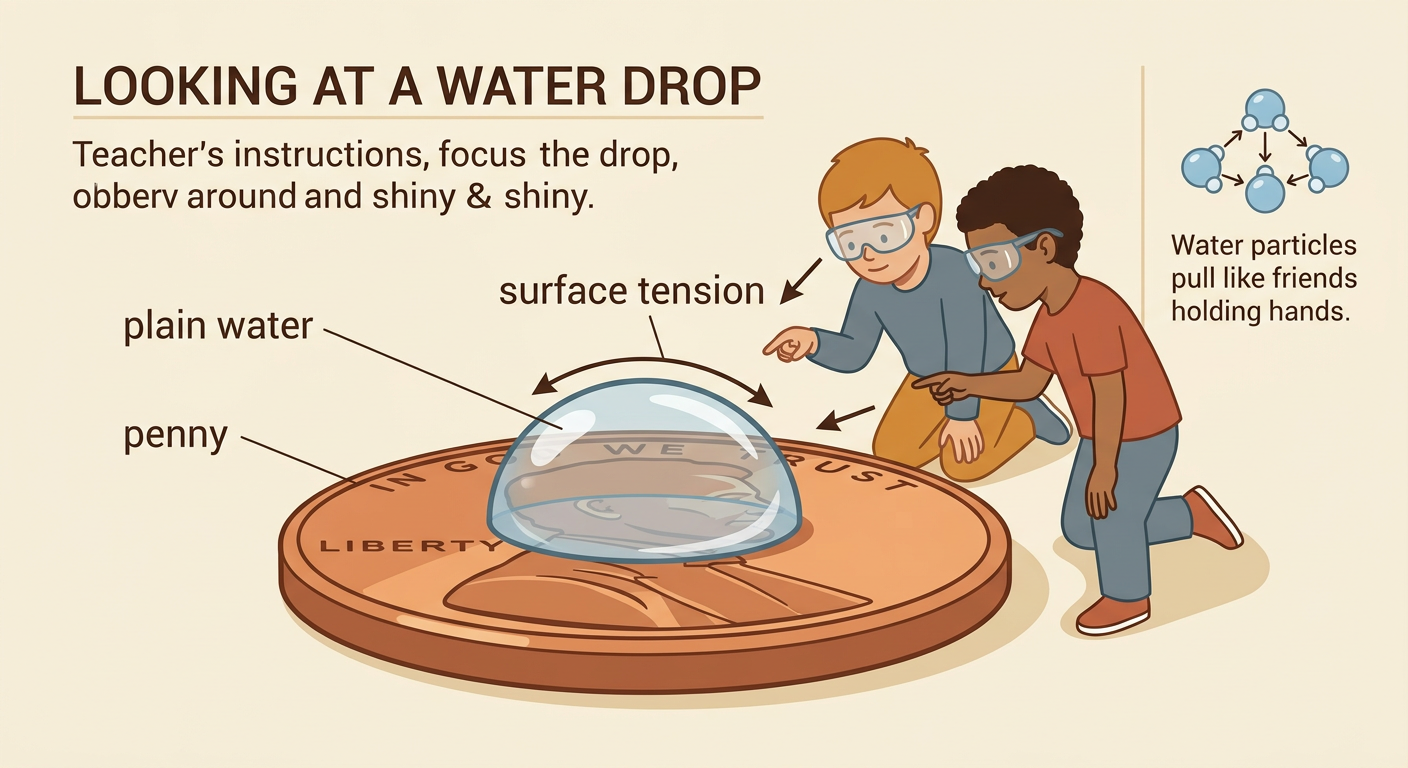
Look closely at a drop of plain water on a clean penny. The drop may look round and raised, like a tiny clear hill. Water particles pull toward one another, helping the drop stay together. This behavior is called surface tension. You do not need to remember the name yet. Focus on what you can see: the drop has a shape, takes up space, and can spread or roll. For example, gently tilt the penny and watch the water move without touching or tasting it. Tell a partner what you notice. You might say, “The drop looks shiny and round.” Listen while your partner shares another observation. Keep the penny flat for the investigation so each test is fair.
Practice Using a Dropper
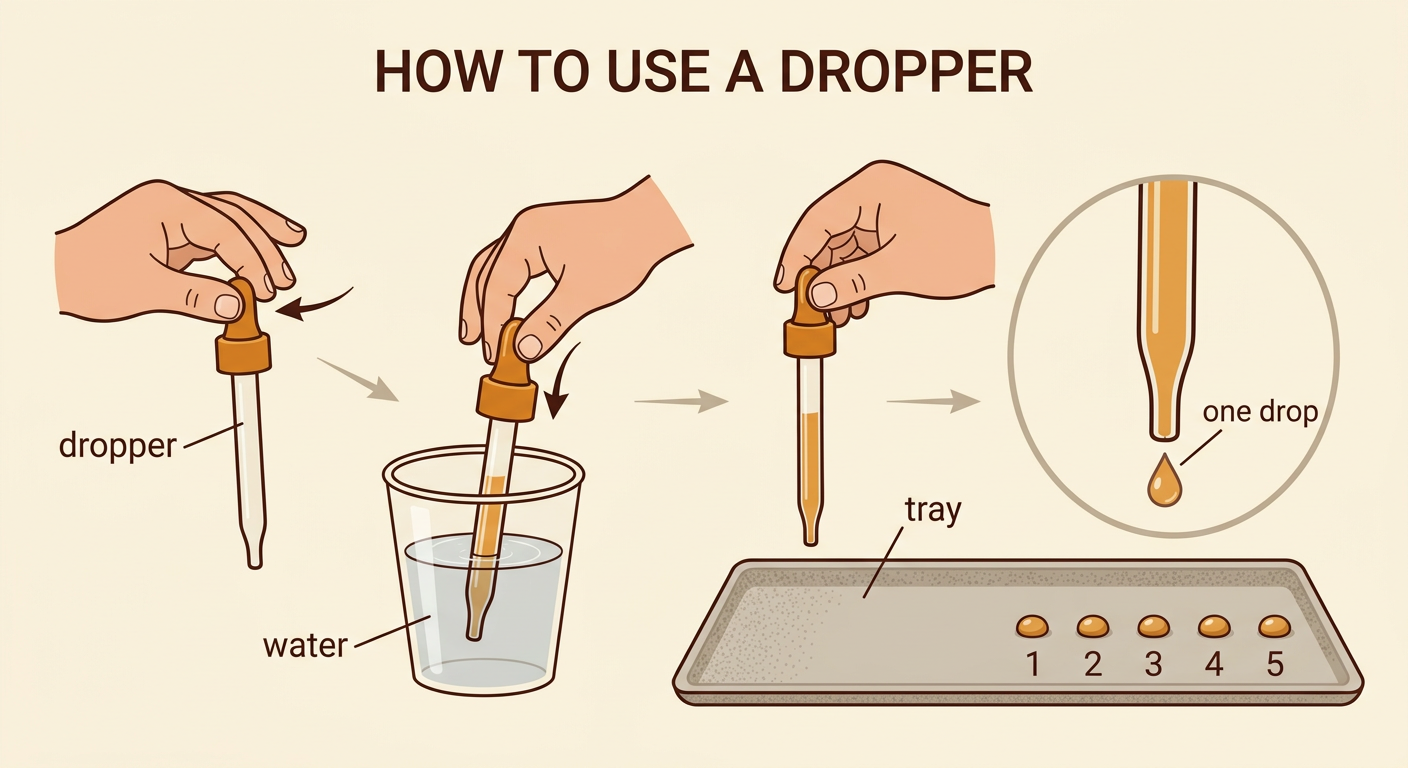
A dropper helps you add water one drop at a time. Gently squeeze the top, place the tip in the water, and slowly let go to pull water inside. Hold the dropper straight above a practice cup or tray. Squeeze softly until one drop falls. Try to make each drop about the same size. Do not let the dropper tip touch the penny because touching can make the water spill. For example, you can practice making five separate drops on a tray while counting, “One, two, three, four, five.” Take turns with your partner. One person can use the dropper while the other person counts. Wipe up spills and keep all water away from your mouth and eyes.
Test Plain Water
Place a clean, dry penny flat on a tray. Decide which side of the penny your class will use, and use that same side in both tests. Fill the dropper with plain water. Hold it straight above the center of the penny, close to the surface but not touching it. Add one drop at a time. Count every drop aloud together. Stop when the water spills over the edge. Record the number of drops that fit before the spill. For example, if the penny holds 18 drops and spills when drop 19 is added, record 18. Your number may be different, and that is okay. Work slowly, take turns, and follow the same steps so the plain-water and soapy-water tests can be compared fairly.

Test Soapy Water
Dry the penny completely before the next test. Use the same penny side, dropper height, and careful squeezing as before. Now fill the dropper with water that has a small amount of liquid soap mixed into it. Add one soapy drop at a time to the center of the penny. Count together and stop when the water spills over the edge. Record how many drops fit before the spill. For example, the soapy water might spread out and spill after 8 drops instead of holding 18 plain-water drops. Soap changes how strongly the water holds together at the surface, so the result is often lower. Do not taste the mixture. If soapy water gets on your hands, wipe or wash them as your teacher directs.

Count and Compare
Look at the two numbers you recorded. One number tells how many plain-water drops stayed on the penny. The other tells how many soapy-water drops stayed on it. Count each set again if needed. Then compare the numbers using the words more, fewer, or the same. For example, if 18 plain-water drops fit and 8 soapy-water drops fit, plain water held more drops. You can find the difference by matching or drawing 18 marks in one row and 8 marks in another row. The extra marks show how many more drops the plain water held. Results can vary because drops are not always exactly the same size. Use the numbers you actually observed rather than changing them to match another group’s results.

Share What Changed
Use your observations and numbers to explain what changed when soap was added. Speak clearly and take turns. Look at the person who is talking, listen without interrupting, and respond kindly. You can use this sentence frame: “Plain water held ___ drops, and soapy water held ___ drops. I noticed ___.” For example, a student might say, “Plain water held 18 drops, and soapy water held 8 drops. I noticed that the soapy water spread out sooner.” A partner might respond, “I also saw that,” or “Our group counted a different number.” Different results are useful to discuss. Together, make a class claim based on the evidence: adding soap changed how the water behaved on the penny.
