Solids and Liquids in Our Community
Students observe whether familiar community goods keep their shape or flow, classify them as solids or liquids, and graph their findings.
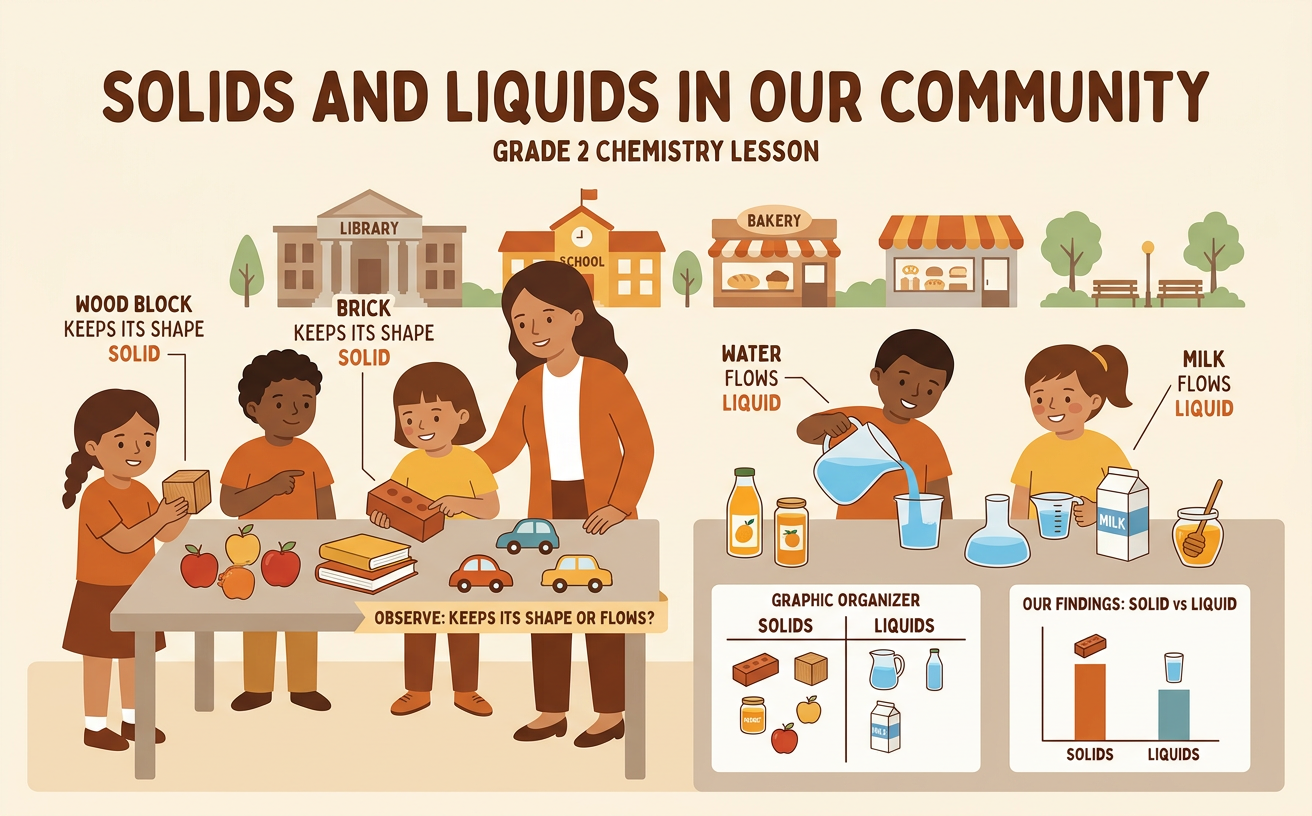
Illustrations are auto-generated and may be placeholders. They can be refreshed to match the narration.
What Is Matter?
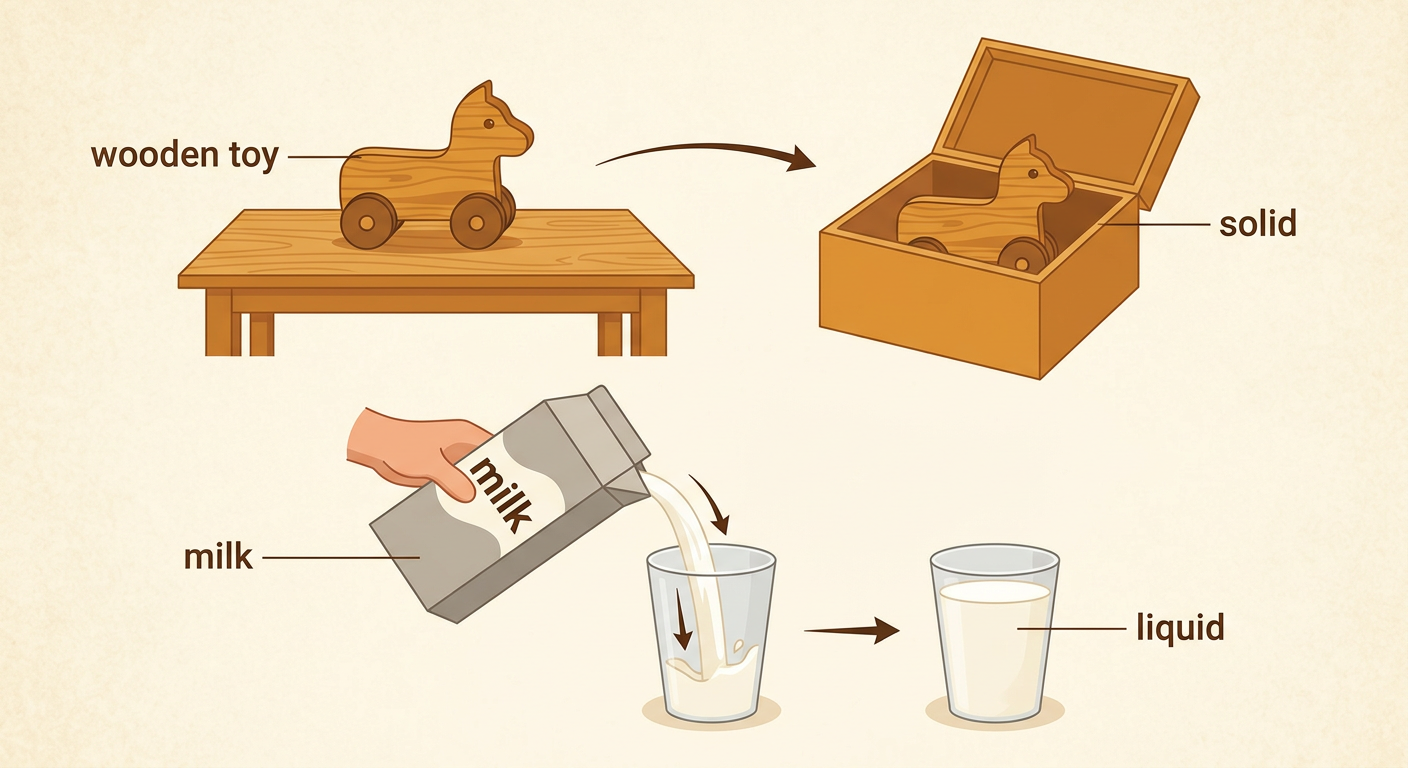
Matter is anything that takes up space and has an amount of material. Your desk, a spoon, water, and milk are all matter. Matter can have different observable properties, such as color, texture, shape, and how it moves. A solid usually keeps its own shape. For example, a wooden toy stays the same shape when it is moved from a table to a box. A liquid flows and takes the shape of its container. Milk may be in a carton, cup, or bowl, but it is still milk. Many community goods are matter. Bread from a bakery is a solid, while juice from a store is a liquid. Scientists observe matter carefully. They never taste an unknown material and touch it only when an adult says it is safe.
Observe Shape and Flow
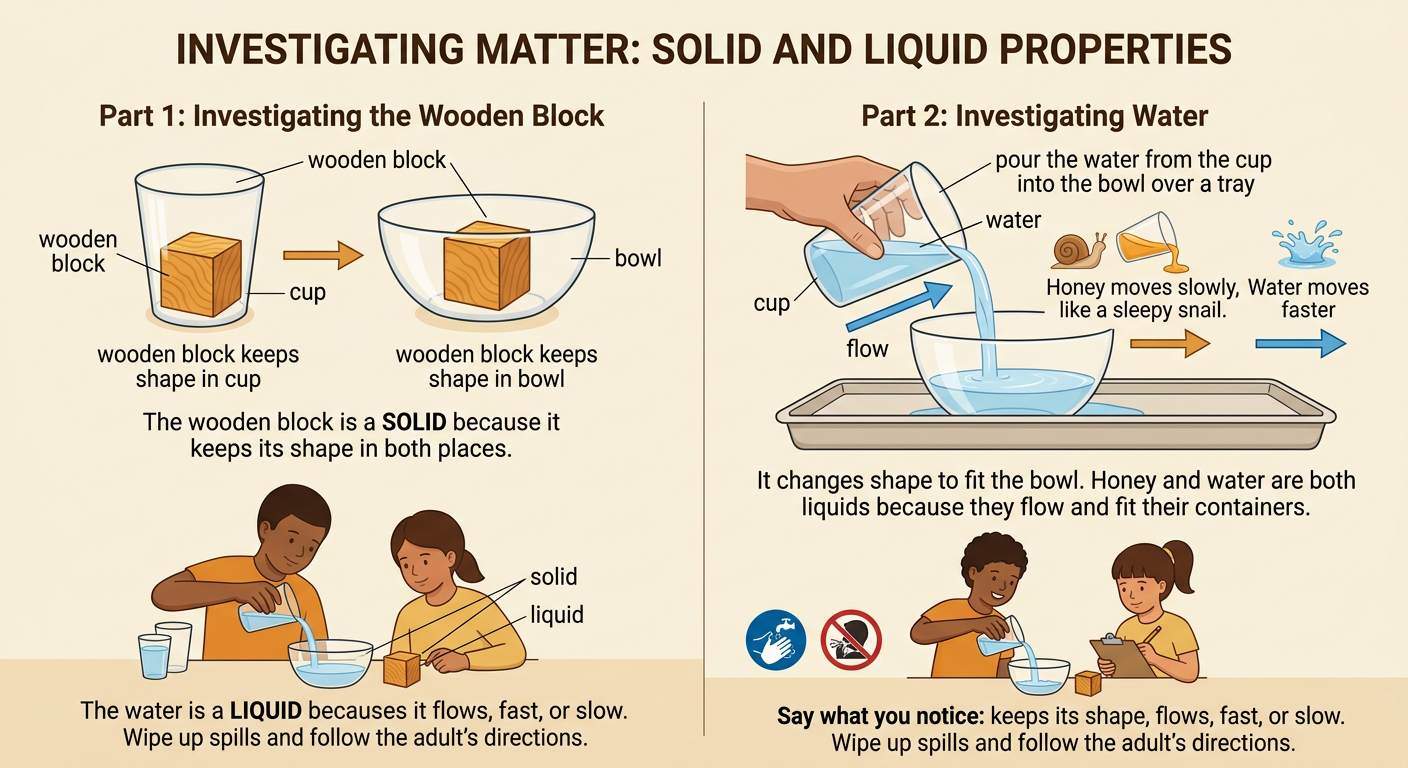
Scientists can observe shape and flow to learn whether a material is a solid or a liquid. Place a wooden block in a cup and then in a bowl. The block keeps its shape, so it is a solid. Next, with an adult's help, pour water from a cup into a bowl over a tray. The water flows and changes shape to fit the bowl, so it is a liquid. Some liquids flow at different speeds. Honey flows more slowly than water, but both are liquids. Work with a partner and take turns observing, pouring, and recording. Use words such as keeps its shape, flows, fast, and slow. Keep materials away from your mouth, wipe up spills, and follow all classroom safety directions.
Classify Solids and Liquids
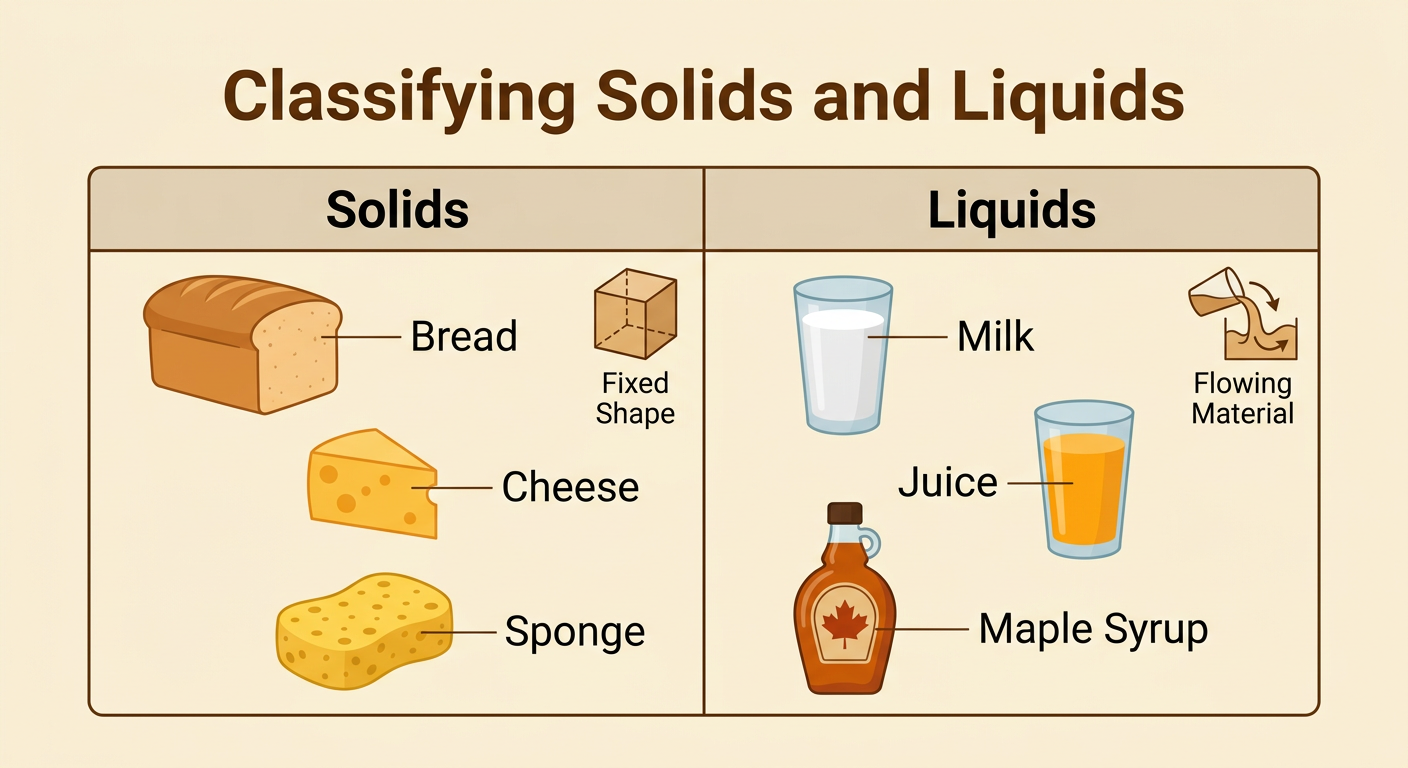
To classify means to put things into groups using shared properties. Make two groups labeled solids and liquids. Observe each community good and ask, “Does it keep its own shape, or does it flow and fit its container?” A loaf of bread from a local bakery keeps its shape, so classify it as a solid. Maple syrup flows and fits its bottle, so classify it as a liquid. Do not classify by hardness alone. A soft sponge is still a solid because it keeps its shape. Listen to your classmates and explain your evidence. You might say, “I classify the cheese as a solid because it keeps its shape.” If group members disagree, repeat the observation and discuss what you notice. Classify the material inside a package, not the bottle, jar, or box holding it.
Graph the Class Results
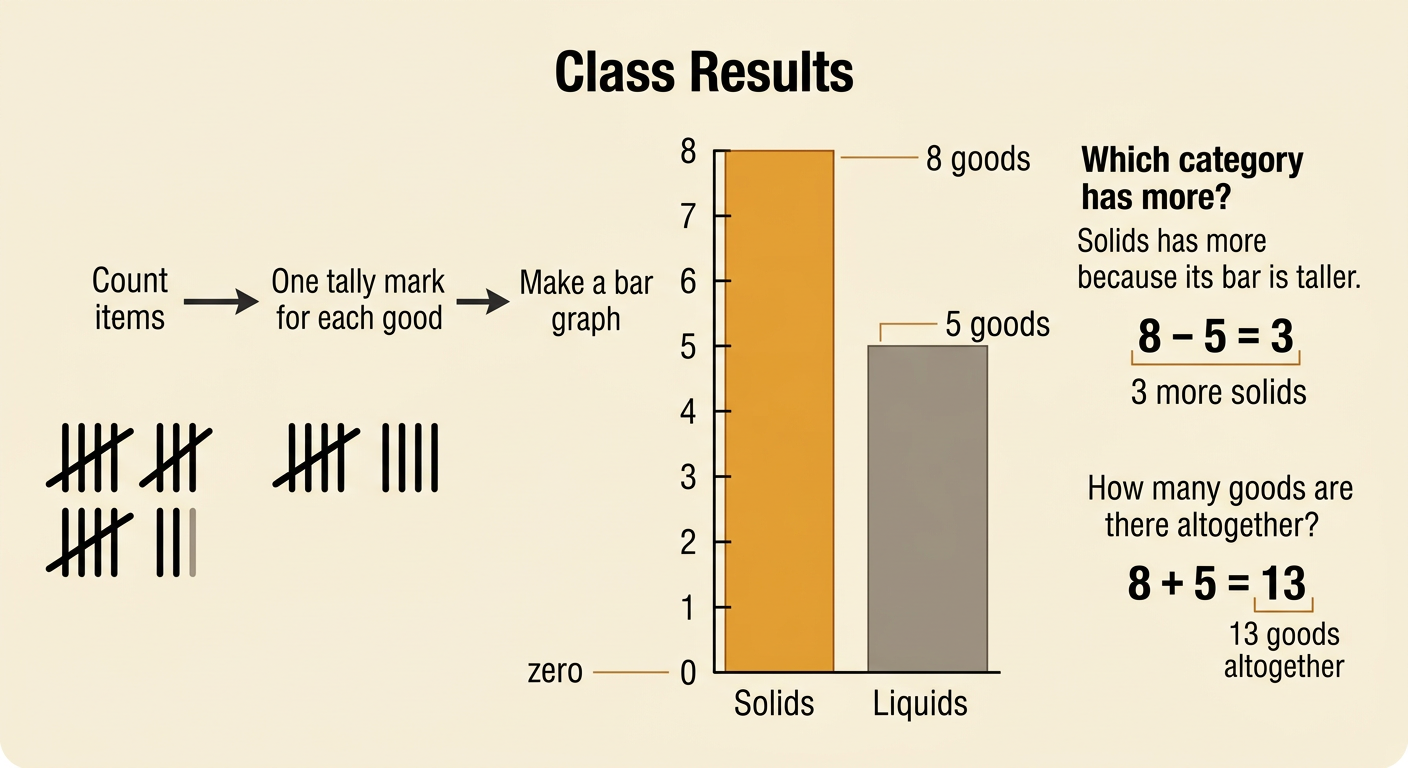
A graph helps the class compare how many goods are in each category. First, count all the goods classified as solids and all the goods classified as liquids. Record one tally mark for each good. Then make a bar graph with the categories Solids and Liquids along the bottom. Begin both bars at zero and color one equal-sized square for each good. Suppose the class found eight solids and five liquids. The solids bar reaches 8, and the liquids bar reaches 5. The graph shows that there are three more solids than liquids. Check that every observed good is counted only once. Partners can ask questions such as, “Which category has more?” or “How many goods are there altogether?” A picture graph may also be used if one picture stands for one good.
Community Goods Review
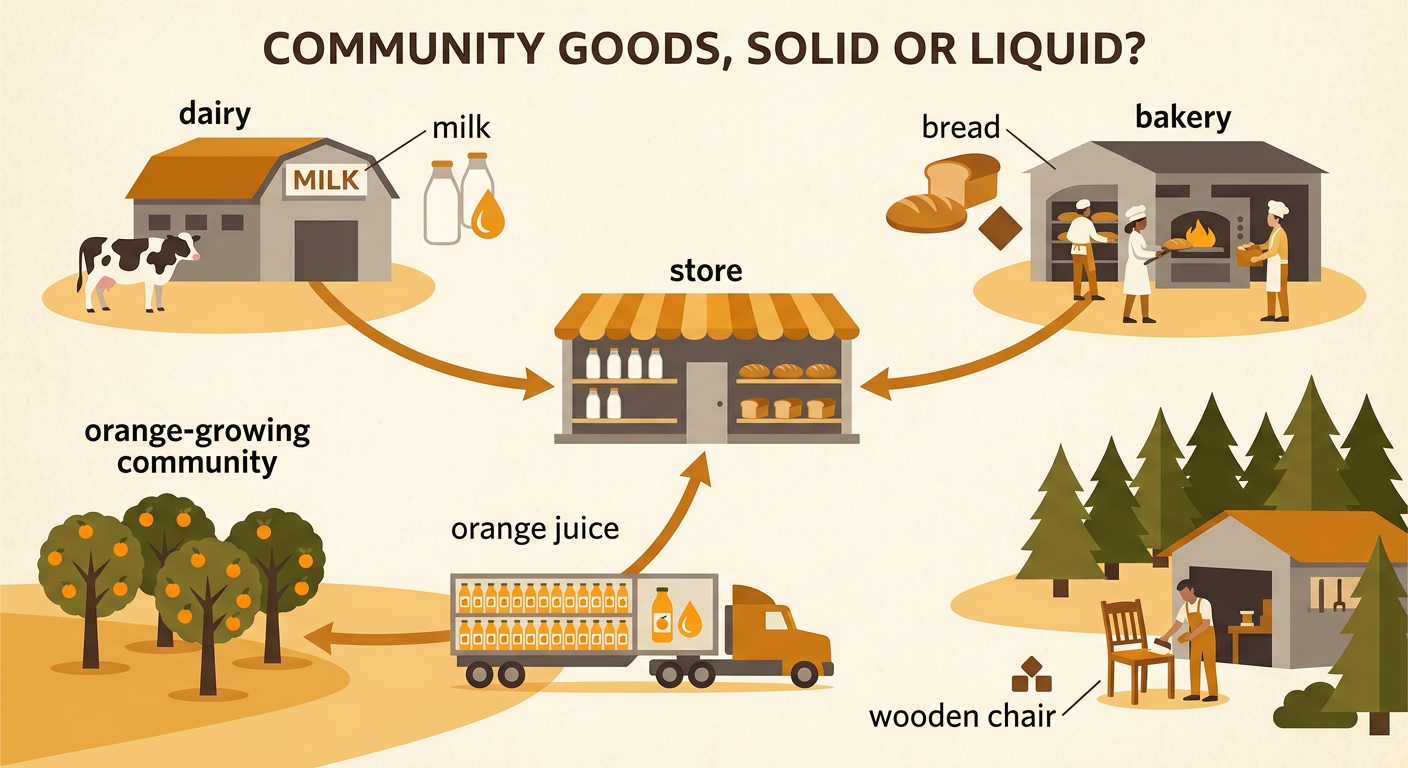
Goods are items that people grow, make, and sell. Communities produce different goods depending on their workers, resources, climate, and businesses. A nearby dairy may produce milk, which is a liquid. A local bakery may make bread, which is a solid. Another community might grow oranges and produce orange juice, a liquid that is shipped to stores. A community near a forest might make wooden chairs, which are solids. Where a good is produced does not decide whether it is a solid or liquid. Its observable properties do. Review each good by naming where it might come from and giving evidence for its classification. For example, say, “This bread may come from our community. It is a solid because it keeps its shape.” Communities trade goods so people can use products made both nearby and far away.