
Solids and Liquids: What Do We Notice?
Students observe, describe, and sort safe everyday substances as solids or liquids based on whether they keep their shape or flow to fit a container.

Illustrations are auto-generated and may be placeholders. They can be refreshed to match the narration.
Meet Solids and Liquids
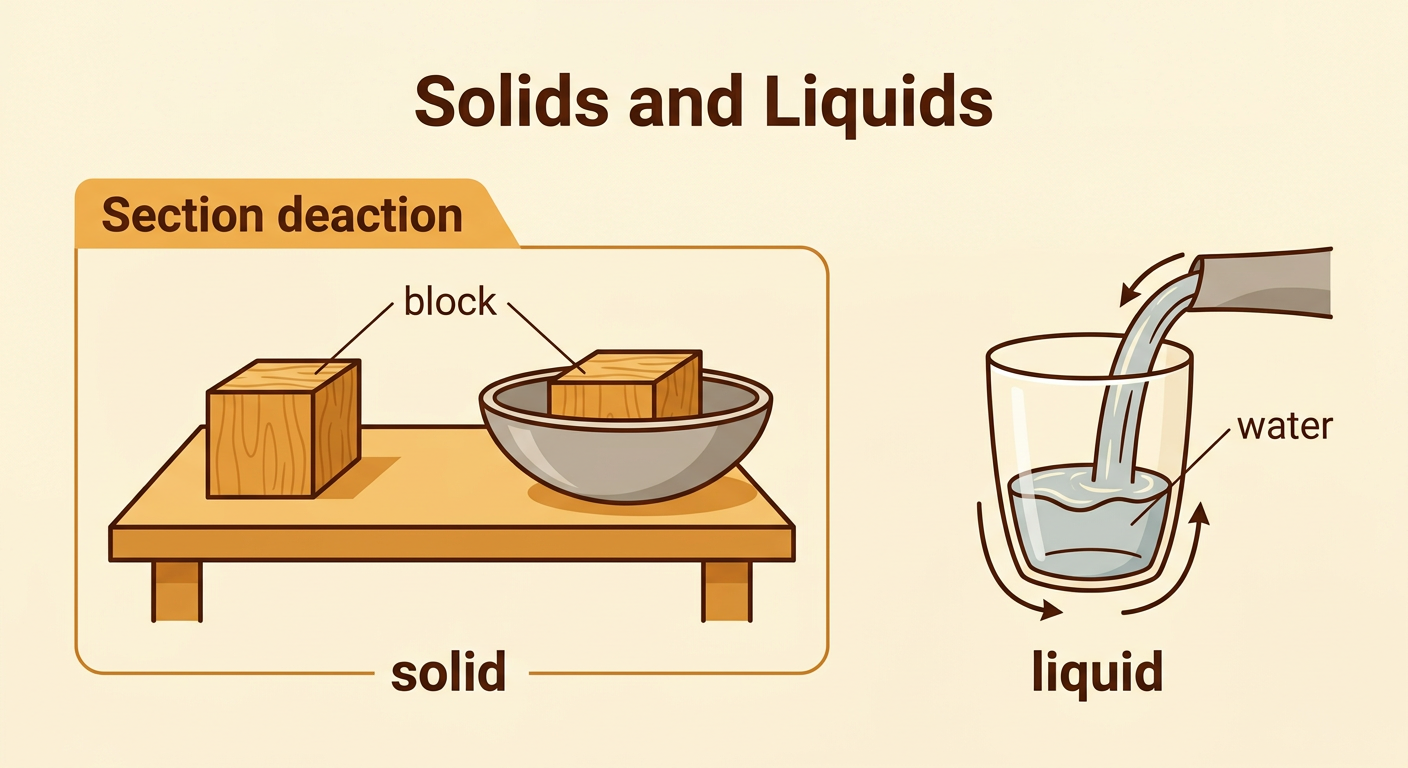
Matter is all around us. A toy block, a spoon, and a crayon are solids. A solid keeps its own shape when you move it. Water, milk, and cooking oil are liquids. A liquid can flow and take the shape of its container. Look at a block beside a clear cup of water. The block has the same shape on a table or in a bowl. The water looks like the inside of its cup. We can use our eyes and careful tests to learn about each sample. We do not taste the samples. We listen to one another and take turns sharing what we notice.
Observe Shape and Flow
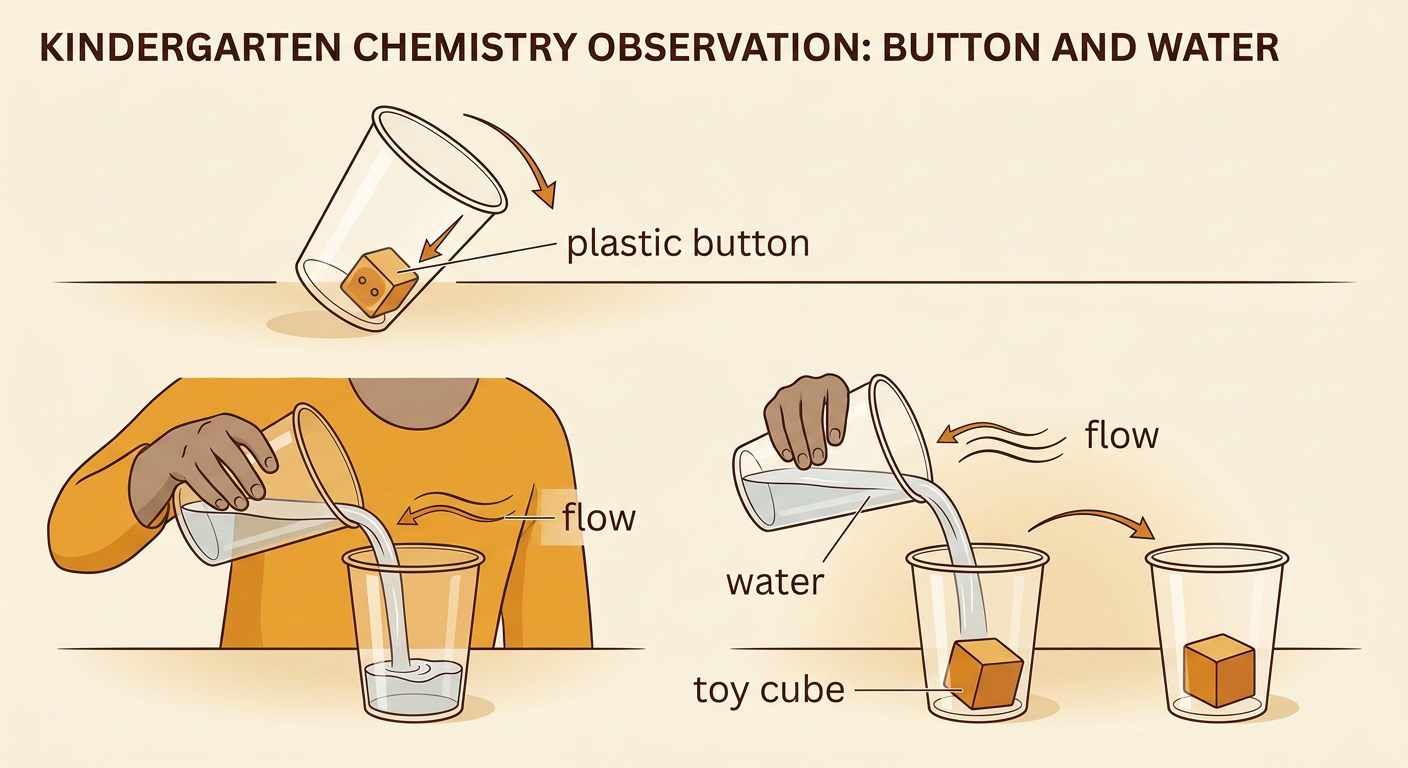
First, observe each sample without touching it. Notice its color, shape, and surface. Then watch what happens when an adult gently tips its container. A solid object, such as a large plastic button, may roll or slide, but it keeps the same shape. A liquid, such as water, flows from one place to another. It does not keep one shape. Imagine tipping a clear cup of water into another cup. The water makes a moving stream. Now imagine moving a toy cube into the second cup. The cube changes places, but it stays cube-shaped. Say what you observe instead of guessing. You might say, “The water flowed,” or “The cube kept its shape.”
Test Different Containers
We can test a sample by placing it in containers with different shapes. Use a tall clear cup and a wide clear bowl. Put a solid block in each container. The block keeps the same size and shape, even though the containers are different. Next, an adult pours the same amount of colored water into each container. In the tall cup, the water looks tall and narrow. In the wide bowl, it looks low and spread out. The water has not become a new material. It has changed shape to fit each container. Work safely with a partner. One person watches while the other helps, and then switch jobs. Keep the containers on the tray so spills are easy to clean.

Sort the Samples
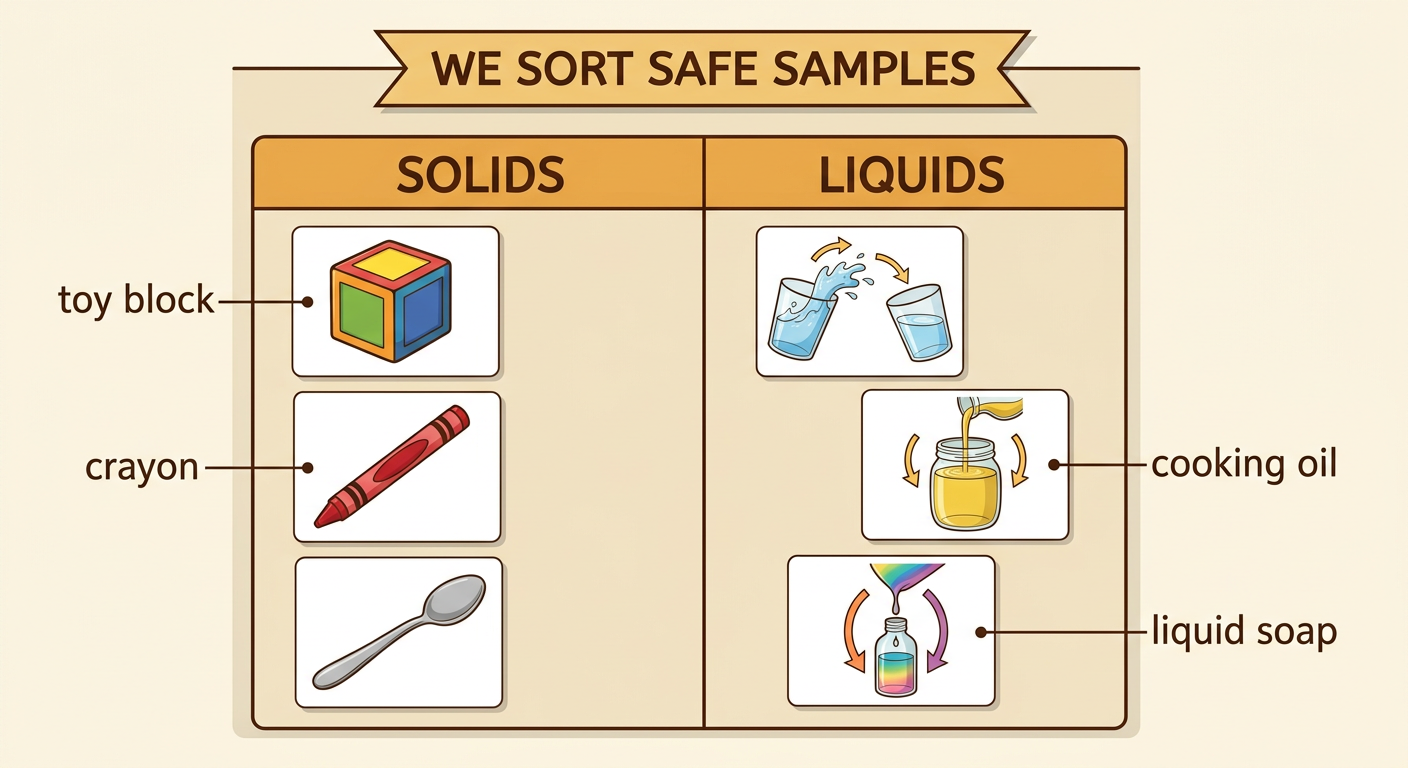
Now sort safe samples into two groups: solids and liquids. Examine a toy block, a crayon, a metal spoon, water, cooking oil, and liquid soap. Ask, “Does it keep its own shape, or does it flow to fit a container?” Place each sample card under the matching group label. The block, crayon, and spoon are solids because each keeps its shape. Water, oil, and liquid soap are liquids because they flow and fit their containers. Some liquids flow slowly, but they are still liquids. If group members disagree, take turns speaking and listen carefully. Test the sample again and use what you observe to make a group decision. Never taste or smell a sample closely.
Count and Compare Groups
After sorting, count the samples in each group. Touch or point to each picture once as you count. Suppose the solid group has a block, a crayon, and a spoon. That is three solids. Suppose the liquid group has water, oil, and liquid soap. That is three liquids. Write or place the number 3 beside each group. The groups are equal because both have the same number of samples. If you add one toy car to the solid group, there are four solids and three liquids. Then the solid group has one more sample. Counting helps us describe and compare our sorted groups. Check the count with a partner and correct mistakes together.

Share Evidence
Scientists use evidence to explain their ideas. Evidence is something you observed during a test. Share one claim about a sample and tell what you saw. You might say, “I think water is a liquid because it flowed into the bowl and fit the bowl’s shape.” For a block, you might say, “I think the block is a solid because it kept its shape in both containers.” During the discussion, face the speaker, listen without interrupting, and wait for your turn. You may agree, ask a question, or politely share different evidence. The group can use the observations to decide where each sample belongs. End by checking that every claim is supported by something the class saw, counted, or tested.
