
Solve Addition and Subtraction Word Problems Within 100
Students identify unknowns, choose addition or subtraction, and use drawings and equations to solve one-step word problems within 100.

Illustrations are auto-generated and may be placeholders. They can be refreshed to match the narration.
Explore a Story Problem
A story problem tells about numbers in a real situation. Read the whole problem slowly. Picture what happens from the beginning to the end. Ask yourself, “What is the story about?” and “What changes?” For example: A classroom shelf has 34 books. Students check out 18 books. How many books remain on the shelf? At the beginning, there are 34 books. Then some books are taken away. The question asks about the books still on the shelf. You can act out the story with counters or draw simple book shapes. Understanding the action in the story helps you decide how to solve it. Do not choose an operation from one word alone. Think about what happens to the group.

Identify What Is Known and Unknown
Known information tells you the numbers given in the problem. The unknown is the number you need to find. You can circle the known numbers and underline the question. Consider this problem: Mia has 27 beads. Leo has 35 beads. How many more beads does Leo have than Mia? The known numbers are 27 and 35. The unknown is the difference between their amounts. You could write a question mark for that missing amount. Notice that the unknown is not always the total. It might be the amount left, the amount added, the starting amount, or the difference between two groups. Before calculating, say what the unknown means: “I need to find how many more beads Leo has.”

Choose Addition or Subtraction
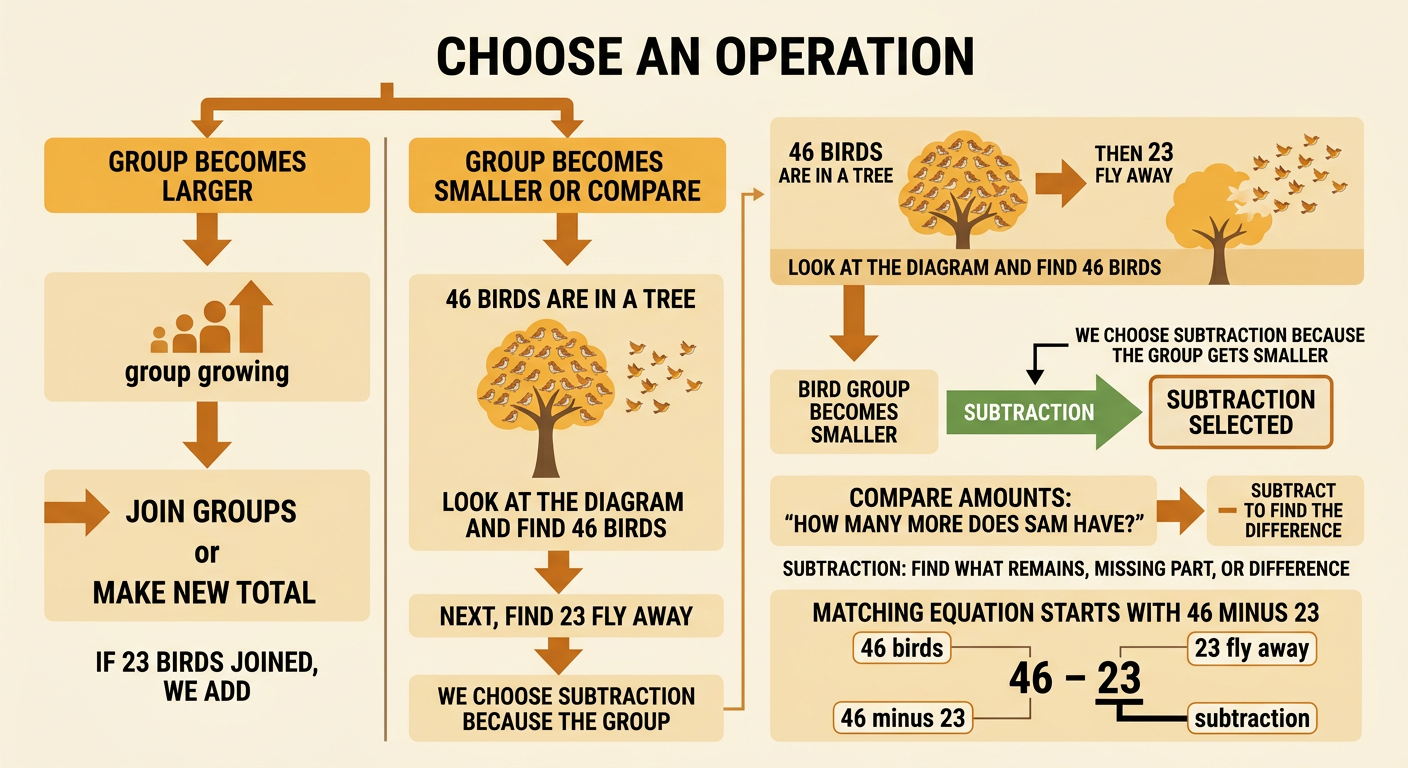
Choose an operation by thinking about the action and the unknown. Addition can combine groups or find a new total when an amount is added. Subtraction can find what remains, a missing part, or the difference between amounts. For example: There are 46 birds in a tree. Then 23 birds fly away. How many birds remain? The group becomes smaller, so subtraction matches the story. Write 46 − 23. If 23 birds joined the group instead, the group would become larger, so you would add. Words such as “more” do not always mean addition. In the question “How many more does Sam have?” you compare two amounts and usually subtract. Always use the meaning of the story to choose.
Model and Write an Equation
A model shows how the quantities in a story are connected. You can use counters, base-ten blocks, a bar model, or a number line. Then write an equation that matches the model. For example: A box holds 28 red crayons and 36 blue crayons. How many crayons are in the box? The two groups are put together, so write 28 + 36 = ?. On an open number line, start at 28. Make a jump of 30 to reach 58. Then make a jump of 6 to reach 64. The equation is 28 + 36 = 64. Label your model so another person can tell which number represents each part of the story.

Solve and Check
After you write an equation, solve it carefully. Use place value, a drawing, or a number-line strategy. Then check whether your answer makes sense in the story. For example: Nora has 72 stickers and gives away 29 stickers. How many stickers does she have left? Write 72 − 29 = ?. With base-ten blocks, regroup 72 as 6 tens and 12 ones. Remove 2 tens and 9 ones. There are 4 tens and 3 ones left, so 72 − 29 = 43. Check with the opposite operation: 43 + 29 = 72. The check returns to the starting amount. Also ask whether 43 is reasonable. Since Nora gave stickers away, her answer should be less than 72.

Independent Practice
Now use the same steps on your own: read, identify the known and unknown quantities, choose an operation, draw a model, write an equation, solve, and check. Try these problems. First, a bus carries 63 children. At one stop, 25 children get off. How many remain? Second, a box had some pencils. A teacher added 22 pencils, and now there are 50 pencils. How many pencils were in the box at first? Third, Ava has 37 cards. Ben has 12 fewer cards than Ava. How many cards does Ben have? For each problem, explain what your unknown means. Your equations should be 63 − 25 = 38, ? + 22 = 50, and 37 − 12 = 25. Check each answer using the story or the opposite operation.
