
Solve Money Word Problems
Students use coins, drawings, and equations to solve one-step word problems involving dollars, quarters, dimes, nickels, and pennies.
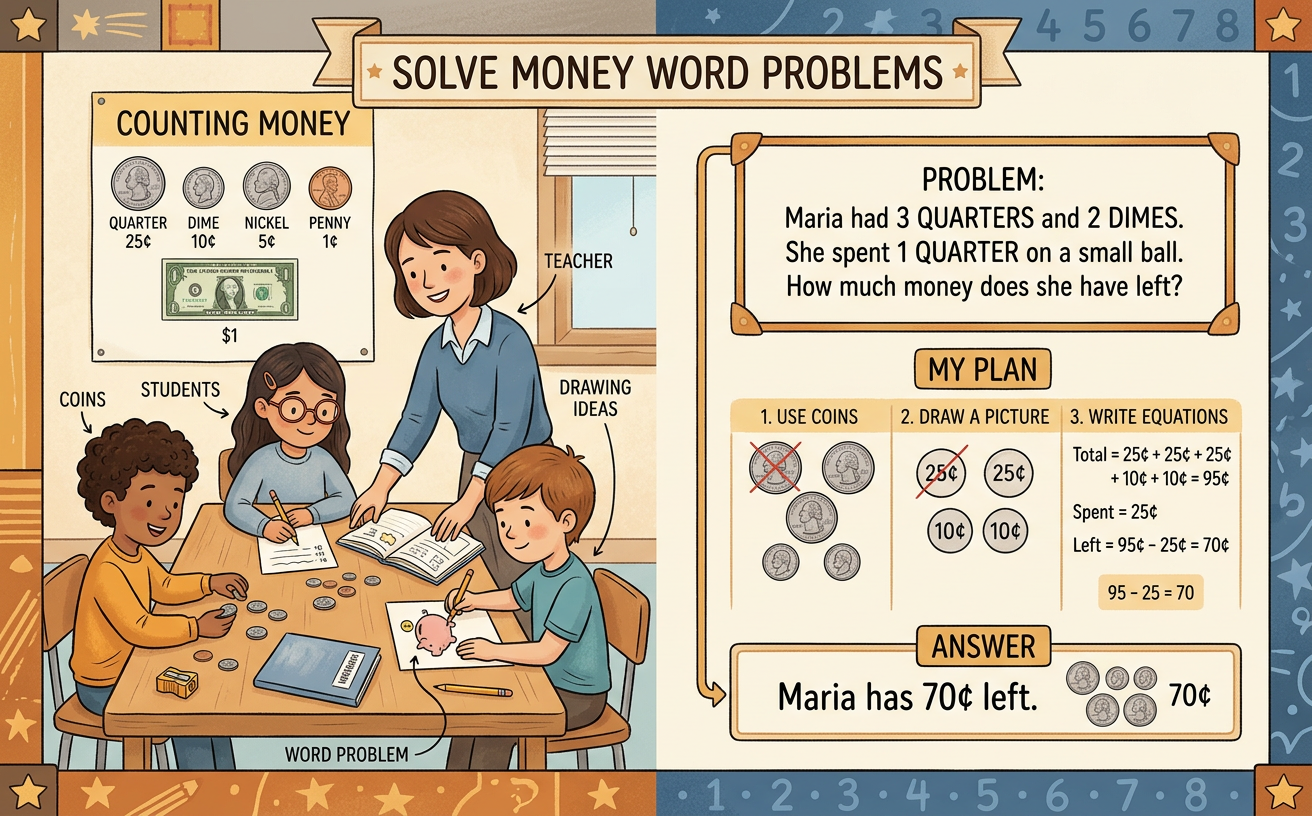
Illustrations are auto-generated and may be placeholders. They can be refreshed to match the narration.
Review Coin Values
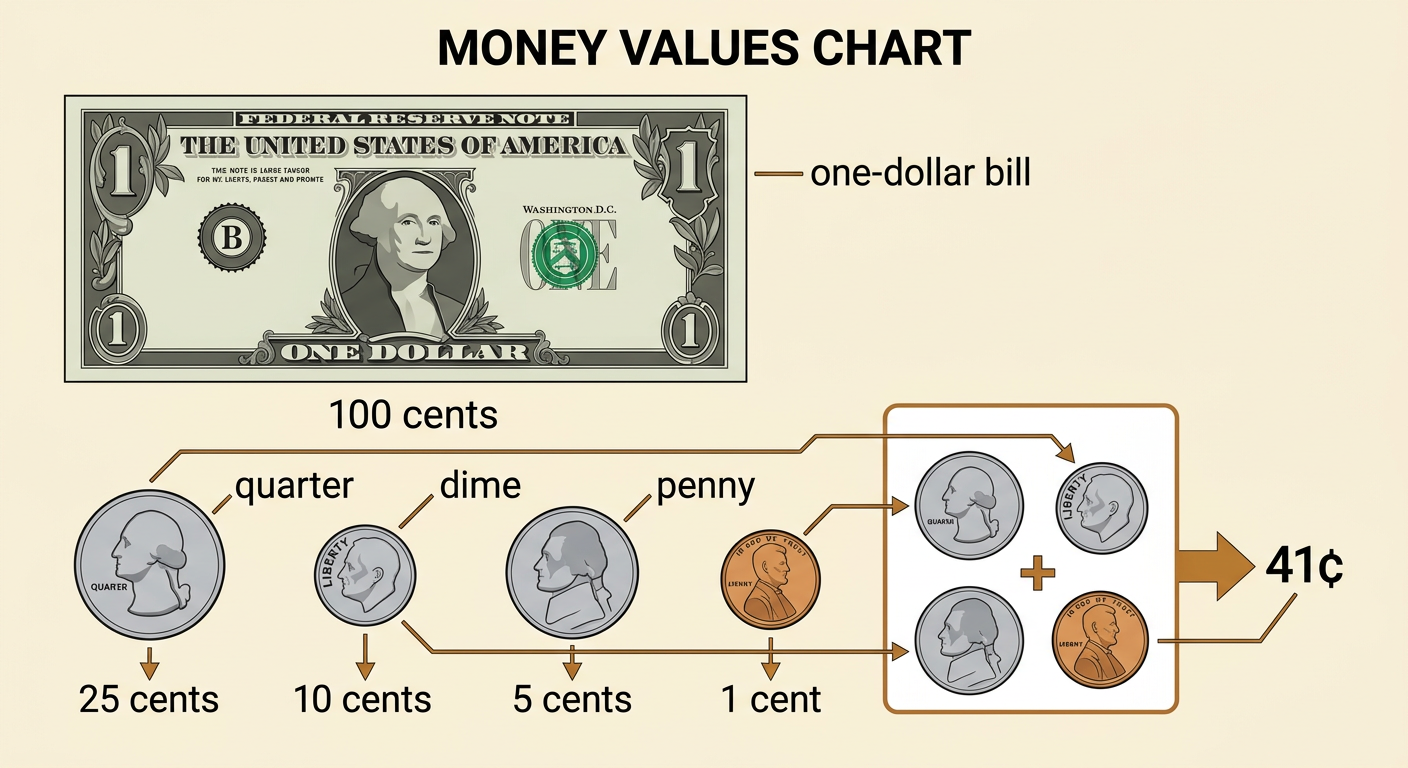
Before solving money problems, remember the value of each coin and bill. A penny is worth 1 cent, a nickel is worth 5 cents, a dime is worth 10 cents, and a quarter is worth 25 cents. A one-dollar bill is worth 100 cents. Use the cent symbol, ¢, for amounts less than one dollar, such as 36¢. Use the dollar symbol, $, before a dollar amount, such as $1 or $4. Coin size does not tell its value. For example, a dime is smaller than a nickel, but it is worth more. To find the value of one quarter, one dime, one nickel, and one penny, add 25¢ + 10¢ + 5¢ + 1¢. The total is 41¢.
Read the Money Problem
Read a money problem slowly and decide what you know and what you need to find. Look for the amounts, the action, and the question. Here is an example: “Lena has 2 dimes and 3 pennies. How much money does she have?” The known information is 2 dimes and 3 pennies. The question asks for the total value, so the values must be added. Replace each coin name with its value. Two dimes are 10¢ + 10¢, and three pennies are 1¢ + 1¢ + 1¢. Watch for words such as “in all,” “altogether,” “spends,” and “left.” These words can help, but think about what happens in the story. In this problem, Lena puts all her coins together, so addition makes sense.

Model with Coins or Drawings
A model helps you see the money in a problem. You can use real or play coins, or you can draw circles and write each coin’s value inside. Consider this problem: “Noah has 37¢. His aunt gives him 15¢ more. How much money does Noah have now?” Model 37¢ with a quarter, a dime, and 2 pennies. Model 15¢ with a dime and a nickel. Then combine the groups. Count the larger values first: 25¢, 35¢, 45¢, 50¢, 51¢, 52¢. Noah now has 52¢. When drawing, label every coin with its value so that a nickel is not confused with a quarter. Your model should show the starting amount, the amount added, and the combined amount.

Write an Equation
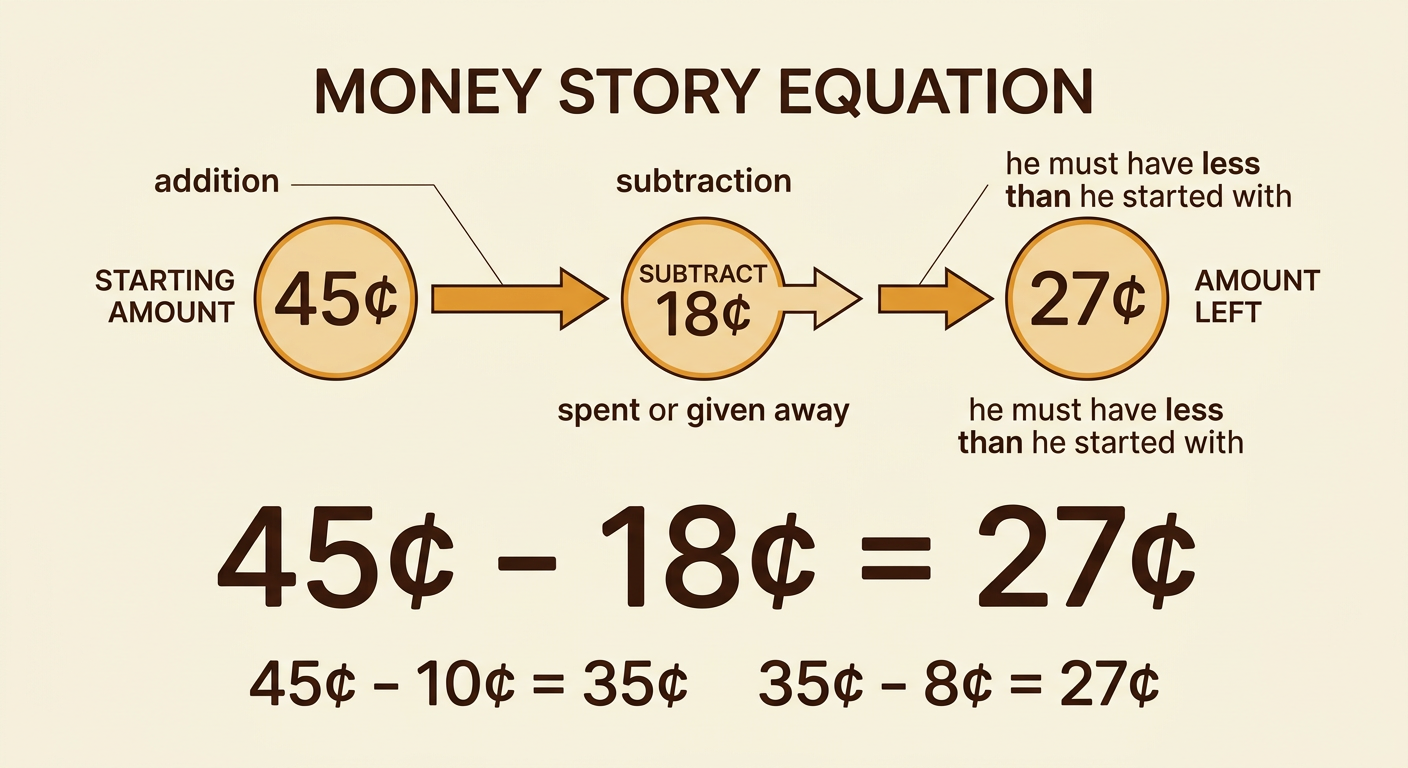
An equation shows the action in a money story with numbers and symbols. First decide whether the amount grows or gets smaller. Use addition when money is joined or received. Use subtraction when money is spent, given away, or compared. For example: “Eli has 45¢ and spends 18¢. How much money does he have left?” The amount gets smaller, so write 45¢ − 18¢ = 27¢. You can subtract by breaking apart 18¢ into 10¢ and 8¢. Start at 45¢, subtract 10¢ to get 35¢, and subtract 8¢ to get 27¢. Keep the units the same throughout the equation. For amounts in cents, use ¢. For whole-dollar amounts, an equation might be $2 + $3 = $5.
Solve and Label the Answer
After writing an equation, solve it carefully and label the answer with the correct money symbol. Then answer the question in a complete sentence. Consider this problem: “Zoe has $5. She buys a puzzle for $2. How much money does she have left?” Write $5 − $2 = $3. The answer is not just 3 because the number needs a money label. Write, “Zoe has $3 left.” Use $ before an amount counted in dollars. Use ¢ after an amount counted in cents. For example, 64 cents is written 64¢, not $64. Check whether your answer is reasonable. Since Zoe spent some of her money, she should have less than $5. The answer, $3, is less than $5, so it makes sense.

Share and Check Strategies
Money problems can be solved in more than one way. Share your strategy and listen to how others solved the same problem. Suppose Jay has 2 quarters and 3 dimes. How much money does he have? One strategy is to count the coin values: 25¢, 50¢, 60¢, 70¢, 80¢. Another strategy is to multiply equal groups mentally: 2 quarters are 50¢, and 3 dimes are 30¢. Then 50¢ + 30¢ = 80¢. Both strategies give the same answer, so they help check each other. You can also check that every coin was counted once and that the cent symbol was used. When explaining, name the coins, tell how you counted, and connect your model to your equation. Jay has 80¢ in all.
