
Solving and Graphing Linear Inequalities
Students solve one-variable linear inequalities, represent solution sets on number lines, and interpret inequalities in real-world situations.
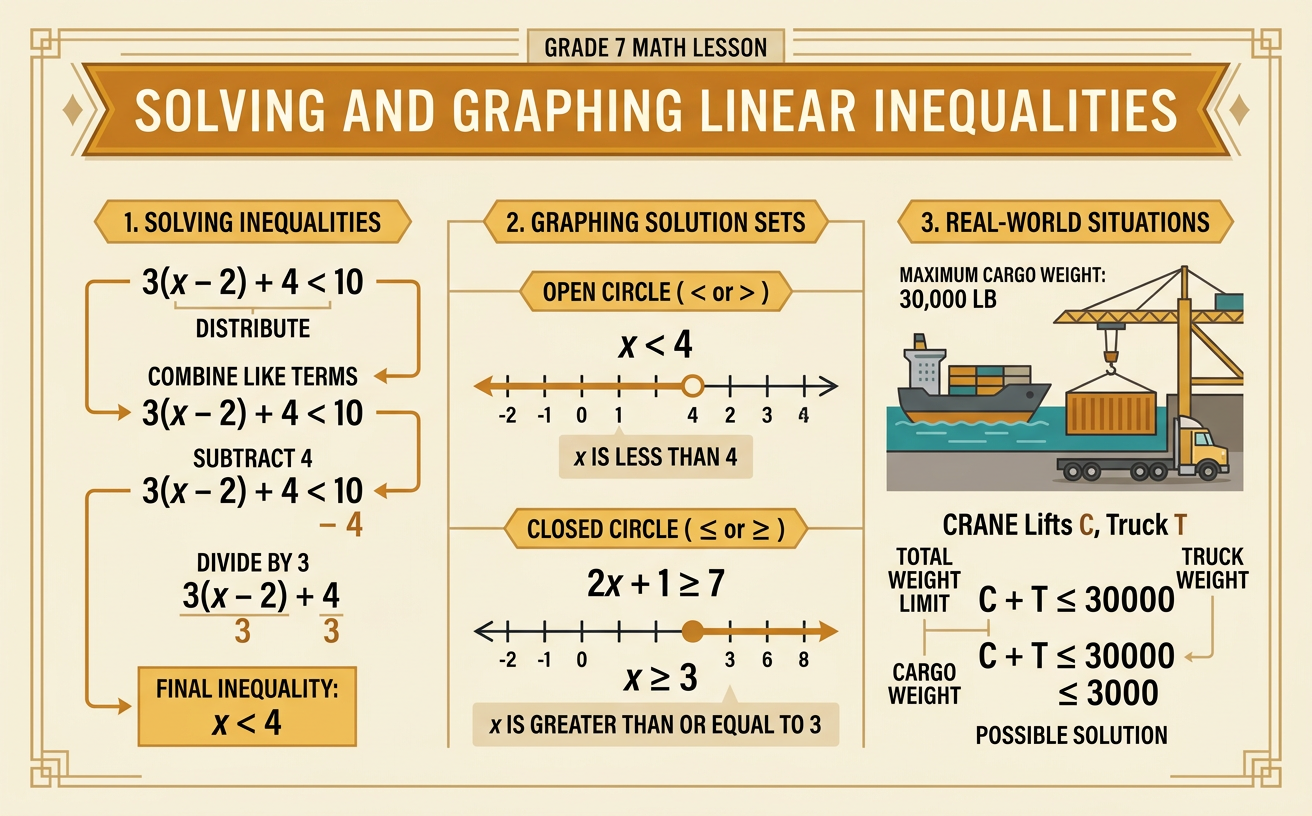
Illustrations are auto-generated and may be placeholders. They can be refreshed to match the narration.
Inequalities and Solution Sets
An inequality compares quantities that may not be equal. The symbol greater than means one expression is larger, while less than means it is smaller. The symbols greater than or equal to and less than or equal to include equality. Unlike an equation, an inequality usually has many solutions. For example, x + 3 < 8 is true for every value of x less than 5. The numbers 4, 0, and -10 are solutions, but 5 and 7 are not. A solution set is the collection of all values that make the inequality true. Substitution can test a possible solution. If x = 2, then 2 + 3 < 8 becomes 5 < 8, which is true. If x = 6, the statement becomes 9 < 8, which is false.
Adding or Subtracting to Isolate the Variable
To solve an inequality, use inverse operations to isolate the variable while keeping the comparison balanced. Adding or subtracting the same number on both sides does not change the direction of the inequality. Consider x - 7 ≥ 4. Add 7 to both sides to obtain x ≥ 11. This means 11 and every number greater than 11 are solutions. For 5 + y < 2, subtract 5 from both sides to get y < -3. Checking a value helps confirm the result. If y = -4, then 5 + (-4) < 2 becomes 1 < 2, which is true. Organize work by writing one equivalent inequality per line. This makes it easier to see that the same operation was performed on both sides.
Multiplying, Dividing, and Reversing the Symbol
Multiplying or dividing both sides by a positive number keeps the inequality symbol unchanged. For 3x > 12, divide both sides by 3 to get x > 4. However, multiplying or dividing by a negative number reverses the inequality symbol. For -2x ≤ 10, divide by -2 and reverse the symbol, giving x ≥ -5. The reversal is necessary because multiplying by a negative reflects numbers across zero. For example, 3 < 5 is true, but after multiplying both numbers by -1, -3 > -5. A useful habit is to circle a negative divisor before solving. Then check a value from the solution set. If x = 0 in -2x ≤ 10, the result is 0 ≤ 10, confirming that 0 should be included.
Solving Multi-Step Inequalities
Some inequalities require more than one inverse operation. Use the reverse order of operations to isolate the variable. In 4x + 7 < 23, first subtract 7 from both sides to obtain 4x < 16. Then divide by 4 to get x < 4. When parentheses appear, distribute before combining terms. For example, 3(x - 2) ≥ 9 becomes 3x - 6 ≥ 9. Add 6 to get 3x ≥ 15, and divide by 3 to obtain x ≥ 5. If the variable appears on both sides, combine variable terms on one side. In 5x + 2 > 2x + 11, subtract 2x and then subtract 2, producing 3x > 9, so x > 3.
Graphing and Interpreting Solutions
A number-line graph displays every solution to an inequality. Use an open circle when the endpoint is not included, as in x < 4. Shade to the left because the solutions are less than 4. Use a closed circle when the endpoint is included, as in x ≥ 4, and shade to the right. Inequalities can model limits in real situations. Suppose a ride requires passengers to be at least 48 inches tall. If h represents height, the condition is h ≥ 48. The graph has a closed circle at 48 and shading to the right. In another example, a theater holds fewer than 300 people, so p < 300. Since people are counted with whole numbers, 299 is the greatest possible attendance. Always interpret the solution using the quantities and restrictions in the context.