
Solving Linear Equations and Inequalities
Students solve multistep linear equations and inequalities by applying the distributive property, combining like terms, and preserving equivalence.
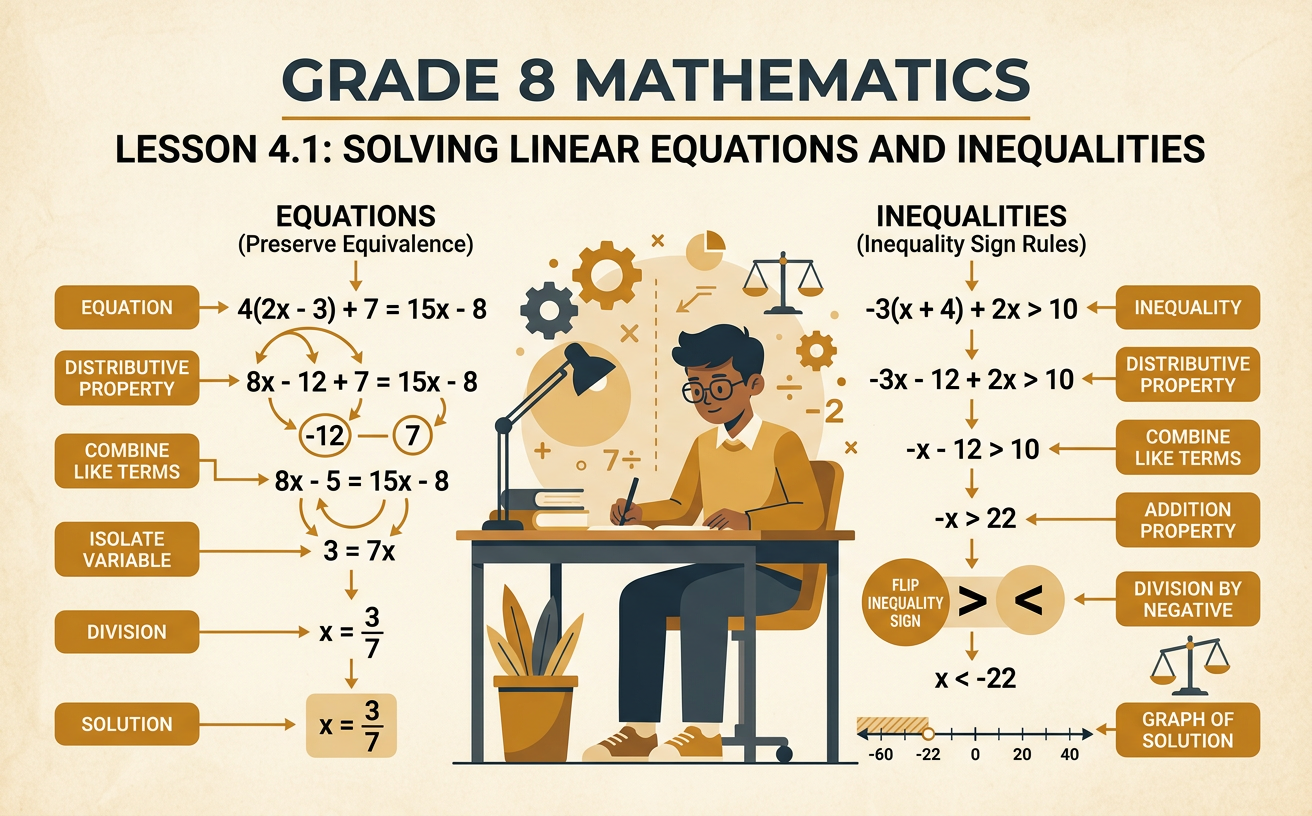
Illustrations are auto-generated and may be placeholders. They can be refreshed to match the narration.
Equivalent Expressions
Equivalent expressions have the same value for every allowed value of the variable, even if they look different. To create an equivalent expression, use properties of operations without changing its value. For example, simplify 3(2x − 1) + 4. First distribute 3 to both terms inside the parentheses: 6x − 3 + 4. Then combine the like constant terms, −3 and 4, to get 6x + 1. Therefore, 3(2x − 1) + 4 and 6x + 1 are equivalent expressions. You can confirm this by substituting a value. If x = 2, both expressions equal 13. Recognizing equivalent expressions helps you simplify each side of an equation or inequality before isolating the variable.
Distributive Property Review
The distributive property multiplies every term inside parentheses by the factor outside. In symbols, a(b + c) = ab + ac. Pay close attention when the outside factor is negative or fractional. For example, simplify −2(3x − 5) + x. Multiply −2 by 3x to get −6x, and multiply −2 by −5 to get positive 10. The expression becomes −6x + 10 + x. Since −6x and x are like terms, combine their coefficients: −6 + 1 = −5. The simplified expression is −5x + 10. A common error is distributing the factor to only the first term or losing a negative sign. Draw arrows from the outside factor to every term inside the parentheses.
Variables on Both Sides
When a variable appears on both sides of an equation, simplify each side and then move variable terms to one side. Solve 4(x − 2) + 3 = 2x + 9. Distribute and combine like terms on the left to get 4x − 5 = 2x + 9. Subtract 2x from both sides, producing 2x − 5 = 9. Add 5 to both sides to get 2x = 14, and divide both sides by 2. The solution is x = 7. Each operation must be applied to both sides to preserve equality. If the variables cancel and leave a true statement, such as 5 = 5, every value is a solution. If they cancel and leave a false statement, such as 5 = 8, there is no solution.
Solving Linear Inequalities
Solve a linear inequality much like an equation, but remember one special rule: reverse the inequality symbol when multiplying or dividing both sides by a negative number. Consider −3(2x − 1) > 9. Distribute to obtain −6x + 3 > 9. Subtract 3 from both sides, giving −6x > 6. Divide both sides by −6 and reverse the symbol, so x < −1. On a number line, place an open circle at −1 because −1 is not included, then shade to the left for values less than −1. A closed circle is used with ≤ or ≥ because the endpoint is included. You can test x = −2: the original inequality becomes 15 > 9, which is true.
Checking and Interpreting Solutions
Check a solution by substituting it into the original equation or inequality, not only the simplified form. Then interpret the result in the context of the problem. Suppose a taxi charges a $4 starting fee plus $2.50 per mile, and you can spend at most $19. Let m represent miles. The inequality is 4 + 2.50m ≤ 19. Subtract 4 to get 2.50m ≤ 15, then divide by 2.50 to find m ≤ 6. Because distance cannot be negative, the meaningful solutions are 0 ≤ m ≤ 6. Check the endpoint by substituting m = 6: 4 + 2.50(6) = 19, so 6 miles is included. In words, you can travel no more than 6 miles without exceeding the budget.