
Solving Multistep Percent Problems
Students use proportional reasoning to solve real-world problems involving discounts, markups, taxes, tips, and percent change.

Illustrations are auto-generated and may be placeholders. They can be refreshed to match the narration.
Review Percent as a Rate per 100
A percent is a rate that compares a quantity with 100. The word percent means “per 100,” so 35% means 35 out of every 100. You can write a percent as a fraction or decimal: 35% = 35/100 = 0.35. To find a percent of a number, multiply the number by the percent written as a decimal. For example, 35% of 80 is 0.35 × 80 = 28. You can also reason with equivalent rates. If 10% of 80 is 8, then 30% is 24 and 5% is 4. Therefore, 35% is 24 + 4, or 28. Both methods show that the part is 28, the whole is 80, and the percent is 35%.

Model Percent Problems with Proportions
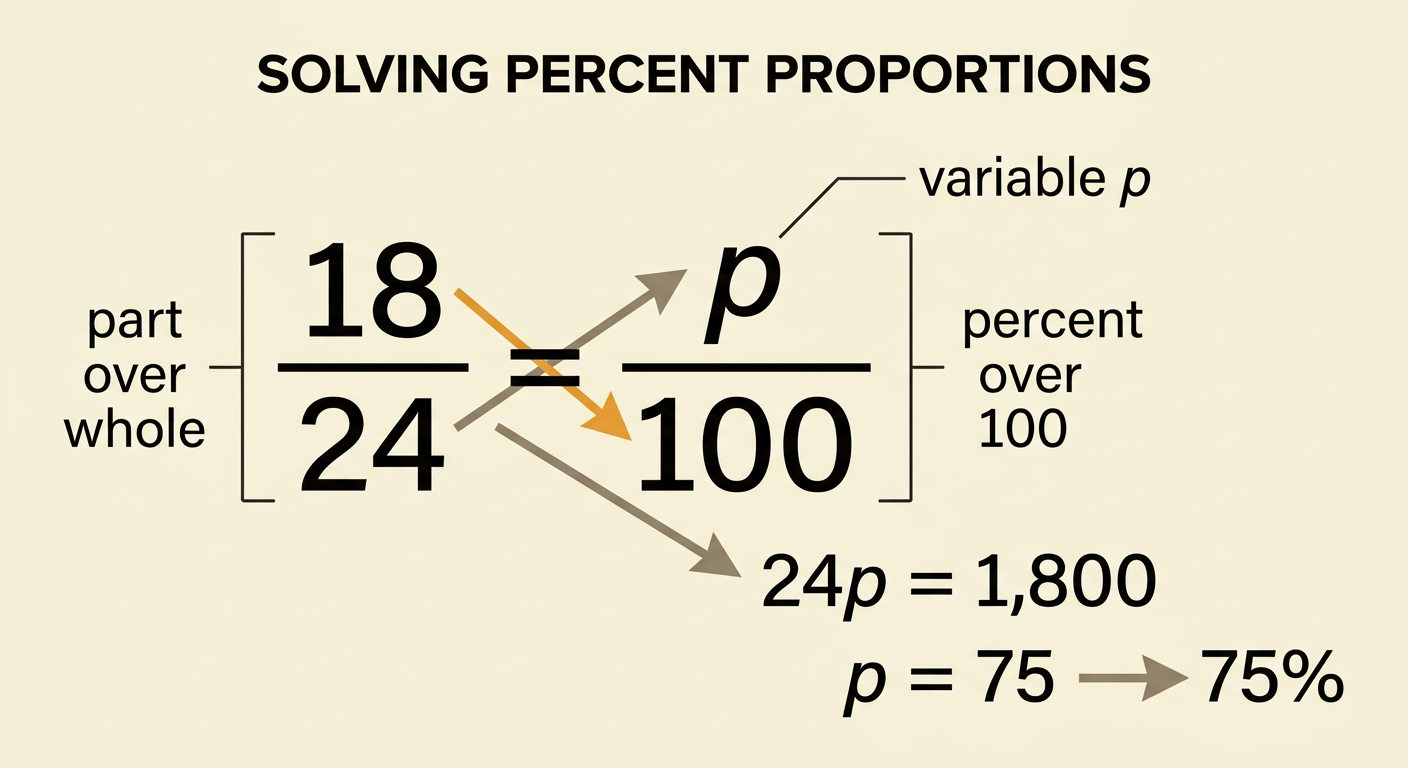
A proportion shows that two ratios are equal. For a percent problem, compare the part to the whole and set it equal to the percent over 100: part/whole = percent/100. Keep corresponding quantities in the same positions. Suppose 18 students in a class of 24 brought lunch from home. To find the percent, write 18/24 = p/100. Cross multiply to get 24p = 1,800, and divide by 24: p = 75. Therefore, 75% of the students brought lunch. You can check by converting 18/24 to a decimal: 18 ÷ 24 = 0.75, which equals 75%. A proportion can also be used to find an unknown part or whole by replacing the missing quantity with a variable.
Calculate Discounts and Markups
A discount decreases an original price, while a markup increases a cost. First calculate the percent amount, and then subtract or add it. A backpack originally costs $60 and is discounted 25%. The discount is 0.25 × $60 = $15. Subtract the discount from the original price: $60 − $15 = $45. A shortcut is to multiply by the percent that remains. After a 25% discount, 75% remains, so 0.75 × $60 = $45. For a markup, suppose a store buys an item for $40 and adds a 30% markup. The markup is 0.30 × $40 = $12, so the selling price is $52. Using a multiplier, 100% + 30% = 130%, and 1.30 × $40 also equals $52.

Solve Tax and Tip Problems
Sales tax and tips are percentages added to an amount. Calculate each percentage using the correct base amount. Suppose a restaurant meal costs $48 before tax. The sales tax is 6.25%, and you leave a 20% tip based on the meal price before tax. The tax is 0.0625 × $48 = $3.00. The tip is 0.20 × $48 = $9.60. Add the meal price, tax, and tip: $48 + $3.00 + $9.60 = $60.60. Do not calculate the tip from the total after tax unless the problem specifically tells you to do so. Estimate to check your answer: 6.25% is a little more than 5%, and 20% is one fifth of $48, so a total near $61 is reasonable.

Analyze Percent Increase and Decrease
Percent change compares the amount of change with the original value. Use percent change = change/original × 100%. If a town’s recycling total rises from 240 tons to 300 tons, the increase is 300 − 240 = 60 tons. Divide by the original amount: 60 ÷ 240 = 0.25, so the percent increase is 25%. If the total later falls from 300 tons to 240 tons, the decrease is still 60 tons, but the original value is now 300. Then 60 ÷ 300 = 0.20, so the percent decrease is 20%. A 25% increase followed by a 20% decrease returns to the starting value because the percentages use different original amounts. Always identify the original value before dividing.

Complete an Exit Problem
Solve this multistep problem: A jacket has an original price of $80. It is discounted 30%, and then 5% sales tax is added to the sale price. First find the discount: 0.30 × $80 = $24. Subtract to find the sale price: $80 − $24 = $56. Next, calculate tax using the sale price, not the original price: 0.05 × $56 = $2.80. Add the tax to the sale price: $56 + $2.80 = $58.80. You can also use multipliers: $80 × 0.70 × 1.05 = $58.80. The order matters because the tax applies after the discount. As a final check, the total should be less than $80 because the 30% discount is much larger than the 5% tax.
