
Solving Multistep Percent Problems
Students use proportional reasoning to solve real-world problems involving discounts, markups, taxes, tips, and percent change.

Illustrations are auto-generated and may be placeholders. They can be refreshed to match the narration.
Reviewing Percent as a Rate per 100
A percent is a rate that compares a quantity with 100. For example, 35 percent means 35 out of every 100, so it can be written as 35 over 100 or as the decimal 0.35. To find 35 percent of 80, multiply 80 by 0.35. The product is 28, so 35 percent of 80 is 28. You can also use the proportion 35 over 100 equals x over 80. Cross-multiplying gives 100x equals 2,800, so x equals 28. Converting a percent to a decimal and using a proportion are two forms of the same proportional reasoning. In multistep problems, first identify the whole, the percent rate, and the part being found.

Finding the Percent or Original Amount
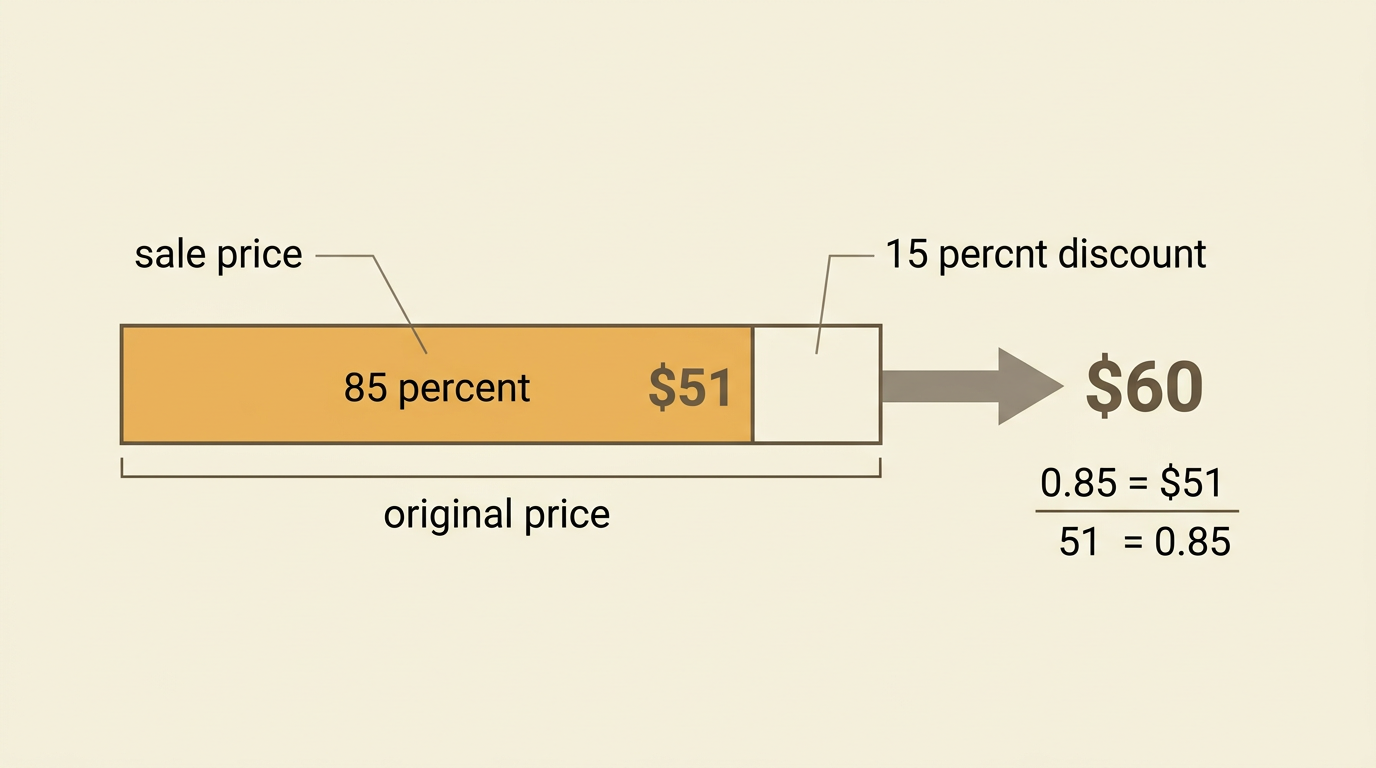
Sometimes the unknown is the percent rather than the part. If 18 of 60 students chose an activity, divide the part by the whole: 18 divided by 60 equals 0.30, or 30 percent. In other problems, the original whole is unknown. Suppose a backpack costs $51 after a 15 percent discount. The sale price is 85 percent of the original price because 100 percent minus 15 percent equals 85 percent. Write 0.85 times the original price equals $51. Dividing $51 by 0.85 gives an original price of $60. Before calculating, decide which quantity represents 100 percent. The original amount is usually the whole, while the new amount may represent a percent greater than or less than 100 percent.
Calculating Discounts and Markups
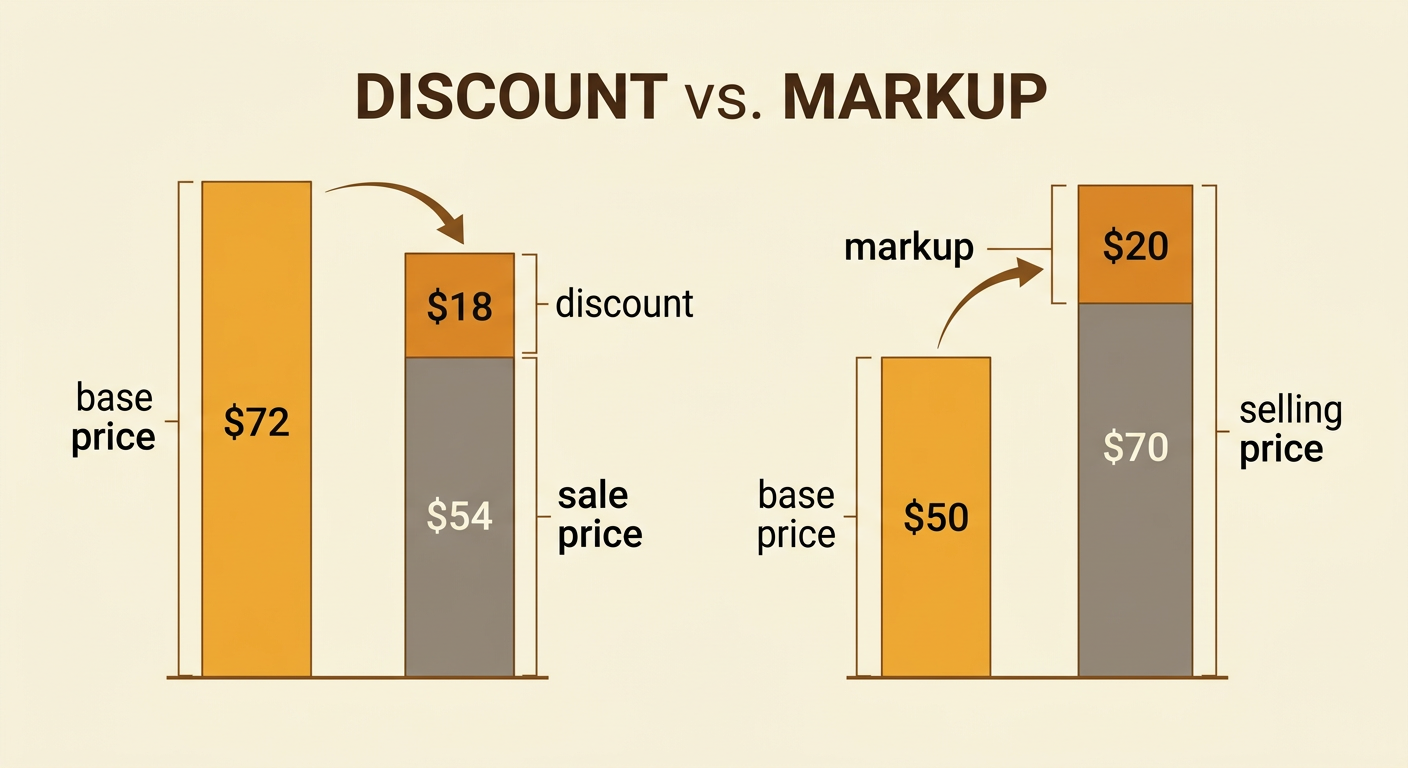
A discount reduces an original price, while a markup increases it. To find a discounted price, calculate the discount and subtract it from the original price. A $72 pair of shoes discounted by 25 percent has a discount of 0.25 times $72, or $18. The sale price is $72 minus $18, which equals $54. A markup works in the opposite direction. If a store buys an item for $50 and adds a 40 percent markup, the markup is 0.40 times $50, or $20. The selling price is $70. You can also use multipliers: multiply by 0.75 for 25 percent off or by 1.40 for a 40 percent markup. Always apply the percent to the stated original or base amount.
Including Tax and Gratuity
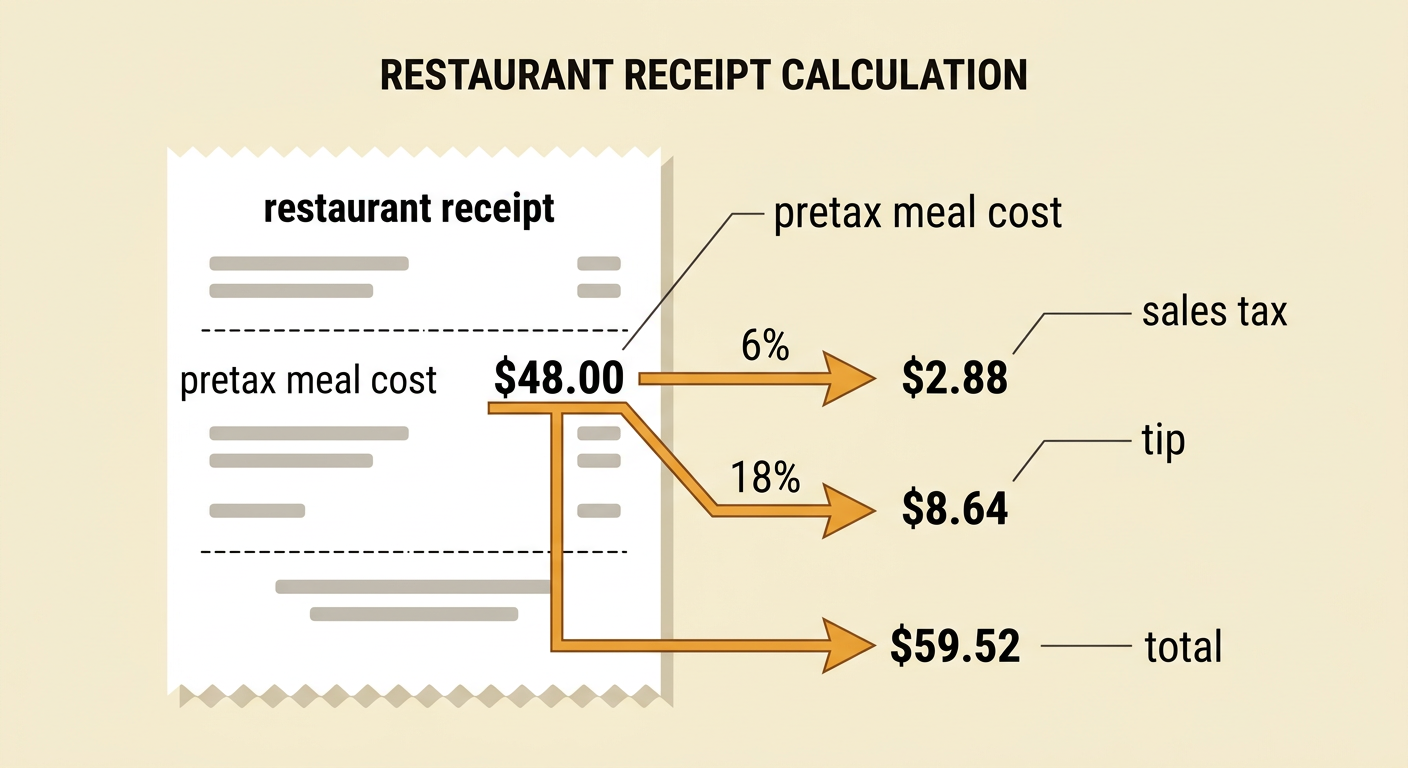
Sales tax and gratuity are additional amounts found by multiplying a base amount by a percent. Suppose a restaurant meal costs $48 before tax and tip. A 6 percent tax is 0.06 times $48, or $2.88. An 18 percent tip based on the pretax meal cost is 0.18 times $48, or $8.64. Add the meal cost, tax, and tip to get $48 plus $2.88 plus $8.64, which equals $59.52. Read each problem carefully to identify the base for every percent. A tip may be based on the pretax cost, while tax rules can vary by location. Do not automatically calculate the tip from the total after tax unless the problem directs you to do so.
Solving a Multistep Shopping Problem
Multistep shopping problems must be solved in the order the changes occur. Suppose three shirts cost $24 each, the store offers a 20 percent discount, and sales tax is 7.5 percent. First find the regular subtotal: 3 times $24 equals $72. Next find the discounted subtotal by multiplying $72 by 0.80. This gives $57.60. Then calculate tax on the discounted subtotal: 0.075 times $57.60 equals $4.32. Finally, add the tax to get $61.92. The calculation can also be written as 3 times $24 times 0.80 times 1.075. Notice that the tax is not calculated from the original $72 because the discount changes the taxable price before tax is added.

Checking Whether Answers Are Reasonable
Estimate and compare quantities to check whether an answer makes sense. Suppose a $120 item receives a 15 percent markup and then a 15 percent discount. After the markup, the price is $120 times 1.15, or $138. The discount is then based on $138, so the final price is $138 times 0.85, or $117.30. This answer is reasonable because 15 percent of $138 is a little more than 15 percent of $120, making the decrease slightly larger than the earlier increase. Equal percent increases and decreases do not cancel when they use different base amounts. You can also estimate: 15 percent is close to one sixth, so both changes should be near $20, and a final price near $120 is sensible.
