Solving One-Step Equations with Inverse Operations
Students use inverse operations and properties of equality to solve one-step equations involving nonnegative rational numbers.
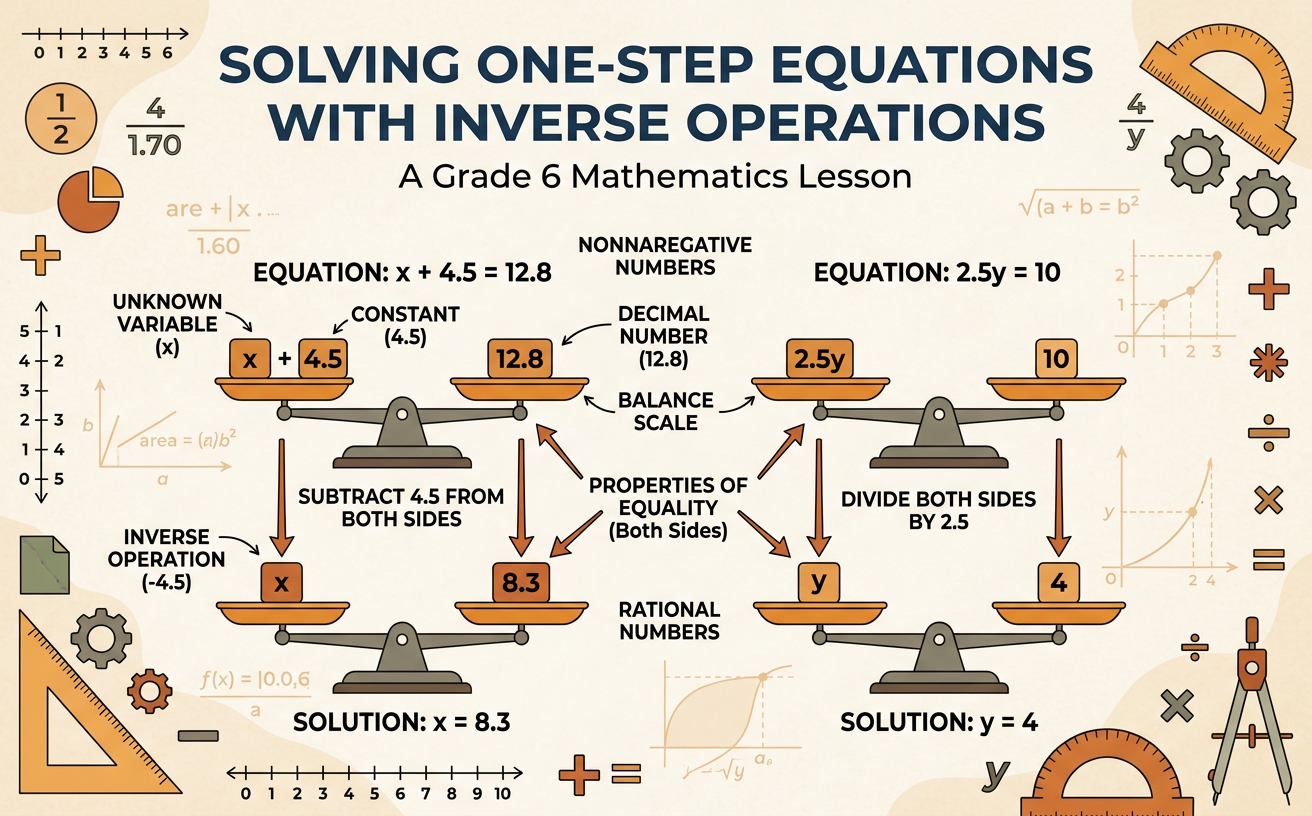
Illustrations are auto-generated and may be placeholders. They can be refreshed to match the narration.
Equations as Balanced Statements
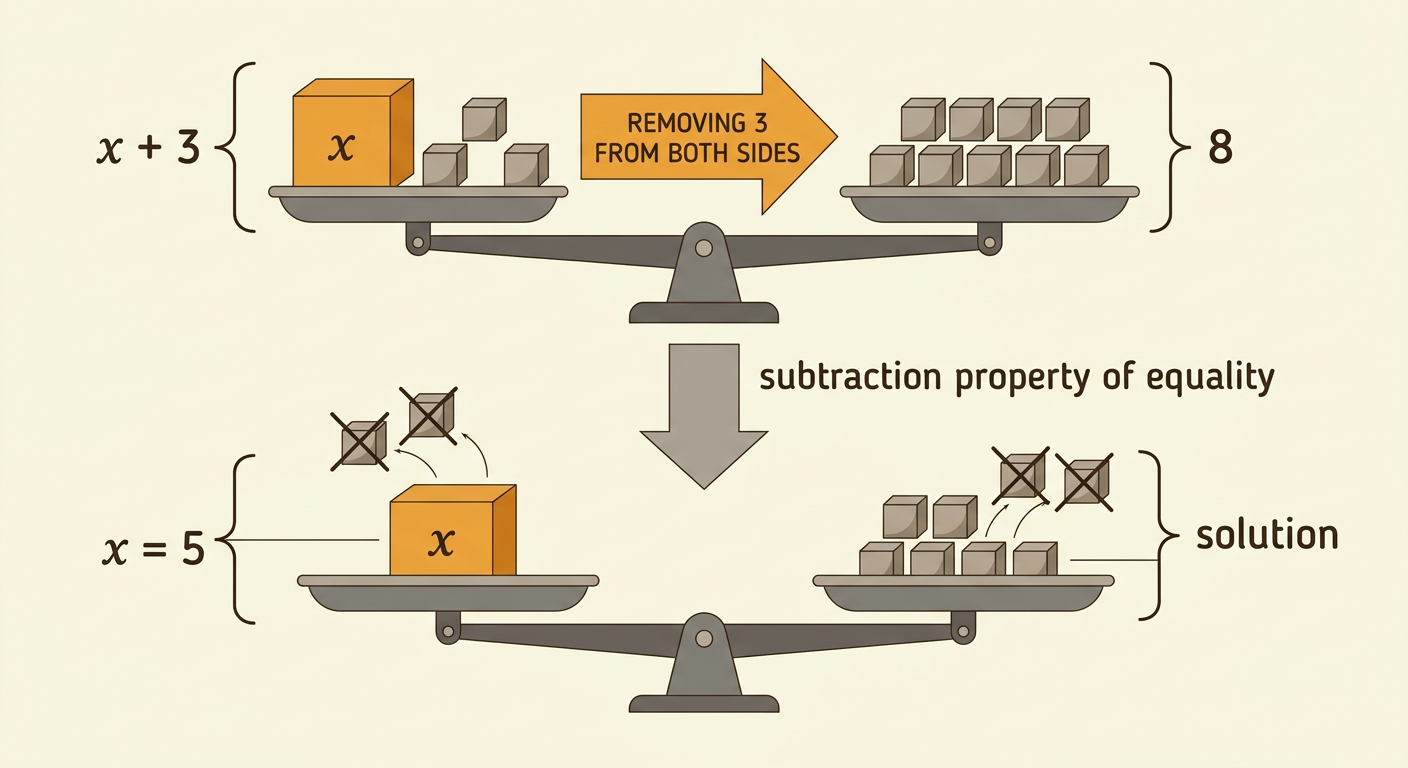
An equation states that two expressions have the same value. The equal sign means “has the same value as,” so both sides of an equation must remain balanced. Imagine a balance scale with x + 3 on one side and 8 on the other. If the scale is level, x + 3 and 8 are equal. To find x, remove 3 from the left side. You must also remove 3 from the right side to keep the scale balanced. This gives x = 5. This step uses the subtraction property of equality: subtracting the same number from both sides produces an equivalent equation. A solution is a value that makes the original equation true. Because 5 + 3 = 8, the value 5 is the solution.
Addition and Subtraction as Inverse Operations
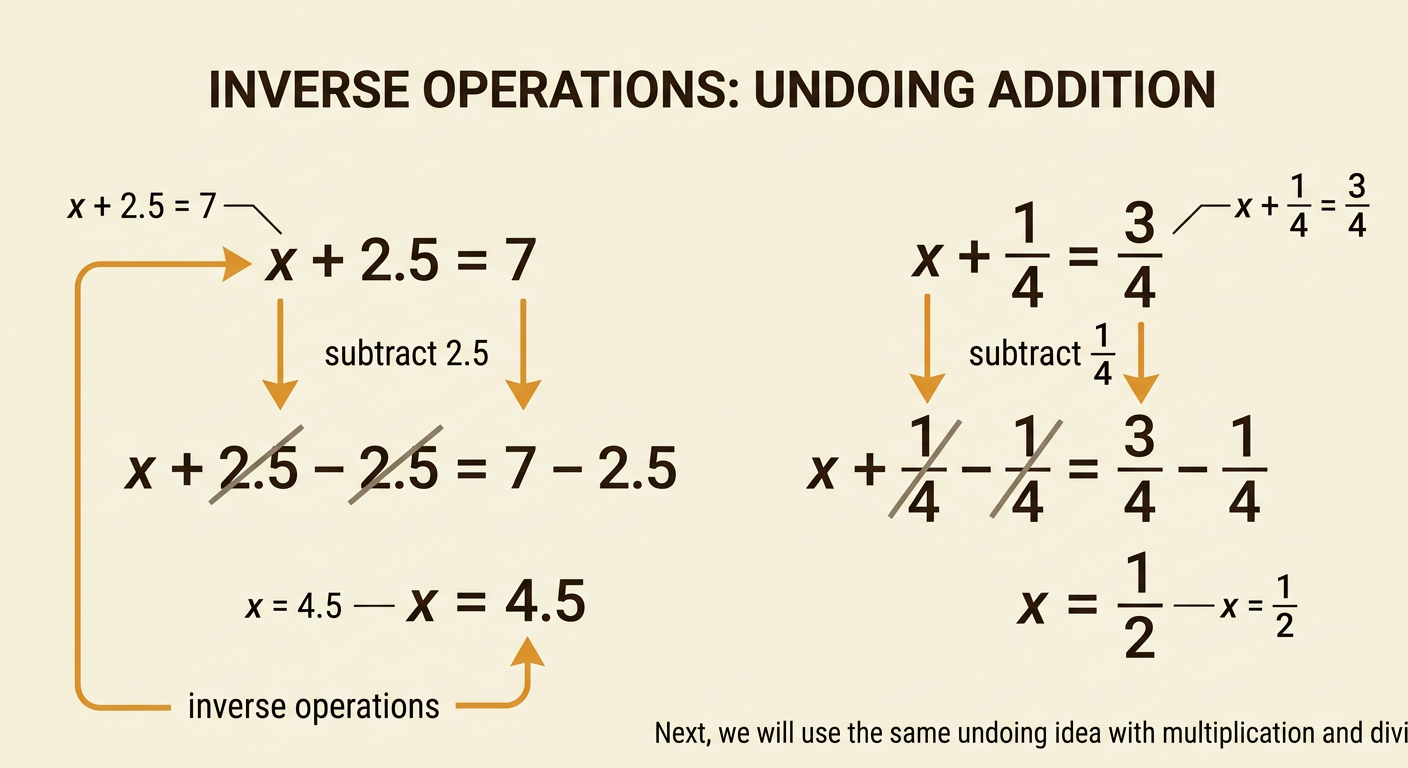
Addition and subtraction are inverse operations because they undo each other. To solve an equation such as x + 2.5 = 7, undo the addition of 2.5 by subtracting 2.5. Use the subtraction property of equality and subtract 2.5 from both sides: x + 2.5 − 2.5 = 7 − 2.5. On the left, adding and subtracting 2.5 cancel each other, leaving x. On the right, 7 − 2.5 = 4.5, so x = 4.5. The same reasoning works with fractions. For x + 1/4 = 3/4, subtract 1/4 from both sides to get x = 2/4, or x = 1/2. Always apply the inverse operation to both sides, not just one side.
Multiplication and Division as Inverse Operations
Multiplication and division are inverse operations because they undo each other. In an equation such as 4x = 10, 4x means 4 times x. Divide both sides by 4 to isolate x: 4x ÷ 4 = 10 ÷ 4. On the left, multiplying by 4 and dividing by 4 cancel, leaving x. On the right, 10 ÷ 4 = 2.5, so x = 2.5. Fractions can also be coefficients. In the equation (1/3)x = 2, divide both sides by 1/3. Dividing by 1/3 is equivalent to multiplying by 3, so x = 6. Using the division property of equality keeps the equation balanced because both sides are divided by the same nonzero number.

Solving One-Step Equations
A one-step equation can be solved with one inverse operation. First, identify the operation being performed on the variable. Next, choose its inverse and apply it to both sides. Finally, simplify to find the variable’s value. For example, suppose a movie ticket costs $3 more than a snack, and the ticket costs $8.50. Let s represent the snack’s cost. The equation is s + 3 = 8.50. Subtract 3 from both sides to get s = 5.50, so the snack costs $5.50. For a multiplication example, three identical notebooks cost $7.50. If n is the cost of one notebook, then 3n = 7.50. Divide both sides by 3 to get n = 2.50. The operation shown in the equation determines which inverse operation to use.

Checking and Explaining Solutions
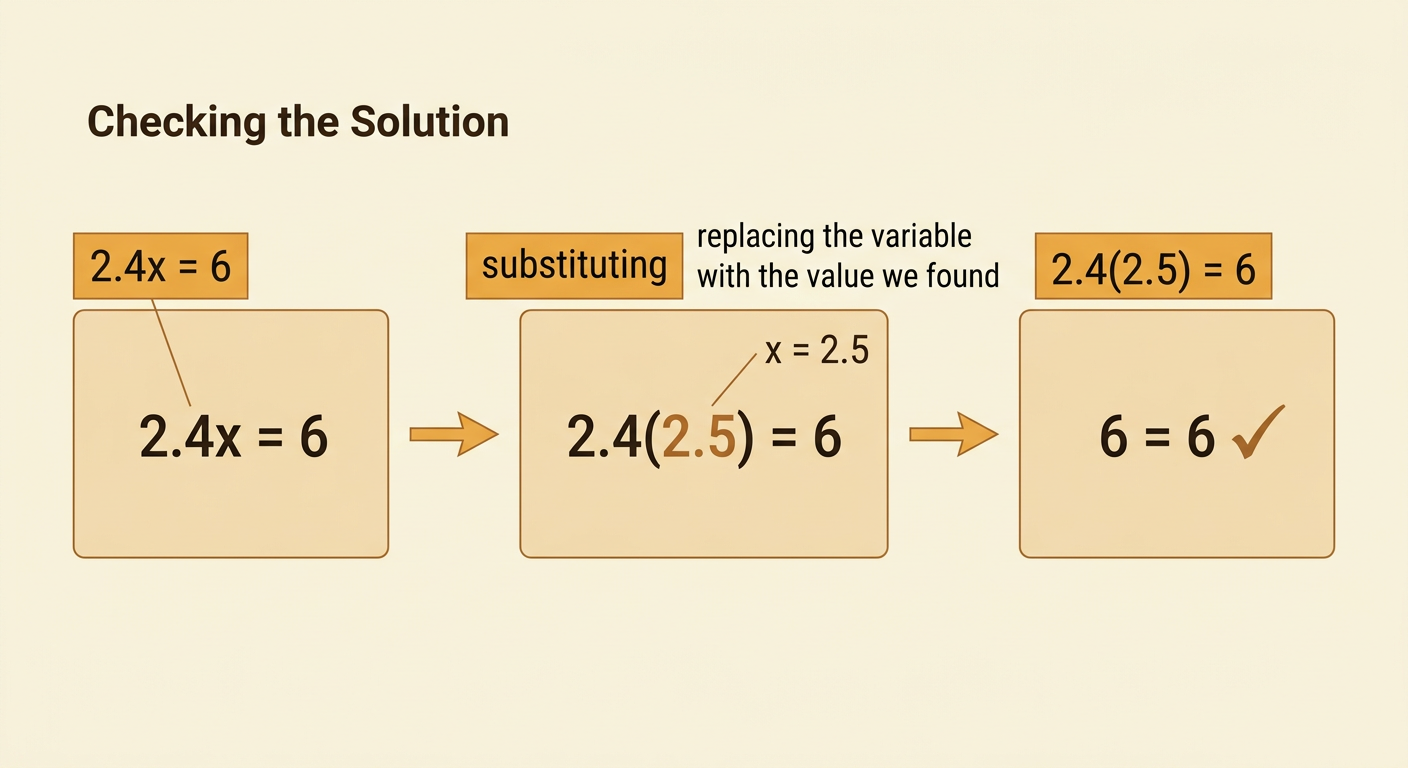
After solving an equation, check the solution by substituting the value for the variable in the original equation. If both sides have the same value, the solution is correct. For example, solve 2.4x = 6 by dividing both sides by 2.4. This gives x = 2.5. To check, replace x with 2.5 in the original equation: 2.4(2.5) = 6. Since 2.4 times 2.5 equals 6, the equation becomes 6 = 6, which is true. A complete explanation names the inverse operation and states that it was applied to both sides. You might write, “I divided both sides by 2.4 to undo multiplication. The solution is 2.5, and substitution confirms that 2.4(2.5) = 6.” A false statement during checking signals an error that should be corrected.