
Solving Proportional and Percent Problems
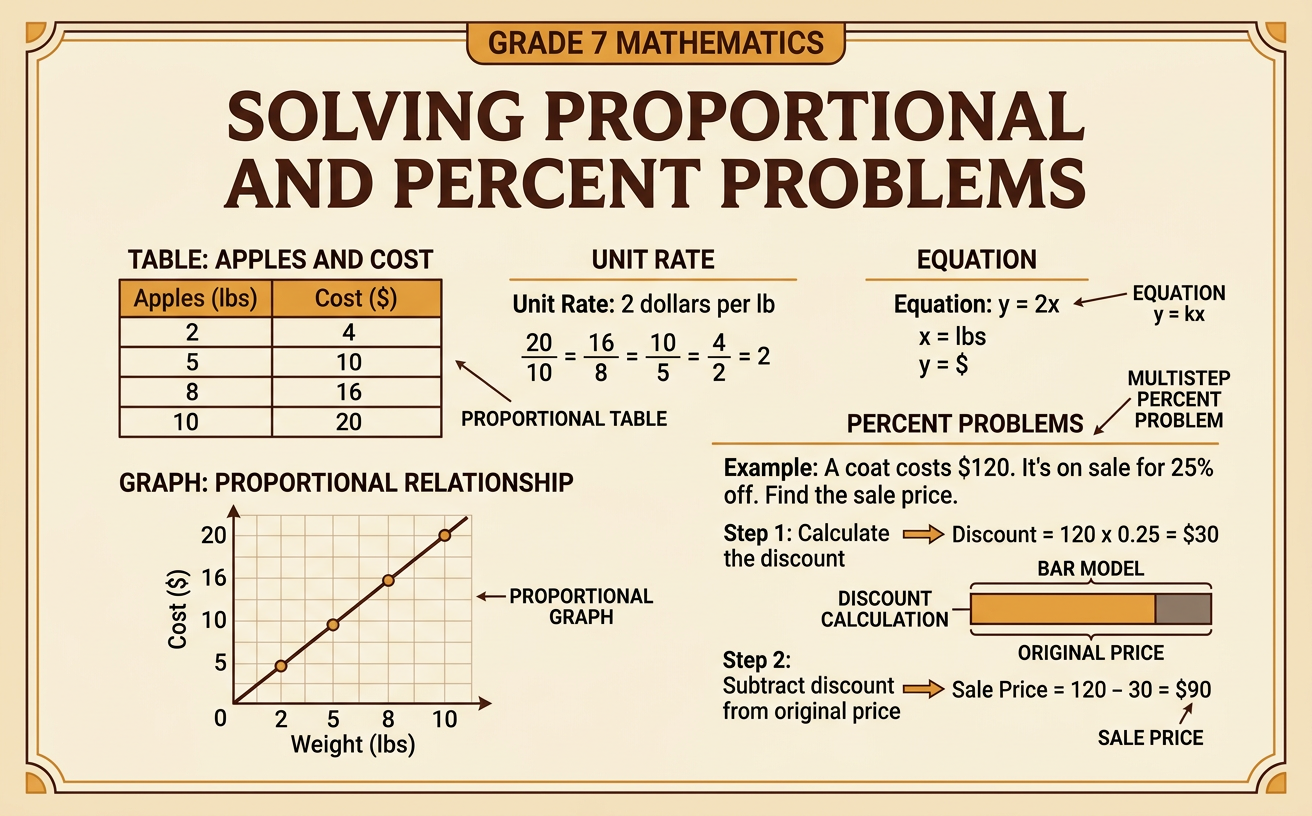
Students represent proportional relationships with tables, equations, and unit rates before using them to solve multistep percent problems.
Illustrations are auto-generated and may be placeholders. They can be refreshed to match the narration.
Recognizing Proportional Relationships
Two quantities are proportional when their ratio remains constant. This constant ratio is called the constant of proportionality. A table showing 2 notebooks for $5, 4 notebooks for $10, and 6 notebooks for $15 is proportional because cost divided by number of notebooks is always 2.5. The constant of proportionality is 2.5 dollars per notebook. A proportional relationship can be written as y = kx, where k is the constant of proportionality. For the notebook example, the equation is y = 2.5x, with x representing notebooks and y representing cost. A table is not proportional if the ratios change. For instance, points (2, 5) and (4, 11) do not share one constant because 5 ÷ 2 is not equal to 11 ÷ 4.
Unit Rates and Equivalent Ratios
A unit rate compares a quantity to one unit of another quantity. Unit rates make it easier to compare prices, speeds, and other proportional situations. Suppose a cyclist travels 42 miles in 3.5 hours. The unit rate is 42 ÷ 3.5 = 12 miles per hour. Therefore, the relationship can be modeled by d = 12t, where d is distance and t is time. Equivalent ratios can also be used to find missing values. If 5 pounds of apples cost $8, then the cost per pound is 8 ÷ 5 = $1.60. Seven pounds would cost 7 × 1.60 = $11.20. Units should be included throughout the work because they show whether to multiply or divide and help explain what the final number represents.
Discounts, Markups, and Tax
A percent is a ratio compared with 100. To calculate a percent of a quantity, convert the percent to a decimal and multiply. Suppose a jacket originally costs $64 and is discounted by 25 percent. The discount is 0.25 × 64 = $16, so the sale price is $64 − $16 = $48. If a 7 percent sales tax is then added, calculate the tax using the sale price: 0.07 × 48 = $3.36. The final cost is $48 + $3.36 = $51.36. The discount and tax should not be combined because they apply to different amounts. A discount multiplier can also be used. Paying 75 percent after a 25 percent discount gives 0.75 × 64 = $48.
Percent Increase and Decrease
Percent change compares the amount of change with the original value. Subtract to find the change, divide by the original value, and convert the result to a percent. Suppose attendance at a school event increases from 240 people to 300 people. The increase is 300 − 240 = 60. Dividing by the original attendance gives 60 ÷ 240 = 0.25, so the percent increase is 25 percent. For a decrease, the process is the same. If a town’s water use falls from 500,000 gallons to 425,000 gallons, the decrease is 75,000 gallons. The ratio 75,000 ÷ 500,000 equals 0.15, so water use decreased by 15 percent. Always divide by the original amount, not the new amount, because percent change measures change relative to the starting value.