
Solving Quadratic Equations by Factoring
Students use the zero-product property to solve factorable quadratic equations and verify their solutions.
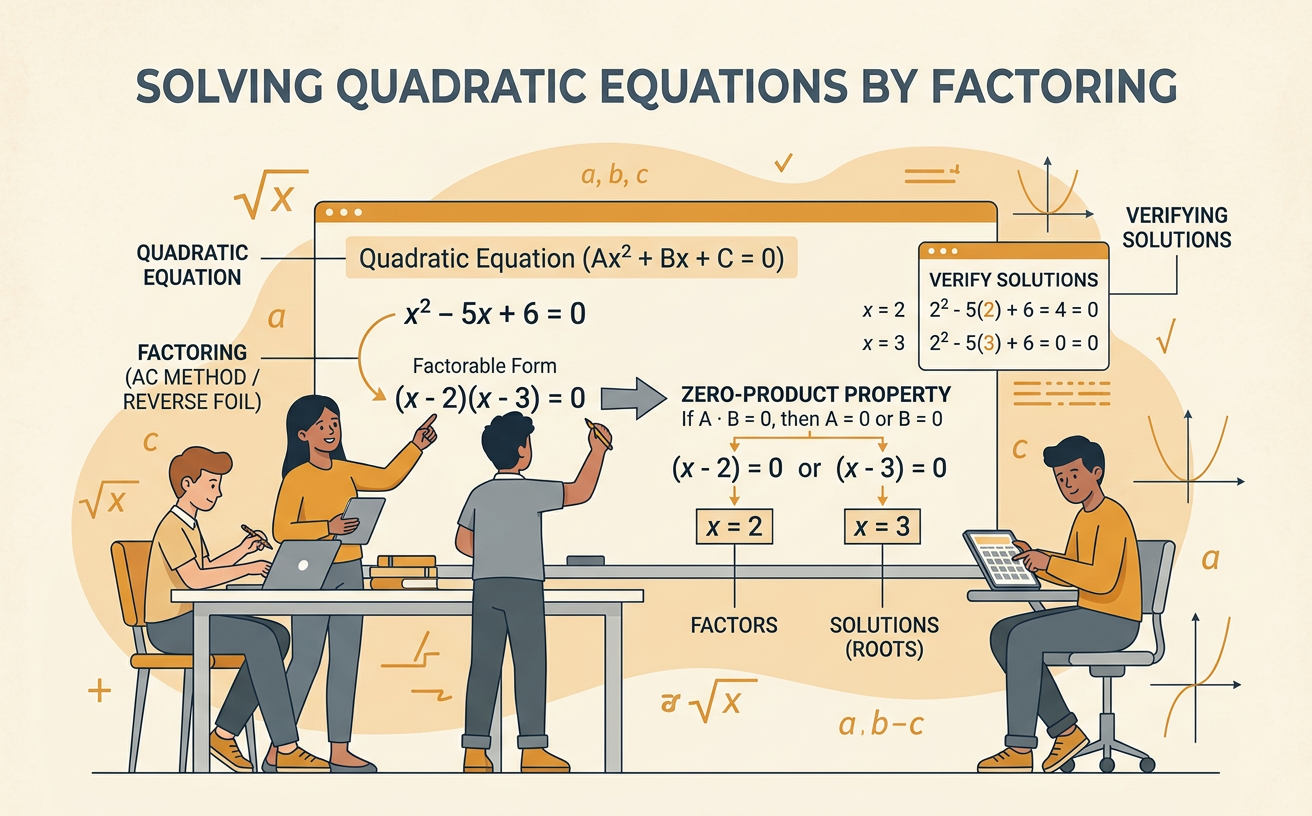
Illustrations are auto-generated and may be placeholders. They can be refreshed to match the narration.
Recognizing Standard Form
A quadratic equation is in standard form when it is written as ax² + bx + c = 0, where a, b, and c are numbers and a is not zero. Before factoring, move every term to one side so that the other side equals zero. Then combine any like terms and arrange the powers of x from greatest to least. For example, consider 2x² + 7x = 15. Subtract 15 from both sides to obtain 2x² + 7x − 15 = 0. In this form, a = 2, b = 7, and c = −15. Standard form makes the expression easier to factor and prepares the equation for the zero-product property. Always check that the equation equals zero before using that property.

Factoring Quadratic Expressions
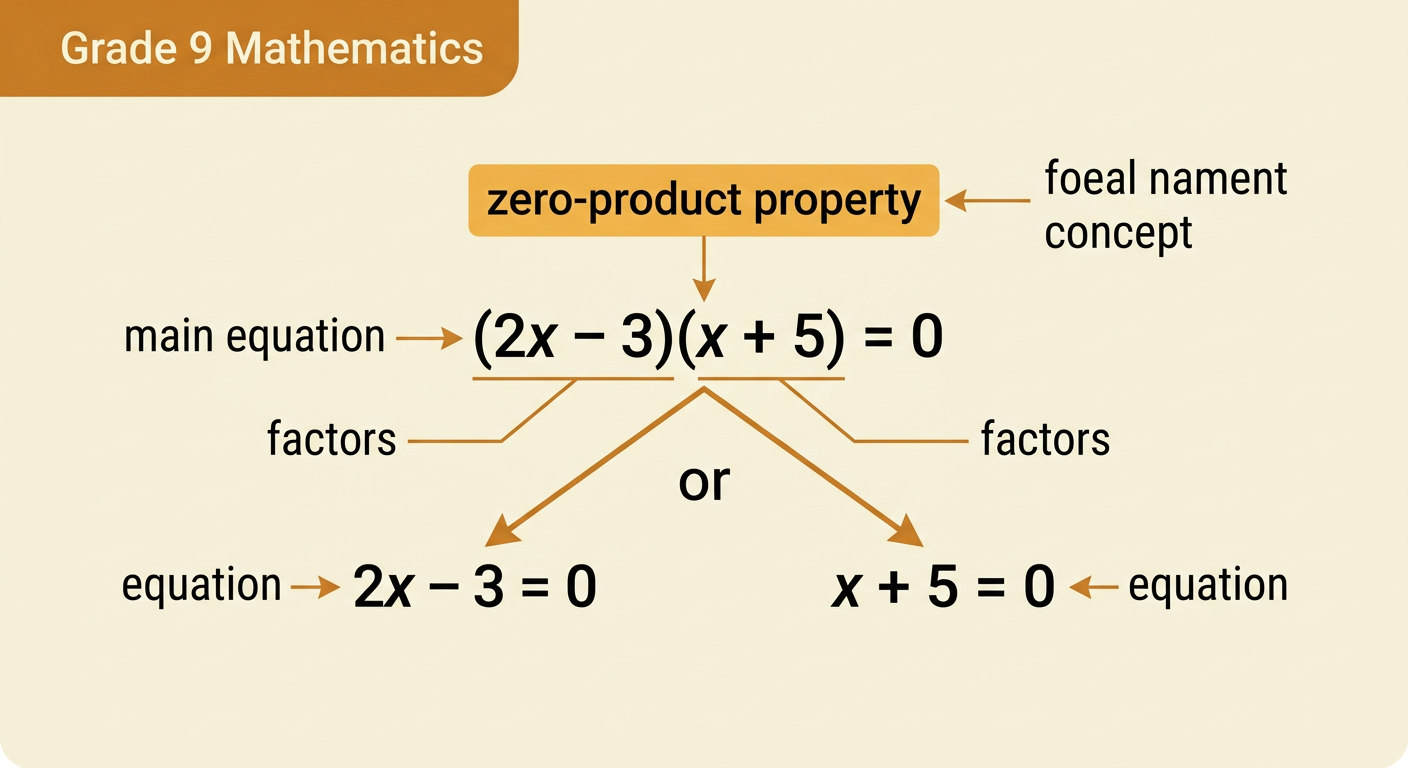
To factor a quadratic expression, rewrite it as a product of two binomials. For 2x² + 7x − 15, multiply the leading coefficient and constant: 2 times −15 equals −30. Find two integers whose product is −30 and whose sum is 7. The numbers 10 and −3 work. Split the middle term to get 2x² + 10x − 3x − 15. Then factor by grouping: 2x(x + 5) − 3(x + 5). Because both groups contain x + 5, the expression factors as (2x − 3)(x + 5). You can confirm the factorization by multiplying the binomials. The product returns 2x² + 7x − 15, so the factors are correct.

Applying the Zero-Product Property
The zero-product property states that if the product of two factors equals zero, then at least one factor must equal zero. After factoring 2x² + 7x − 15 = 0, the equation becomes (2x − 3)(x + 5) = 0. This product can equal zero only if 2x − 3 = 0 or x + 5 = 0. The word or is important because either factor may be zero. Do not set the factors equal to each other, and do not divide by a factor containing x because that could remove a valid solution. Instead, create one equation from each factor. The zero-product property connects the factored form of a quadratic equation to simpler linear equations that can be solved separately.
Solving for Both Roots
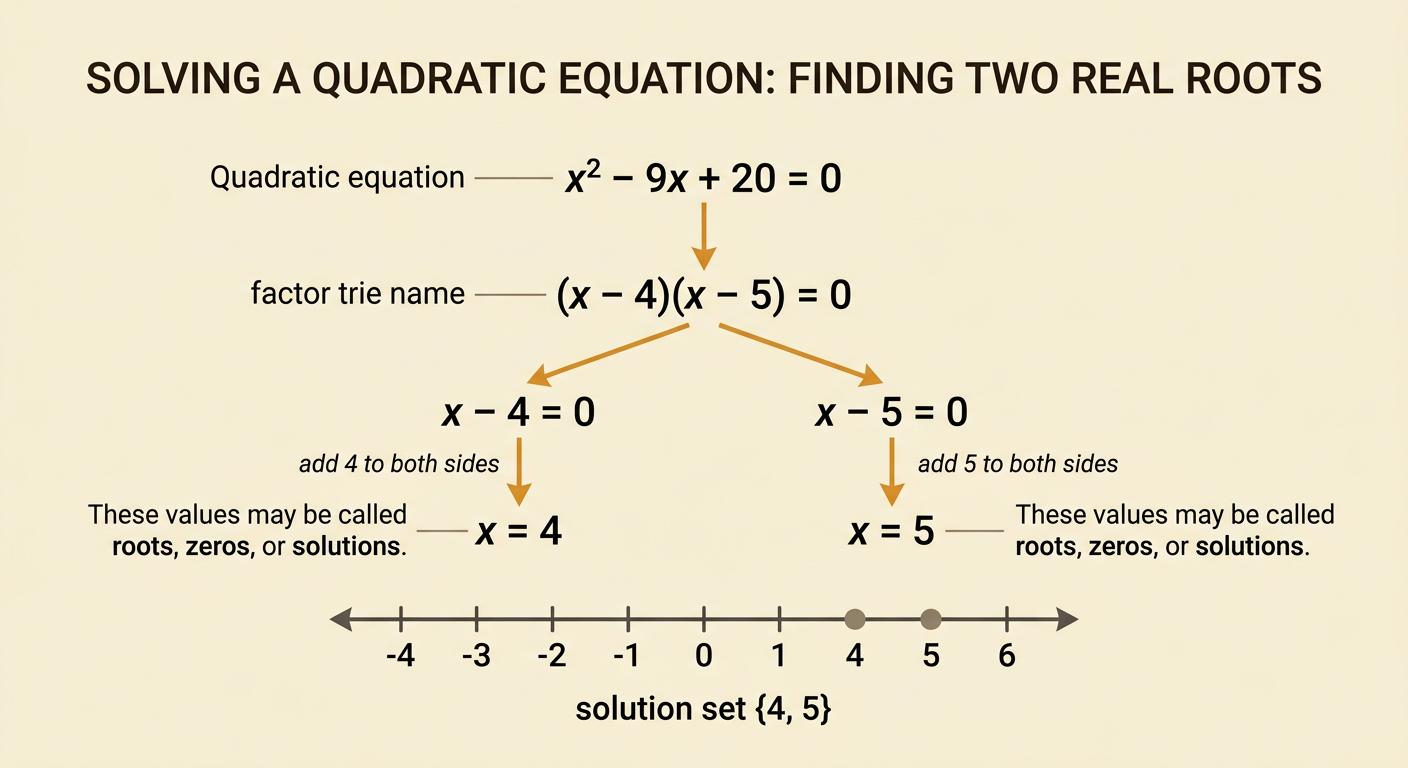
A quadratic equation can have two real solutions, so solve every linear equation produced by the factors. Consider x² − 9x + 20 = 0. The expression factors as (x − 4)(x − 5) = 0 because −4 and −5 multiply to 20 and add to −9. Apply the zero-product property: x − 4 = 0 or x − 5 = 0. Solving gives x = 4 or x = 5. These values are called roots, zeros, or solutions of the quadratic equation. Record both values in the solution set, {4, 5}. Stopping after solving only one factor would give an incomplete answer. In some equations, both factors may produce the same root, but each distinct factor should still be examined.
Checking Solutions
Check each proposed solution by substituting it into the original equation. For 2x² + 7x − 15 = 0, factoring gives the possible solutions x = 3/2 and x = −5. Substitute x = 3/2: 2(3/2)² + 7(3/2) − 15 = 9/2 + 21/2 − 15 = 15 − 15 = 0. Next substitute x = −5: 2(−5)² + 7(−5) − 15 = 50 − 35 − 15 = 0. Both substitutions produce a true equation, so both values are solutions. Checking can reveal arithmetic mistakes, incorrect signs, or missing roots. A value is verified only when substitution makes the left side equal the right side of the original equation.
