Solving Quadratic Equations with the Quadratic Formula
Students use the quadratic formula and discriminant to solve quadratic equations and determine the number and type of solutions.

Illustrations are auto-generated and may be placeholders. They can be refreshed to match the narration.
Review Standard Form
A quadratic equation is written in standard form as ax² + bx + c = 0, where a, b, and c are real numbers and a cannot equal zero. The terms are arranged from the greatest exponent to the least: the squared term, the linear term, and the constant. One side of the equation must be zero before you use the quadratic formula. For example, begin with 2x² + 5 = 3x. Subtract 3x from both sides to obtain 2x² − 3x + 5 = 0. This is standard form, with the terms in descending order. If a were zero, the squared term would disappear, and the equation would be linear rather than quadratic. Rewriting carefully helps prevent errors when identifying coefficients.

Identify Coefficients
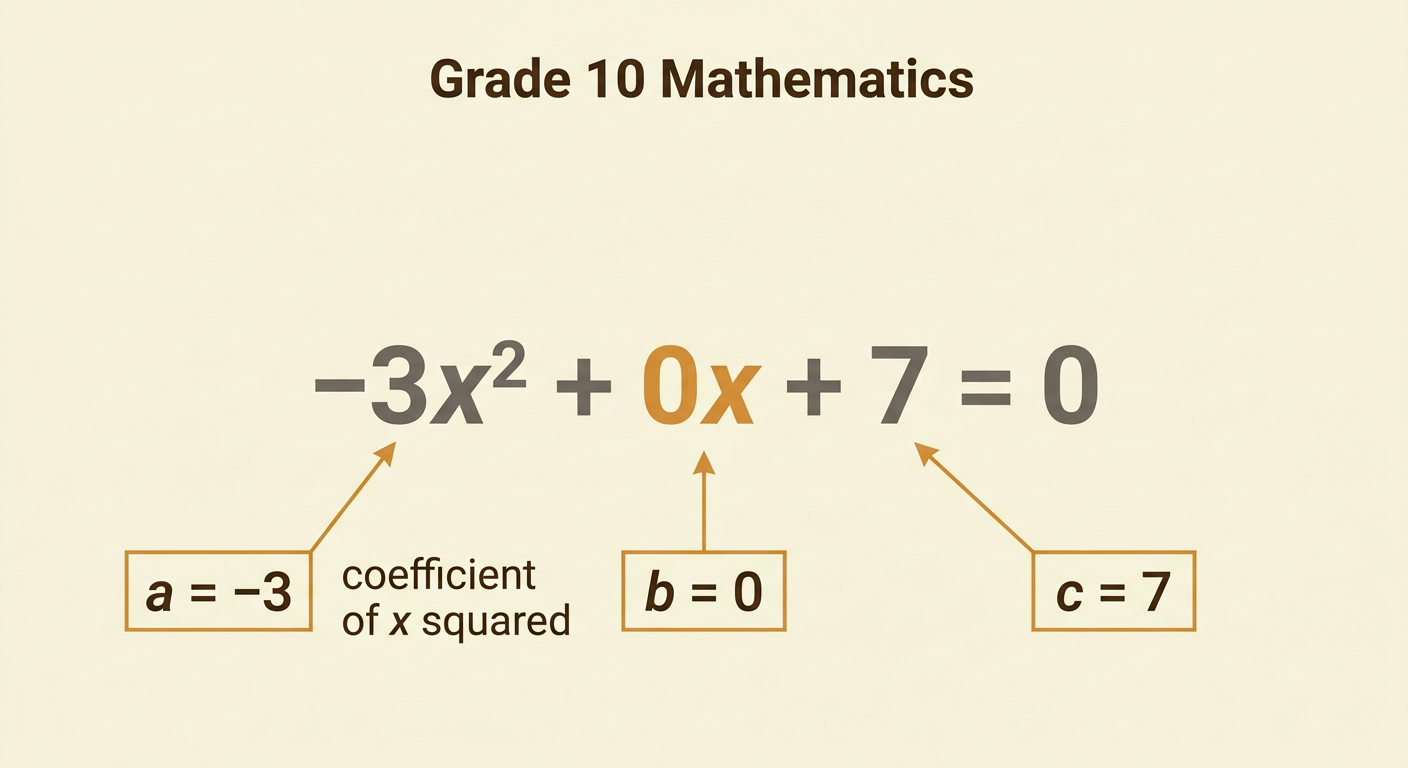
In the standard form ax² + bx + c = 0, a is the coefficient of x², b is the coefficient of x, and c is the constant. Include each sign when identifying a coefficient. For the equation −3x² + 7 = 0, write the missing linear term as 0x: −3x² + 0x + 7 = 0. Therefore, a = −3, b = 0, and c = 7. The negative sign belongs to a, not to the quadratic formula’s subtraction symbol. A missing constant would similarly have a value of zero. Always identify a, b, and c only after the equation is in standard form. Correct coefficient values are essential because every part of the quadratic formula depends on them.
Apply the Quadratic Formula
The quadratic formula solves any equation in the form ax² + bx + c = 0: x = (−b ± √(b² − 4ac)) ÷ 2a. The plus-or-minus symbol means you usually calculate two values, one using addition and one using subtraction. Solve x² − 5x + 6 = 0. Here, a = 1, b = −5, and c = 6. Substitute these values: x = (5 ± √((−5)² − 4(1)(6))) ÷ 2(1). Simplify inside the square root to get x = (5 ± √1) ÷ 2. The two calculations are x = (5 + 1) ÷ 2 = 3 and x = (5 − 1) ÷ 2 = 2. Thus, the solutions are 2 and 3.

Interpret the Discriminant
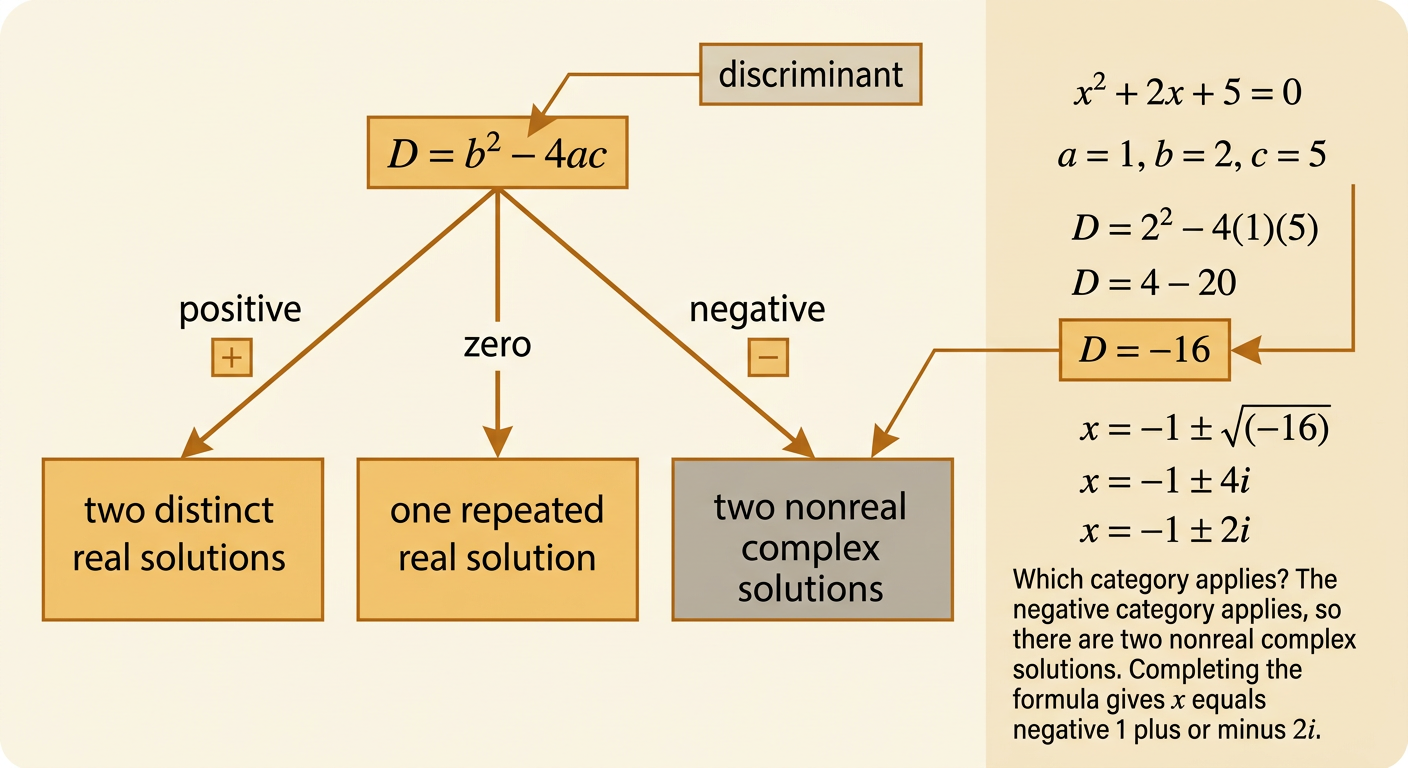
The expression b² − 4ac inside the square root is called the discriminant, written D = b² − 4ac. Its value predicts the number and type of solutions. If D is positive, the equation has two distinct real solutions. If D equals zero, it has one repeated real solution. If D is negative, it has two nonreal complex solutions because the square root of a negative number is not real. For example, consider x² + 2x + 5 = 0. Here, D = 2² − 4(1)(5) = 4 − 20 = −16. Because D is negative, the equation has two nonreal solutions. In fact, the quadratic formula gives x = −1 ± 2i. For equations with integer coefficients, a positive perfect-square discriminant produces rational solutions.
Check and Classify Solutions
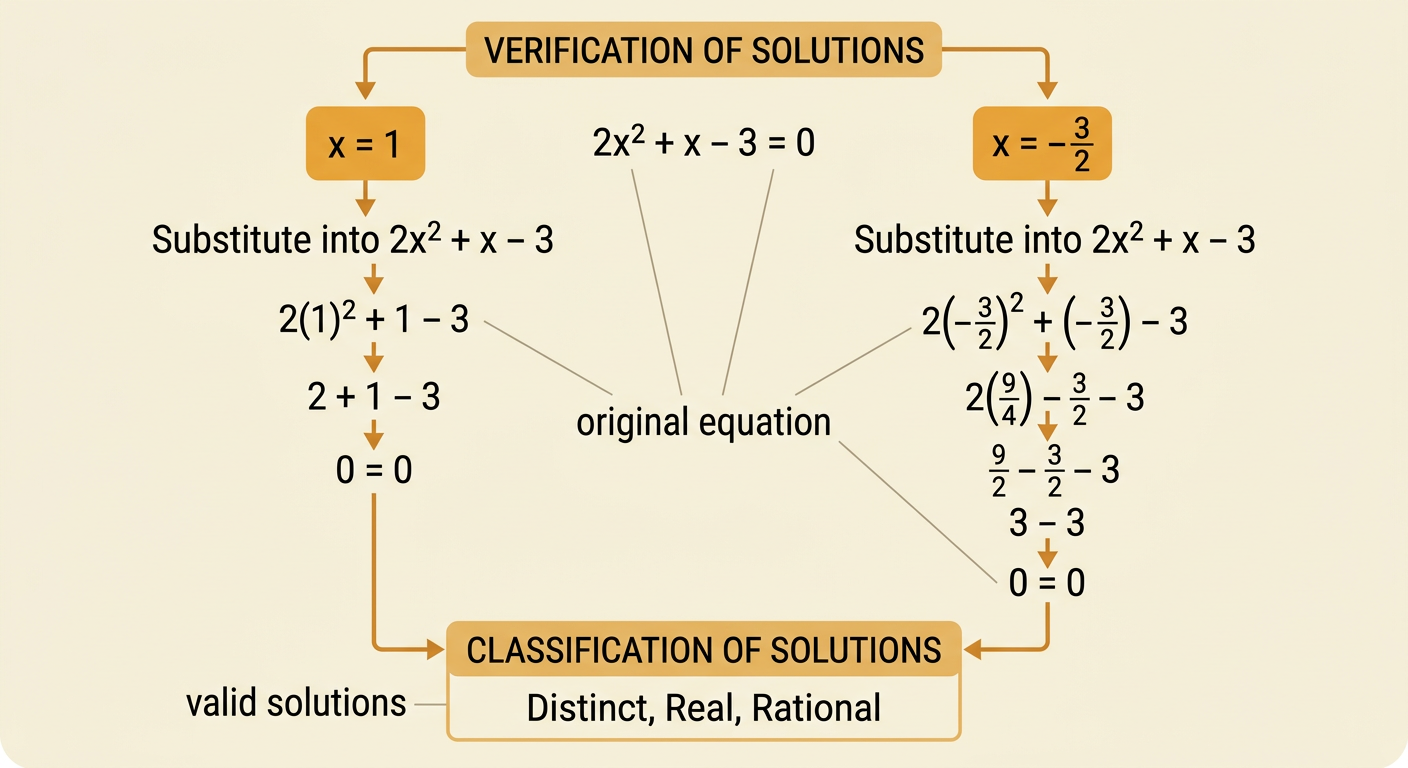
After finding solutions, substitute each value into the original equation to verify that it makes the equation true. Then classify the solutions as real or nonreal, distinct or repeated, and rational or irrational when appropriate. For example, solve 2x² + x − 3 = 0. The quadratic formula gives x = (−1 ± √25) ÷ 4, so the solutions are x = 1 and x = −3/2. Check x = 1: 2(1)² + 1 − 3 = 0. Check x = −3/2: 2(−3/2)² − 3/2 − 3 = 0. Both substitutions produce zero, so both values are valid. Since the discriminant is 25, a positive perfect square, the equation has two distinct real rational solutions.