
Solving Real-World Problems with Two-Step Equations
Students translate real-world situations into two-step equations and solve them using inverse operations while checking that solutions make sense in context.
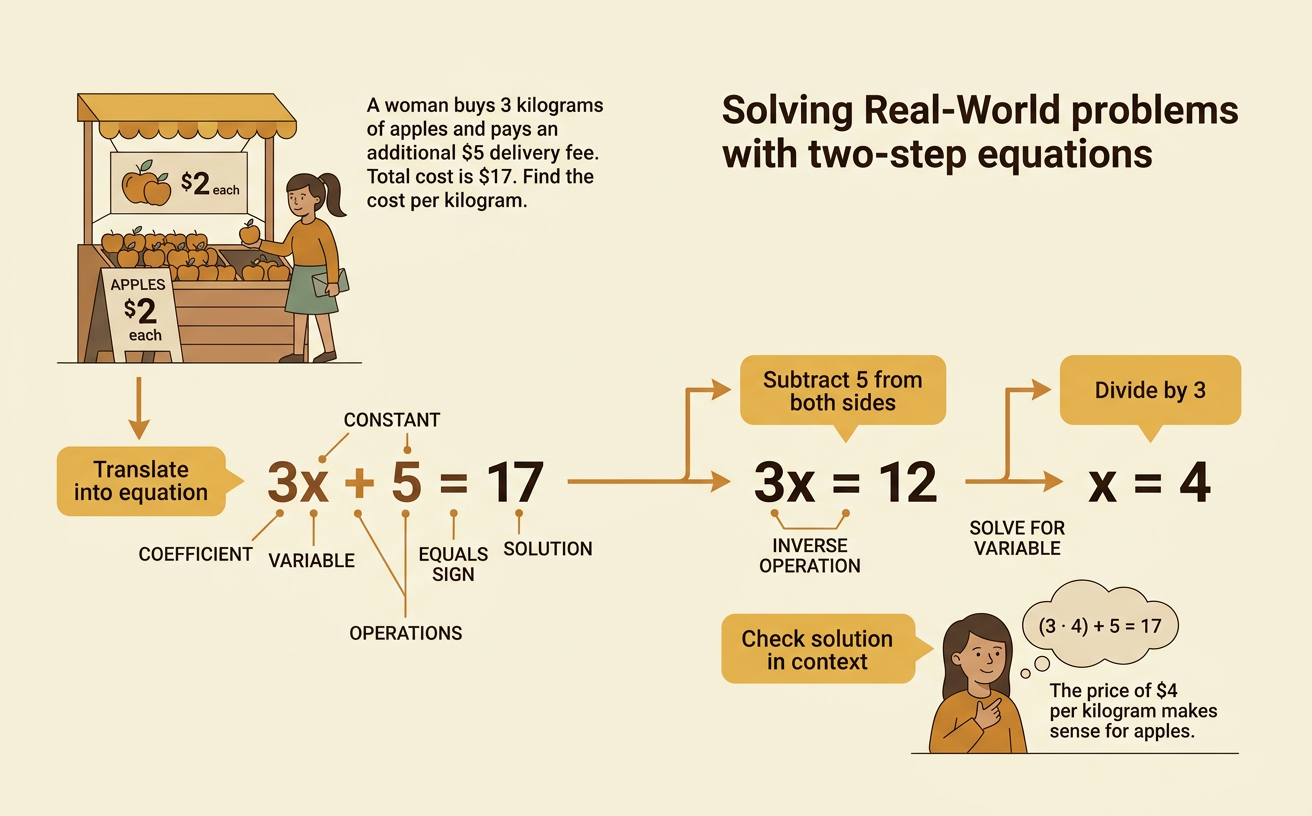
Illustrations are auto-generated and may be placeholders. They can be refreshed to match the narration.
Identify the Unknown Quantity
Begin by asking what quantity the problem wants you to find. Represent that unknown quantity with a variable, such as x, and state what the variable means, including its unit. Then separate the known information from the unknown. For example, a taxi ride costs a $3 starting fee plus $2 for each mile traveled. The total cost is $17. The unknown is the number of miles, so let x represent the number of miles traveled. The starting fee, rate per mile, and total cost are known. Because the number of miles cannot be negative, a reasonable solution must be zero or greater. Clearly defining the variable helps you connect every number and operation in the situation to its correct mathematical meaning.

Translate Words into an Equation
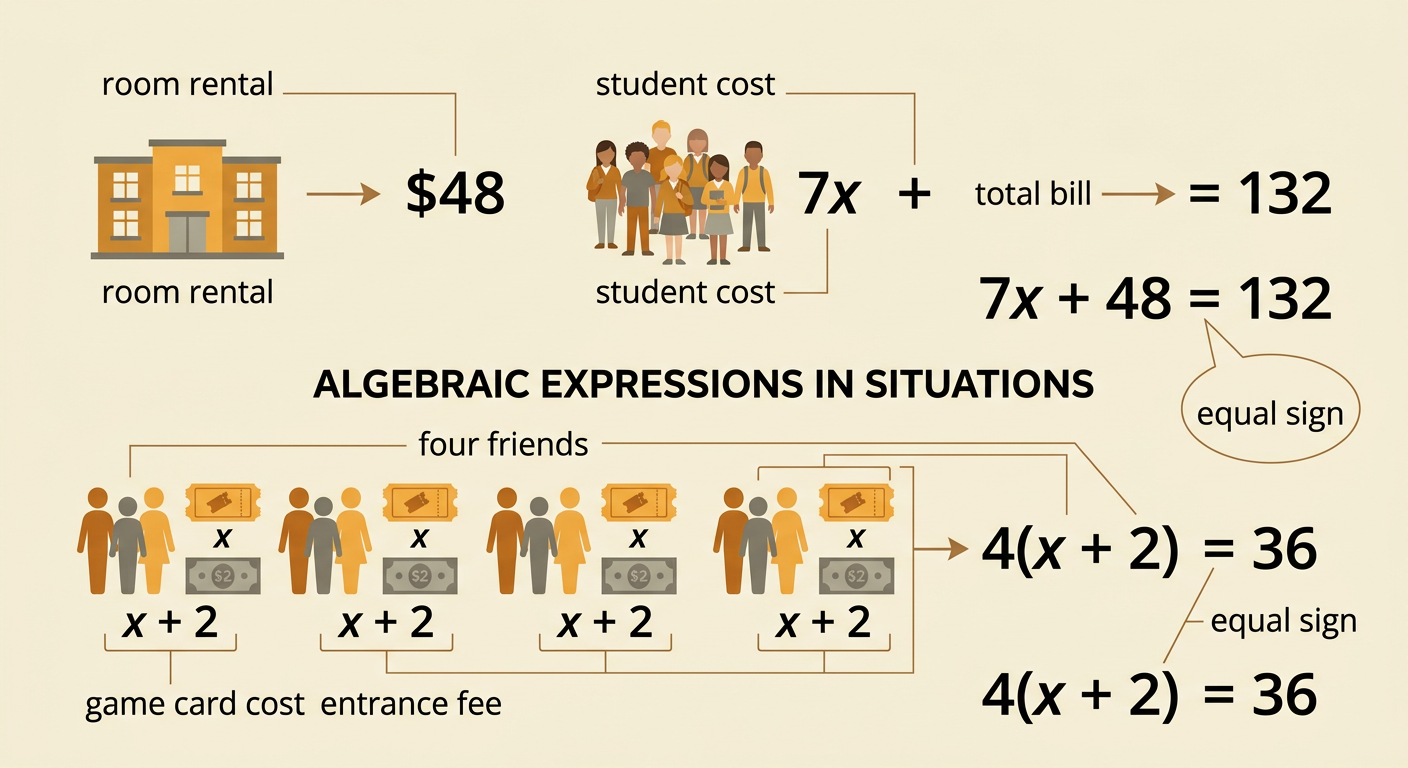
Translate the relationships in a situation, not just individual words. Look for a starting amount, a repeated rate, and a total. Suppose a school club pays $48 to rent a room and $7 for each student who attends. The total bill is $132. If x is the number of students, the student cost is 7x, so the equation is 7x + 48 = 132. Some situations produce grouped expressions. If four friends each pay a $2 entrance fee plus x dollars for a game card, and they spend $36 altogether, the equation is 4(x + 2) = 36. In both equations, the equal sign states that the calculated cost must be the same as the given total.
Apply Inverse Operations
Inverse operations undo each other: addition and subtraction are inverses, and multiplication and division are inverses. To keep an equation balanced, perform the same operation on both sides. Consider 5x + 6 = 31, which could represent five identical items plus a $6 delivery fee. First undo the added 6 by subtracting 6 from both sides: 5x + 6 − 6 = 31 − 6, so 5x = 25. Next undo multiplication by 5 by dividing both sides by 5: 5x ÷ 5 = 25 ÷ 5. Therefore, x = 5. Work in reverse order of the operations applied to x. Since x was first multiplied by 5 and then increased by 6, subtract 6 before dividing by 5.

Solve Two-Step Equations
Solve a two-step equation by isolating the variable through two inverse operations. For example, three identical gift bags each contain an item costing x dollars plus $1.50 for wrapping. The total cost is $25.50, so the equation is 3(x + 1.50) = 25.50. First divide both sides by 3 to undo the three equal groups: x + 1.50 = 8.50. Then subtract 1.50 from both sides: x = 7. The item in each bag costs $7. You could also use the distributive property to write 3x + 4.50 = 25.50, subtract 4.50, and divide by 3. Both correct methods produce the same solution because the equations are equivalent.

Check and Interpret the Solution
After solving, substitute the value into the original equation and decide whether it makes sense in context. Return to the taxi equation 2x + 3 = 17. Solving gives x = 7 because subtracting 3 gives 2x = 14, and dividing by 2 gives x = 7. To check, replace x with 7: 2(7) + 3 = 14 + 3 = 17. The result matches the original total, so the solution is correct. Interpret the answer with its unit: the taxi traveled 7 miles. Also consider whether the answer is reasonable. Seven miles is nonnegative and produces the stated fare. A mathematically calculated value may still be unsuitable if it violates the context, such as a negative distance or part of a person.
