Solving Real-World Problems with Unit Rates
Students calculate and compare unit rates to solve real-world problems involving prices, speeds, and other ratios.

Illustrations are auto-generated and may be placeholders. They can be refreshed to match the narration.
Review Ratios and Rates
A ratio compares two quantities by division. For example, if a car travels 12 miles in 3 hours, the ratio of miles to hours is 12 to 3, or 12/3. A rate is a ratio that compares quantities measured in different units, such as miles and hours. The rate in this example is 12 miles per 3 hours. Ratios and rates can be written with words, a fraction bar, or a colon. The order of the quantities matters. The rate 12 miles per 3 hours is different from 3 hours per 12 miles. Rates help describe real situations involving distance, time, cost, weight, and other measurements. A unit rate is a special rate with a second quantity of 1.

Identify the Two Quantities
Before calculating a unit rate, identify the two quantities being compared and their units. Suppose 4 pounds of oranges cost $6.00. The two quantities are cost, measured in dollars, and weight, measured in pounds. If the question asks for the cost per pound, place the cost first and divide $6.00 by 4 pounds. The word per tells which quantity should become 1. Cost per pound means the amount of money for 1 pound. If the question instead asks for pounds per dollar, the division order changes. Reading labels carefully prevents mistakes. Write the units next to every number, and decide what the final unit should be before dividing. Here, the desired unit is dollars per pound.

Find the Unit Rate
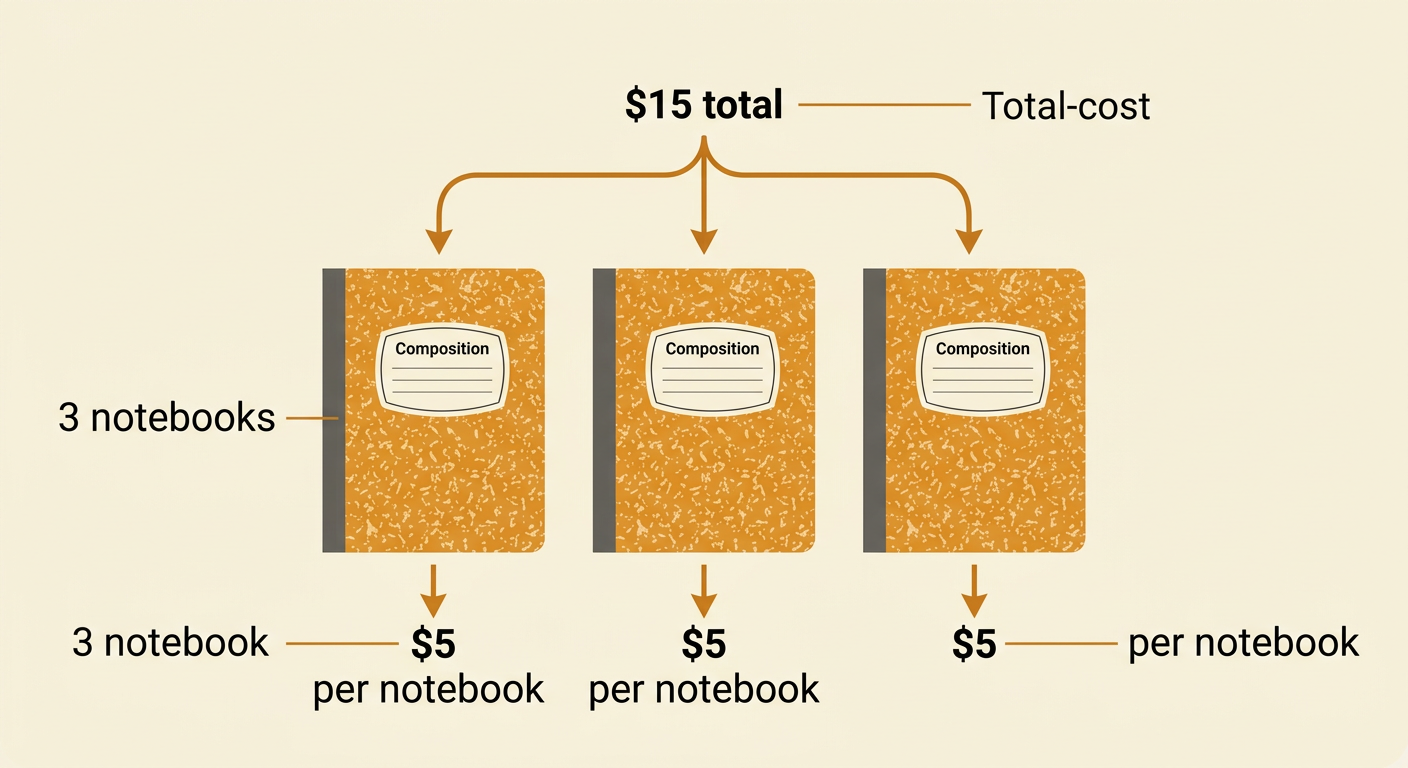
To find a unit rate, divide both quantities in a rate by the second quantity so that it becomes 1. Suppose 3 notebooks cost $15. Divide the cost by the number of notebooks: $15 ÷ 3 = $5. The unit rate is $5 per notebook. You can also see this by splitting the total cost equally among the three notebooks. Each notebook receives $5 of the total. Include the units in the answer because the number 5 alone does not explain the rate. You can check the result by multiplying: 3 notebooks × $5 per notebook = $15. Since the product matches the original cost, the unit rate is correct. This method works for prices, speeds, work rates, and many other ratios.
Compare Unit Prices
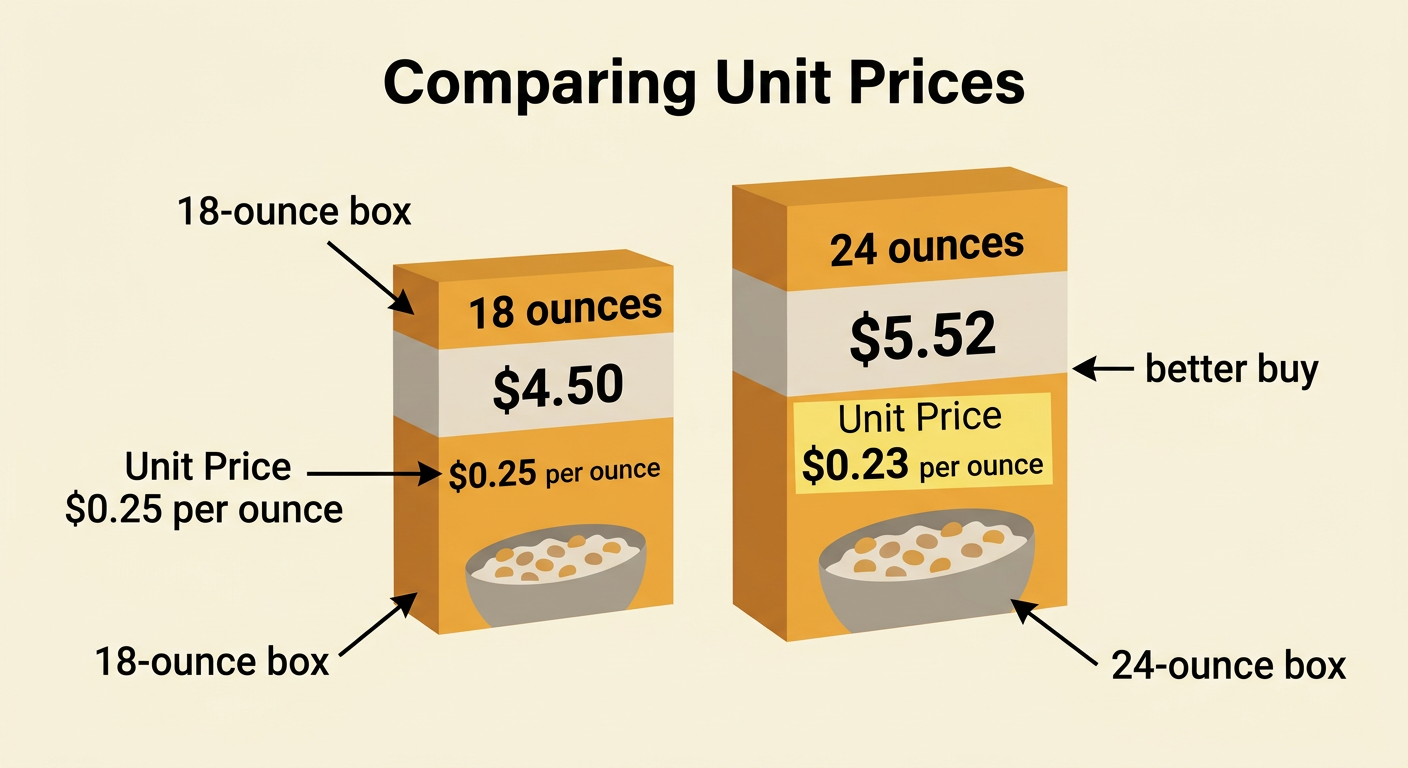
Unit prices make it possible to compare packages of different sizes fairly. Suppose an 18-ounce box of cereal costs $4.50, while a 24-ounce box costs $5.52. Find each cost per ounce. For the first box, calculate $4.50 ÷ 18 = $0.25 per ounce. For the second box, calculate $5.52 ÷ 24 = $0.23 per ounce. The 24-ounce box has the lower unit price, so it is the better buy if the cereals are otherwise equally useful. It costs $0.02 less for each ounce. Do not choose a package only because its total price is lower. A smaller package may cost less overall but more for each unit. Comparing the same unit, such as dollars per ounce, creates a fair comparison.
Solve a Real-World Problem
Unit rates can be used to solve problems involving constant speed. A cyclist travels 36 miles in 3 hours at a constant speed. First find the distance traveled in 1 hour: 36 miles ÷ 3 hours = 12 miles per hour. The cyclist's unit rate is 12 miles per hour. To find the distance traveled in 5 hours, multiply the unit rate by the new time: 12 miles per hour × 5 hours = 60 miles. Therefore, the cyclist travels 60 miles in 5 hours. This calculation assumes the speed remains constant, meaning the cyclist covers the same distance each hour. A table can show the pattern: 12 miles in 1 hour, 24 miles in 2 hours, and 60 miles in 5 hours.

Explain the Solution
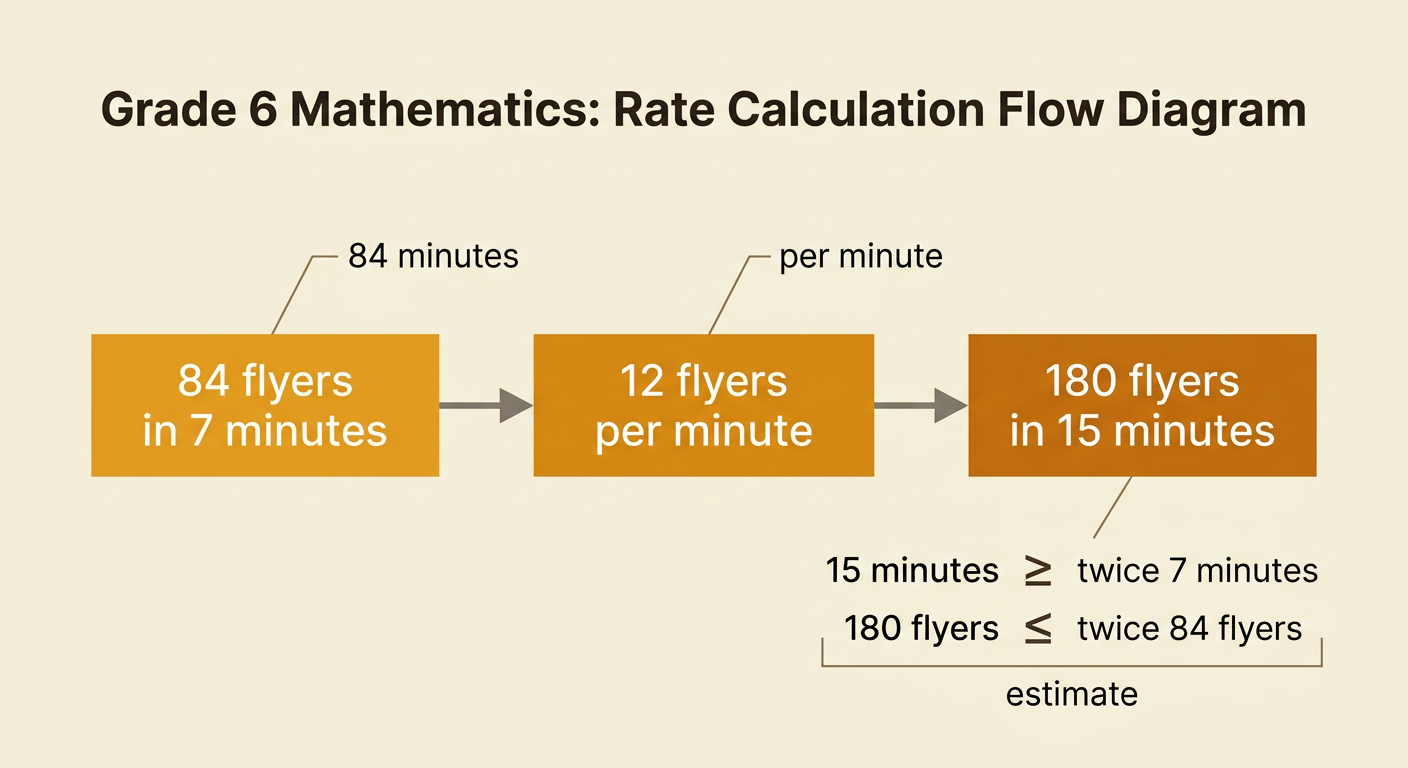
A complete solution should state the calculation, include the correct units, answer the question, and explain why the result makes sense. Suppose a printer produces 84 flyers in 7 minutes. Divide to find the unit rate: 84 flyers ÷ 7 minutes = 12 flyers per minute. At the same rate, the printer produces 12 × 15 = 180 flyers in 15 minutes. A clear explanation is: “The printer makes 12 flyers each minute, so in 15 minutes it makes 180 flyers.” Check the answer using the original relationship. Because 15 minutes is a little more than twice 7 minutes, 180 flyers should be a little more than twice 84 flyers. This estimate agrees with the calculated answer and helps show that the solution is reasonable.