Solving Systems of Linear Equations by Elimination
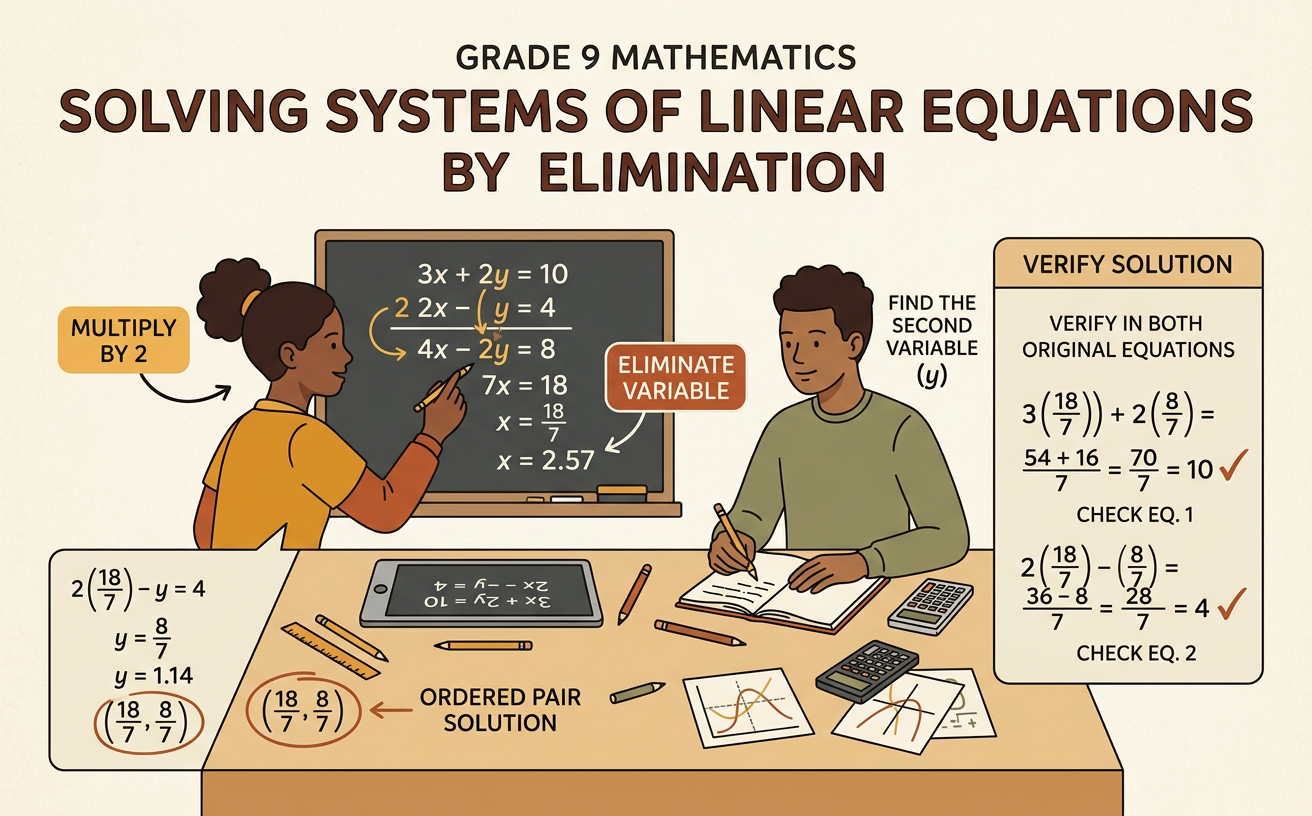
Students use elimination to solve systems of two linear equations and verify each solution in both original equations.
Illustrations are auto-generated and may be placeholders. They can be refreshed to match the narration.
Review Solutions to a System
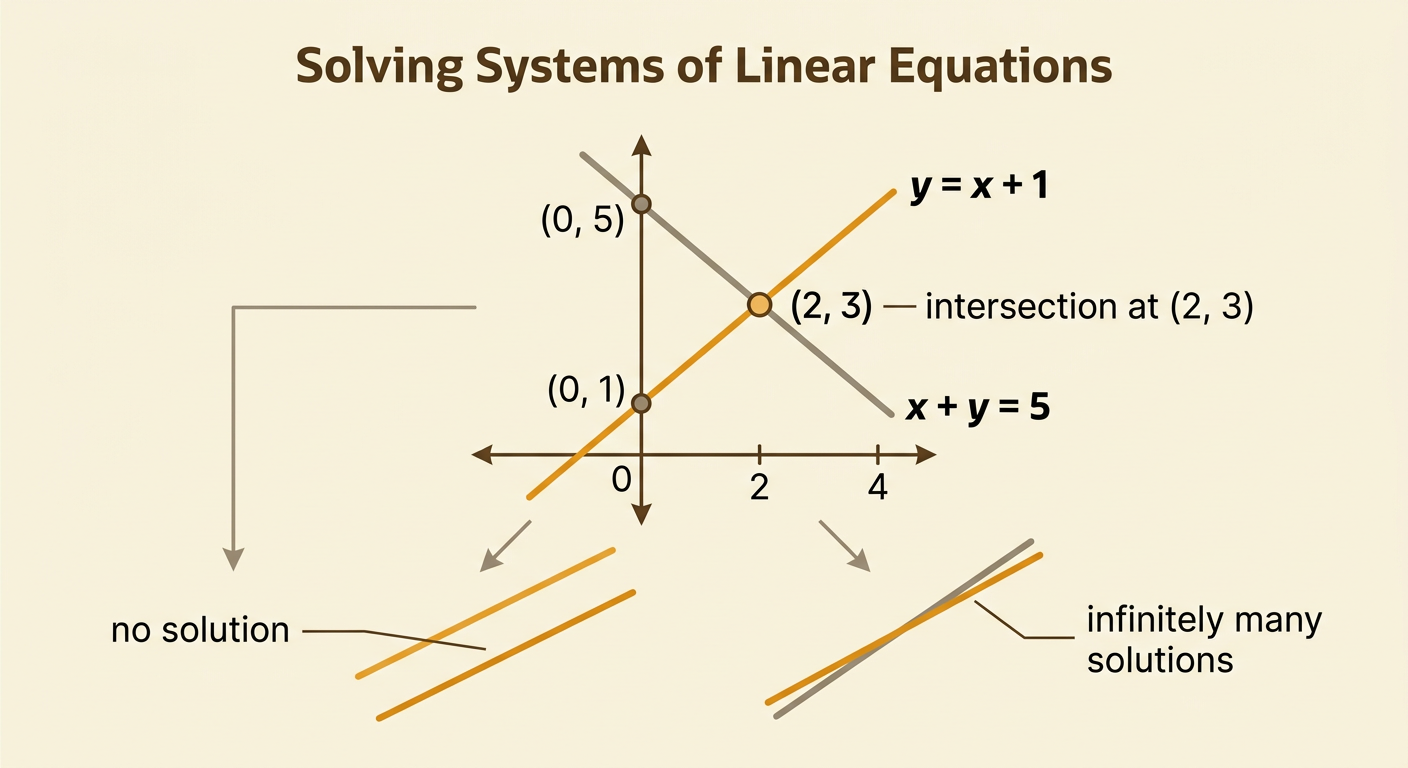
A system of linear equations contains two or more equations that use the same variables. A solution to a system is an ordered pair that makes every equation true at the same time. On a graph, the solution is the point where the lines intersect. For example, consider y = x + 1 and x + y = 5. The lines intersect at (2, 3). Check this pair in the first equation: 3 = 2 + 1, which is true. Check it in the second equation: 2 + 3 = 5, which is also true. Therefore, (2, 3) is the solution. If two lines never intersect, the system has no solution. If they are the same line, the system has infinitely many solutions.
Align Equations by Variable
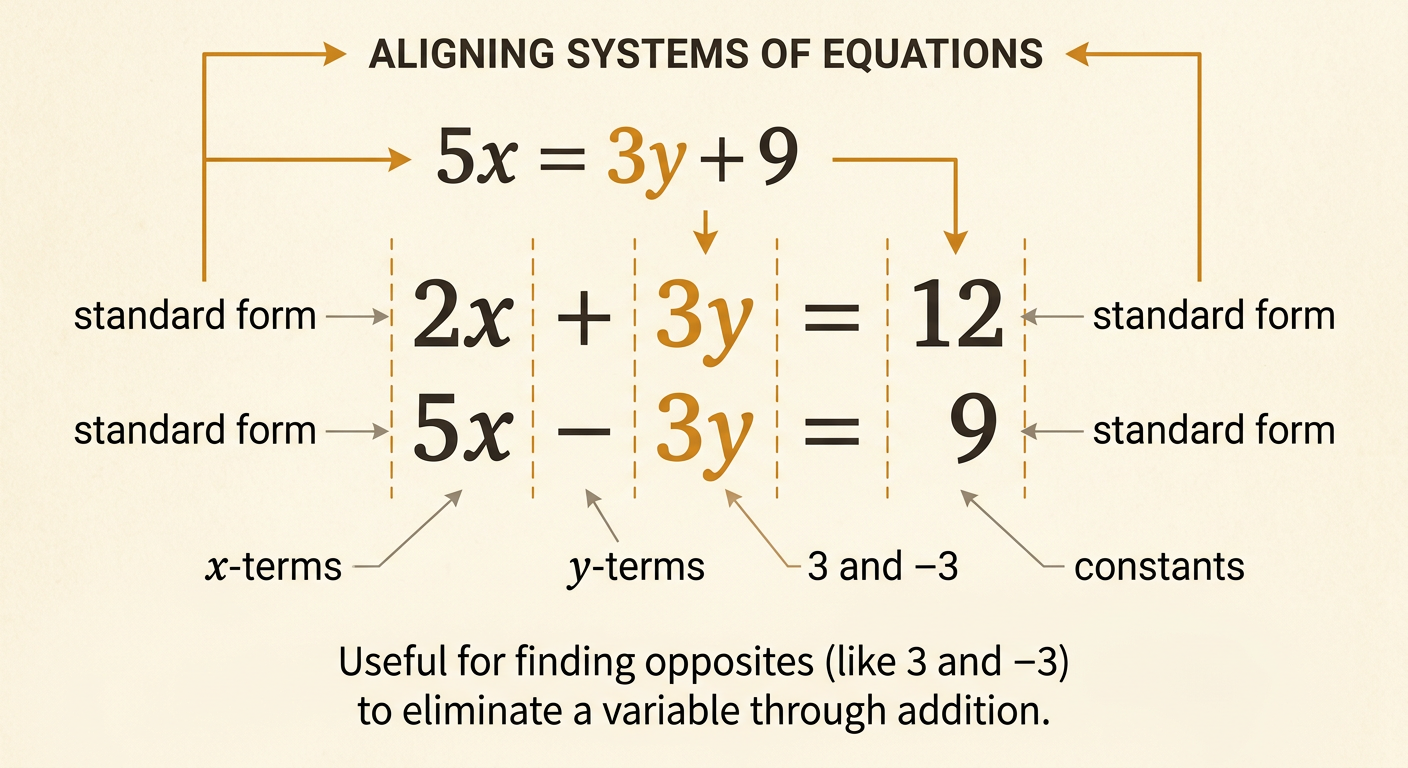
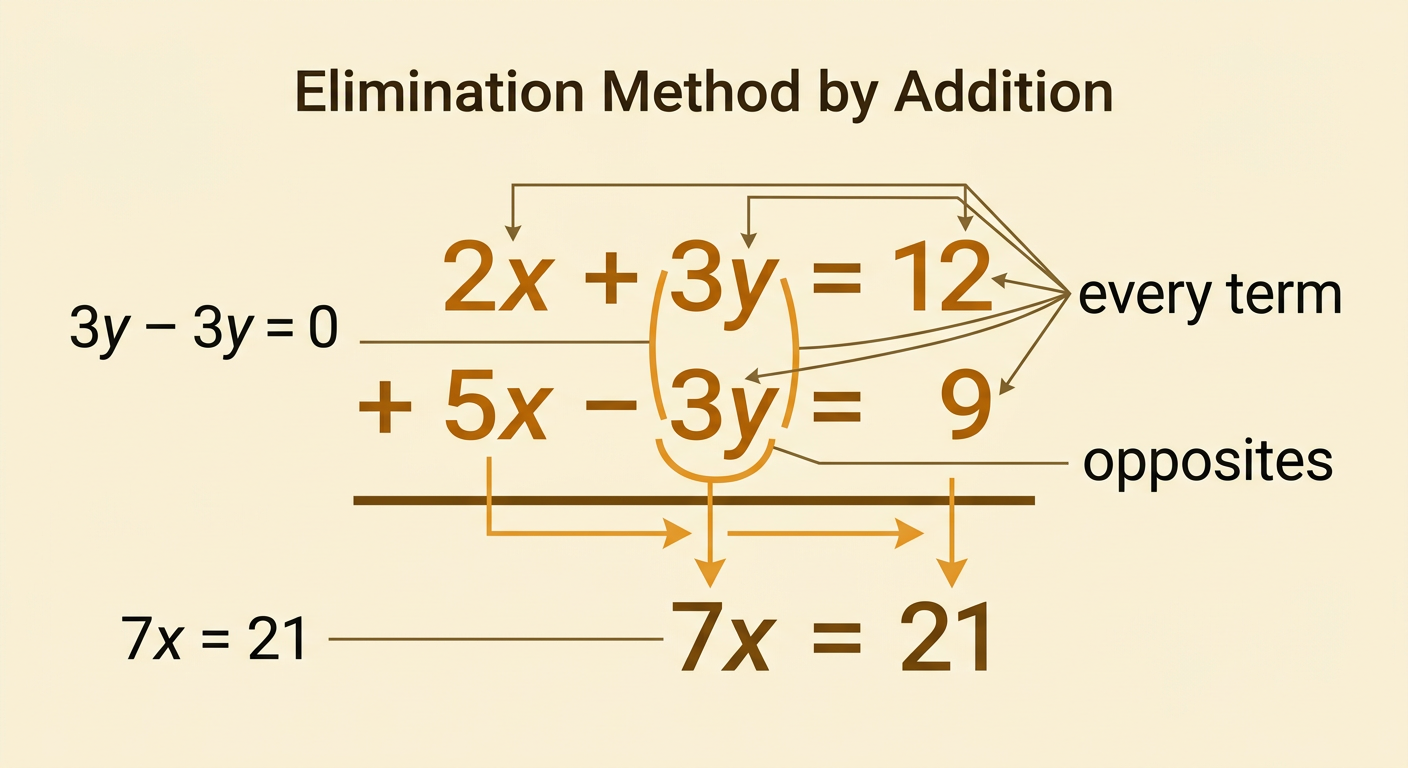
Before using elimination, write both equations in standard form, Ax + By = C. Then place like terms in vertical columns: x-terms under x-terms, y-terms under y-terms, and constants under constants. Suppose the system is 2x + 3y = 12 and 5x = 3y + 9. Rewrite the second equation by subtracting 3y from both sides, giving 5x − 3y = 9. Now the equations are aligned as 2x + 3y = 12 and 5x − 3y = 9. The coefficients of y are opposites, 3 and −3, so these terms will cancel when the equations are added. Careful alignment helps prevent combining unlike terms or losing a negative sign.
Eliminate One Variable
Elimination works by adding or subtracting equations so that one variable cancels. In the aligned system 2x + 3y = 12 and 5x − 3y = 9, the y-coefficients are opposites. Add the equations: (2x + 5x) + (3y − 3y) = 12 + 9. Because 3y − 3y equals zero, the result is 7x = 21. The variable y has been eliminated. If the coefficients are equal rather than opposite, subtract one equation from the other. If neither variable has equal or opposite coefficients, multiply one or both equations by suitable nonzero numbers first. Whatever operation is performed must apply to every term in an equation, including the constant.
Solve for the Remaining Variable
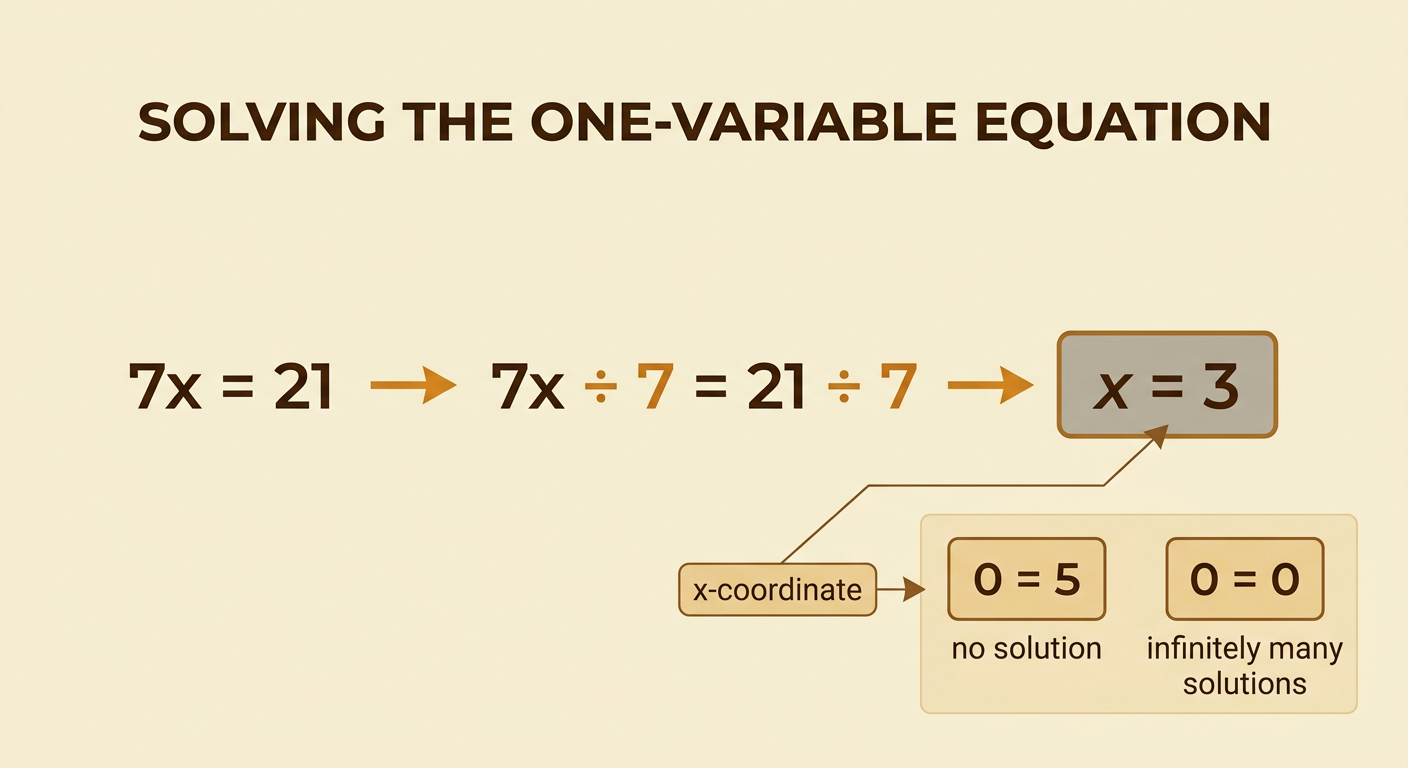
After one variable is eliminated, solve the resulting one-variable equation using inverse operations. From the example, adding the original equations produced 7x = 21. Divide both sides by 7 to isolate x: x = 3. Keep this value clearly labeled because it is only one coordinate of the system’s solution. Do not stop after finding one variable; a solution to a two-variable system normally requires both an x-value and a y-value. Also check whether the elimination step produced a special statement. A false statement, such as 0 = 5, means there is no solution. A true statement, such as 0 = 0, means the equations describe the same line and there are infinitely many solutions.
Substitute and Verify
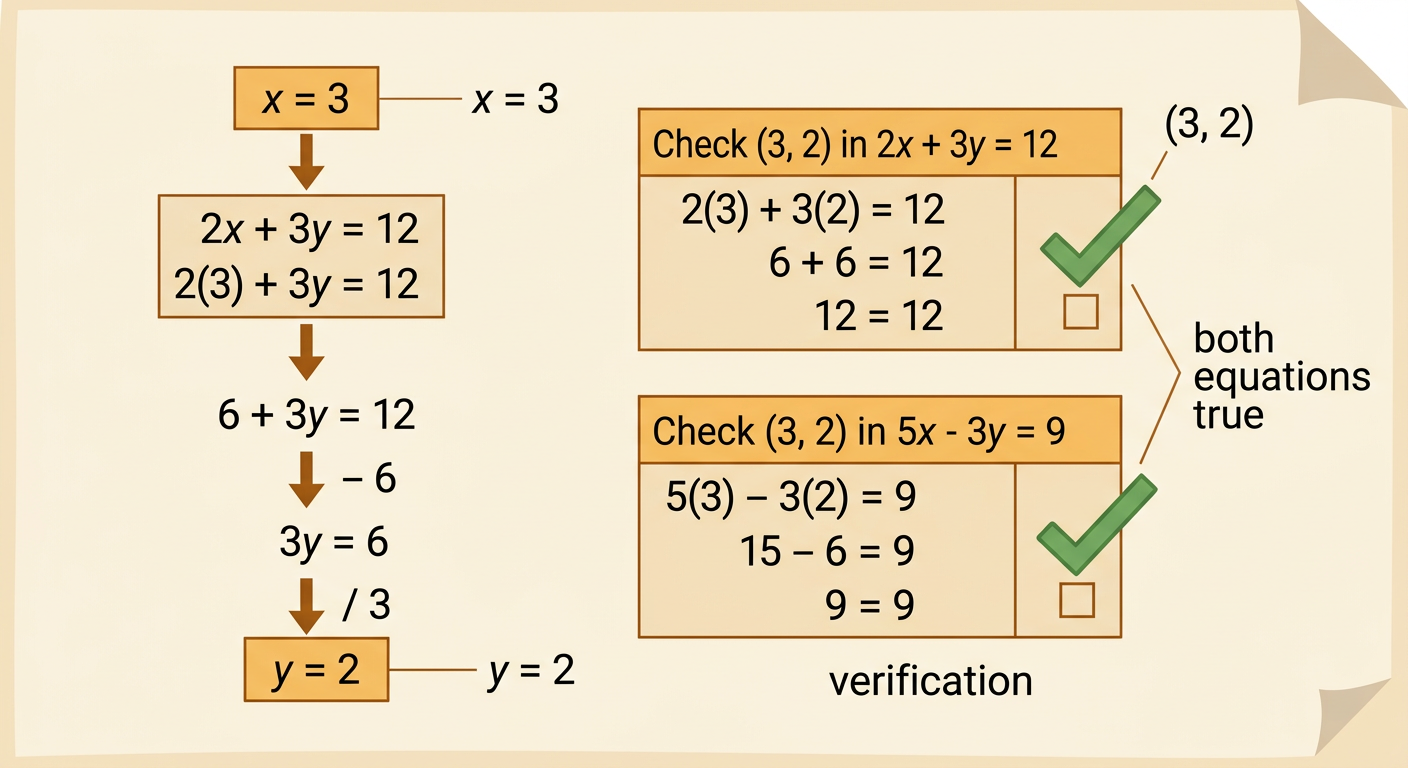
Substitute the known value into either original equation to find the other variable. Since x = 3, use 2x + 3y = 12. Substitute: 2(3) + 3y = 12. Simplify to 6 + 3y = 12, subtract 6, and divide by 3 to get y = 2. The proposed solution is (3, 2). Verify it in both original equations. In the first, 2(3) + 3(2) = 6 + 6 = 12. In the second, 5(3) − 3(2) = 15 − 6 = 9. Both statements are true, so (3, 2) is correct. Verification catches arithmetic mistakes and confirms that the ordered pair satisfies the entire system, not just one equation.
Practice with a Real-World System
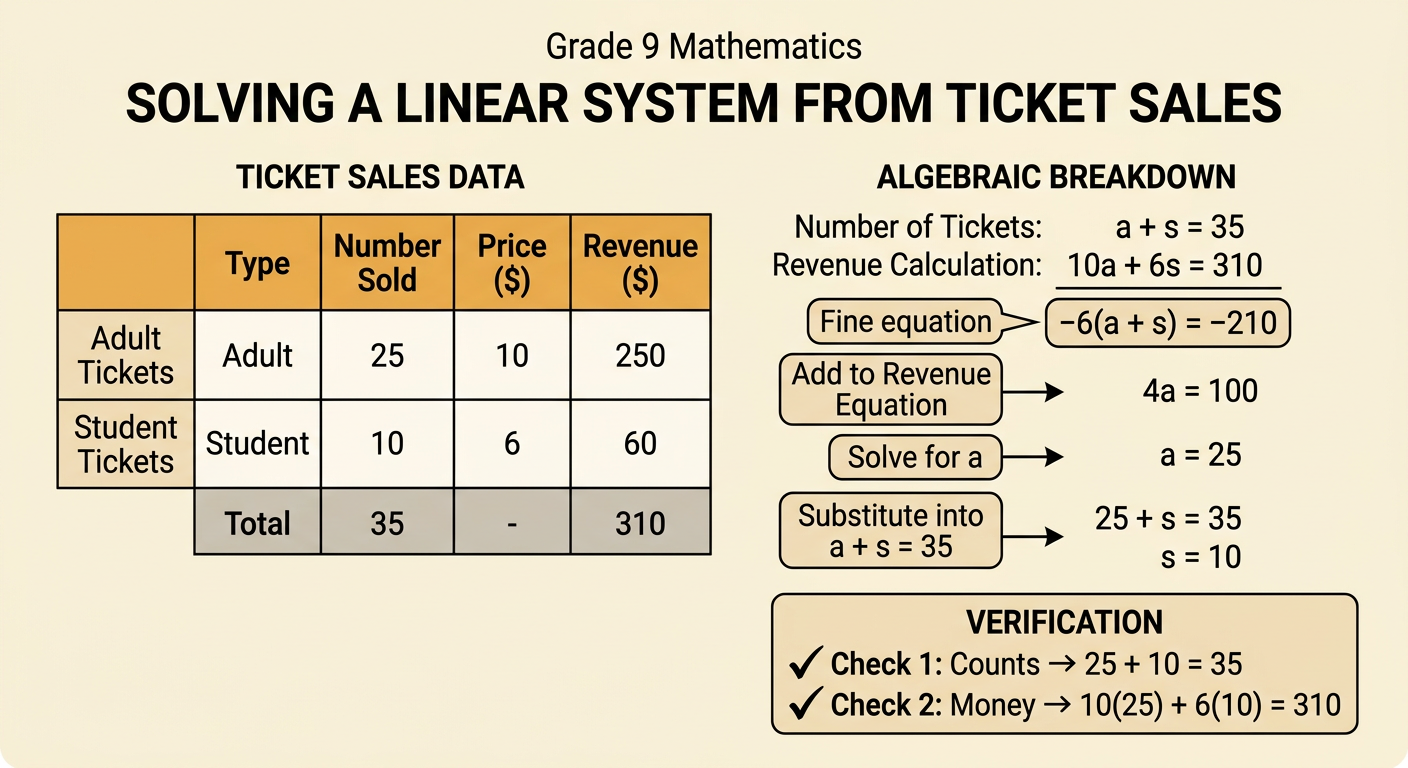
Suppose a school sells 35 event tickets. Adult tickets cost $10, student tickets cost $6, and total sales are $310. Let a represent adult tickets and s represent student tickets. The system is a + s = 35 and 10a + 6s = 310. Multiply the first equation by −6 to get −6a − 6s = −210. Add it to the second equation, producing 4a = 100, so a = 25. Substitute into a + s = 35: 25 + s = 35, so s = 10. Verify the result: 25 + 10 = 35 tickets, and 10(25) + 6(10) = 250 + 60 = 310 dollars. Therefore, the school sold 25 adult tickets and 10 student tickets.