Solving Systems of Linear Equations by Elimination
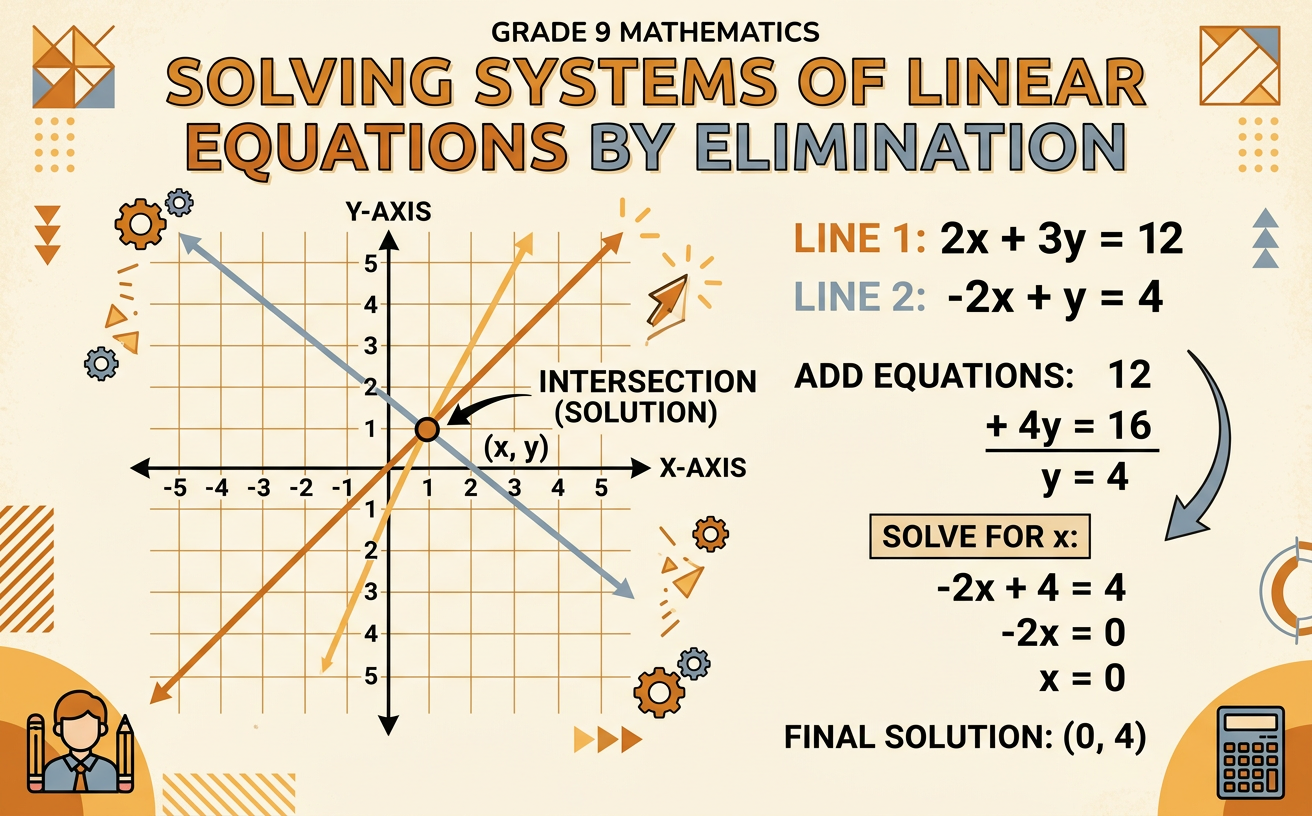
Students use elimination to solve pairs of linear equations and interpret the solution as the intersection of two lines.
Illustrations are auto-generated and may be placeholders. They can be refreshed to match the narration.
Reviewing Systems and Solutions
A system of linear equations is a set of two or more equations considered at the same time. For a system with two variables, a solution is an ordered pair that makes every equation true. Consider y = x + 1 and y = −2x + 7. The ordered pair (2, 3) satisfies both equations because 3 = 2 + 1 and 3 = −2(2) + 7. On a coordinate plane, each equation represents a line. The point where the lines intersect represents the shared solution. A system may have one solution if the lines intersect once, no solution if the lines are parallel, or infinitely many solutions if the equations describe the same line. Elimination is one exact method for finding that shared solution without first graphing.
Aligning the Equations
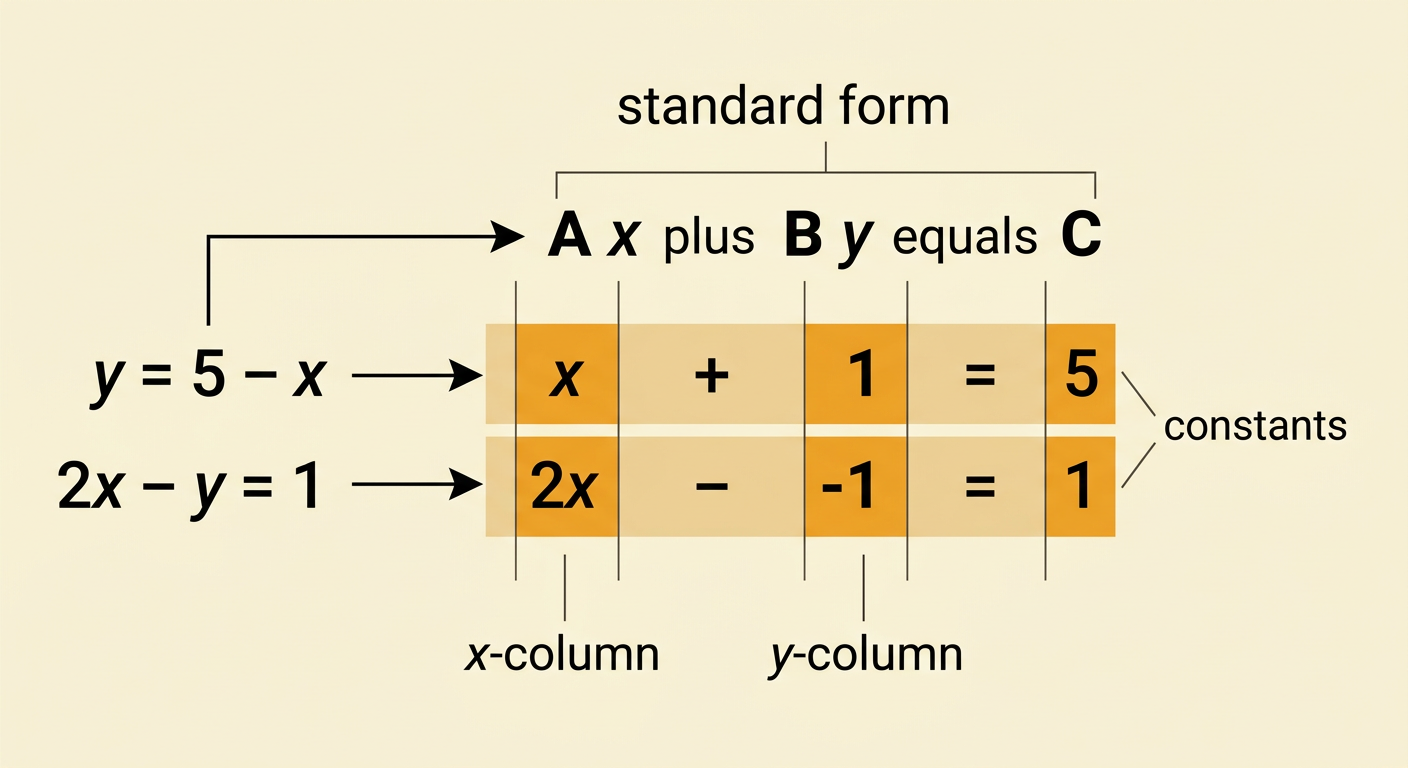
Before using elimination, write both equations so matching variables and constants form vertical columns. A useful arrangement is standard form, Ax + By = C. For example, suppose the system is y = 5 − x and 2x − y = 1. Rewrite the first equation by adding x to both sides, producing x + y = 5. Place it above 2x − y = 1 so the x-terms, y-terms, equal signs, and constants line up. Keep each positive or negative sign attached to its term. The aligned system is x + y = 5 and 2x − y = 1. Because the coefficients of y are 1 and −1, the y-terms are opposites. This alignment makes it easy to see that adding the equations will eliminate y.
Eliminating One Variable
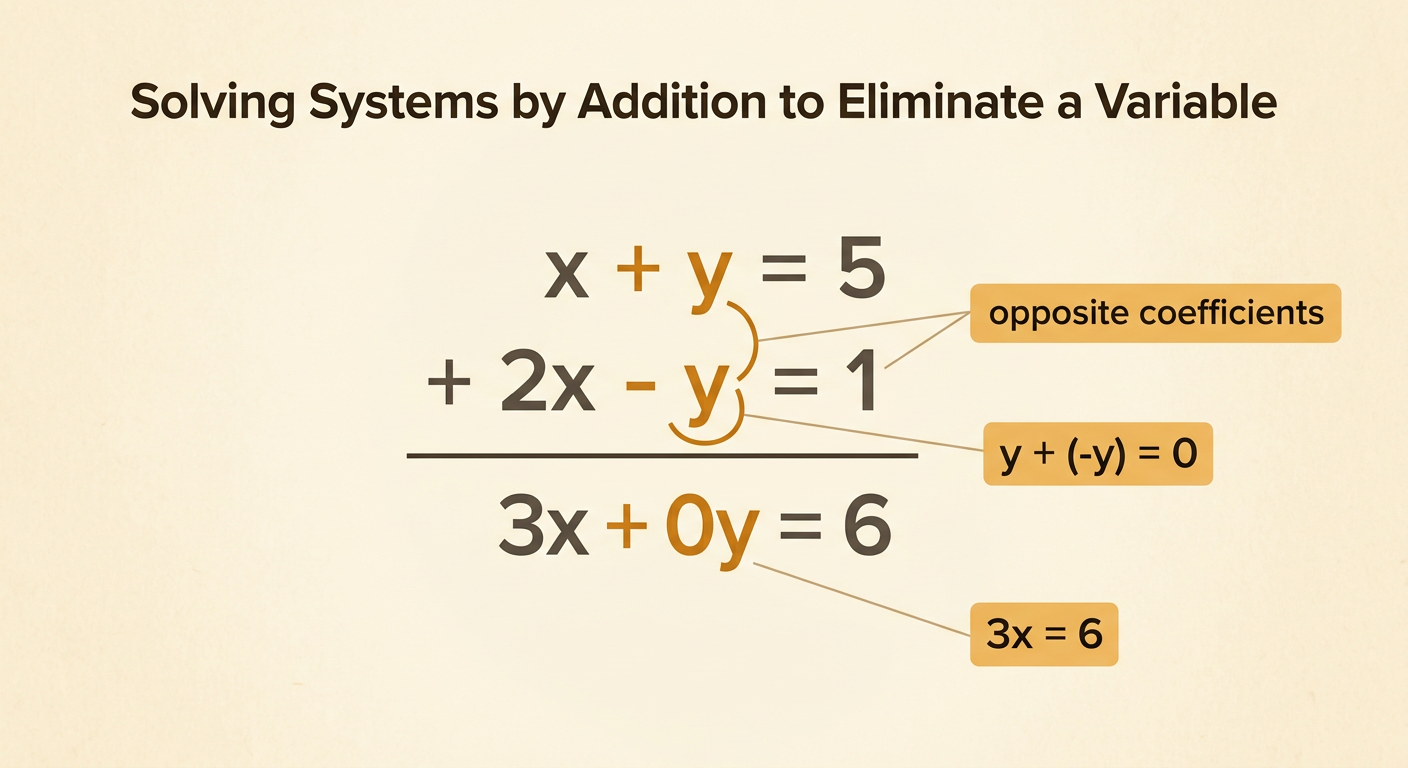
To eliminate a variable, add or subtract the equations so one pair of variable terms cancels. In the aligned system x + y = 5 and 2x − y = 1, the y-coefficients are opposites. Add the left sides and add the right sides: (x + y) + (2x − y) = 5 + 1. Combine like terms to get 3x + 0y = 6, or simply 3x = 6. The y-terms disappear because y + (−y) = 0. If a system does not already contain opposite coefficients, multiply one or both entire equations by suitable nonzero numbers first. Every term on both sides must be multiplied. The goal is to create equal coefficients with opposite signs so addition removes one variable while preserving the system’s solutions.
Solving for the Remaining Variable
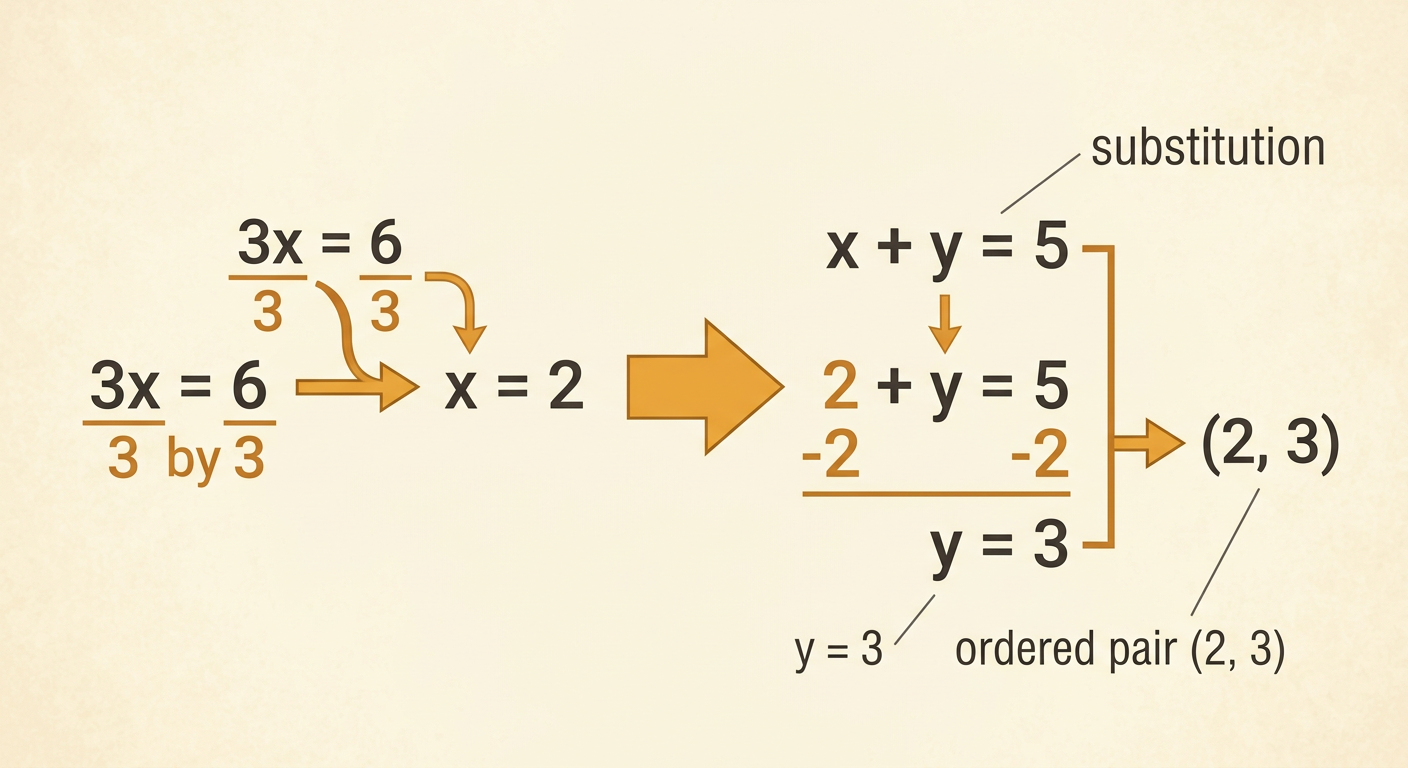
After one variable is eliminated, solve the resulting one-variable equation. From 3x = 6, divide both sides by 3 to find x = 2. Next, use this value in either original equation to find the other coordinate. Substituting x = 2 into x + y = 5 gives 2 + y = 5. Subtract 2 from both sides to obtain y = 3. Therefore, the possible solution is the ordered pair (2, 3). Write x first and y second because ordered-pair position matters. You could instead substitute x = 2 into 2x − y = 1: 4 − y = 1 also gives y = 3. Choosing the equation with simpler coefficients often reduces arithmetic and makes errors less likely.
Checking the Ordered-Pair Solution
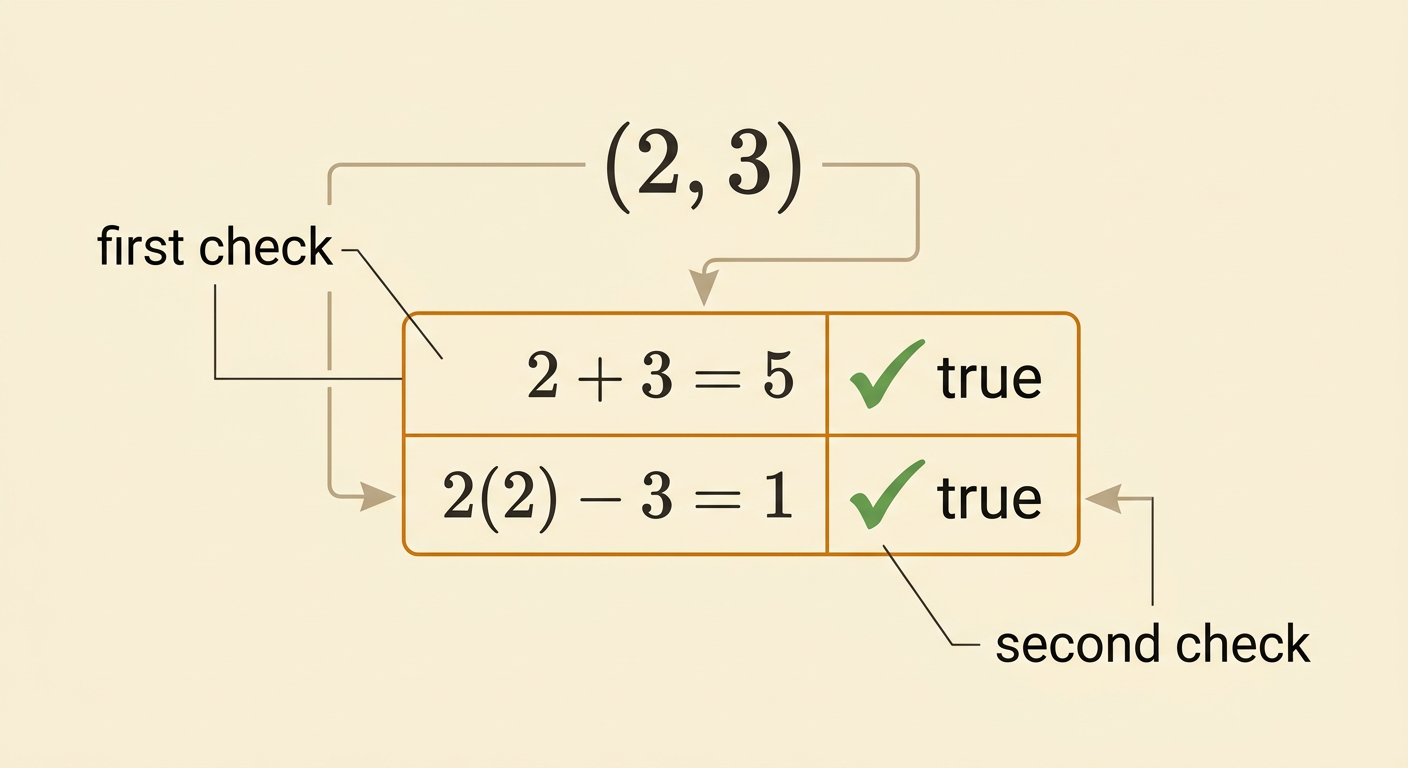
Always check the ordered pair in both original equations, not only in the equation used for substitution. For the system x + y = 5 and 2x − y = 1, test (2, 3). In the first equation, replace x with 2 and y with 3: 2 + 3 = 5, which is true. In the second equation, substitute the same values: 2(2) − 3 = 1, so 4 − 3 = 1, which is also true. Because both statements are true, (2, 3) is the solution to the system. If either check is false, the ordered pair is not a solution. Recheck signs, multiplication, addition, and substitution steps to locate the error. Verification is especially important when negative numbers or fractions appear.
Interpreting the Intersection
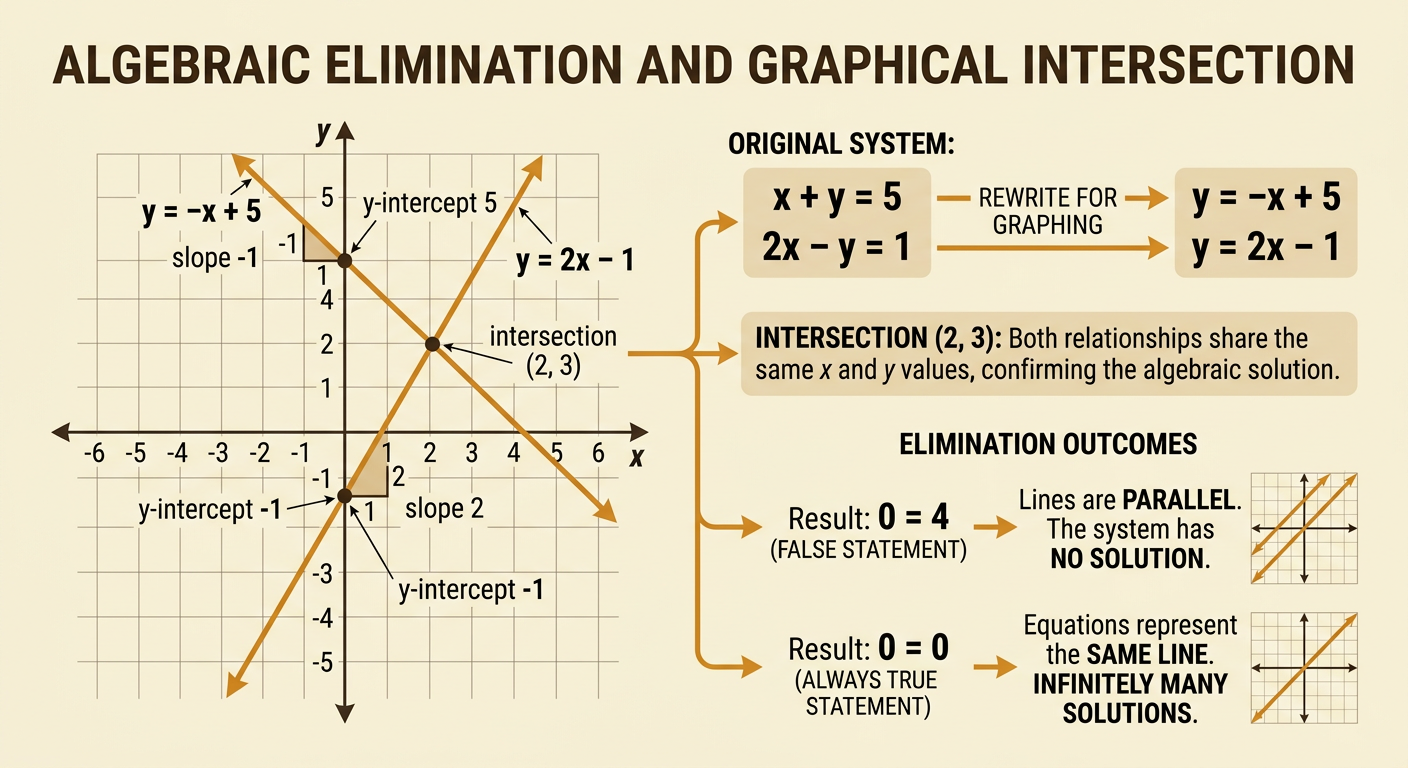
The solution found by elimination also has a graphical meaning. Rewrite x + y = 5 as y = −x + 5 and rewrite 2x − y = 1 as y = 2x − 1. When graphed, the first line has slope −1 and y-intercept 5, while the second has slope 2 and y-intercept −1. The lines meet at (2, 3), matching the solution found algebraically. At this point, both relationships have the same x-value and y-value. Elimination identifies this intersection exactly, even when estimating it from a graph would be difficult. If elimination produces a false statement such as 0 = 4, the lines are parallel and there is no solution. If it produces a true identity such as 0 = 0, the lines coincide and there are infinitely many solutions.