
Solving Systems of Linear Equations
Students solve pairs of linear equations using graphing, substitution, and elimination while interpreting one, none, or infinitely many solutions.
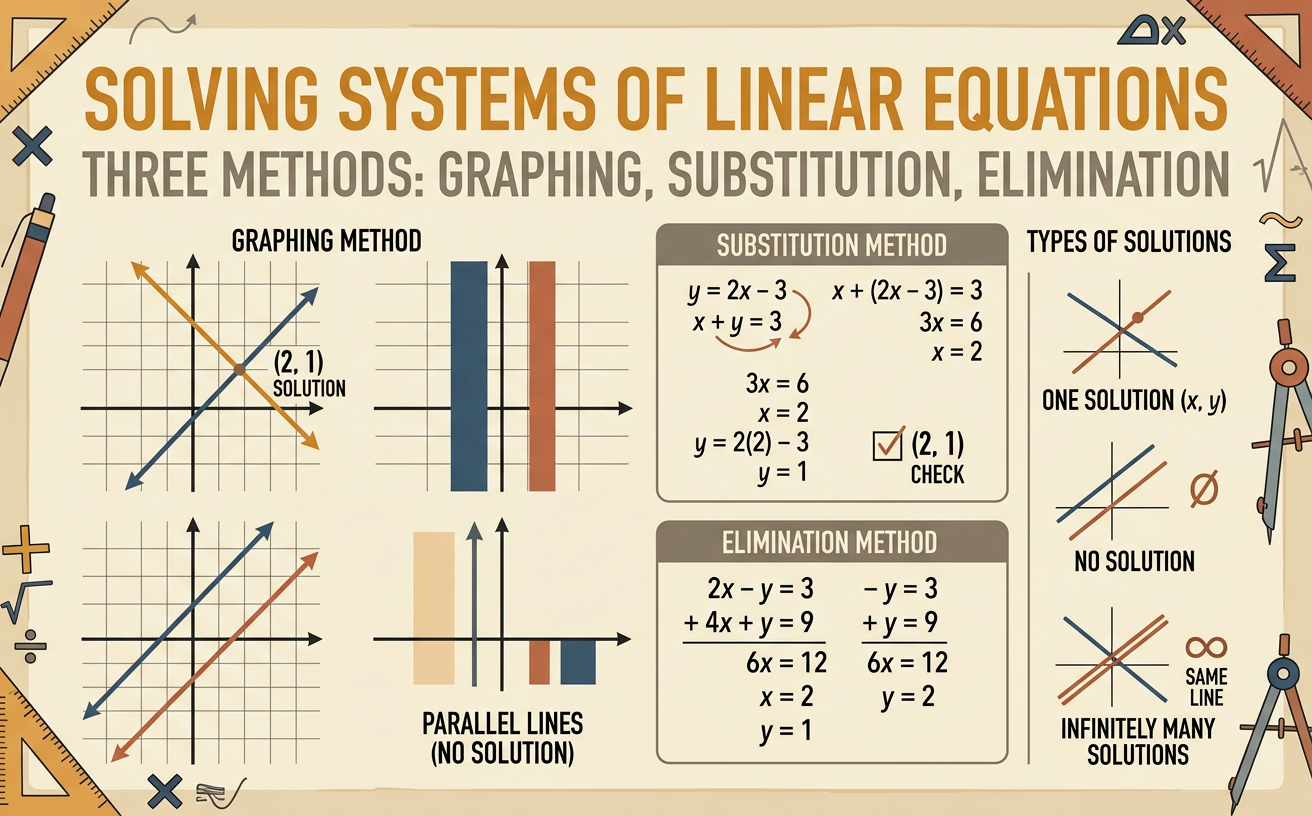
Illustrations are auto-generated and may be placeholders. They can be refreshed to match the narration.
Solutions as Intersections
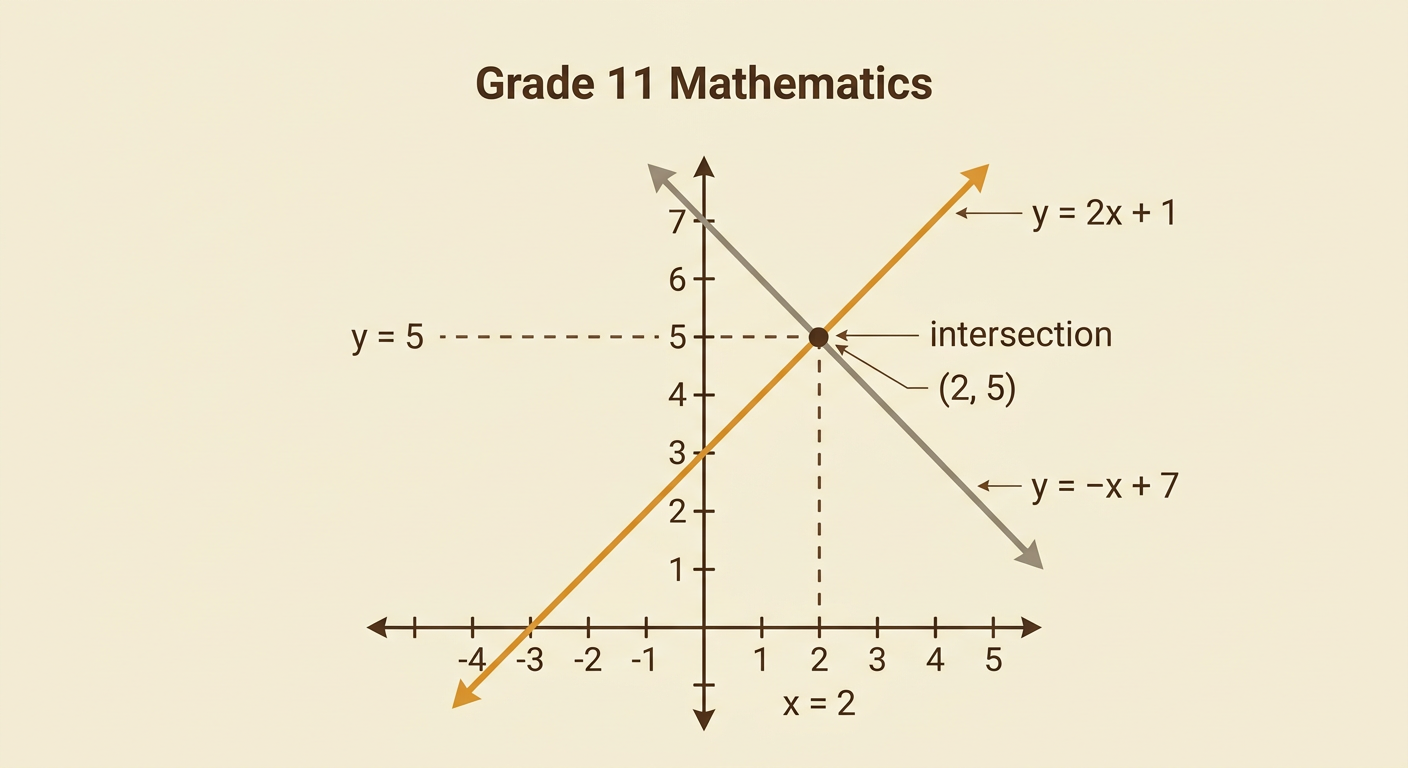
A system of linear equations contains two or more equations considered at the same time. For a pair of equations in two variables, a solution is an ordered pair that makes both equations true. On a coordinate plane, each equation forms a line, so a shared solution appears where the lines intersect. Consider y = 2x + 1 and y = −x + 7. The lines intersect at (2, 5). Substituting x = 2 and y = 5 into the first equation gives 5 = 2(2) + 1. Substitution into the second gives 5 = −2 + 7. Both statements are true, so (2, 5) solves the system. The intersection connects the algebraic meaning of a shared solution with its graphical representation.
Solving by Graphing
To solve a system by graphing, draw both equations on the same coordinate plane and identify their intersection. Rewrite each equation in a form that is easy to graph, such as y = mx + b, where m is the slope and b is the y-intercept. For example, graph y = 0.5x + 1 and y = −x + 4. The first line has a y-intercept of 1 and a slope of 0.5. The second has a y-intercept of 4 and a slope of −1. The lines intersect at (2, 2), so x = 2 and y = 2 solve the system. Graphing can provide an exact answer when the intersection is clear, but it may provide only an approximate answer when the coordinates are not integers or the graph has limited precision.

Solving by Substitution
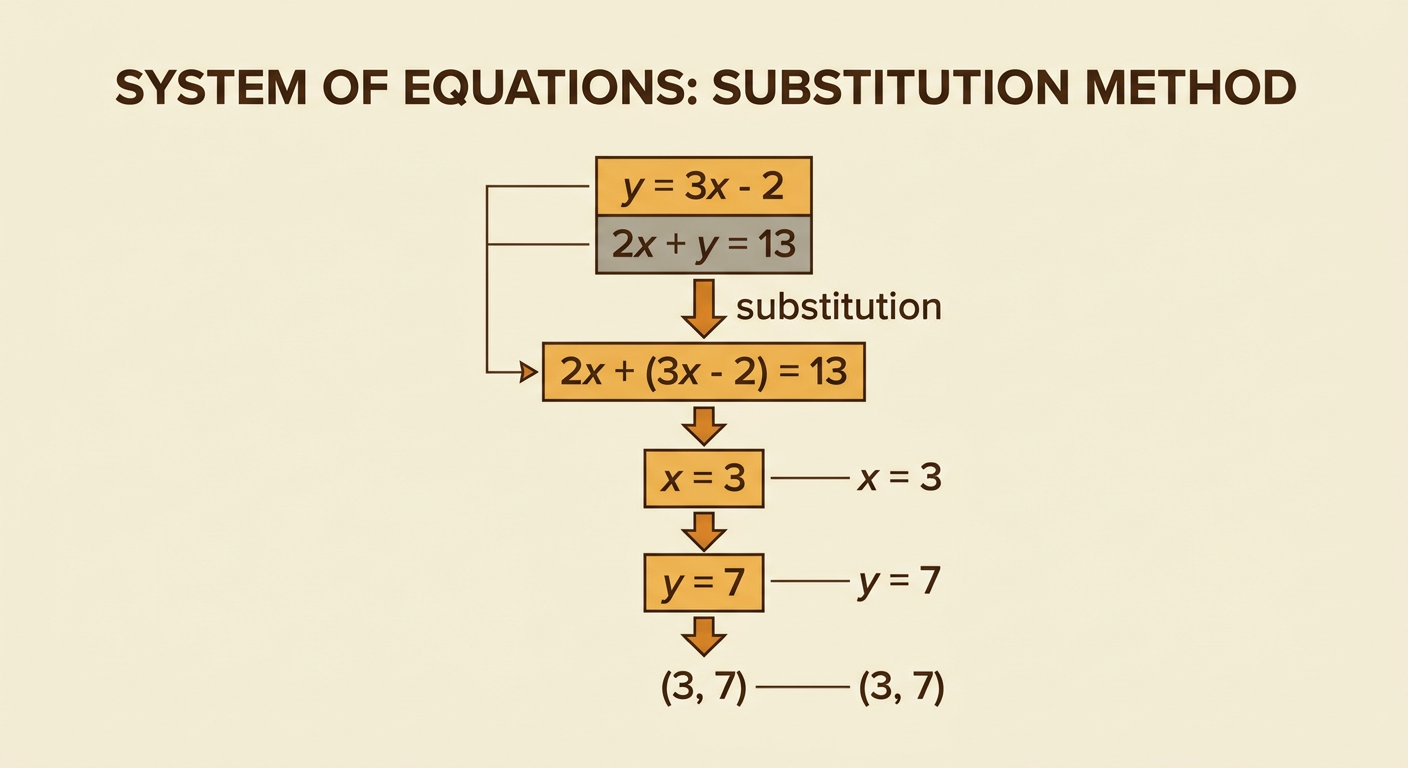
Substitution works well when one equation is already solved for a variable or can be rearranged easily. First, replace that variable in the other equation with its equivalent expression. Then solve the resulting equation with one variable. Consider y = 3x − 2 and 2x + y = 13. Substitute 3x − 2 for y in the second equation: 2x + (3x − 2) = 13. Combining like terms gives 5x − 2 = 13, so 5x = 15 and x = 3. Return to y = 3x − 2 and substitute 3 for x: y = 3(3) − 2 = 7. Therefore, the solution is (3, 7). Substitution preserves equality because the expression 3x − 2 has the same value as y.
Solving by Elimination
Elimination combines equations to remove one variable. Write the equations with like terms aligned, and add or subtract them. If the coefficients are not opposites, multiply one or both equations by a suitable number first. For example, consider x + y = 7 and 2x − y = 2. The coefficients of y are opposites, so add the equations. This gives 3x = 9 because y + (−y) = 0. Therefore, x = 3. Substitute x = 3 into x + y = 7 to get 3 + y = 7, so y = 4. The solution is (3, 4). Multiplying an equation by a nonzero number or adding equal quantities preserves its solution set, which is why elimination produces an equivalent and simpler equation.

Classifying Solution Types
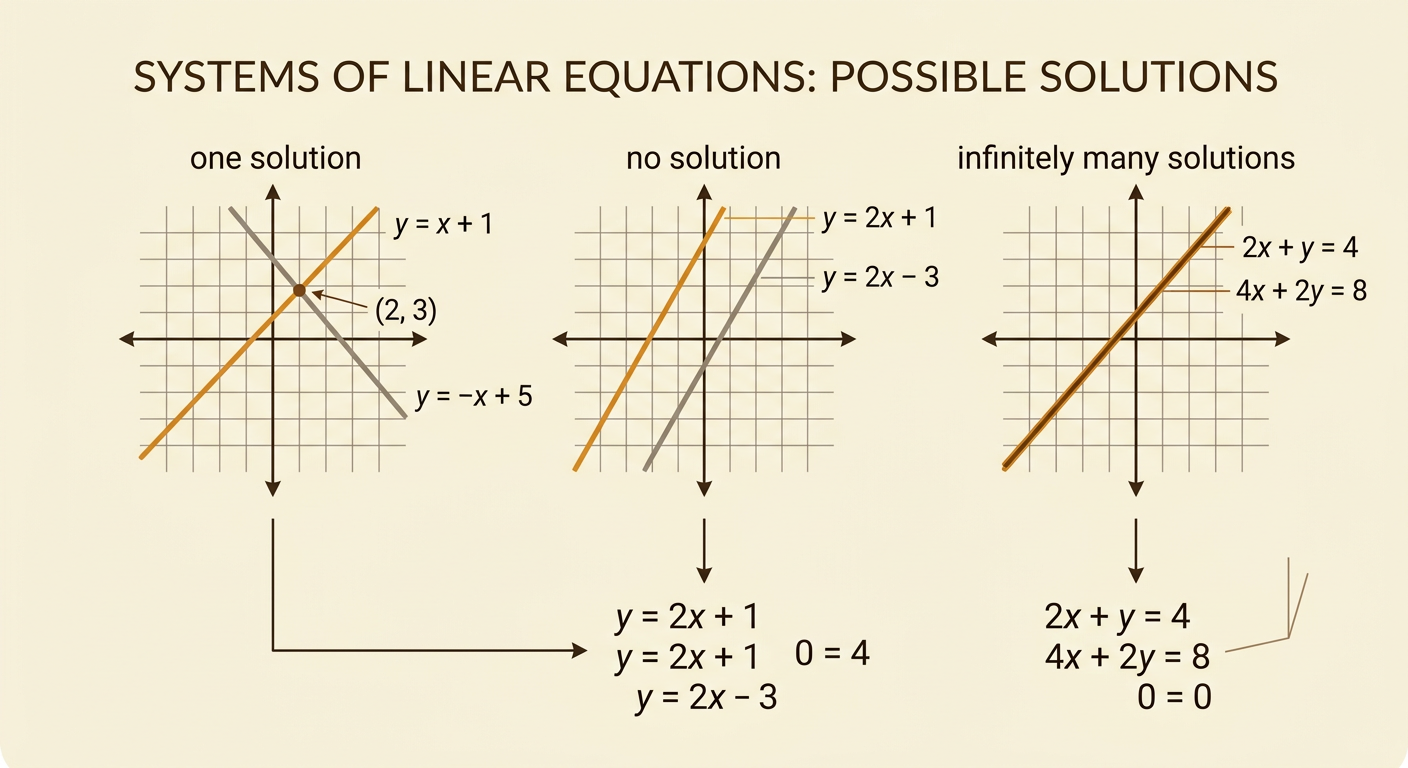
A system of two linear equations can have one solution, no solution, or infinitely many solutions. Different slopes produce lines that intersect once, giving one solution. For example, y = x + 1 and y = −x + 5 meet at (2, 3). Lines with the same slope but different y-intercepts are parallel and never meet. Thus, y = 2x + 1 and y = 2x − 3 have no solution. Equations that describe the same line have every point in common and therefore infinitely many solutions. For example, 2x + y = 4 and 4x + 2y = 8 are equivalent because the second equation is twice the first. Algebraically, elimination may produce a true statement such as 0 = 0 for infinitely many solutions or a false statement such as 0 = 4 for no solution.
Checking and Interpreting Solutions
After solving a system, substitute the ordered pair into both original equations. A correct solution must make both equations true. Then interpret the values according to the situation and check that they are reasonable. Suppose a school sold 120 event tickets. Adult tickets cost $8, student tickets cost $5, and total sales were $750. Let a represent adult tickets and s represent student tickets. The system is a + s = 120 and 8a + 5s = 750. Solving gives a = 50 and s = 70. Check the number of tickets: 50 + 70 = 120. Check the revenue: 8(50) + 5(70) = 400 + 350 = 750. Both equations are satisfied. In context, the solution means the school sold 50 adult tickets and 70 student tickets.
