
Solving Two-Step Word Problems
Students solve two-step word problems by identifying the needed operations, writing an equation with a letter for the unknown, and checking whether the answer is reasonable.
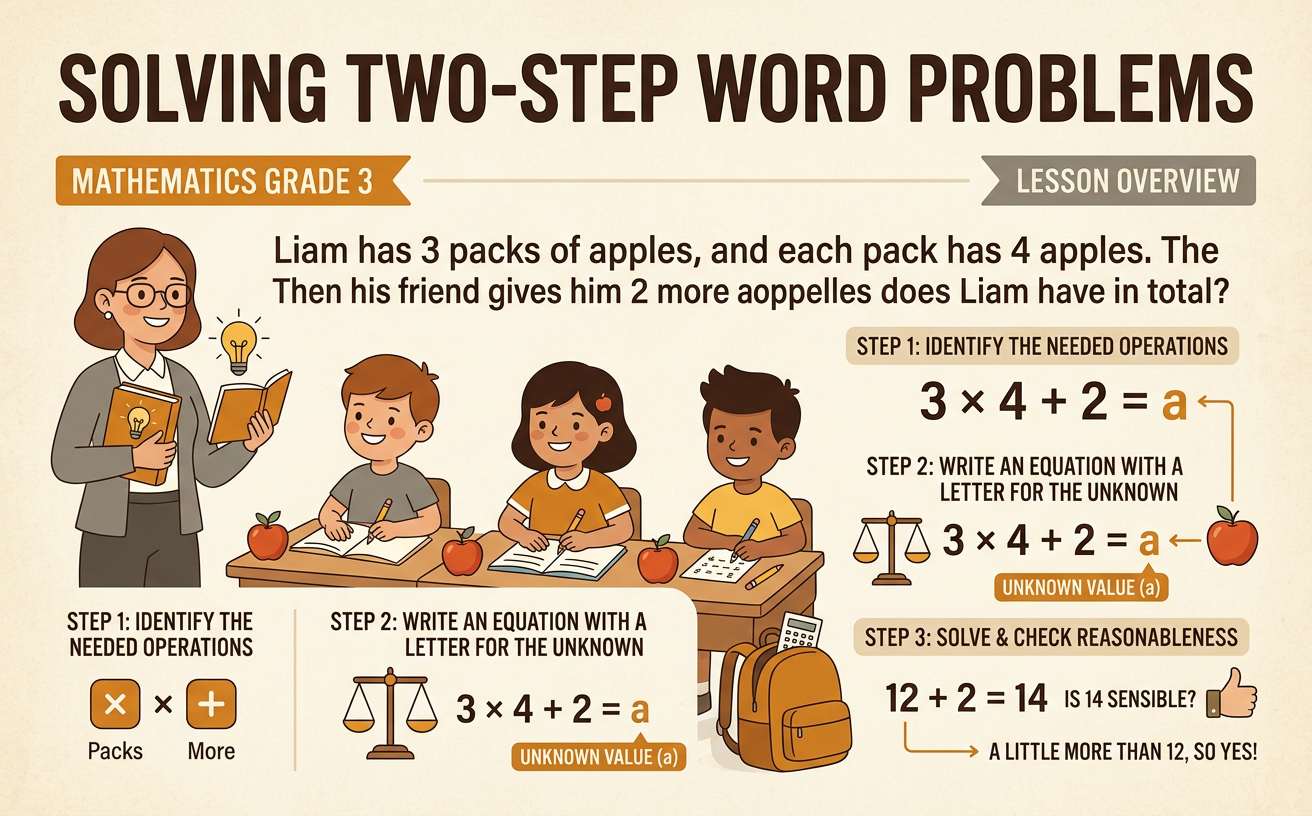
Illustrations are auto-generated and may be placeholders. They can be refreshed to match the narration.
Identify the Question and Key Information
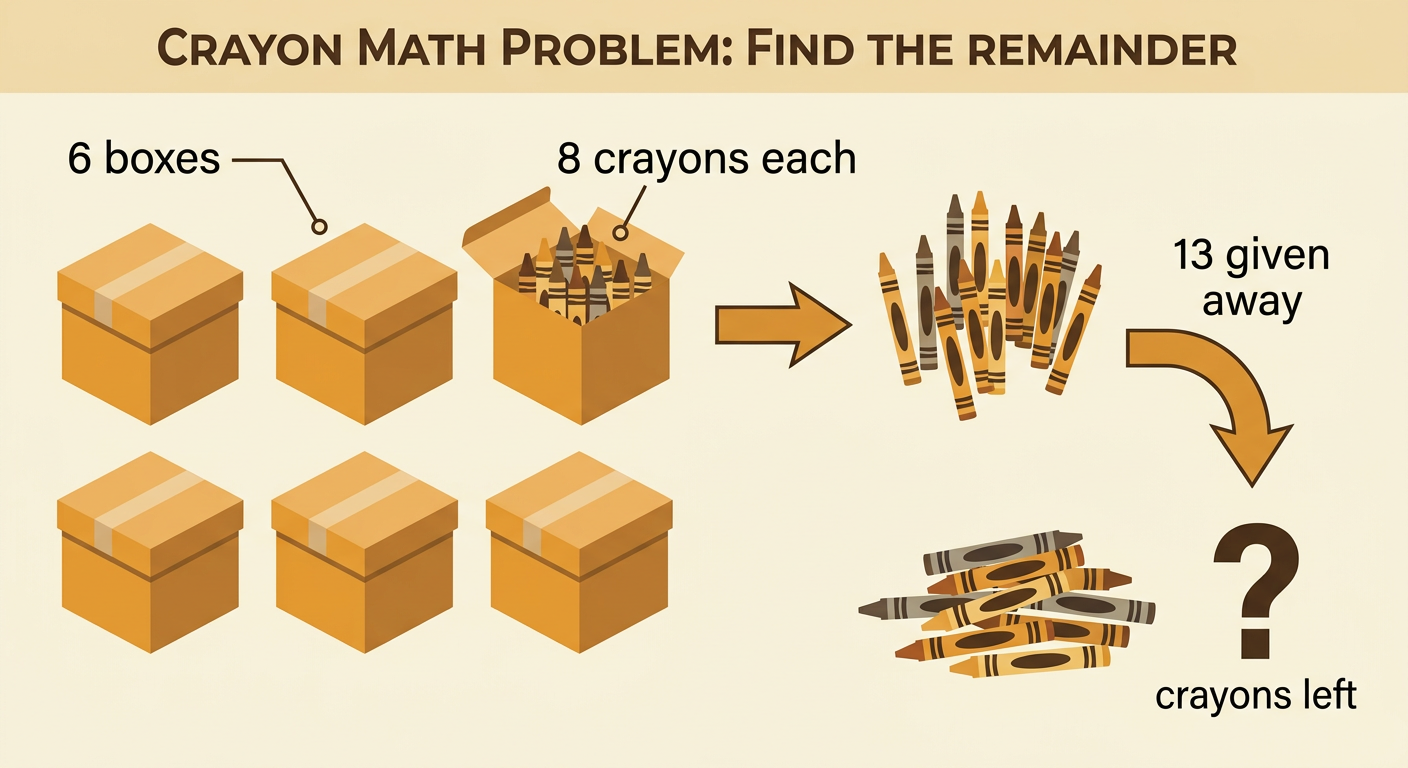
Begin by reading the entire problem and finding what it asks you to discover. Then identify the numbers and facts needed to answer that question. For example: A teacher has 6 boxes of crayons. Each box holds 8 crayons. She gives 13 crayons to students. How many crayons are left? The question asks how many crayons remain, so the answer must be a number of crayons. The key information is that there are 6 equal groups of 8 crayons and then 13 crayons are given away. Notice the order of events: first the teacher has all the crayons in the boxes, and then some are removed. Restating the problem in your own words can help you understand what must happen in each step.
Choose Operations for Each Step
A two-step problem requires two operations. Think about what happens first and what happens next. In the crayon problem, there are 6 equal boxes with 8 crayons in each box. Equal groups suggest multiplication, so the first operation is 6 times 8. This finds the total number of crayons before any are given away. Next, the teacher gives away 13 crayons. Giving away means the amount becomes smaller, so the second operation is subtraction. The plan is multiply first, then subtract. Ask yourself what each operation finds. Multiplication finds the starting total, and subtraction finds how many remain. Choosing operations from the meaning of the story is more reliable than choosing an operation just because you see certain numbers.

Write an Equation with an Unknown
An equation represents the steps of the story with numbers, operation symbols, and a letter for the unknown quantity. Let c stand for the number of crayons left. The equation for the problem is c = (6 × 8) − 13. The expression inside parentheses shows the first step: multiply 6 by 8 to find the total number of crayons in the boxes. Subtracting 13 shows the second step: remove the crayons given to students. The letter c is helpful because the number of crayons left is not known yet. You could also write (6 × 8) − 13 = c. Both equations have the same meaning. Always explain what the letter represents so the equation connects clearly to the question in the word problem.

Solve the Two-Step Problem
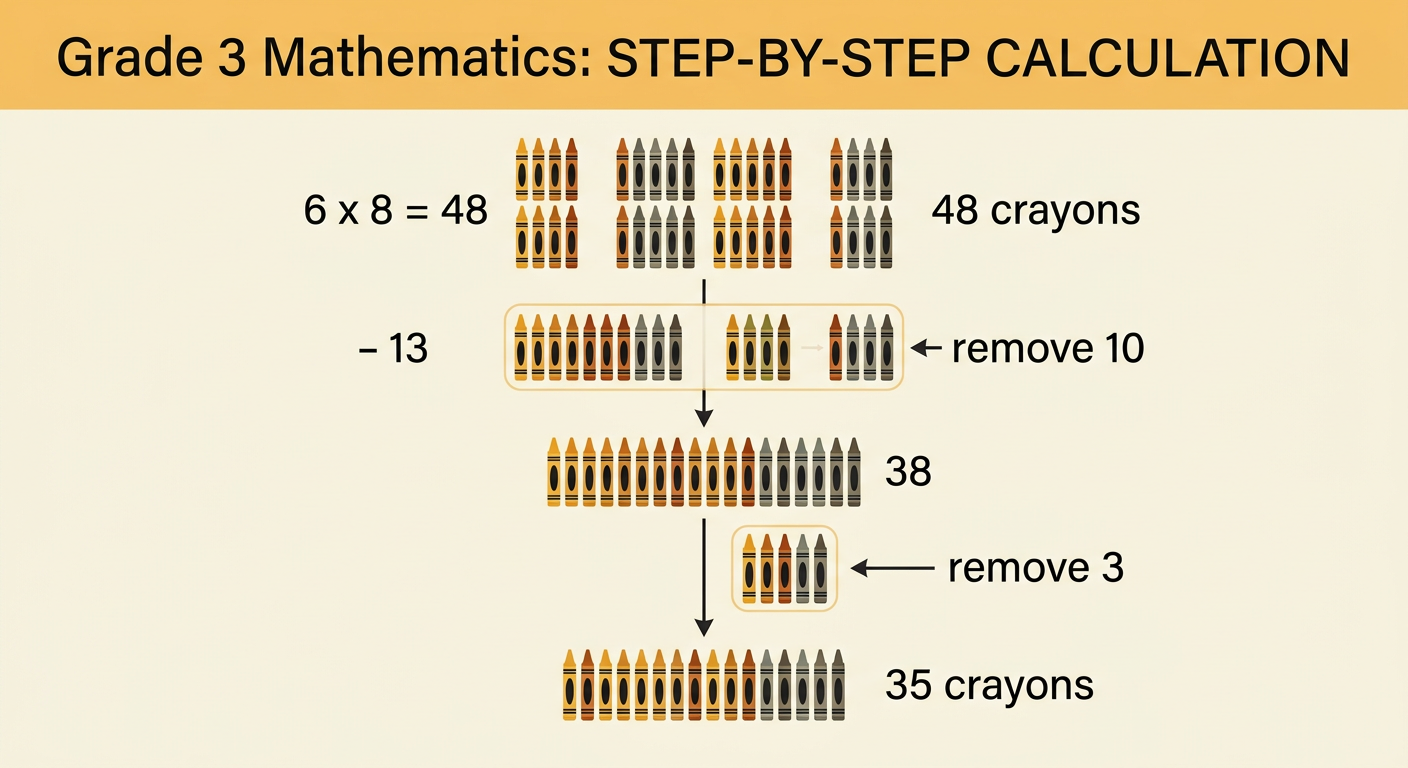
Solve the equation one step at a time and keep the steps in the correct order. Start with the multiplication inside the parentheses: 6 × 8 = 48. This means the teacher begins with 48 crayons in all. Next, subtract the 13 crayons that she gives away: 48 − 13 = 35. One way to subtract is to remove 10 first and then remove 3. From 48, subtracting 10 gives 38, and subtracting 3 more gives 35. Therefore, c = 35. Write the answer with its unit: 35 crayons are left. Including the unit matters because it tells what the number means. Finally, reread the question to make sure the answer gives the amount that was requested.
Check Whether the Answer Is Reasonable
A reasonable answer makes sense for the numbers and actions in the problem. Use estimation to check the result. The first step gives 48 crayons. Round 48 to 50 and round 13 to 10. Then estimate 50 − 10 = 40. The exact answer, 35, is close to the estimate of 40, so it is reasonable. Also think about the story. Because 13 crayons were given away, the answer must be less than 48. The answer 35 passes that check. You can also use the opposite operation: 35 + 13 = 48. This confirms that subtracting 13 from 48 was correct. Estimation does not always give the exact answer, but it helps you notice answers that are much too large, much too small, or impossible.
