
Sorting Solids by Their Properties
Students observe, describe, and sort familiar solid materials by properties such as color, texture, hardness, and flexibility.

Illustrations are auto-generated and may be placeholders. They can be refreshed to match the narration.
Meet the Mystery Objects
Imagine a tray holding a wooden block, a metal spoon, a rubber eraser, a plastic lid, and a soft sponge. These objects are all solids. A solid keeps its own shape unless we bend, cut, squeeze, or break it. We can investigate the objects to find out how they are alike and different. First, look at each object without sorting it. What do you notice? The wooden block and spoon may both feel hard, but they are made of different materials. The eraser and sponge can both be squeezed, but the sponge changes shape more easily. Our question is: How can we sort these solid objects by properties we can observe?

Observe with Our Senses
Scientists gather evidence by making careful observations. We can use our eyes to notice color, shape, size, and shine. We can use our hands to feel texture and to test whether an object is stiff, bendable, soft, or hard. Handle each object gently and safely. Do not taste any classroom material. You might observe that the metal spoon is shiny, smooth, and stiff. The sponge may look yellow, feel rough, and squash when you press it. Listen when you gently tap an object on the table. A wooden block and a sponge may make different sounds. Record what you observe instead of guessing. Careful observations give us evidence for sorting the objects later.

Name Material Properties
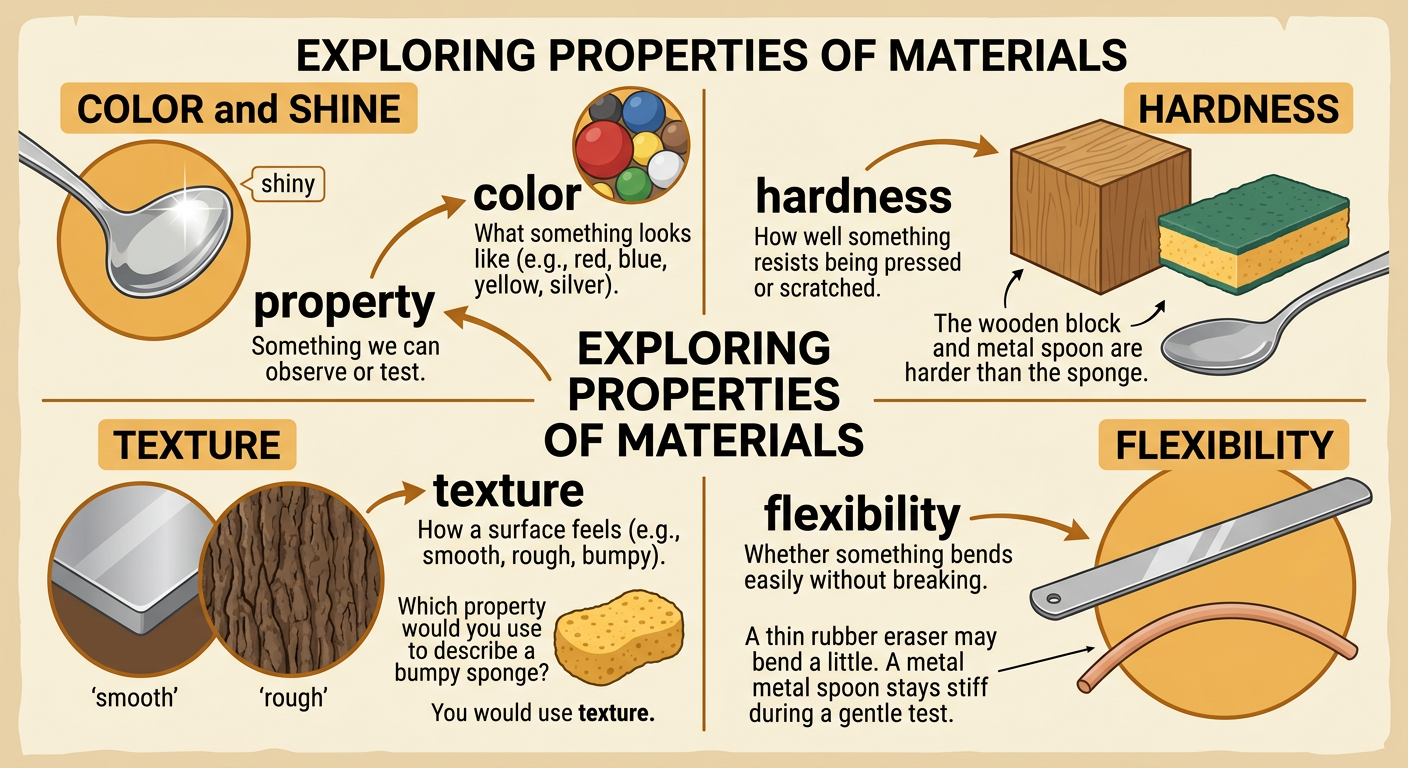
A property is something we can observe or test about a material. Color tells what something looks like, such as red, blue, or silver. Texture tells how a surface feels, such as smooth, rough, or bumpy. Hardness describes how well a material resists being scratched or pressed. A wooden block and metal spoon are harder than a sponge. Flexibility tells whether something bends easily without breaking. A thin rubber eraser may bend a little, while a metal spoon stays stiff during a gentle test. We can also describe an object as shiny or dull. Use property words that match your evidence. Instead of saying, “The spoon is nice,” say, “The spoon is silver, shiny, smooth, hard, and stiff.”
Sort and Count the Objects
To sort, choose one clear rule and place objects into groups. Suppose the rule is texture. Put the wooden block, metal spoon, plastic lid, and rubber eraser in the smooth group. Put the sponge in the rough group. Then count each group. The smooth group has four objects, and the rough group has one object. A picture graph can show these data, with one picture standing for one object. Compare the groups: the smooth group has three more objects than the rough group. We can sort the same objects again using a different property. With a flexibility rule, bendable objects go in one group and stiff objects go in another. Always tell the sorting rule so others understand what the groups mean.

Explain the Sorting Rule
After sorting, explain what rule you used and give evidence. A strong explanation names the property, tells which objects belong together, and gives an example from your observations. You might say, “I sorted by texture. The spoon, lid, block, and eraser are in the smooth group because their surfaces feel even. The sponge is in the rough group because its surface feels uneven.” You can use your counts as more evidence: “There are four smooth objects and one rough object.” Another student may sort the same objects by flexibility or color. That can also be correct if the rule is clear and every object fits the rule. Ask yourself: What did I observe, how did I sort, and what evidence supports my choice?
