
Sound Comes from Vibrations
Students observe that vibrating objects create sound and use evidence from simple investigations to describe the connection between vibrations and sound.
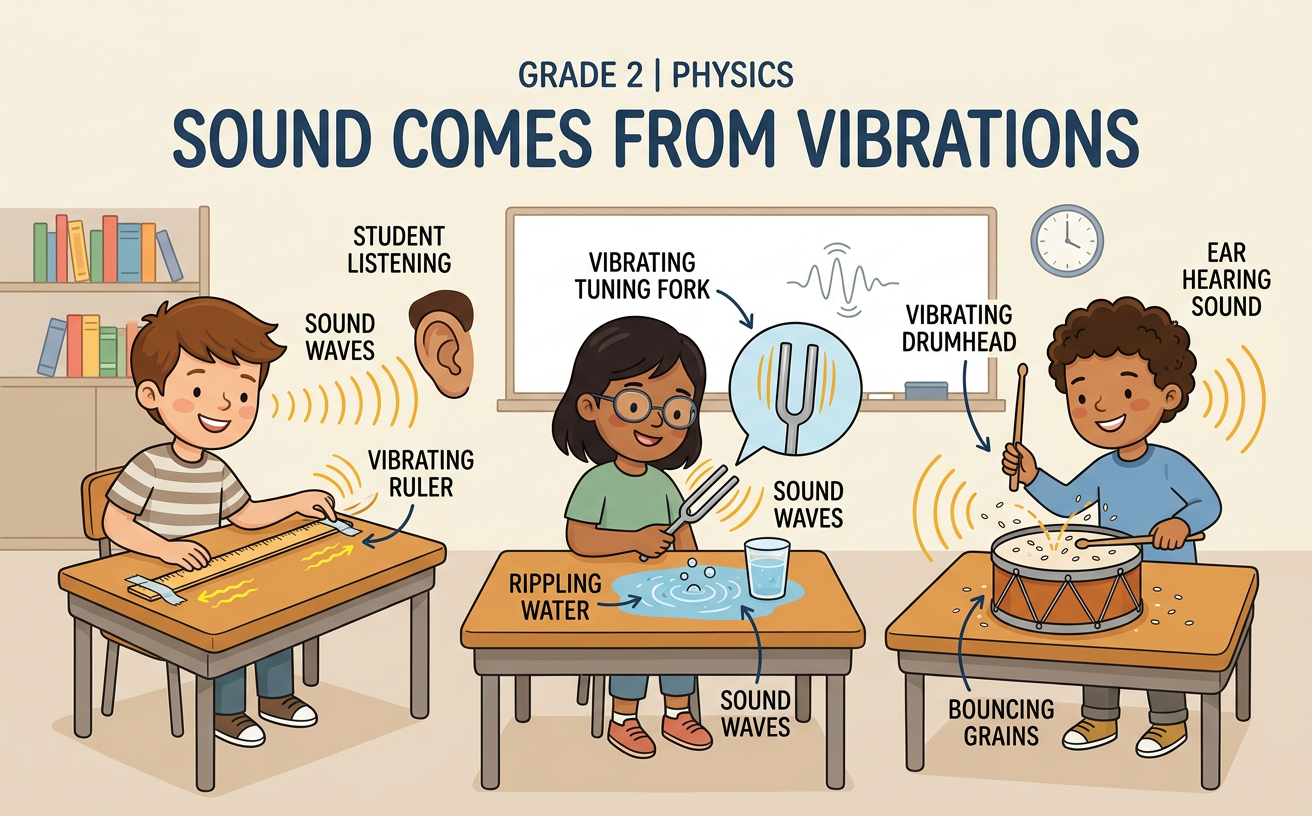
Illustrations are auto-generated and may be placeholders. They can be refreshed to match the narration.
Notice Sounds Around Us
Close your eyes for a quiet moment and listen. You might hear a clock ticking, shoes tapping, a pencil dropping, or someone speaking. Each sound begins with something moving back and forth very quickly. This motion is called a vibration. We may not always see the vibration, but we can hear the sound it creates. People have made sound-producing objects for a very long time. An old photograph, drawing, or museum object can show how people used bells, drums, or rattles in the past. These historical sources help us learn how sound was used for music, warnings, celebrations, and communication. With a partner, name one sound you hear, identify the object that makes it, and describe what you think is vibrating.

Observe Objects Vibrating
A vibration is a quick back-and-forth motion. You can observe one by gently plucking a stretched rubber band. The band may look blurry because it moves back and forth so fast. As it vibrates, you hear a sound. Touch the band to stop it. When the vibration stops, the sound stops too. You can also place your fingertips lightly on the front of your throat while you hum. You may feel a buzzing motion. Parts inside your throat called vocal cords vibrate when you make your voice. Never press hard on your throat. Tell a partner what you saw, heard, or felt. These observations are evidence because they help show what happened during the investigation.

Test Rubber Bands and Rulers
Work with a partner to test two objects. First, stretch a rubber band securely around a small open box. Pluck the band, then record whether you see vibration and hear sound. Next, place a plastic ruler on a table with part of it hanging over the edge. Hold the ruler firmly against the table and gently push down and release the free end. Do not aim it toward anyone. Watch the end move up and down and listen for a sound. Change how much of the ruler hangs over the edge, then test it again. Compare the sounds, but focus on the main pattern: each sound happens while the object is vibrating. Take turns as tester and recorder, and discuss what stays the same in both tests.

Connect Vibrations to Sound
The tests show a cause-and-effect connection. Plucking or releasing an object causes it to vibrate, and the vibration makes sound. Sound can also make another material vibrate. Place a few grains of dry rice on a tightly stretched piece of plastic wrap covering a bowl. Keep the rice away from mouths and clean it up after the test. Hold a sounding device near the bowl without touching it. When the sound is loud enough, the rice may wiggle or bounce because the plastic wrap vibrates. The sound carries energy through the air to the plastic wrap. This is evidence that sound can make materials vibrate. In both directions, sound and vibrations are connected: vibrations can create sound, and sound can cause vibrations.

Share Evidence and Conclusions
Scientists use evidence to explain their ideas. Review your observations with your group. You might say, “When we plucked the rubber band, we saw it move back and forth and heard a sound. When we stopped the band, the sound stopped.” You could add that the ruler vibrated while it made sound or that sound made rice move on vibrating plastic wrap. Listen carefully while classmates speak, ask questions, and take turns adding ideas. Then make a conclusion that matches the evidence: vibrating materials can make sound, and sound can make materials vibrate. You can also compare your investigation with a historical source showing a drum or bell. Explain which part of the old object likely vibrated to make sound. A drum skin vibrates when struck, and a bell vibrates when rung.
