
Stoichiometry, Limiting Reactants, and Percent Yield
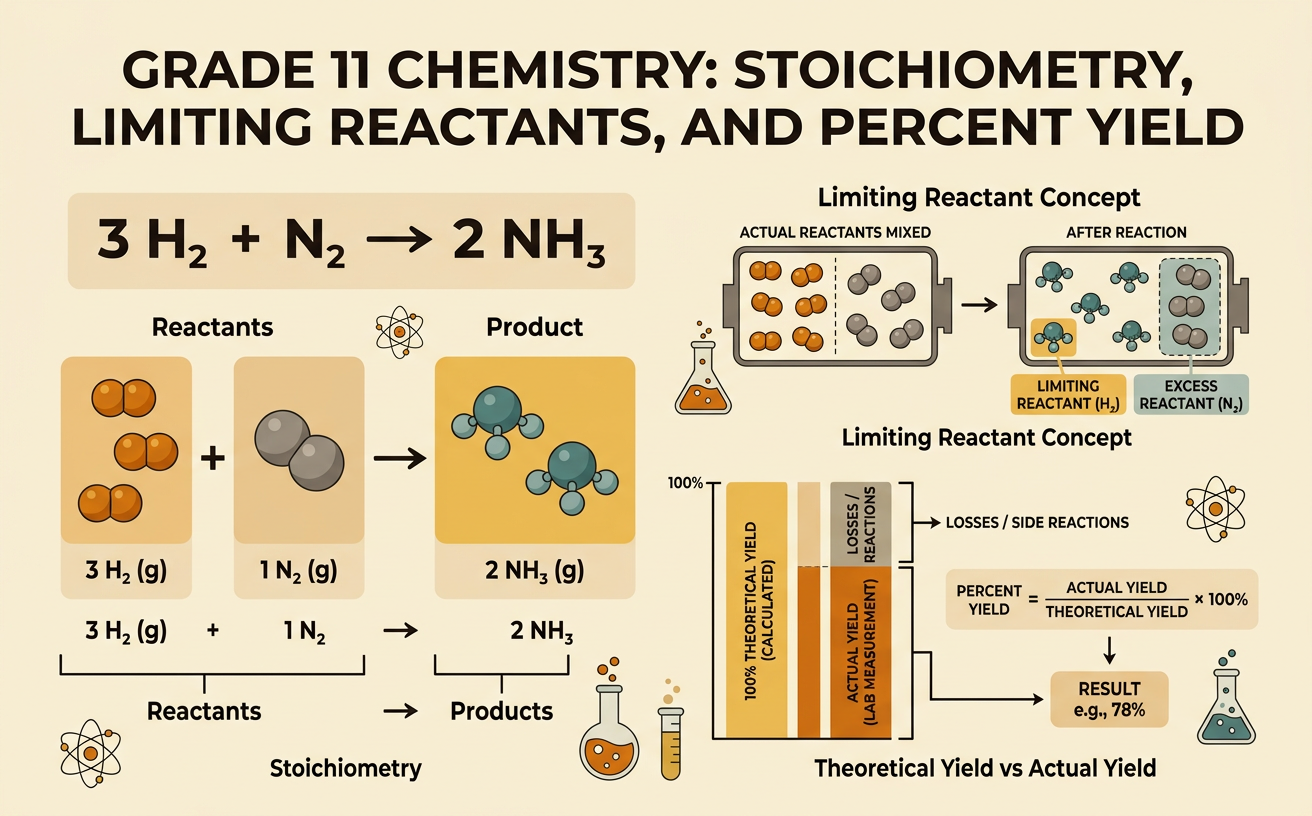
Students use balanced equations to predict reactant consumption and product formation. They identify limiting and excess reactants and compare theoretical yield with actual laboratory yield.
Illustrations are auto-generated and may be placeholders. They can be refreshed to match the narration.
Using Mole Ratios in Stoichiometry
Stoichiometry uses the coefficients in a balanced equation to relate amounts of reactants and products. The coefficients create mole ratios that serve as conversion factors. In the equation N2 + 3H2 → 2NH3, one mole of nitrogen reacts with three moles of hydrogen to produce two moles of ammonia. If 4.0 moles of nitrogen react with excess hydrogen, the calculation uses 2 moles NH3 divided by 1 mole N2. The predicted amount is 8.0 moles of ammonia. A mole ratio is valid only when it comes from a correctly balanced equation. Students should therefore balance first, identify the known and unknown substances, and select a ratio that cancels the known unit.
Solving Mass-to-Mass Problems
Many laboratory problems begin with the mass of one substance and ask for the mass of another. The reliable path is grams of known substance to moles of known substance, then to moles of unknown substance, and finally to grams of unknown substance. For example, consider 2H2 + O2 → 2H2O. Starting with 16.0 grams of oxygen, divide by 32.00 grams per mole to obtain 0.500 mole O2. The equation predicts twice as many moles of water, so 1.00 mole H2O can form. Multiplying by water’s molar mass gives approximately 18.0 grams of water. The coefficients relate moles, while molar masses connect moles and grams.
Identifying the Limiting Reactant
When both reactants are available in measured amounts, one may be used up before the other. The reactant consumed first is the limiting reactant, and it determines the maximum amount of product. The other substance is the excess reactant. For 2H2 + O2 → 2H2O, suppose 5.0 moles of hydrogen are mixed with 2.0 moles of oxygen. Two moles of oxygen require 4.0 moles of hydrogen, so oxygen is limiting and 1.0 mole of hydrogen remains. Another dependable method is to calculate how much product each reactant could form. The reactant producing the smaller amount of product is limiting. Comparing initial masses alone is not sufficient because substances have different molar masses and react in different mole ratios.
Theoretical Yield and Actual Yield
Theoretical yield is the maximum amount of product predicted from the limiting reactant. Actual yield is the amount collected during an experiment. Actual yield is often lower because reactions may be incomplete, side reactions may occur, or product may be lost during transfer and purification. Suppose a calculation predicts 10.0 grams of a precipitate, but a student dries and collects only 8.5 grams. The theoretical yield is 10.0 grams, while the actual yield is 8.5 grams. A yield greater than the prediction usually signals wet product, contamination, or measurement error rather than successful creation of extra matter. Distinguishing these terms helps students connect mathematical predictions with experimental results.
Calculating and Evaluating Percent Yield
Percent yield measures how closely an experiment approaches its theoretical prediction. It is calculated as actual yield divided by theoretical yield, multiplied by 100 percent. If the actual yield is 8.5 grams and the theoretical yield is 10.0 grams, the percent yield is 85 percent. This value indicates that 85 percent of the predicted product was recovered. Students should use the limiting reactant to calculate theoretical yield before applying the percent-yield formula. They should also evaluate possible sources of loss. For example, crystals may remain dissolved in the solvent, or some solid may stick to filter paper. A useful analysis identifies a specific procedural cause and explains whether it would make the measured yield too high or too low.