
Story Elements: Character, Setting, and Events
Students listen to a short story and identify its main character, setting, and major events with teacher support.
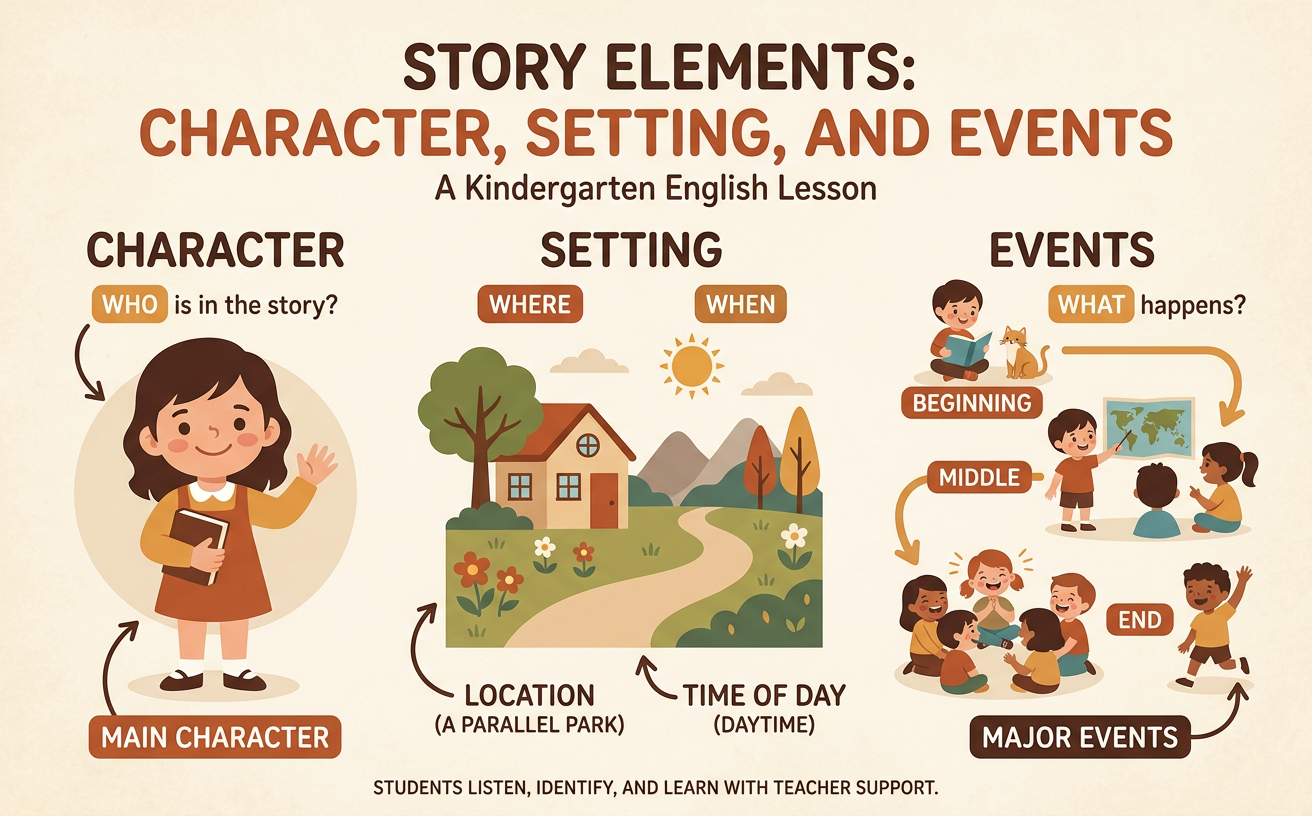
Illustrations are auto-generated and may be placeholders. They can be refreshed to match the narration.
Introduce Story Elements
Every story has important parts called story elements. Characters are the people or animals in a story. The setting tells where and when the story happens. Events are the important things that happen. Imagine a story about a rabbit finding a carrot in a garden. The rabbit is a character. The garden is the setting. Finding the carrot is an event. As you listen to a story, ask yourself three questions: Who is the story about? Where and when does it happen? What happens first, next, and last? These questions help us understand and remember the story. Today, we will listen carefully and find the characters, setting, and major events together.

Read the Story Aloud
Listen as your teacher reads this story. On a windy morning, Mia and her dog, Pip, went to Maple Park. Mia carried her new red kite. She ran across the grass, and the kite rose high in the sky. Suddenly, a strong gust blew the kite into a small tree. Mia could not reach it. Pip barked, and a park worker named Mr. Lee came to help. Mr. Lee used a long pole to gently lift the kite from the branch. Mia thanked him. Then Mia and Pip flew the red kite again. While listening, picture the people, animals, and place in your mind. Notice what happens at the beginning, in the middle, and at the end.
Name the Characters
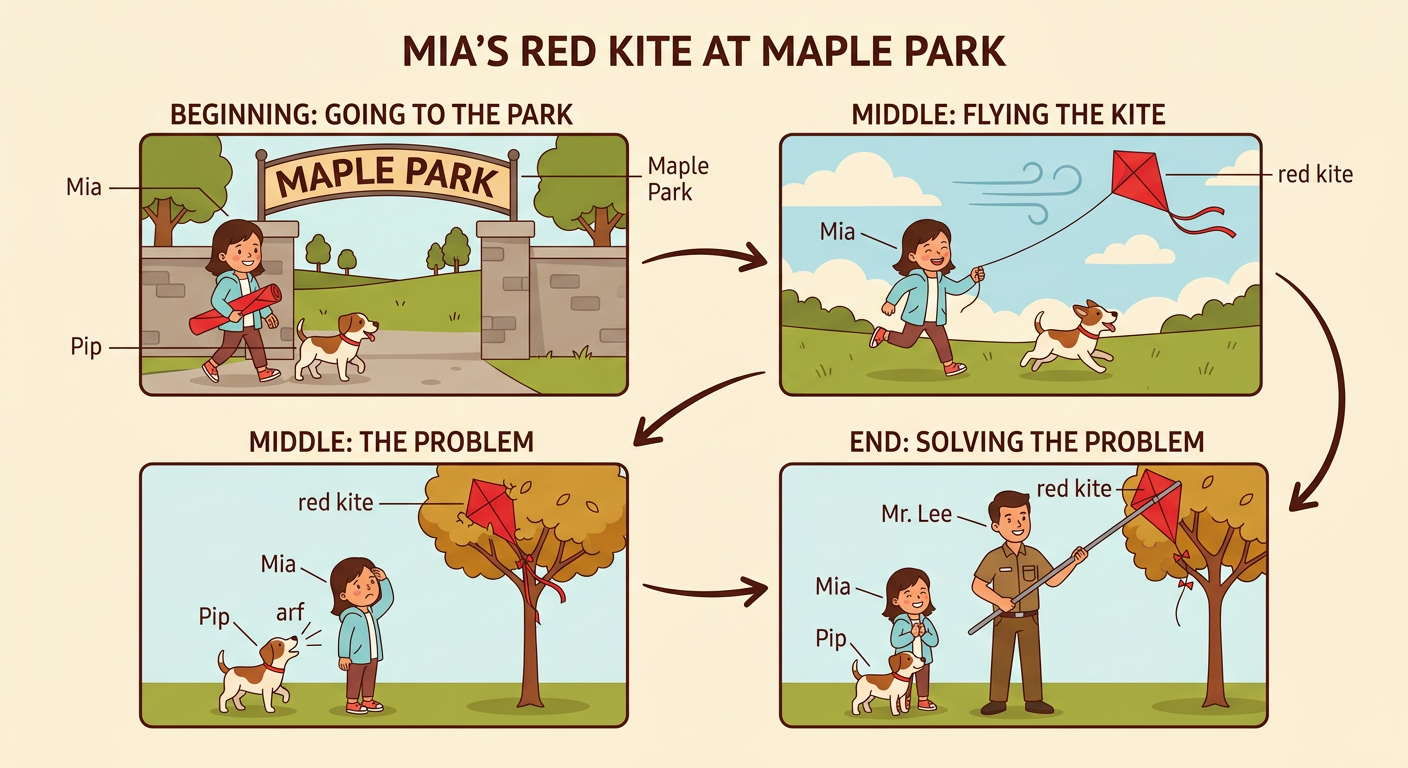
Characters are the people or animals who take part in a story. In this story, the characters are Mia, Pip, and Mr. Lee. Mia is the main character because most of the story is about what she does and what happens to her. Pip is Mia's dog. He goes to the park with her and barks when the kite is stuck. Mr. Lee is a park worker who helps Mia. We can name a character and tell one detail about that character. For example, we can say, “Mia is the main character. She flies a red kite.” With your teacher's help, point to each character and tell what that character does in the story.
Identify the Setting
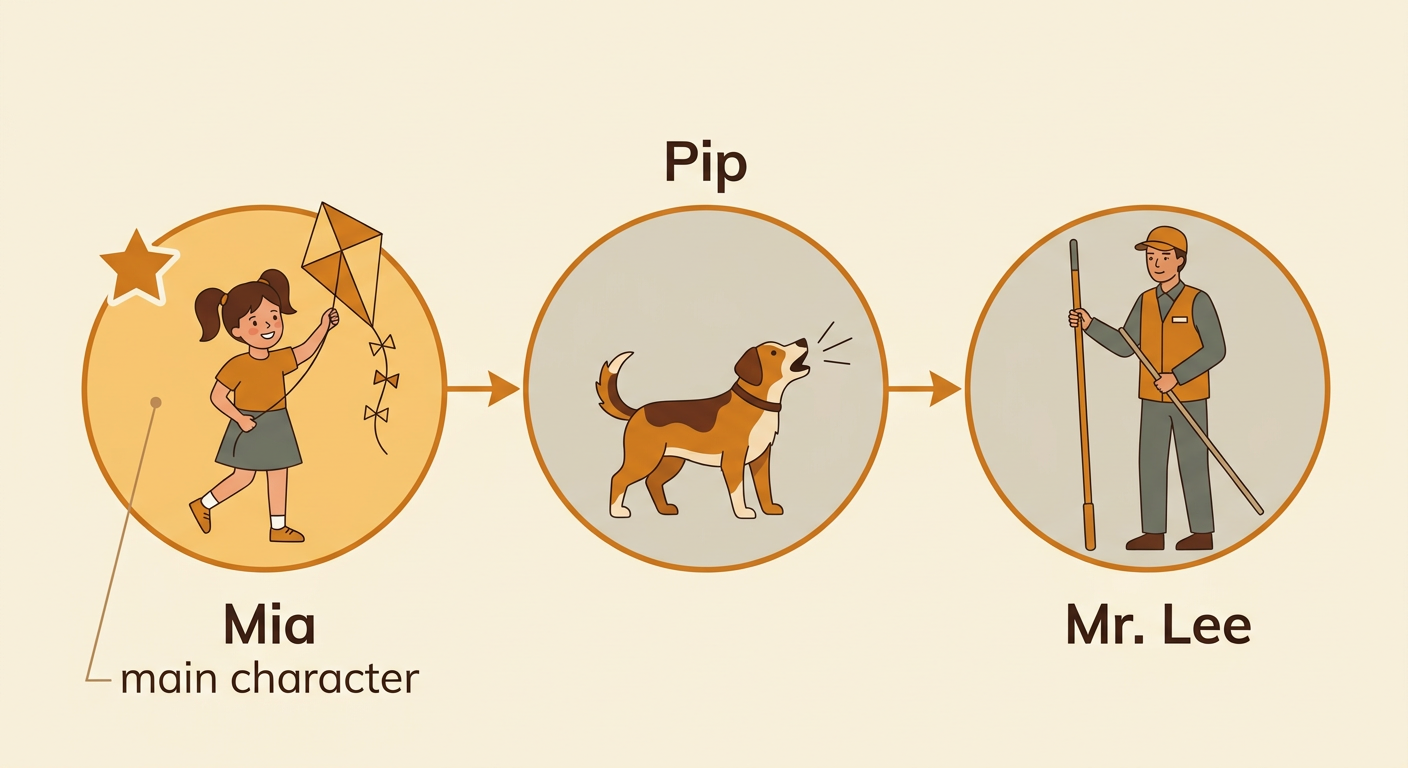
The setting tells where and when a story happens. Look and listen for place words, time words, and picture clues. Mia's story happens at Maple Park. That is where the characters run, fly the kite, and meet Mr. Lee. The story happens on a windy morning. The moving tree branches and flying kite are clues that the weather is windy. “Maple Park” answers the question “Where?” “A windy morning” answers the question “When?” We can put the clues together and say, “The setting is Maple Park on a windy morning.” A setting is not a character or an event. It is the place and time around the characters as the events happen.
Sequence Major Events
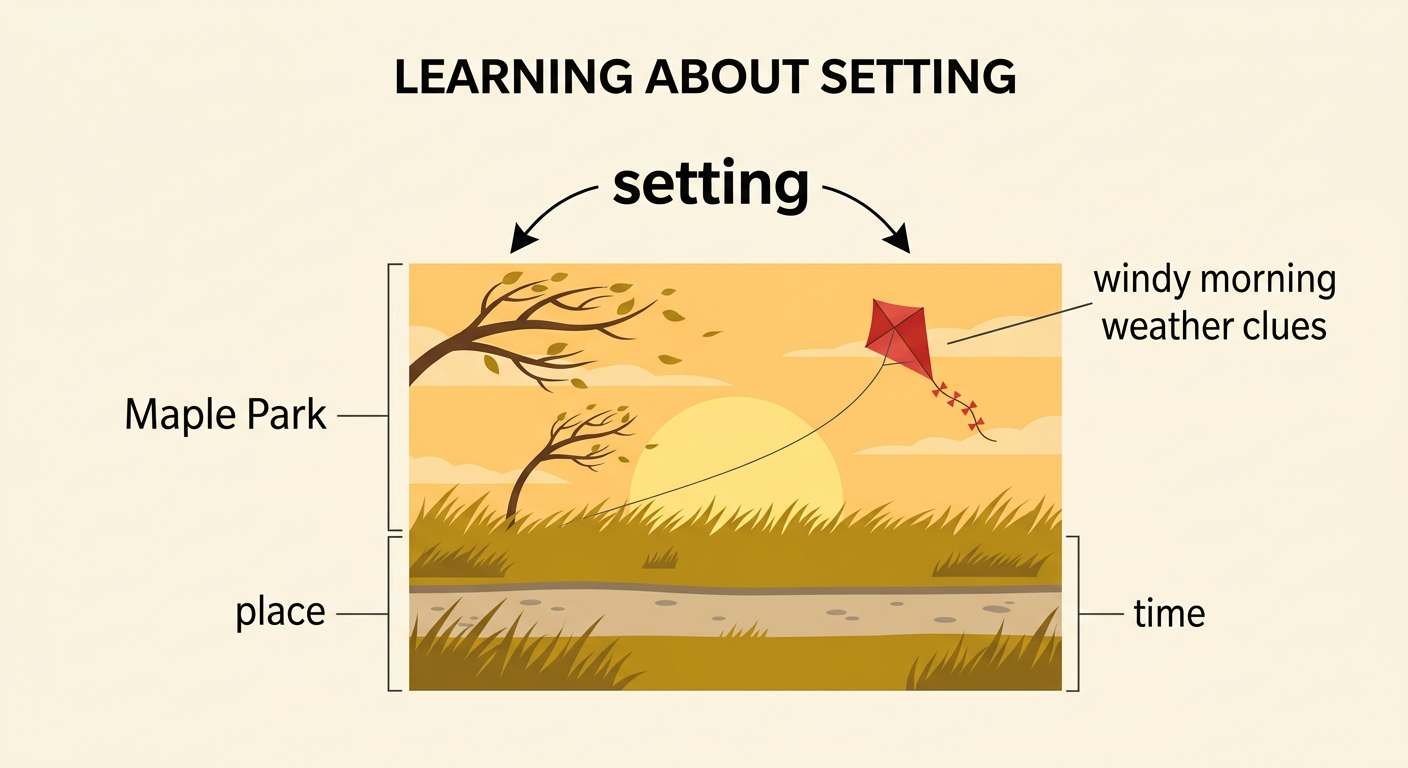
Major events are the most important things that happen in a story. We can put them in order using the words first, next, then, and last. First, Mia and Pip go to Maple Park with a red kite. Next, Mia flies the kite across the grass. Then, a strong gust blows the kite into a tree, and Mia cannot reach it. Last, Mr. Lee gets the kite down, and Mia flies it again. Small details, such as the color of the kite, help us imagine the story, but they are not always major events. To check the order, ask, “Could this happen before the event in the picture ahead of it?” Point to each picture and retell the events in your own words.

Review and Share
Now let us review the story elements. The main character is Mia. Other characters are Pip and Mr. Lee. The setting is Maple Park on a windy morning. The major events are that Mia flies her kite, the kite gets stuck in a tree, and Mr. Lee helps her get it back. Use a complete sentence to share one story element. You might say, “Mia is the main character,” or “The story happens at Maple Park.” You can also retell an event: “The kite gets stuck in a tree.” Listen as classmates share, and give a quiet thumbs-up when you hear a character, setting, or event named correctly. These details show that we understand the story.
