
Strength in Numbers: How Animal Groups Survive
Students examine examples and simple data to explain how living in groups can help animals find food, avoid predators, and protect their young.

Illustrations are auto-generated and may be placeholders. They can be refreshed to match the narration.
Why Animals Form Groups
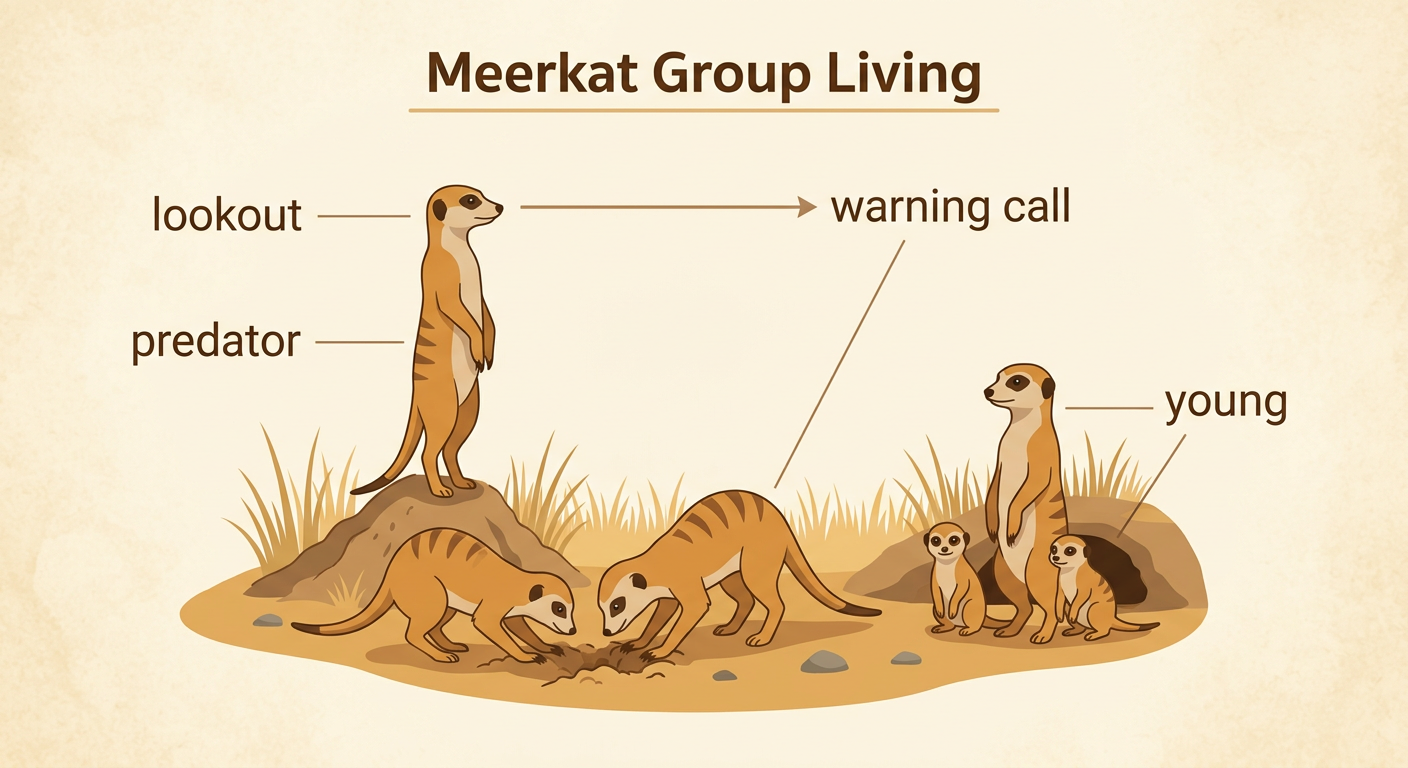
Many animals live, travel, hunt, or rest in groups because working together can help them survive. More eyes and ears can notice danger sooner. Group members may cooperate to find or catch food. Adults may also surround, carry, or watch over young animals. For example, meerkats take turns watching for predators while others search for insects. A lookout stands upright and calls if it sees danger, giving the group time to hide. Living in a group does not remove every danger, and animals may have to share food. Still, group behavior can increase each member’s chance of getting food, escaping predators, or keeping young safe. Scientists observe these behaviors and collect evidence to explain how groups help animals survive.
Group-Survival Examples
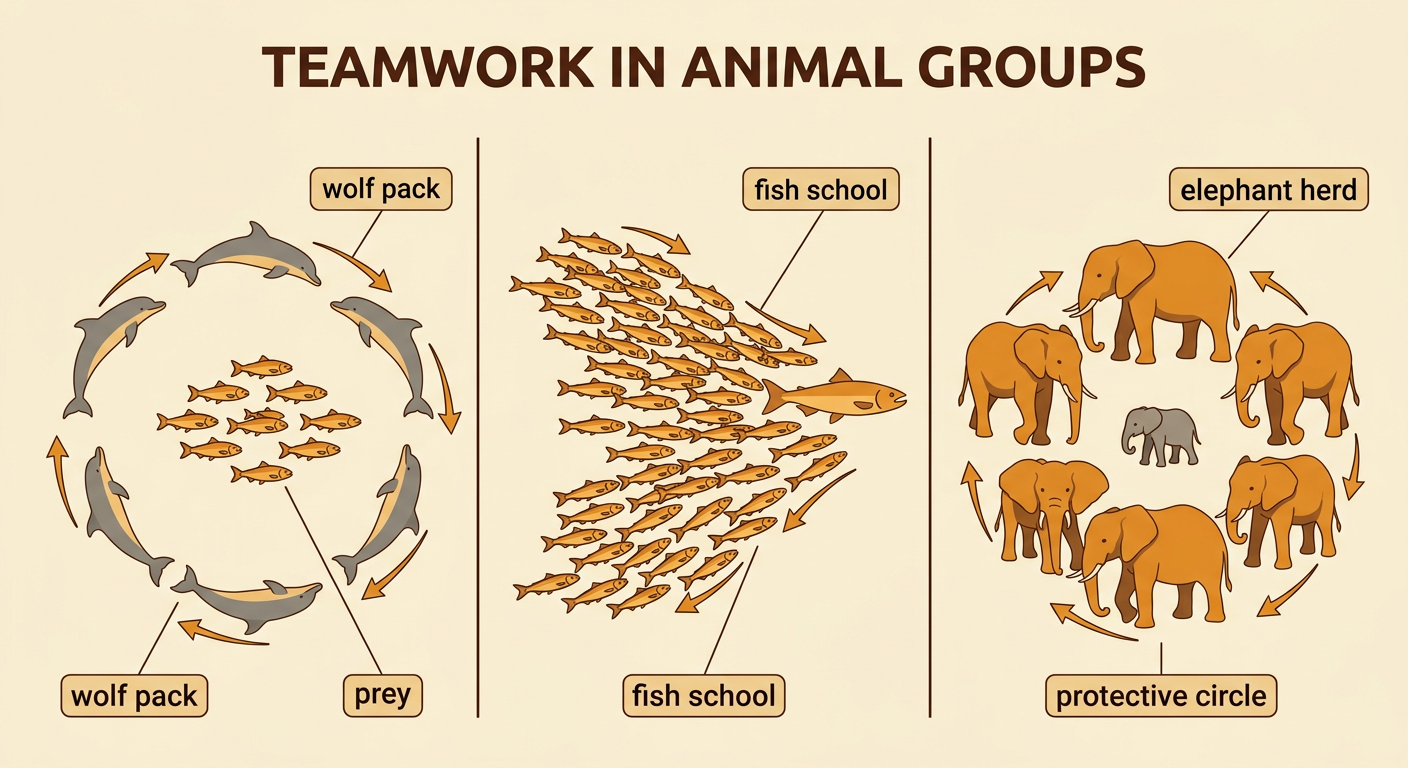
Animal groups survive in different ways. A wolf pack can cooperate to chase prey that may be difficult for one wolf to catch. Dolphins may work together to surround a school of fish, making the fish easier to capture. In an elephant herd, adults often stay close to calves and may form a protective circle when danger approaches. Fish in a school move together, which can make it harder for a predator to focus on one fish. These examples show three important benefits: finding food, avoiding predators, and protecting young. The animals do not plan with words as people do, but they respond to one another’s movements, sounds, and signals. Each example provides evidence that group behavior can improve the survival chances of group members.
Read and Graph the Evidence
Graphs help scientists compare observations. Imagine researchers watched animals during ten equal observation periods. A wolf pack found food in eight periods, while a lone wolf found food in four periods. A scaled bar graph can display these results. The horizontal axis names the pack and the lone wolf. The vertical axis shows the number of periods in which food was found. If each square represents two periods, the pack’s bar is four squares tall and the lone wolf’s bar is two squares tall. To read the graph, check the title, labels, and scale before comparing the bars. The pack found food in four more periods than the lone wolf. This sample evidence supports the idea that cooperation can help wolves find food, but it does not prove that every pack always succeeds.

Compare Group and Solo Survival
To compare group and solo survival, look for a fair comparison and identify both benefits and costs. Suppose a second set of observations shows that fish in schools escaped a predator in nine out of twelve encounters, while fish swimming alone escaped in five out of twelve encounters. The difference is four successful escapes. This evidence suggests that schooling helped the fish avoid the predator. A predator may struggle to select one fish from a moving group, and many fish can detect danger. However, living in a group can also mean more competition for food or a greater chance of being noticed. Scientists should not claim that groups always do better. Instead, they explain what the data show: in these observed encounters, grouped fish escaped more often than solo fish.

Make an Evidence-Based Claim
An evidence-based argument has a claim, evidence, and reasoning. A claim answers the question. Evidence includes facts from texts, diagrams, observations, or graphs. Reasoning explains how the evidence supports the claim. For example, a student might claim, “Some animals form groups because groups can help members survive.” One piece of evidence is that meerkat lookouts warn others about predators. Another is that the sample wolf graph shows the pack found food in eight periods, compared with four periods for the lone wolf. A third is that schooling fish escaped in nine of twelve encounters, compared with five of twelve for solo fish. The reasoning is that warning others, cooperating to find food, and escaping predators can increase survival chances. Strong arguments use more than one source and avoid saying that group living always guarantees survival.
