Strong and Gentle Pushes
Students test gentle and strong pushes on a toy car and compare how far the car moves.

Illustrations are auto-generated and may be placeholders. They can be refreshed to match the narration.
Notice How Toys Move
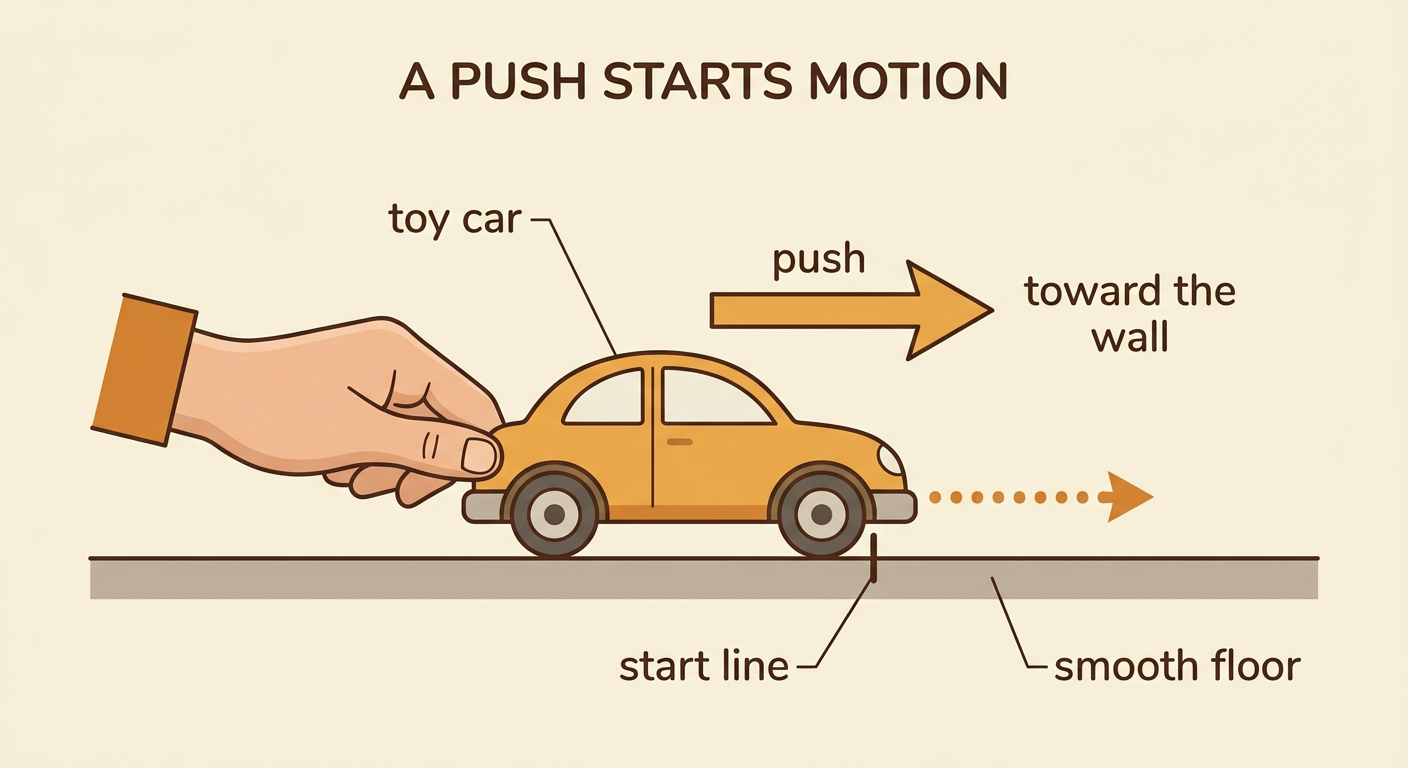
A toy car can be still or moving. A push can make a still car begin to move. A push can also change how fast or how far the car travels. Place a toy car on a smooth, level floor. Touch the back of the car and push it forward. Watch where it goes. Notice that the car moves in the same direction as the push. It may roll for a while and then stop. The floor and the wheels can affect its motion, so we will use the same car and the same floor for every test. For example, if Maya pushes the car toward a wall, the car rolls toward the wall. What did the push make the car do?
Predict Gentle and Strong Pushes
Before testing, think about what might happen. A gentle push uses a small amount of force. A strong push uses more force. Which push do you think will make the same toy car travel farther? Tell a partner your prediction and your reason. You might say, “I predict the strong push will make the car travel farther because it gives the car a bigger push.” A prediction is an idea that we can test. It is okay if the result is different from your prediction. Listen while your partner shares, take turns speaking, and ask a question. For example, you could ask, “Why do you think the gentle push will make the car stop sooner?” Record both predictions with words or pictures.

Test Each Push
Now plan and conduct a fair test with a partner. Use the same toy car, the same smooth floor, and the same start line each time. First, place the front of the car at the start line. Give the car one gentle push. Do not touch it again while it rolls. Mark the place where the front of the car stops. Return the car to the start line. Next, give it one strong push in the same direction. Mark where it stops. Repeat each kind of push if your teacher asks. One partner can push while the other watches and marks the stopping place. Then switch jobs. Keep hands and feet out of the car's path. For example, use a blue card to mark the gentle-push stop and a red card to mark the strong-push stop.

Compare Travel Distances
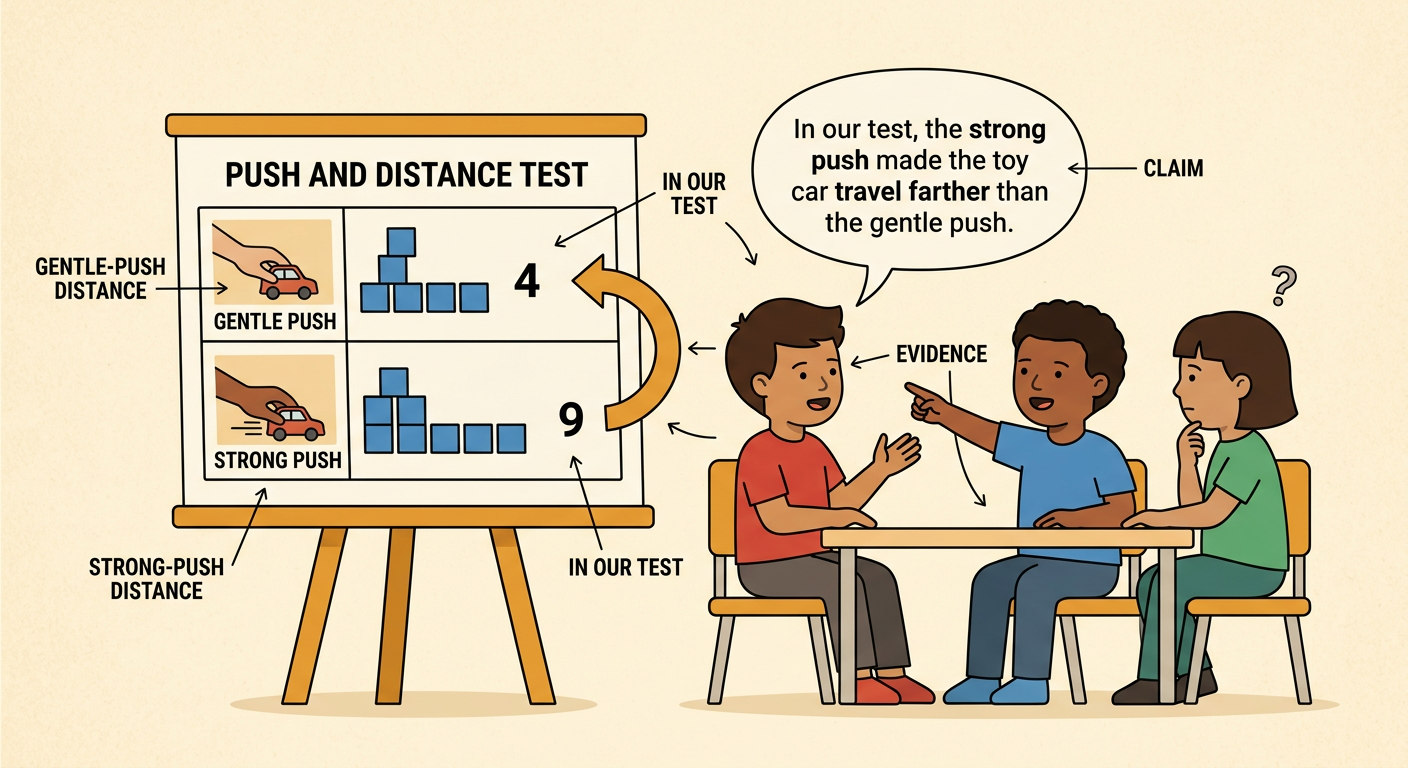
Distance tells how far the car traveled from the start line to its stopping place. Compare the two distances directly. You can lay equal-size blocks in a straight row from the start line to each stop marker. Do not leave gaps or overlap the blocks. Count the blocks for each distance. You may also place two paper strips beside the paths and compare their lengths. Use words such as farther, shorter, longer, or the same. For example, suppose the gentle-push path measures four blocks and the strong-push path measures nine blocks. Nine blocks is more than four blocks, so the strong-push distance is longer in that test. Record the numbers or draw the block rows. Measurements help the class compare the pushes using evidence instead of guesses.

Share an Evidence-Based Claim
A claim tells what you learned. Evidence is what you observed or measured during the test. Talk with your group and use the distance results to make a claim. You can say, “In our test, the strong push made the toy car travel farther than the gentle push.” Then add evidence: “The strong-push distance was nine blocks, and the gentle-push distance was four blocks.” The words “in our test” are important because they describe what your group found. Another group may have different numbers, but it can still compare its two distances. Take turns sharing, listen to each speaker, and ask a question about the evidence. For example, ask, “Where did your car stop after the gentle push?” A good claim matches the measurements collected during the investigation.