Stronger Together: How Animal Groups Help Members Survive
Students examine examples and graph simple data to explain how living in a group can help animals find food, avoid predators, and protect their young.
Illustrations are auto-generated and may be placeholders. They can be refreshed to match the narration.
Why Do Animals Form Groups?
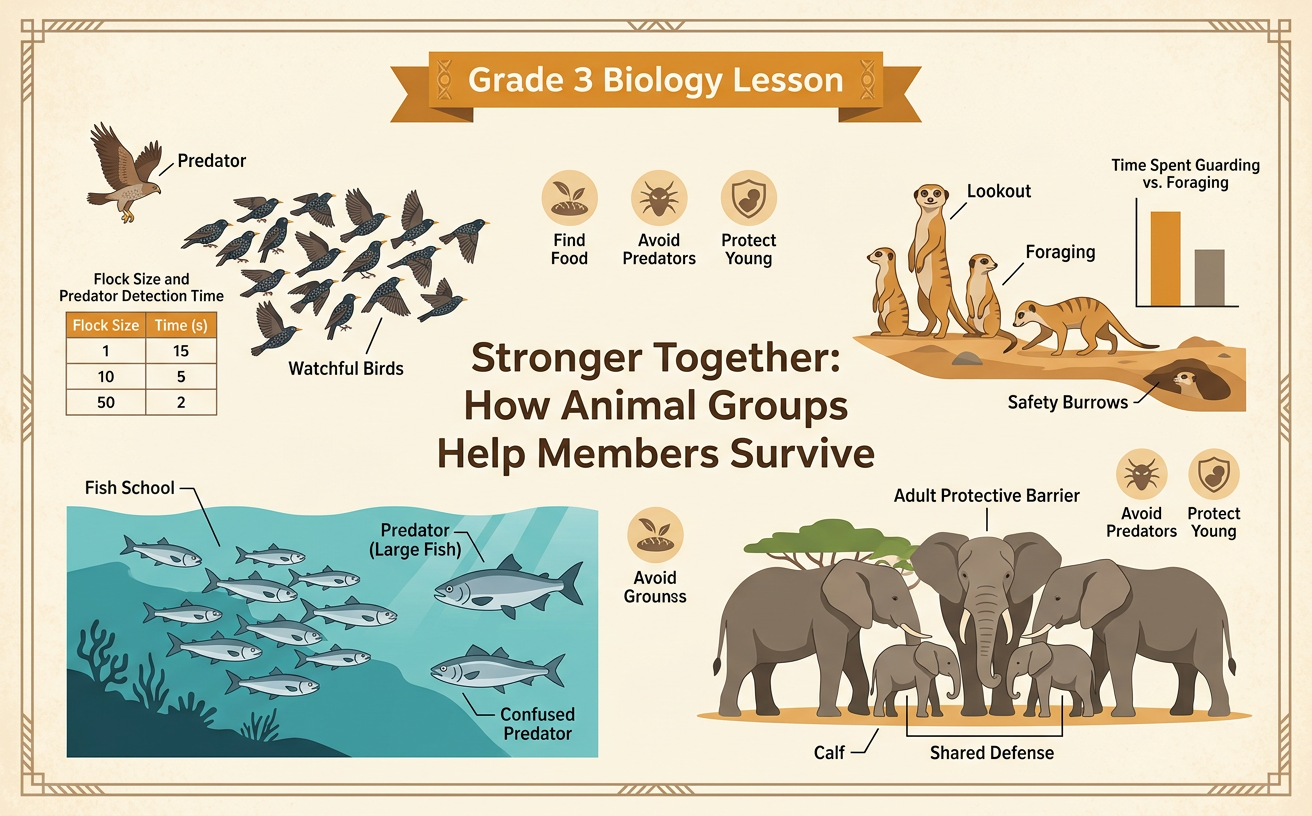
Animals form groups when being together helps them meet their needs. A group may help members find food, notice predators, defend themselves, or care for their young. Each animal may have a job or respond to signals from others. For example, meerkats often search for insects together. While some meerkats look for food, one may stand upright and watch for predators. If the watcher sees danger, it makes an alarm call. The other meerkats quickly hide in burrows. Living in a group does not guarantee that every animal will survive, and group members may compete for food. However, working together can give the animals a better chance of surviving than they would have alone.

Group-Survival Examples
Different animal groups gain different survival benefits. Wolves hunt in packs, which can help them surround and catch prey that may be too large for one wolf. Fish swim in schools, making it harder for a predator to focus on one fish. Adult elephants form protective circles around calves when danger approaches. Emperor penguins huddle closely during cold Antarctic weather, reducing heat loss and shielding members from wind. Group living can also help animals raise young. In a lion pride, several adult females may guard or care for cubs. These examples show that animal groups do not all behave in the same way. The helpful behavior depends on the animal’s habitat, food, predators, and needs. In each case, cooperation improves at least one member’s chance of survival.

Read and Gather Evidence
To explain how groups help animals survive, gather evidence from useful sources. Begin with a question such as, “How does a meerkat group avoid predators?” An informational book, a zoo website, a wildlife scientist’s article, or an observation video can provide helpful facts. A story in which animals talk may be entertaining, but it is not strong scientific evidence. As you read, record the source and the exact fact that answers your question. For example, a text might state that a meerkat watcher gives an alarm call when it sees a predator. Ask, “What did the text say?” and point to the sentence or image that supports your answer. Check more than one reliable source when possible. Matching evidence from multiple sources makes an explanation stronger.

Graph the Survival Data
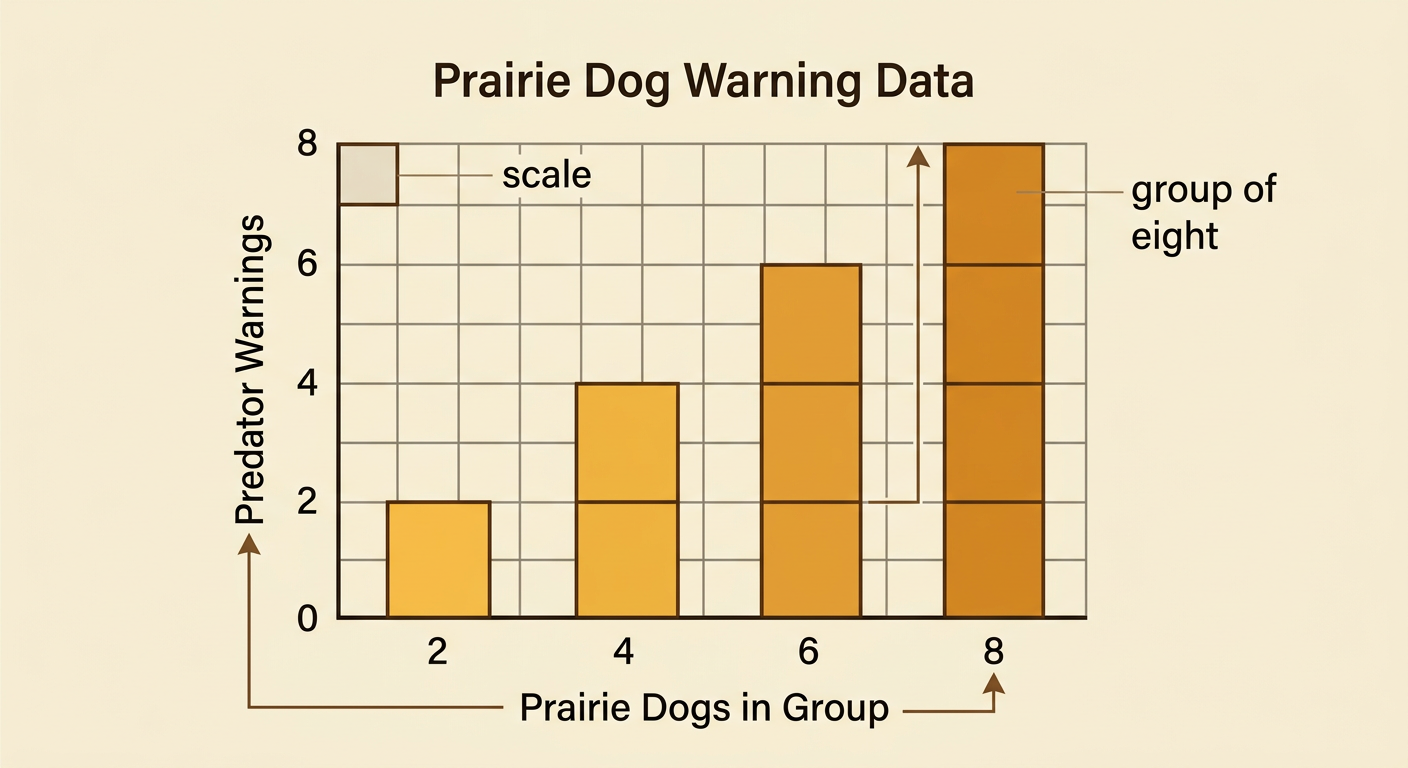
A bar graph can make patterns in survival data easier to see. Imagine that researchers watched prairie dog groups for equal amounts of time. Groups of 2, 4, 6, and 8 prairie dogs gave 2, 4, 6, and 8 predator warnings. Draw one bar for each group size. Use a scale in which one graph square represents two warnings. The bars will be 1, 2, 3, and 4 squares tall. Label the horizontal axis “Prairie Dogs in Group” and the vertical axis “Predator Warnings.” The graph shows that larger groups gave more warnings during these observations. For example, the group of eight gave six more warnings than the group of two. This pattern can support an explanation, but it does not prove that group size was the only cause.
Make an Evidence-Based Claim
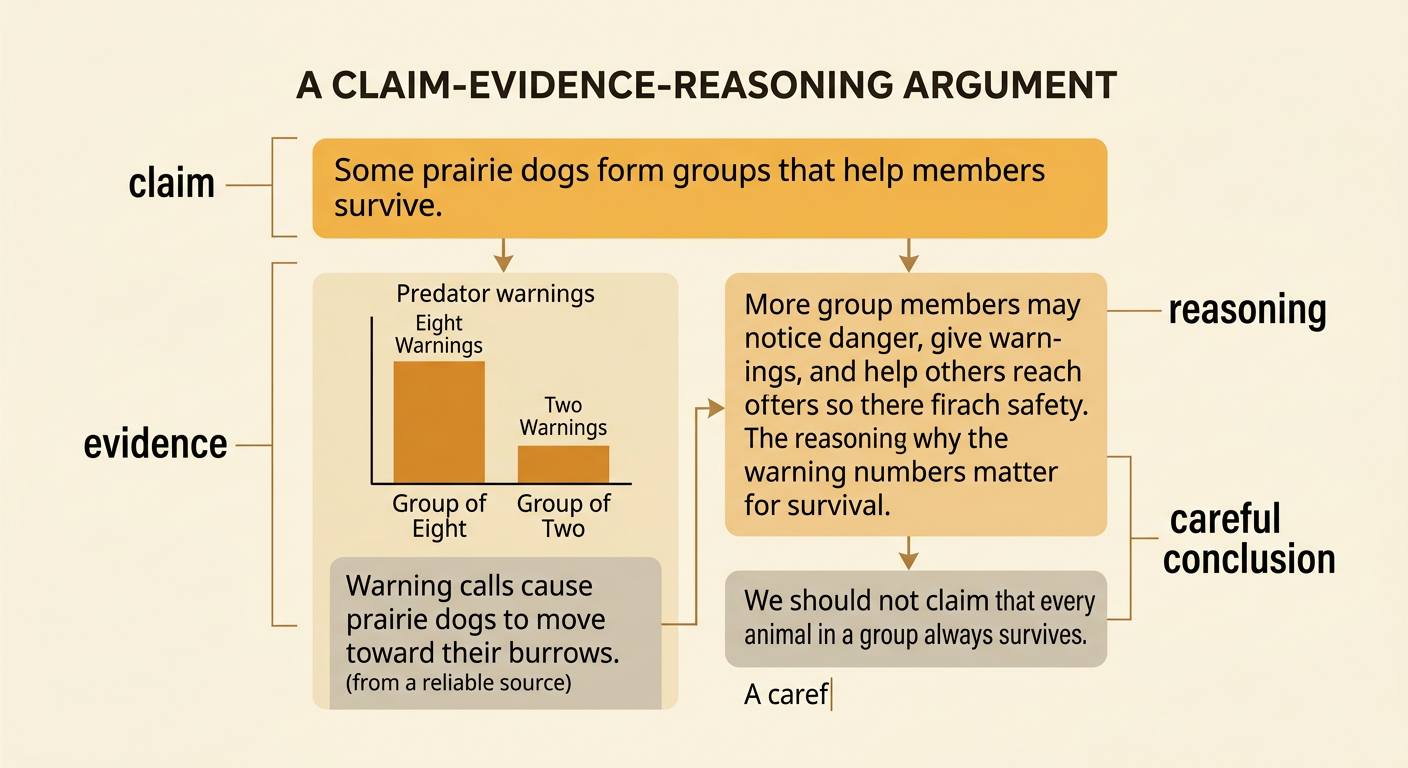
An evidence-based argument includes a claim, evidence, and reasoning. The claim answers the question. Evidence includes facts from reliable sources and numbers from a graph. Reasoning explains how the evidence supports the claim. For example, a student might claim, “Some prairie dogs form groups that help members survive.” The graph shows that the group of eight gave eight predator warnings, while the group of two gave only two. An informational source explains that warning calls cause prairie dogs to move toward their burrows. Together, these details suggest that more group members can notice danger and warn others. Use words such as because, for example, and therefore to connect ideas. Do not claim that every grouped animal always survives. A careful conclusion is that group behavior can improve members’ chances of survival.