
Subtract Two-Digit Numbers Using Place Value
Students use tens, ones, drawings, and equations to subtract two-digit numbers within 100.
Illustrations are auto-generated and may be placeholders. They can be refreshed to match the narration.
Review Tens and Ones
Every two-digit number has a tens digit and a ones digit. The tens digit tells how many groups of ten are in the number. The ones digit tells how many single ones are left. In 47, the 4 means 4 tens, or 40. The 7 means 7 ones. Therefore, 47 equals 40 plus 7. You can build 47 with four tens rods and seven single cubes. Place-value understanding helps you subtract because you can work with tens and ones separately. Say the number 62. It has 6 tens and 2 ones, so 62 equals 60 plus 2. When you look at a two-digit number, always ask, “How many tens? How many ones?”

Model Subtraction with Base-Ten Blocks
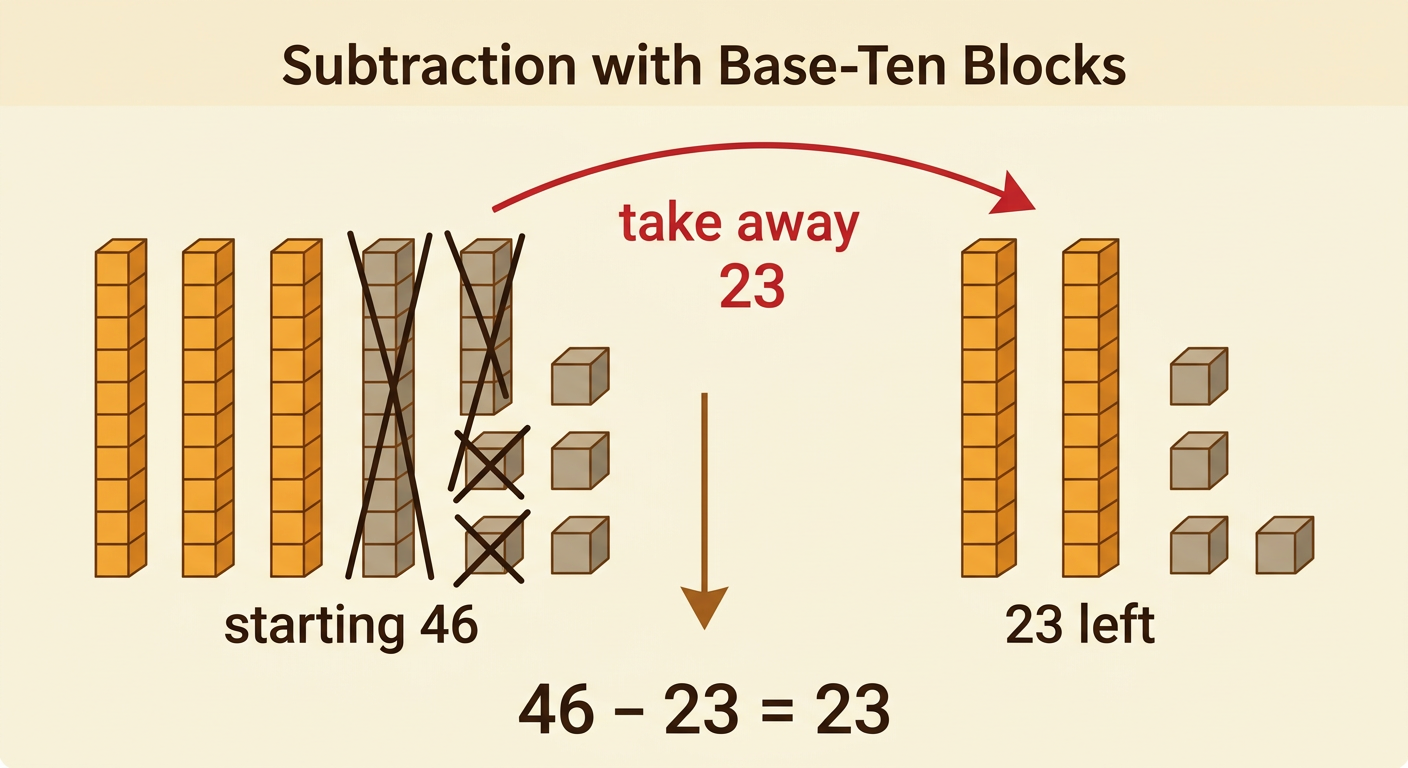
Base-ten blocks can show what happens when you subtract. Model 46 minus 23. First, build 46 with four tens rods and six ones cubes. The number 23 has two tens and three ones, so remove two tens rods and three ones cubes. Count what remains. Two tens rods and three ones cubes are left. Two tens equal 20, and three ones equal 3. Together, they make 23. Therefore, 46 minus 23 equals 23. The blocks show that subtraction means taking away part of a quantity. They also help you keep tens with tens and ones with ones. After removing the blocks, always count both the remaining tens and the remaining ones.
Subtract Tens and Ones
You can subtract by breaking each number into tens and ones. Find 68 minus 25. The number 68 is 60 plus 8. The number 25 is 20 plus 5. First, subtract the tens: 60 minus 20 equals 40. Next, subtract the ones: 8 minus 5 equals 3. Then combine the results: 40 plus 3 equals 43. Therefore, 68 minus 25 equals 43. This method works directly because 8 ones are enough to take away 5 ones. Keep the place values lined up so that tens are subtracted from tens and ones are subtracted from ones. You can check the answer with addition: 43 plus 25 equals 68.

Explain the Place-Value Strategy
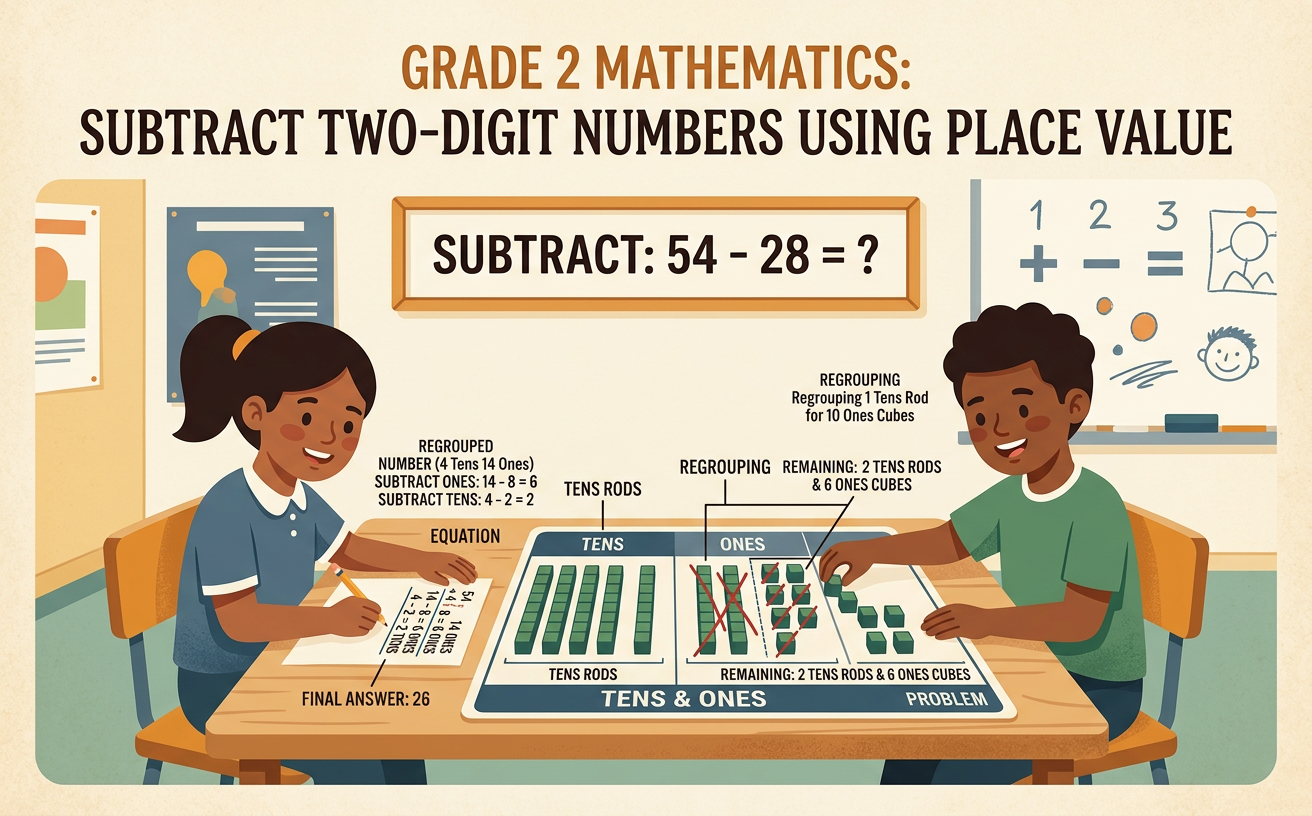
Sometimes there are not enough ones to subtract. Find 52 minus 28. You cannot take 8 ones from 2 ones, so trade 1 ten for 10 ones. Five tens and 2 ones become 4 tens and 12 ones. The total is still 52. Now subtract the ones: 12 minus 8 equals 4. Subtract the tens: 4 tens minus 2 tens equals 2 tens, or 20. Combine 20 and 4 to get 24. Therefore, 52 minus 28 equals 24. Trading works because 1 ten has the same value as 10 ones. You changed the way 52 was grouped, but you did not change its value. Check with addition: 24 plus 28 equals 52.

Independent Practice
Use place value to solve each problem. Draw tens rods and ones cubes if they help. For 63 minus 21, subtract 2 tens from 6 tens and 1 one from 3 ones. The answer is 42. For 74 minus 32, subtract tens from tens and ones from ones. The answer is 42. For 51 minus 27, notice that 1 one is not enough to subtract 7 ones. Trade 1 ten for 10 ones. Then 51 becomes 4 tens and 11 ones. Subtract 7 ones to get 4 ones, and subtract 2 tens from 4 tens to get 2 tens. The answer is 24. Check each result by adding the difference to the number that was subtracted.
