Subtract Two-Digit Numbers Using Place Value
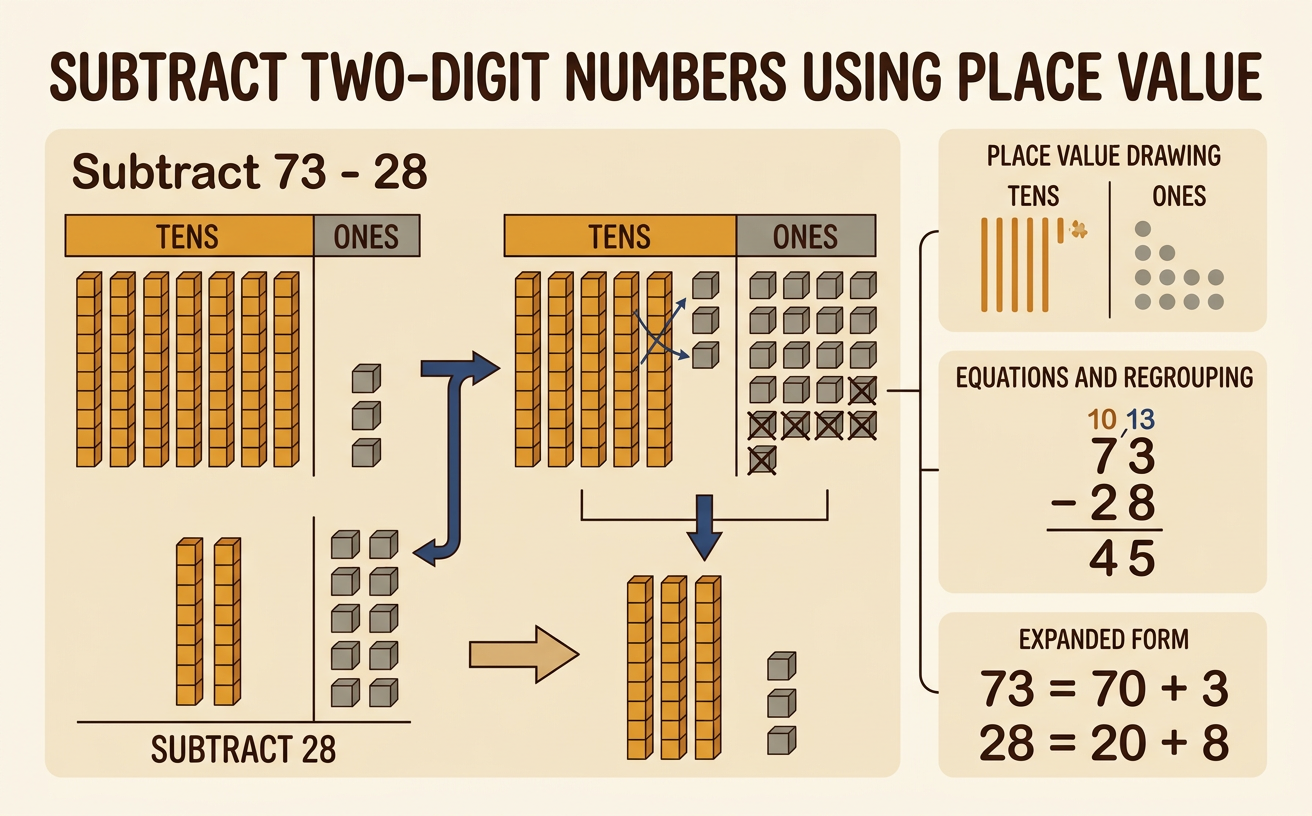
Students use tens, ones, drawings, and equations to subtract two-digit numbers within 100.
Illustrations are auto-generated and may be placeholders. They can be refreshed to match the narration.
Review Tens and Ones
Two-digit numbers are made of tens and ones. In the number 47, the digit 4 is in the tens place, so it means 4 tens, or 40. The digit 7 is in the ones place, so it means 7 ones. We can build 47 with four tens rods and seven single cubes. We can also write 47 as 40 + 7. Place value helps us understand the size of each digit. When we subtract, we subtract ones from ones and tens from tens. Before subtracting, say each number by its tens and ones. For example, 35 has 3 tens and 5 ones. The number 52 has 5 tens and 2 ones. Knowing these parts will help you subtract accurately.

Model Subtraction with Base-Ten Blocks
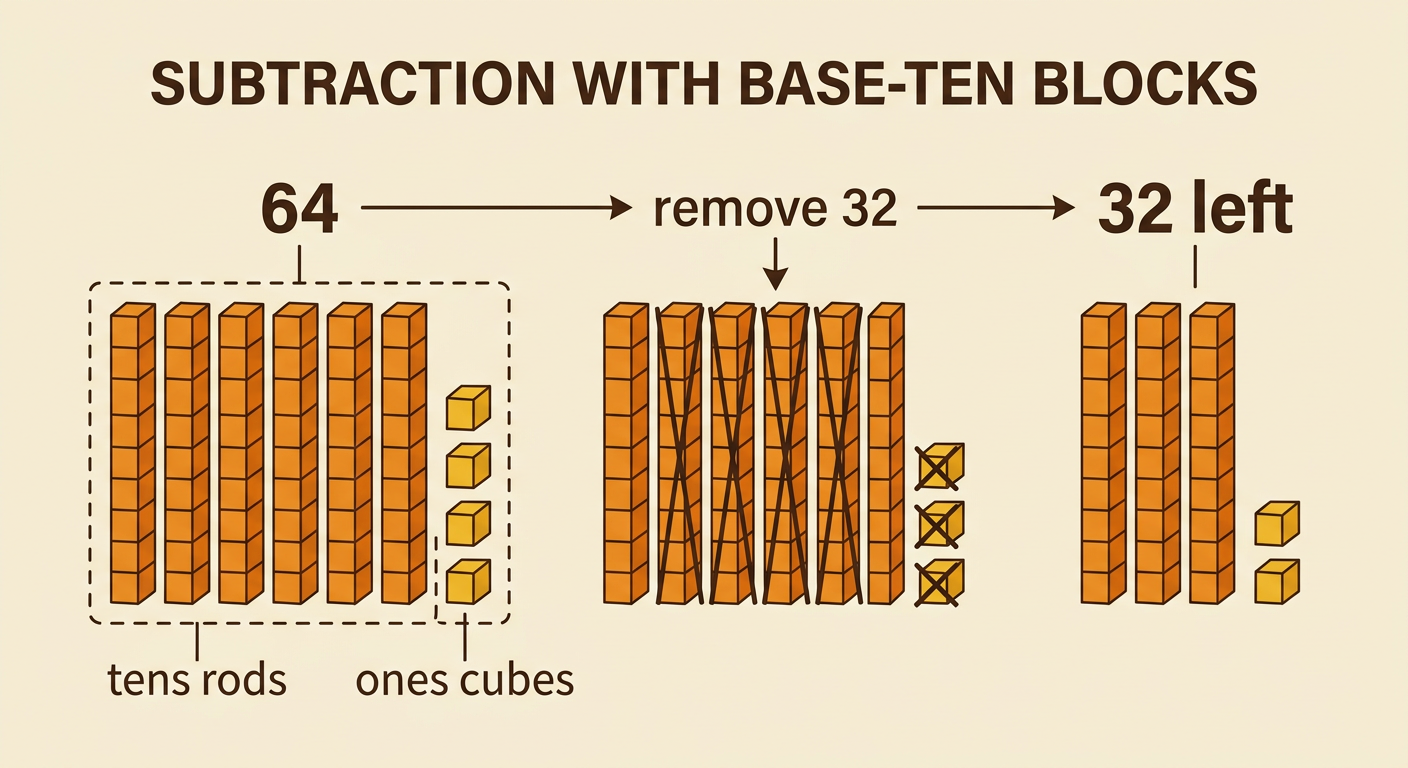
Base-ten blocks can show what happens when we subtract. Let us solve 64 − 32. Build 64 with 6 tens rods and 4 ones cubes. The number 32 has 3 tens and 2 ones, so remove 3 tens rods and 2 ones cubes. Count what remains. There are 3 tens rods and 2 ones cubes left. Three tens equal 30, and two ones equal 2. Together, they make 32. Therefore, 64 − 32 = 32. Notice that we removed ones from the ones and tens from the tens. We did not need to trade a ten because 4 ones were enough to remove 2 ones. The blocks make each place-value step easy to see.
Draw Place-Value Models
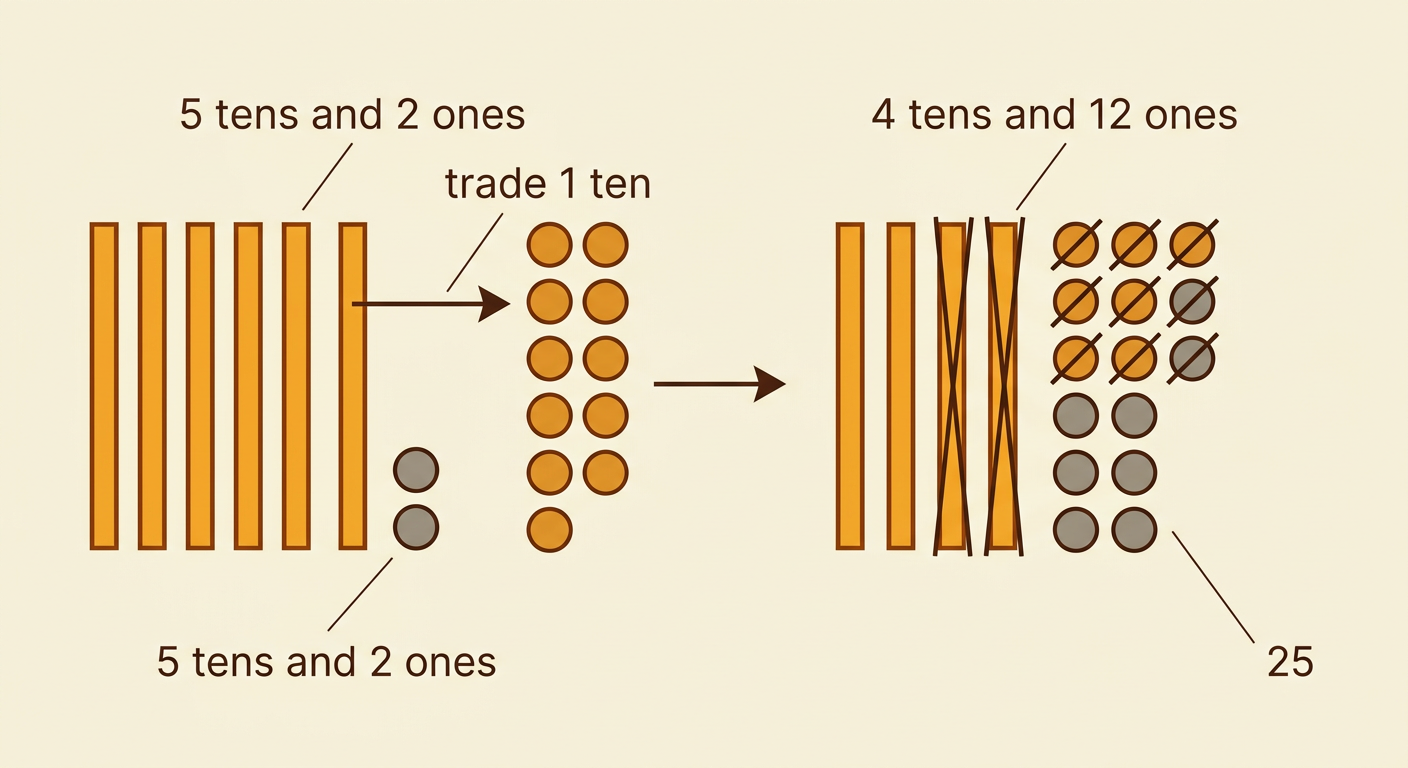
You can draw quick lines for tens and small circles for ones. Use a drawing to solve 52 − 27. Draw 5 tens lines and 2 ones circles for 52. You cannot cross out 7 ones because only 2 ones are shown. Trade 1 ten for 10 ones. Now the drawing has 4 tens and 12 ones. Cross out 7 ones, leaving 5 ones. Then cross out 2 tens, leaving 2 tens. The model now shows 2 tens and 5 ones, which equals 25. So, 52 − 27 = 25. Trading does not change the total value. Five tens and 2 ones have the same value as 4 tens and 12 ones. The drawing simply shows 52 in a new way.
Write Matching Equations
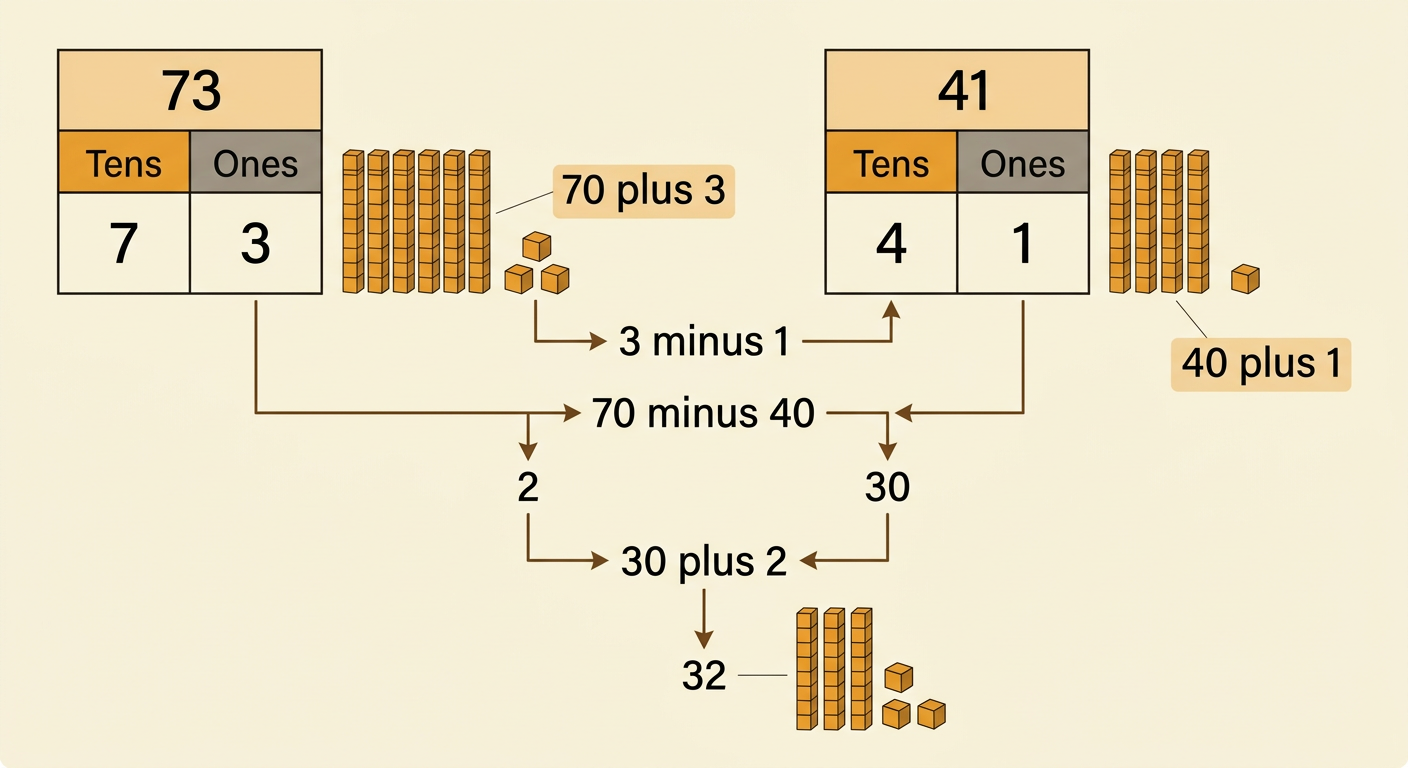
An equation can match the work shown in a place-value model. Solve 73 − 41 by breaking each number into tens and ones. The number 73 is 70 + 3. The number 41 is 40 + 1. Subtract the ones: 3 − 1 = 2. Subtract the tens: 70 − 40 = 30. Then combine the differences: 30 + 2 = 32. The complete equation is 73 − 41 = 32. You can also record the thinking as (70 − 40) + (3 − 1) = 30 + 2 = 32. Parentheses show which parts to subtract first. Matching the equation to the model helps you explain why the answer is correct. Each digit keeps its place value throughout the work.
Practice Two-Digit Subtraction
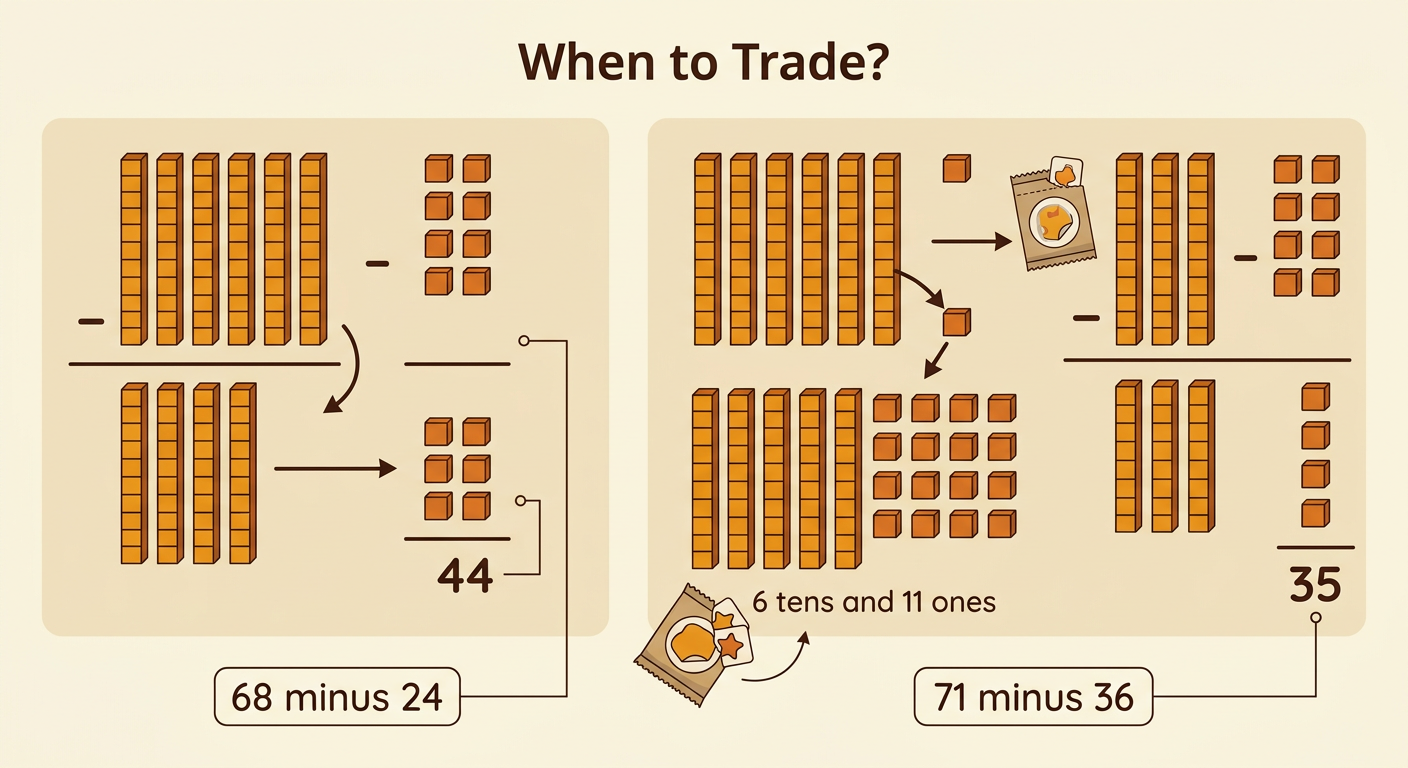
Choose a place-value strategy for each problem. First solve 68 − 24. Subtract the ones: 8 − 4 = 4. Subtract the tens: 6 tens − 2 tens = 4 tens. The answer is 44. Now solve 71 − 36. You cannot subtract 6 ones from 1 one, so trade 1 ten for 10 ones. Then 71 becomes 6 tens and 11 ones. Subtract the ones: 11 − 6 = 5. Subtract the tens: 6 tens − 3 tens = 3 tens. The answer is 35. Try to decide whether a trade is needed before you begin. If the top number has fewer ones than the number being subtracted, trade 1 ten for 10 ones. Then subtract carefully by place.
Explain and Check
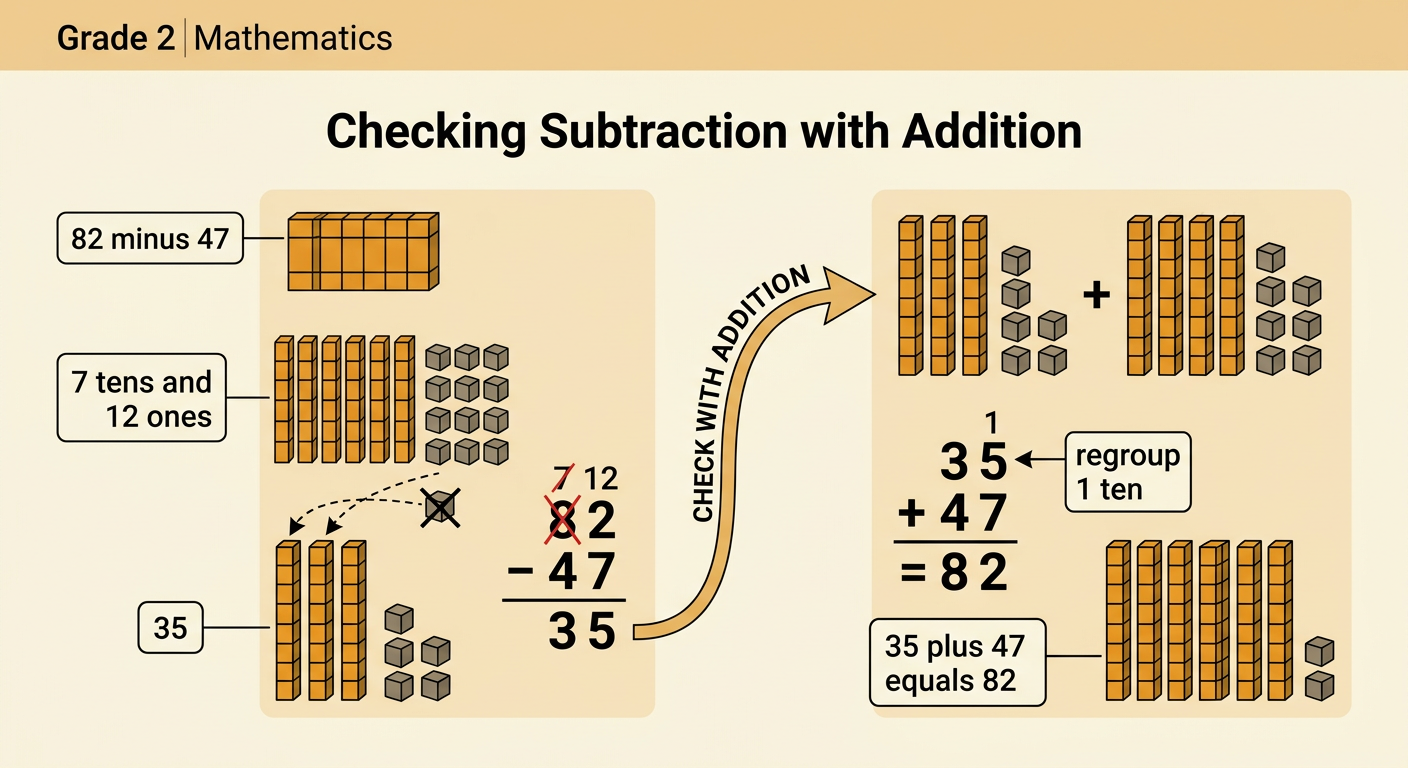
After subtracting, explain your steps and check the answer with addition. Solve 82 − 47. Trade 1 ten so that 82 becomes 7 tens and 12 ones. Subtract 7 ones from 12 ones to get 5 ones. Subtract 4 tens from 7 tens to get 3 tens. Therefore, 82 − 47 = 35. To check, add the difference to the number that was subtracted: 35 + 47. Add the ones: 5 + 7 = 12, so write 2 ones and regroup 1 ten. Add the tens: 3 + 4 + 1 = 8 tens. The sum is 82. Because 35 + 47 = 82, the subtraction answer is correct. A clear explanation tells what you traded, subtracted, and checked.