Subtract Two-Digit Numbers Using Place Value
Students use tens, ones, drawings, and equations to subtract two-digit numbers within 100 and explain their reasoning.
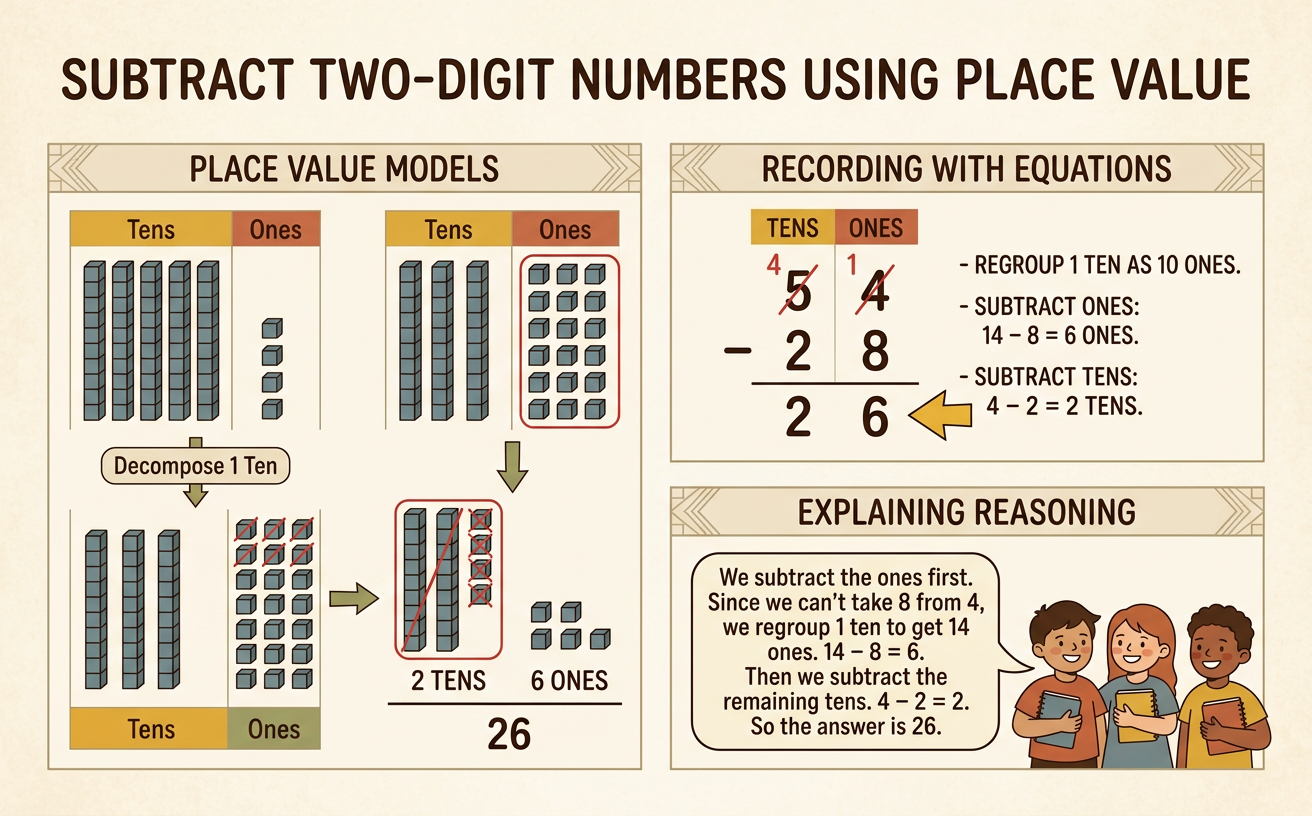
Illustrations are auto-generated and may be placeholders. They can be refreshed to match the narration.
Review Tens and Ones
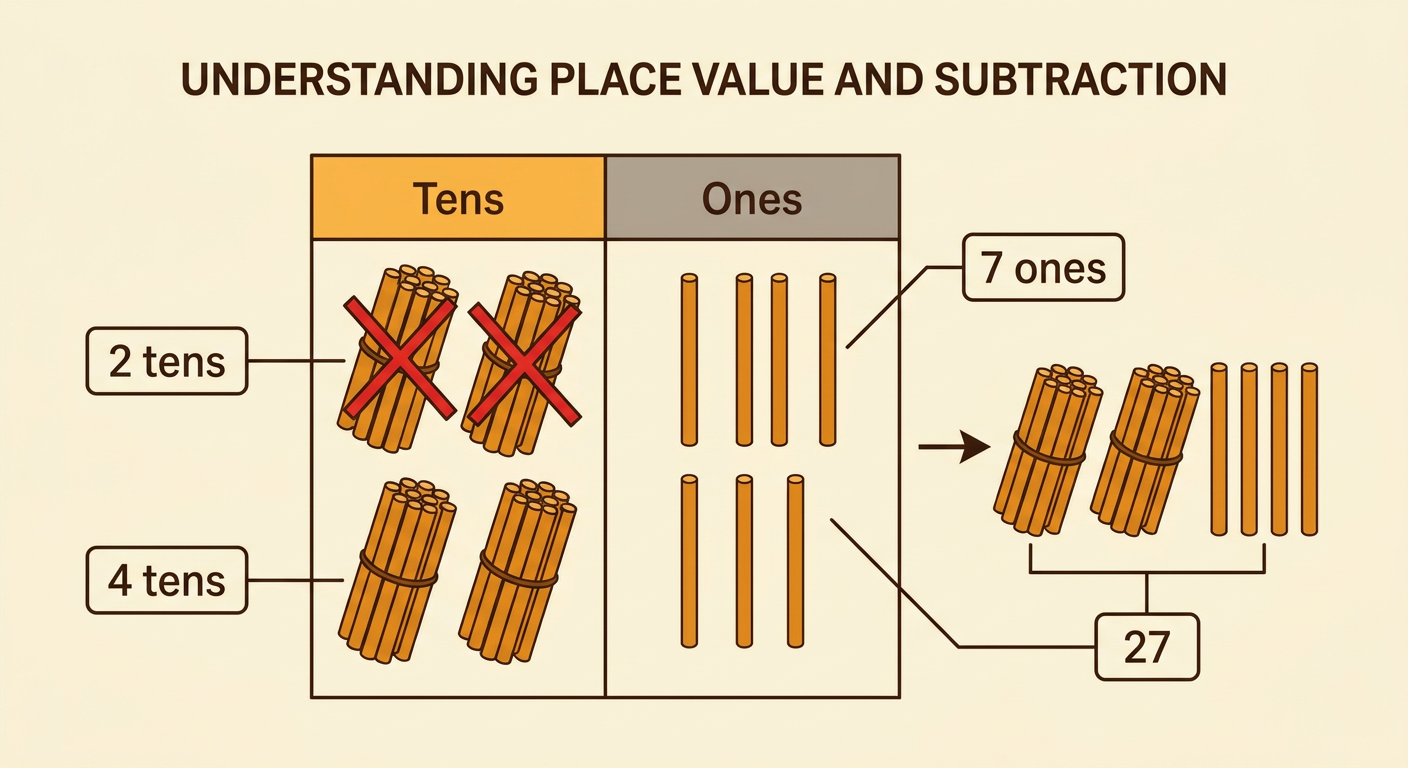
Two-digit numbers are made of tens and ones. In the number 47, the digit 4 means 4 tens, or 40. The digit 7 means 7 ones. Altogether, 40 + 7 = 47. Place value helps us see how numbers can be taken apart and put back together. To subtract, line up tens with tens and ones with ones. For example, think about 47 − 20. Start with 4 tens and 7 ones. Take away 2 tens. There are 2 tens and 7 ones left, so 47 − 20 = 27. Say the answer using place value: 2 tens and 7 ones make 27.
Model Subtraction with Base-Ten Blocks
Base-ten blocks can show subtraction, including when you need to regroup. Model 52 − 27. Build 52 with 5 tens rods and 2 ones cubes. You need to remove 7 ones, but there are only 2 ones. Trade 1 tens rod for 10 ones cubes. Now the model has 4 tens and 12 ones, which is still 52. Remove 7 ones from 12 ones, leaving 5 ones. Then remove 2 tens from 4 tens, leaving 2 tens. The remaining blocks show 2 tens and 5 ones. Therefore, 52 − 27 = 25. Regrouping changes how the number is represented, but it does not change its value.

Draw Place-Value Representations
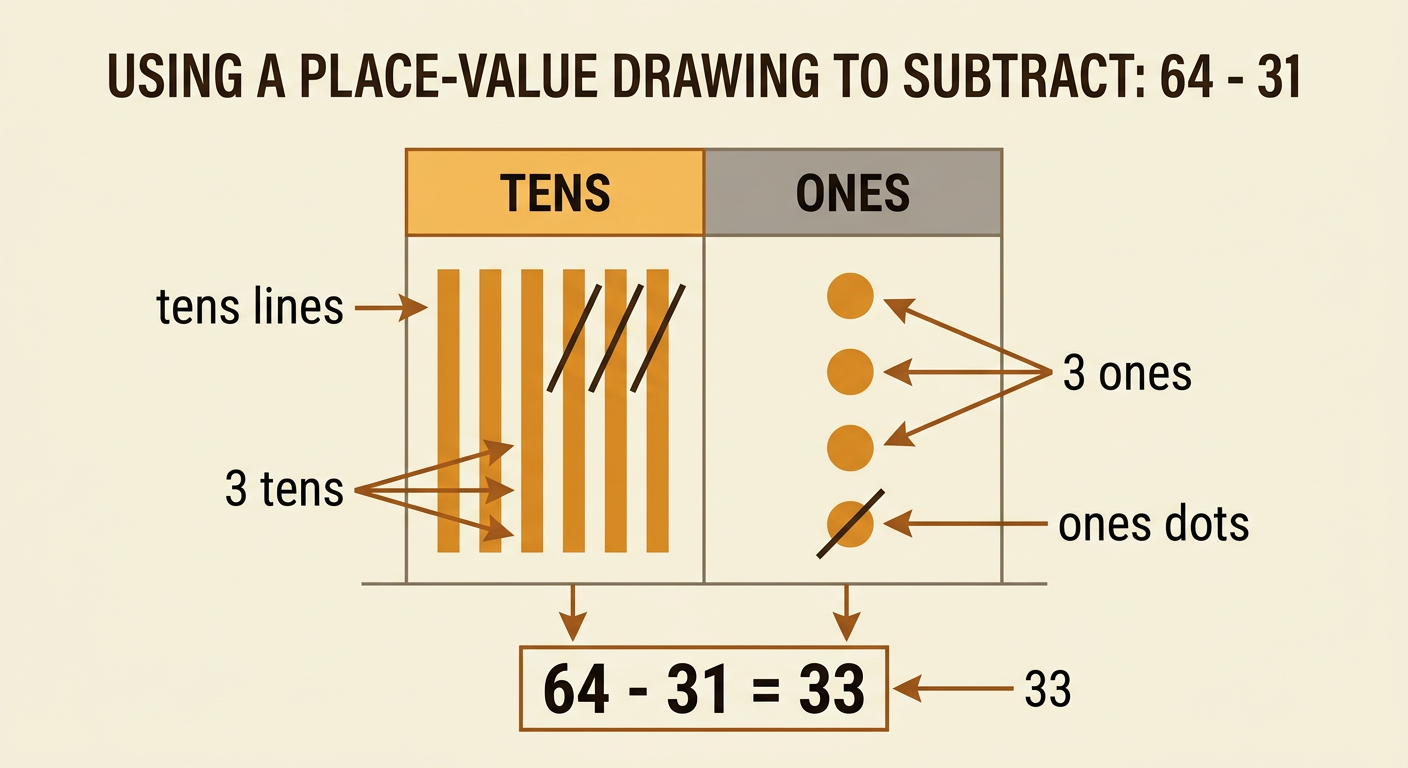
You can draw quick pictures instead of using blocks. Draw a long line for each ten and a small dot for each one. To solve 64 − 31, draw 6 tens lines and 4 ones dots. The number being subtracted has 3 tens and 1 one. Cross out 1 ones dot, leaving 3 ones dots. Then cross out 3 tens lines, leaving 3 tens lines. Your drawing now shows 3 tens and 3 ones, which equals 33. Therefore, 64 − 31 = 33. Keep the tens and ones in separate columns so your work is easy to read. Cross out only what the second number tells you to remove.
Connect Models to Equations
A place-value model matches an equation. Solve 73 − 48. The model begins with 7 tens and 3 ones. Because 3 ones are not enough to remove 8 ones, regroup 1 ten as 10 ones. Now 73 is shown as 6 tens and 13 ones. In an expanded equation, write 73 as 60 + 13 and 48 as 40 + 8. Subtract the ones: 13 − 8 = 5. Subtract the tens: 60 − 40 = 20. Combine the parts: 20 + 5 = 25. So, 73 − 48 = 25. The blocks, drawings, and equations all show the same place-value thinking.

Practice and Explain
Solve 71 − 26 using place value, and explain each step. Begin with 7 tens and 1 one. You cannot remove 6 ones from 1 one, so trade 1 ten for 10 ones. Now you have 6 tens and 11 ones. Remove 6 ones, leaving 5 ones. Remove 2 tens, leaving 4 tens. The difference is 4 tens and 5 ones, or 45. You can explain, “I regrouped 71 as 6 tens and 11 ones. I subtracted 2 tens and 6 ones. I had 4 tens and 5 ones left.” Check with addition: 45 + 26 = 71. This confirms that 71 − 26 = 45.

Complete an Exit Check
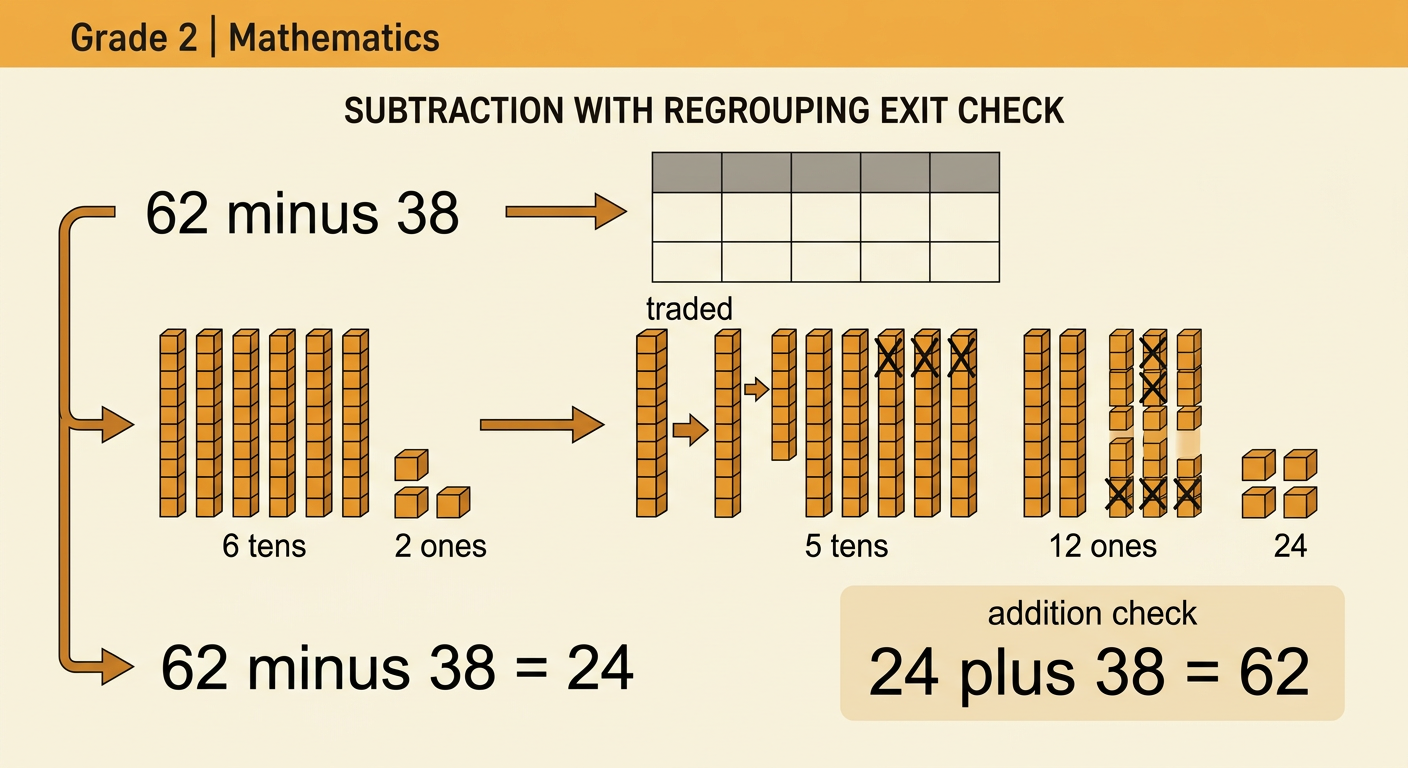
Try this problem on your own: 62 − 38. Draw 6 tens and 2 ones. Since you cannot remove 8 ones from 2 ones, regroup 1 ten as 10 ones. You now have 5 tens and 12 ones. Cross out 8 ones, leaving 4 ones. Cross out 3 tens, leaving 2 tens. The answer is 2 tens and 4 ones, or 24. Record the equation 62 − 38 = 24. Then write one sentence explaining your work. You might write, “I traded 1 ten for 10 ones, subtracted the tens and ones, and found 24.” Check your answer using addition: 24 + 38 = 62.