Suburbanization and Interstate Highways in Postwar America
Students analyze historical sources and demographic data to explain how federal policy, automobile culture, and suburban growth reshaped American communities and the environment after World War II.
Illustrations are auto-generated and may be placeholders. They can be refreshed to match the narration.
The Postwar Housing Boom
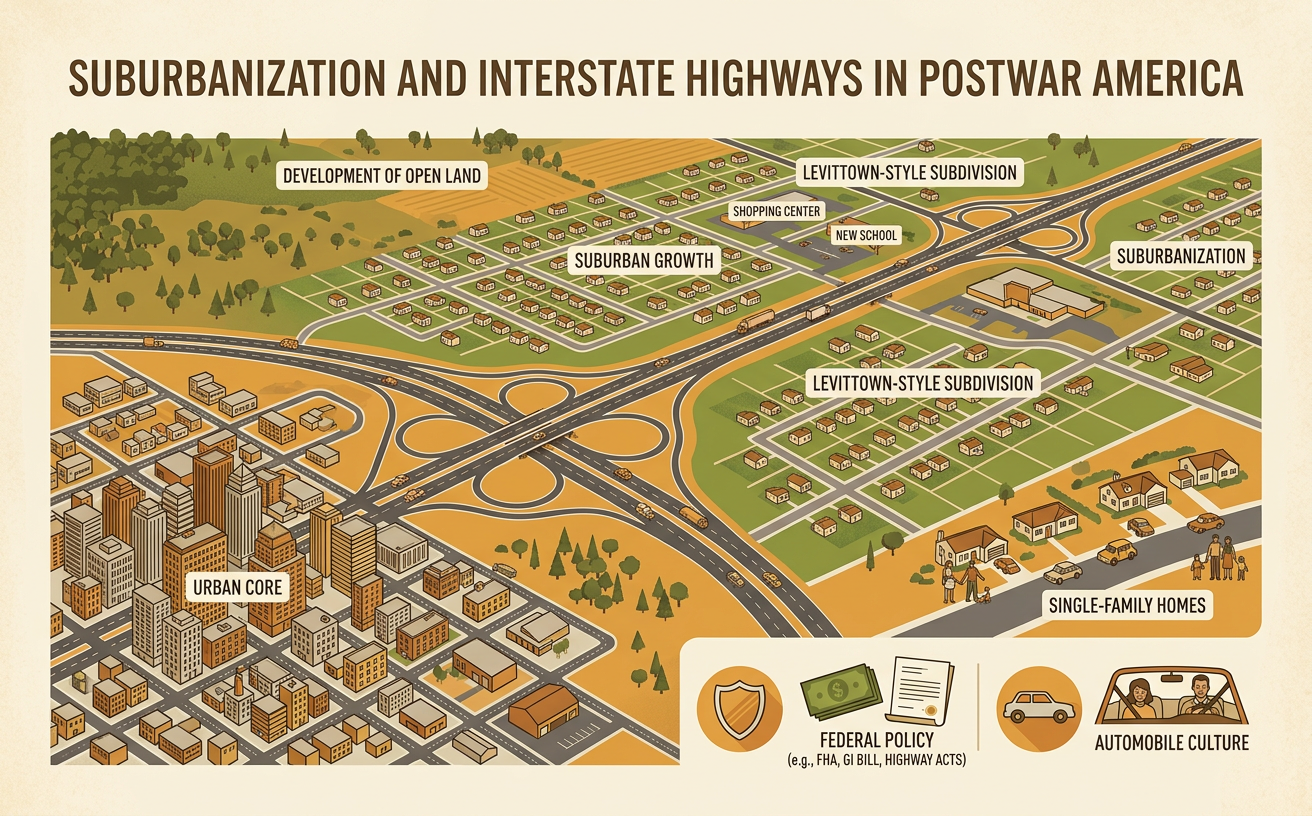
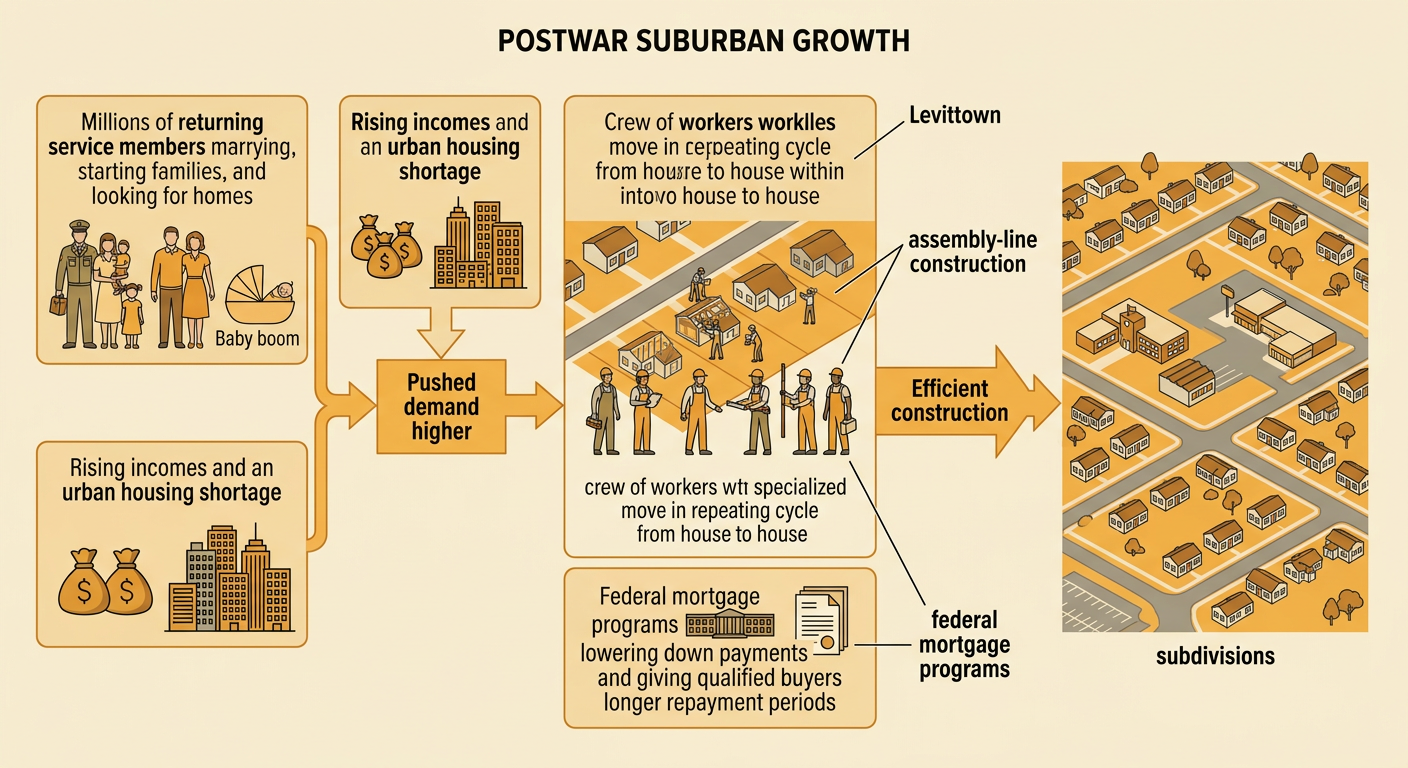
After World War II, millions of returning service members married, started families, and sought homes. Rising incomes, the baby boom, and a shortage of urban housing increased demand. Builders responded by purchasing large tracts outside cities and using standardized designs and assembly-line methods. In Levittown, New York, construction crews repeated specialized tasks, allowing homes to be built quickly and sold at prices many middle-class families could afford. Federal mortgage programs also reduced down payments and extended repayment periods for qualified buyers. Farms and open land became subdivisions with detached houses, yards, schools, and shopping centers. This boom did not result from one cause alone. Population growth, consumer prosperity, construction methods, government support, and the desire for homeownership combined to accelerate suburban growth.
Federal Policies and Highway Construction
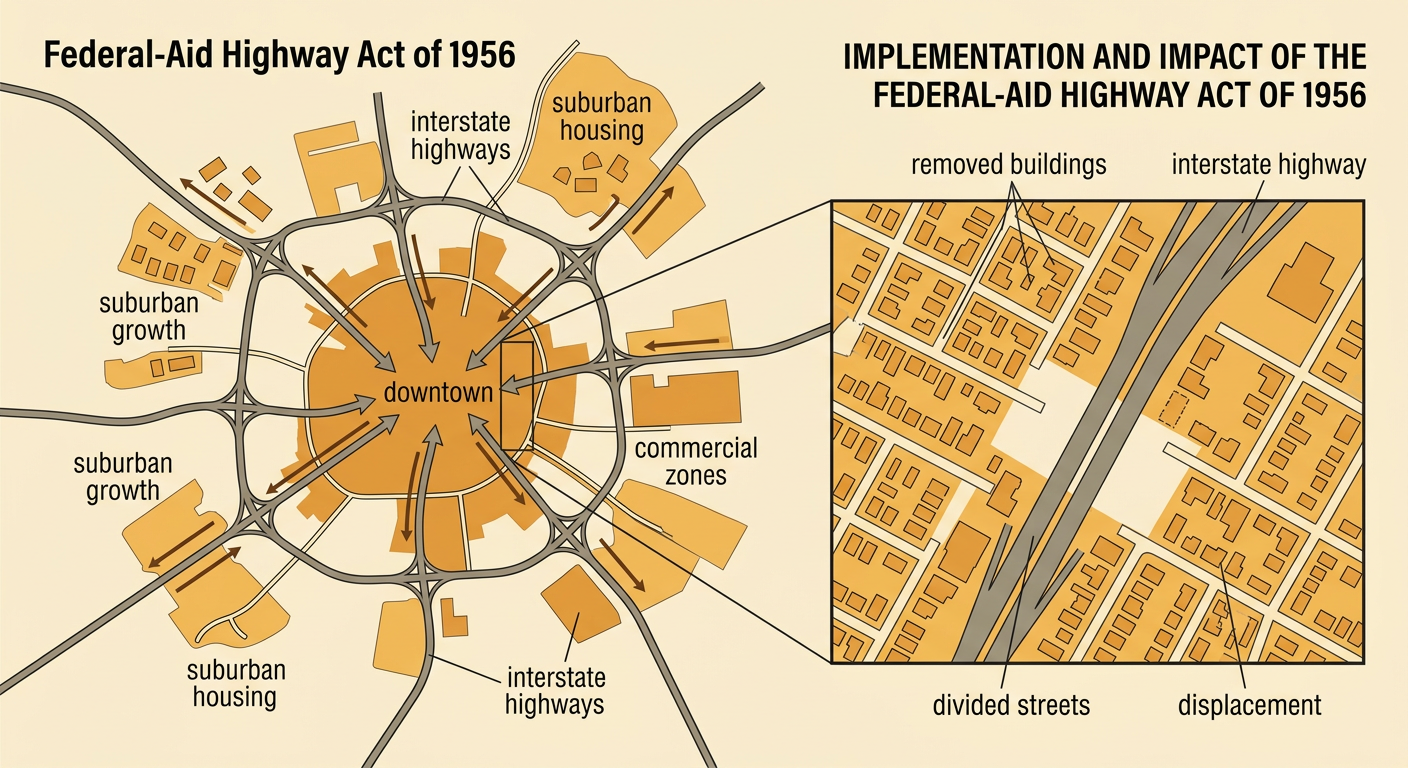
Federal policy made suburban expansion easier by supporting both homeownership and automobile travel. The Federal-Aid Highway Act of 1956 authorized about 41,000 miles of interstate highways, with the federal government paying 90 percent of construction costs. Supporters argued that the system would improve commerce, military transportation, and evacuation routes. Highways also shortened driving times between suburban homes and urban jobs. For example, a household could live beyond a city boundary yet commute downtown by car. However, planners often routed expressways through neighborhoods with limited political power, including many Black and low-income communities. Homes and businesses were demolished, residents were displaced, and local street networks were divided. Thus, the same policy that improved regional mobility and encouraged suburban development also imposed severe costs on particular urban communities.
Reading Population and Transportation Data
Demographic and transportation data can reveal relationships among suburban growth, car ownership, and commuting. Census-based summaries indicate that the suburban population grew by about 47 percent during the 1950s, much faster than the population of central cities. Passenger-car registrations also increased substantially during the decade. To examine the relationship, place year on the horizontal axis and either suburban population or registered cars on the vertical axis. A rising pattern in both data series suggests a positive association. A scatterplot comparing car ownership and suburban population across metropolitan areas could show whether places with more cars also tended to have larger suburban populations. Students should calculate a trend line and describe its direction and strength. However, correlation alone does not prove that cars caused suburbanization; income, housing policy, highway construction, and population growth may influence both variables.

Segregation and Unequal Access to Suburbs
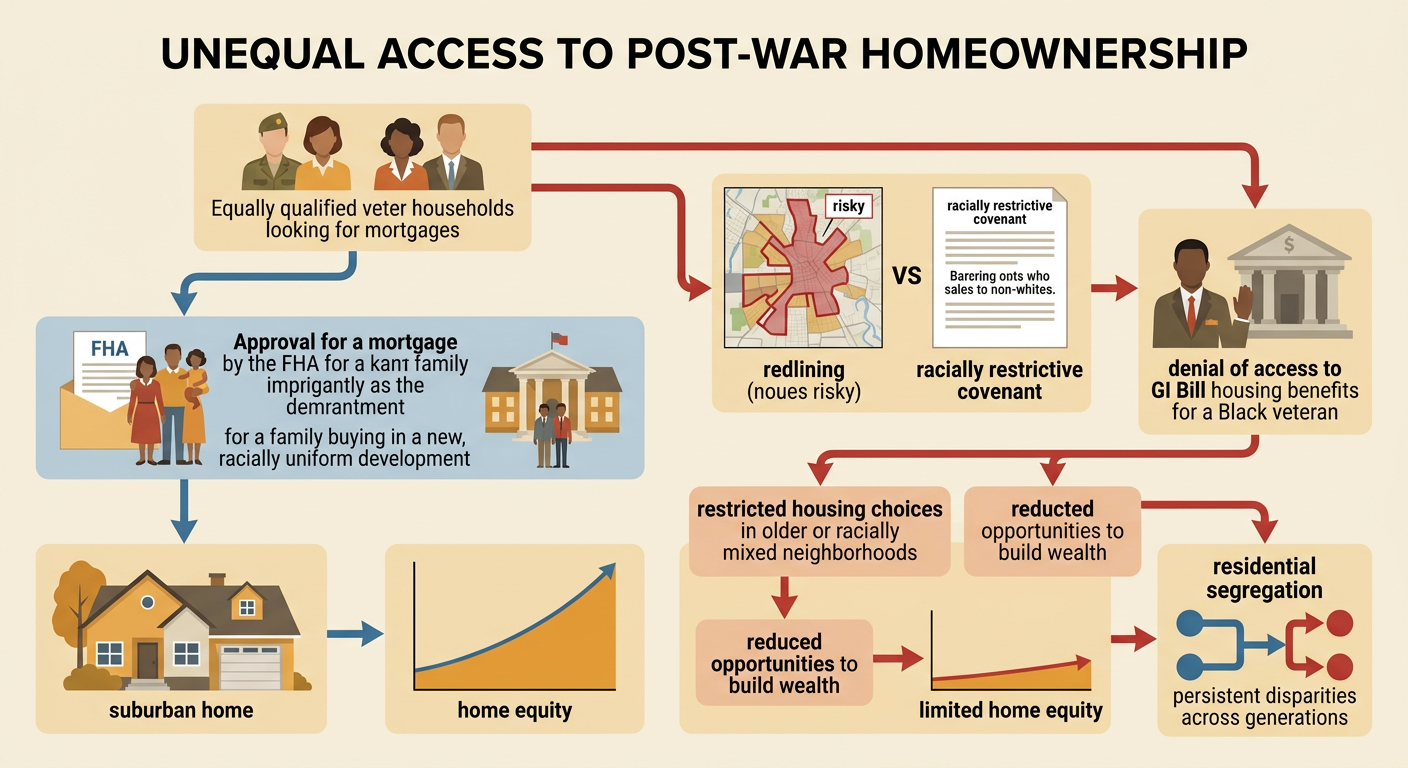
The benefits of suburban homeownership were distributed unequally. Federal Housing Administration underwriting practices favored new, racially uniform developments and treated many older or racially mixed neighborhoods as risky investments. Redlining maps and discriminatory lending restricted mortgage credit in many Black communities. Although the Supreme Court ruled in Shelley v. Kraemer in 1948 that courts could not enforce racially restrictive covenants, private discrimination continued. The GI Bill was race-neutral in its language, but local banks, real estate agents, and officials often denied Black veterans equal access to its housing benefits. Levittown, New York, for example, initially refused to sell homes to Black buyers. Because home values later increased, families admitted to suburban markets gained wealth that could be passed to later generations. Excluded families lost both housing choices and an important opportunity to build wealth.
Environmental Effects of Automobile Dependence
Low-density suburban development usually separates homes, workplaces, stores, and schools, making daily car travel more common. More driving increases gasoline use and releases carbon dioxide and air pollutants. Roads and parking lots replace vegetation with impervious surfaces, causing faster stormwater runoff and carrying oil, metals, and other pollutants into waterways. Development can also fragment wildlife habitat and consume farmland. A typical suburban shopping center surrounded by parking illustrates how land use and transportation systems work together. Possible solutions include reliable public transit, safe walking and bicycling routes, mixed-use development, electric vehicles, and construction near existing infrastructure. Each solution has limits. Electric vehicles reduce tailpipe emissions but still require energy, roads, and parking, while compact development may face cost or community opposition. Evaluating solutions requires comparing environmental benefits, economic costs, feasibility, and effects on different groups.

Evaluating the Legacy of Suburbanization
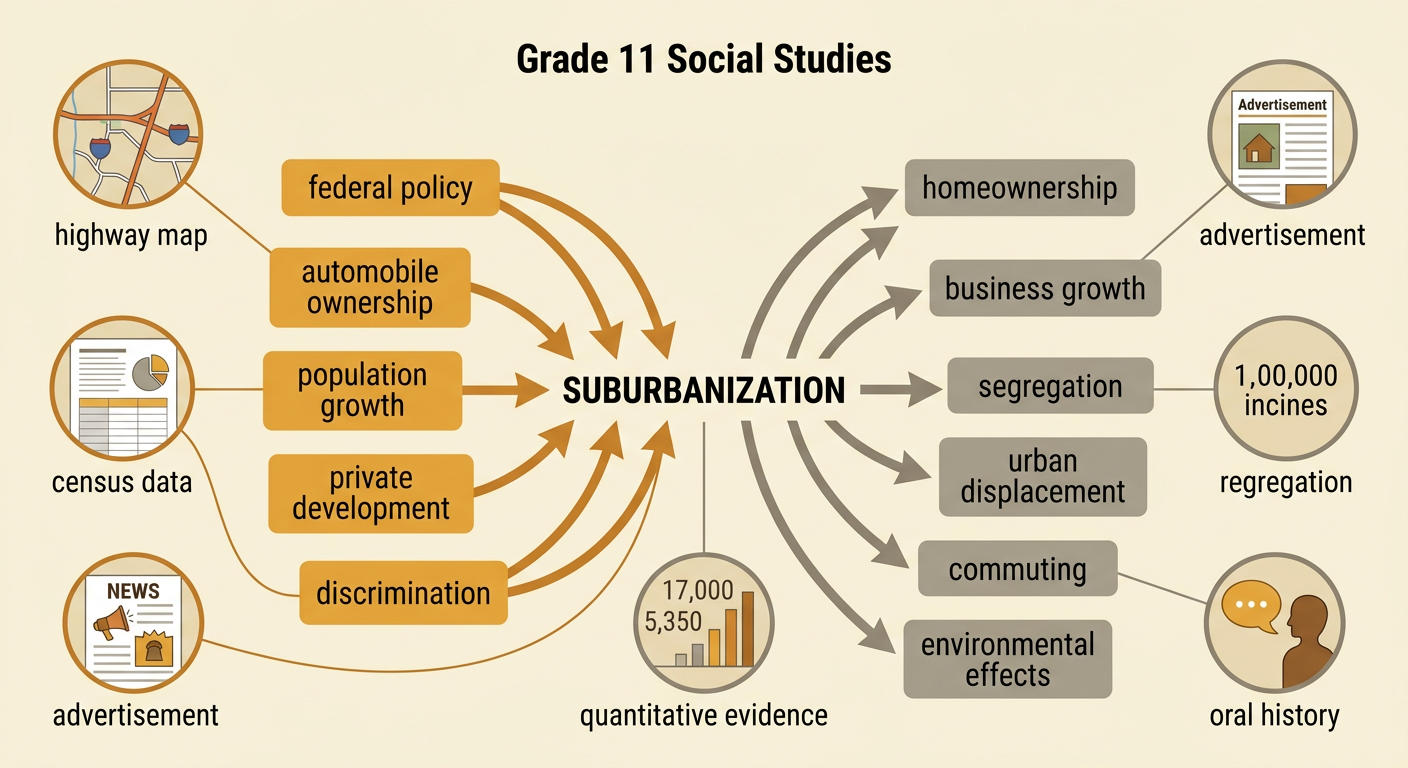
Suburbanization reshaped American life through multiple connected causes and effects. Federal mortgages, highway spending, automobile ownership, population growth, racial discrimination, and private development all influenced where people lived. The results included wider access to homeownership for many families, new schools and businesses, longer commutes, urban disinvestment, residential segregation, and environmental damage. No single source captures this full history. A highway map can show new connections, census data can measure population shifts, an advertisement can reveal ideals about family life, and an oral history can document displacement. Students should compare who created each source, its purpose, and what evidence it provides or omits. A strong historical claim might argue that federal policy accelerated suburbanization while distributing its benefits and costs unequally. The claim should be supported with both quantitative evidence and accounts from affected communities.