
Sun or Shade: What Helps Plants Grow?
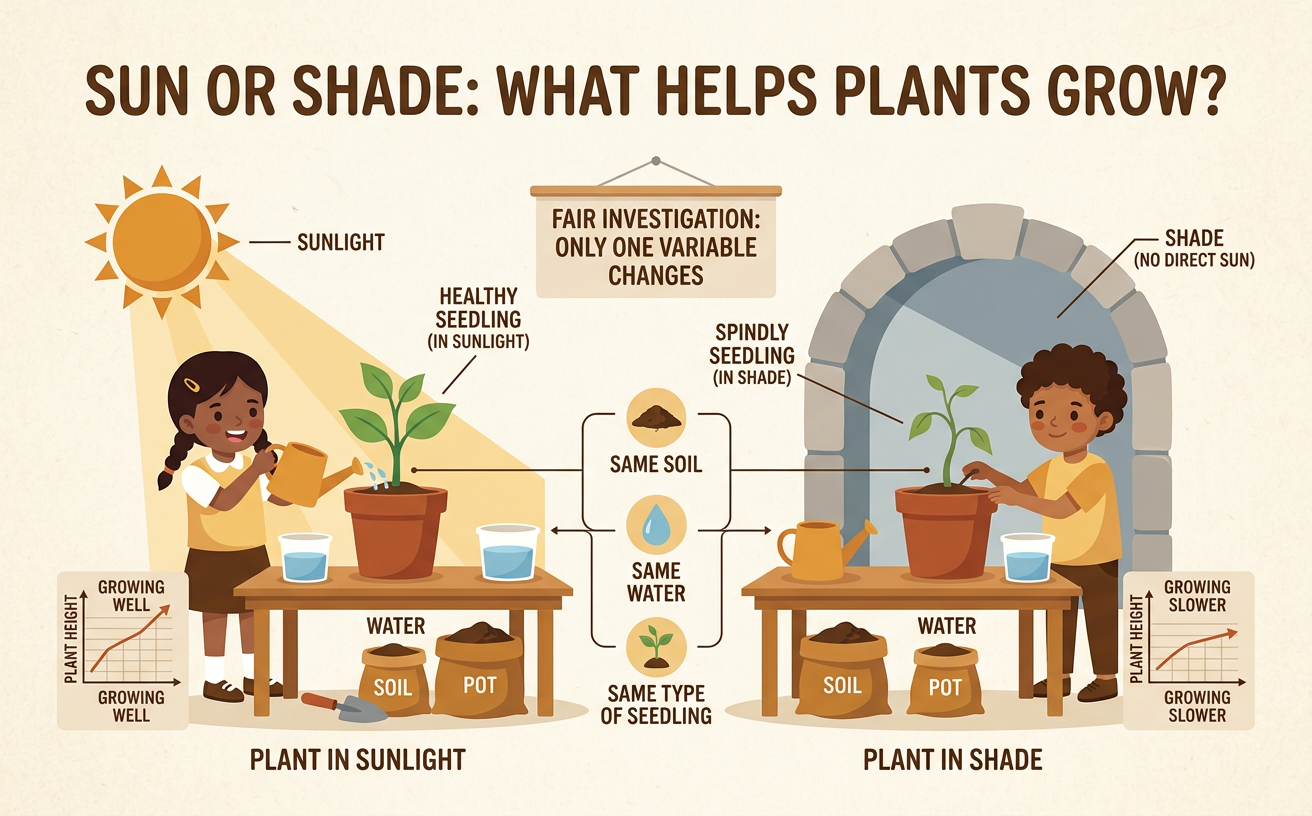
Students plan a fair investigation to compare how seedlings grow in sunlight and shade while keeping water and other conditions the same.
Illustrations are auto-generated and may be placeholders. They can be refreshed to match the narration.
Notice How Plants Grow
Plants need water and light to grow, but different places give plants different amounts of sunlight. Look around your classroom, schoolyard, or home. A windowsill may be sunny for several hours, while a shelf or a spot under a tree may be shaded. Notice the plants in each place. Look at their height, leaf color, number of leaves, and the direction they lean. For example, a bean seedling near a sunny window might have several green leaves. A seedling farther from the window might be shorter or lean toward the light. These observations can help you think of questions. However, one observation does not prove that sunlight caused a difference. The plants may also have received different amounts of water or care. A fair investigation can help identify what affects their growth.

Ask a Testable Question
A testable question can be answered by making observations or measurements. Ask about one condition you can change and one result you can measure. For this investigation, ask, “How does growing in sunlight or shade affect the height of bean seedlings?” The condition you change is the amount of sunlight. This is called the test condition. The result you measure is seedling height. Decide what sunlight and shade mean in your test. For example, the sunlight group might sit by a window that receives direct sunlight, while the shade group sits behind a shade screen nearby. You will give both groups the same amount of water. A question such as “Which plant is happier?” is not as useful because happiness cannot be measured clearly. Height, number of leaves, and leaf color can be observed and recorded.

Plan a Fair Sunlight Test
A fair test changes only one main condition. Prepare two groups with at least three similar bean seedlings in each group. Use the same kind and size of pot, the same amount and type of soil, and seedlings that begin at about the same height. Place one group in sunlight and one group in shade. Keep the groups near each other so the air and temperature are as similar as possible. Give every plant the same measured amount of water on the same days. For example, give each seedling two tablespoons of water every other day. Measure the plants at the same time of day for one or two weeks. Label every pot so the groups do not get mixed up. A simple classroom map can show the sunny window, the shade screen, and each group’s location. This records an important environmental characteristic of each place.

Predict the Results
A prediction tells what you think will happen before you begin the test. It should answer the testable question and include a reason based on what you know or have observed. You might write, “I predict that the seedlings in sunlight will grow taller than the seedlings in shade because plants use light to grow.” Another possible prediction is that both groups will grow, but the sunlight group will develop more green leaves. Predictions can be different, and they do not have to be correct. Their purpose is to record your thinking before you collect evidence. Do not change your prediction after seeing the measurements. Instead, compare the final evidence with your original idea. In a shared class project, each student can draw or write a prediction, and the class can count how many students chose each possible result.

Measure and Graph Growth
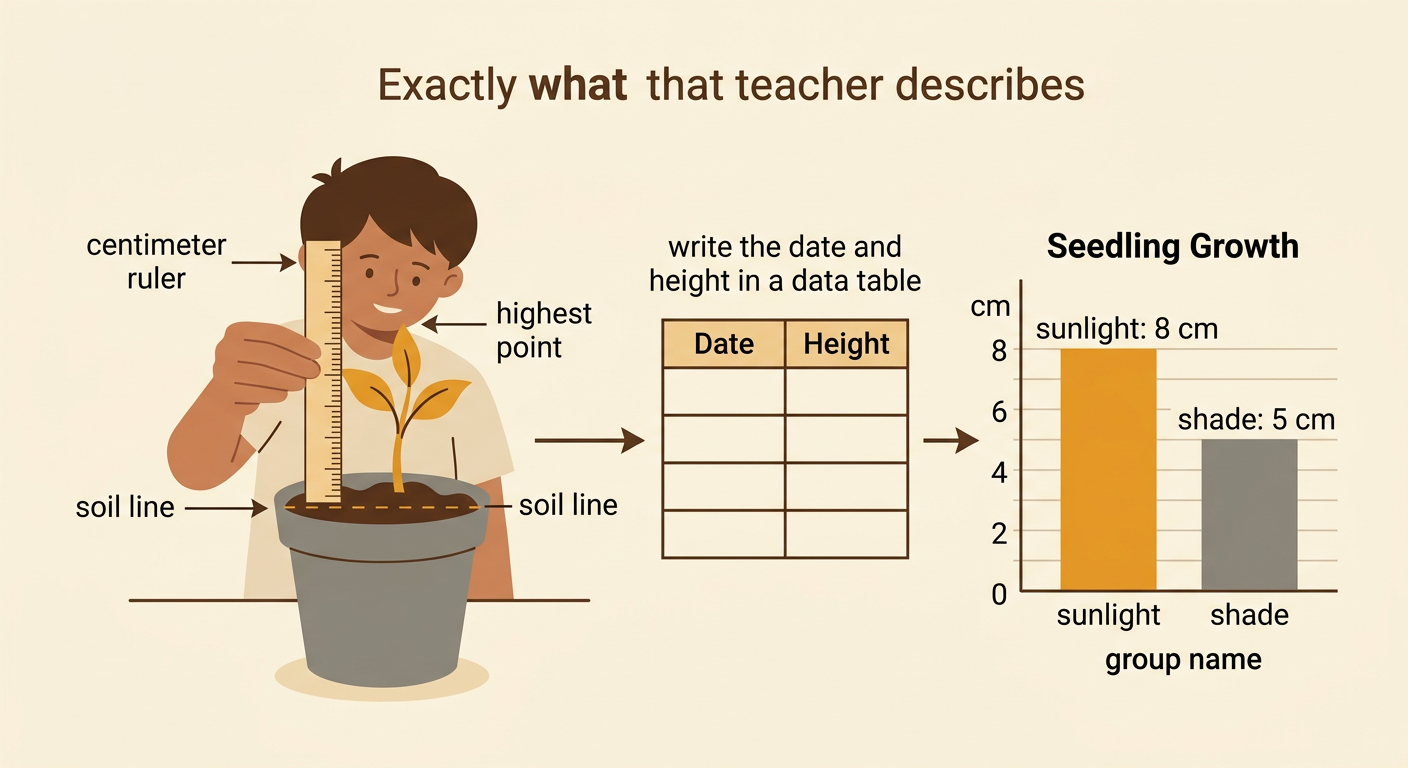
Measure each seedling from the soil line to its highest point using a centimeter ruler. Measure gently and at the same time of day. Record the date and height in a data table. You can also count leaves and take photographs from the same position. After several days, use the measurements to make a picture graph or bar graph. Give the graph a title, label the sunlight and shade groups, and show height in centimeters on the number scale. For example, imagine that one labeled sunlight seedling grows from 3 centimeters to 8 centimeters, while one labeled shade seedling grows from 3 centimeters to 5 centimeters. The final bars would show 8 and 5. The sunlight seedling would be 3 centimeters taller because 8 minus 5 equals 3. Graphs make patterns and differences easier to see, but they must match the recorded data.
Share Evidence-Based Conclusions
A conclusion explains what the evidence shows. Begin with a claim that answers the testable question. Then include measurements from the table or graph as evidence. Finally, explain how the evidence supports the claim. For example, you might write, “In our test, the sunlight seedling reached 8 centimeters, and the shade seedling reached 5 centimeters. The sunlight seedling was 3 centimeters taller, so our evidence supports the claim that more sunlight helped this seedling grow taller.” Use the words “in our test” because one investigation may not prove what happens to every plant. Discuss unusual results, such as a damaged leaf or spilled water. Work with classmates to create a shared report containing the question, setup map, photographs, data graph, and conclusion. Explain how the sunny and shaded locations differed and suggest how the investigation could be improved or repeated.
