
Sunlight and Ice: Where Does It Melt Faster?
Students compare ice placed in sunlight and shade to observe how warming can change solid ice into liquid water.
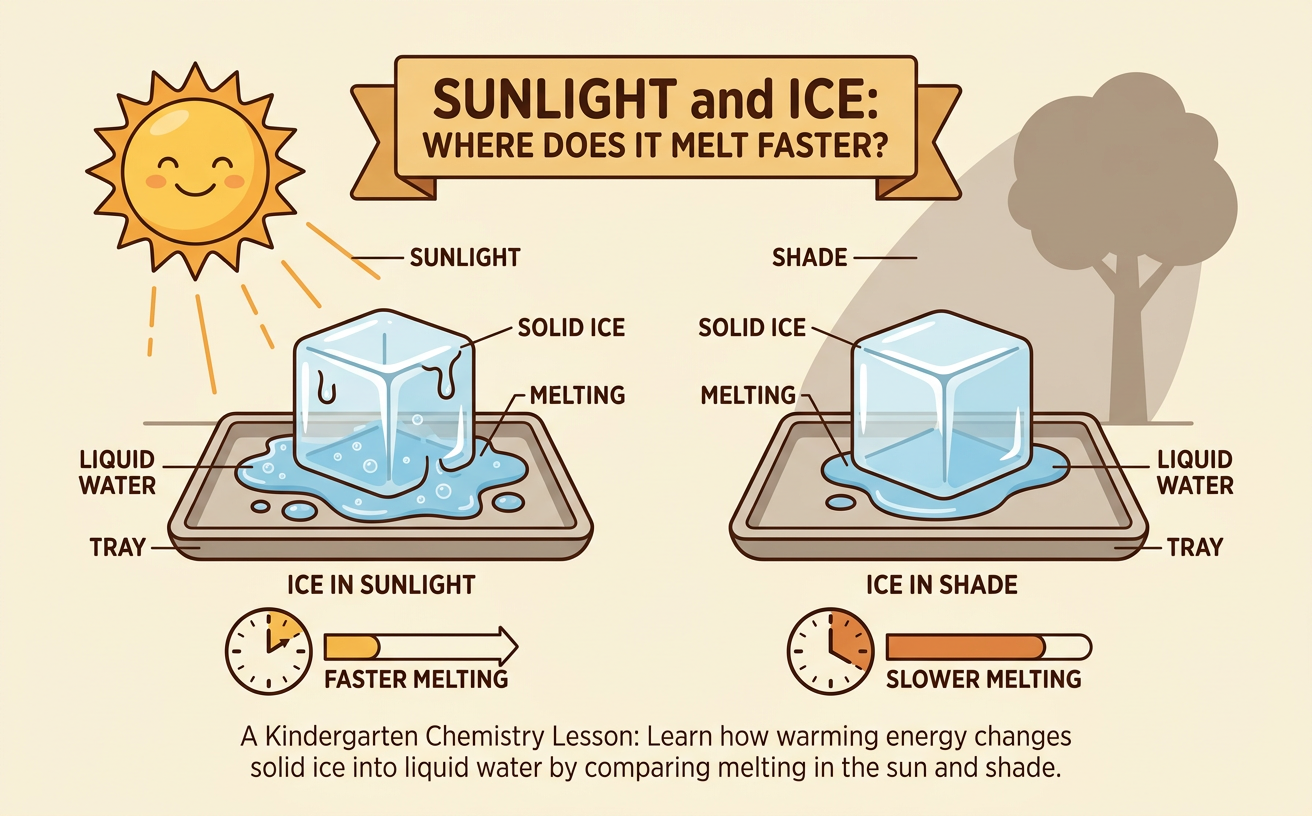
Illustrations are auto-generated and may be placeholders. They can be refreshed to match the narration.
Meet Solid Ice
Ice is water in a solid state. A solid keeps its own shape, so an ice cube stays cube-shaped when it is placed on a plate. Ice also feels cold because energy moves from warmer objects, such as your hand, into the colder ice. As the ice warms, it can change into liquid water. Liquid water does not keep one shape. It spreads out and takes the shape of its container. For example, a solid ice cube may slowly become smaller while a puddle of liquid water grows around it. This change from solid ice to liquid water is called melting. The water has not disappeared. It has only changed from one state of matter to another.

Predict Sunlight or Shade
A prediction tells what you think will happen before a test begins. Imagine placing one equal-sized ice cube in sunlight and another equal-sized ice cube in shade. Which cube do you think will melt faster? Sunlight carries energy that can warm Earth’s surfaces, including the ground, a table, or a plate. A warmer surface can help warm the ice resting on it. The ice in shade may also melt, but it may melt more slowly because it receives less direct sunlight. You might predict, “The ice cube in sunlight will melt faster.” Share your prediction with a partner. Listen to your partner’s idea, and explain your thinking using the words sunlight, shade, warmer, or cooler.

Set Up the Ice Test
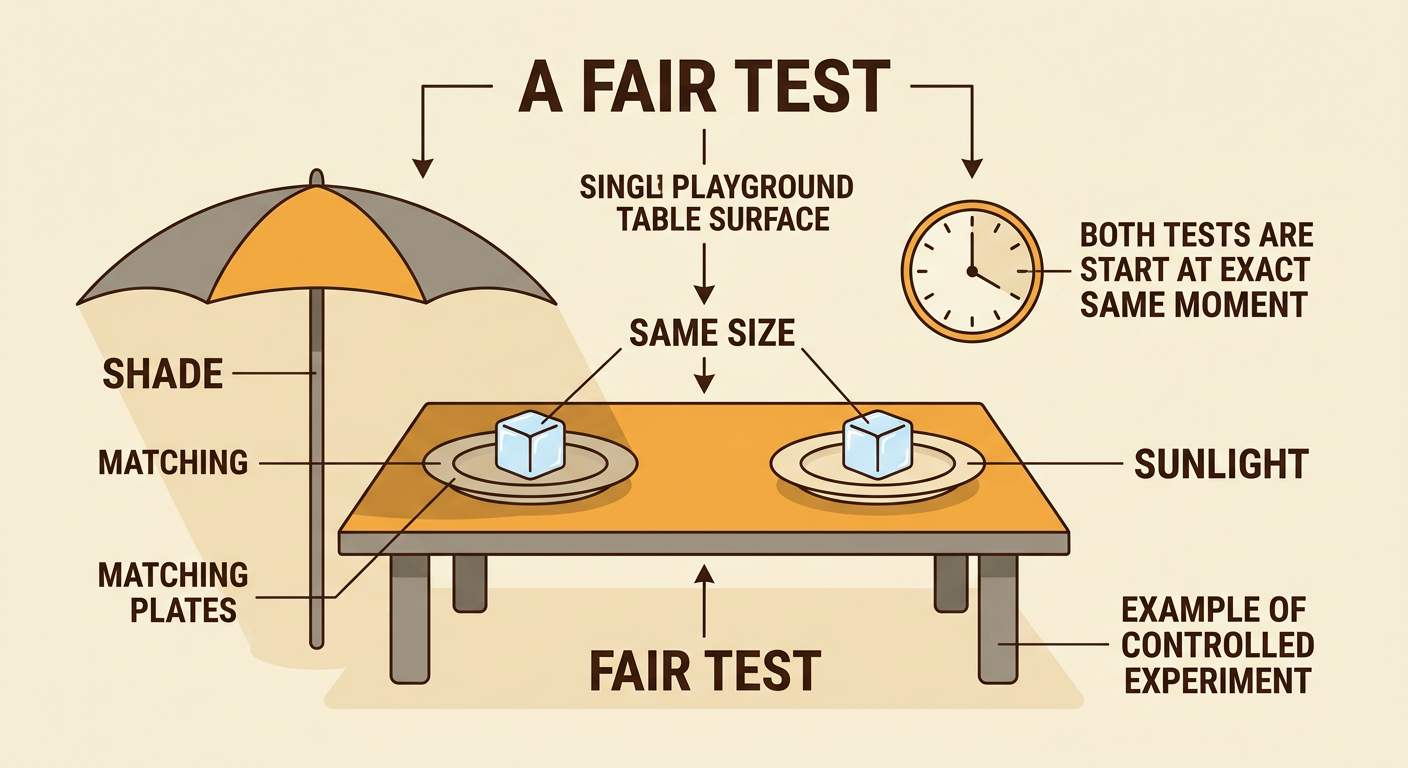
To make a fair test, use two ice cubes that are as close to the same size as possible. Put each cube on the same kind of plate. Place one plate in direct sunlight and the other in nearby shade. Both plates should be outdoors at the same time and on the same kind of surface. Start the test at the same moment so each ice cube has an equal amount of melting time. Do not move, taste, or play with the ice during the test. An adult can help choose safe places away from streets and hot surfaces. For example, place one plate on a sunny part of a playground table and the other on the shaded part of that same table. Now only the amount of sunlight is purposefully different.
Observe and Compare
Observe the ice cubes at regular times, such as every two minutes. Look without moving the plates. Compare the size of each solid cube and the amount of liquid water around it. You can say one cube is larger, smaller, or about the same size as the other. You can also compare the puddles by saying one has more or less liquid water. For example, after six minutes, the sunny cube may be smaller and its puddle may be larger than those of the shaded cube. Draw what you see or place a mark in a class chart. Continue until one cube has melted. Tell your group what you notice, listen to their observations, and decide together which ice cube melted faster. Record what actually happened, even if it differs from your prediction.

Explain the Change
Sunlight carries energy to Earth’s surface. In the test, sunlight warms the plate and the ice in the sunny place. When solid ice gains enough energy, it melts into liquid water. This is why the ice in direct sunlight will often melt faster than equal ice in nearby shade. The shaded ice can still gain energy from the surrounding air and surface, so it can melt too. Melting does not create new water or make the ice vanish; it changes water from a solid to a liquid. Sunlight also affects people’s choices. On a sunny day, people may choose shade to stay cooler, protect frozen foods in an insulated cooler, or move an ice drink away from a sunny window. Weather and sunlight help shape how people work, play, and keep things cool.
