Sunlight Warms Earth’s Surface
Students observe and compare sunny and shaded surfaces to discover that sunlight warms Earth’s surface.

Illustrations are auto-generated and may be placeholders. They can be refreshed to match the narration.
Notice Sun and Shade
Go outside with your teacher and look around without looking directly at the Sun. Find places where sunlight reaches the ground. These places are sunny. Then find places where a tree, roof, or other object blocks the sunlight. These places are shaded. Notice that a shadow forms on the side away from the Sun. Compare two spots made of the same material, such as one sunny part and one shaded part of a sidewalk. Using the same material helps us make a fair comparison. Look closely at both spots. They may look alike even when they do not feel the same. Sunlight carries energy to Earth’s surface and can make the ground, water, and other surfaces warmer.

Predict Which Surface Is Warmer
A prediction is a careful guess about what you think will happen. Before comparing the sunny and shaded sidewalk, think about the sunlight. Which spot do you predict will be warmer? You might say, “I predict the sunny sidewalk will be warmer because sunlight reaches it.” Another student may have a different idea. Take turns sharing predictions and listening to one another. Point to the place you choose or place a picture card beside it. Use words that describe temperature, such as warm, warmer, cool, or cooler. It is all right if a prediction is not correct. Scientists make predictions and then gather information to find out what happens. Everyone will use observations to check the predictions.

Observe and Safely Compare Surfaces
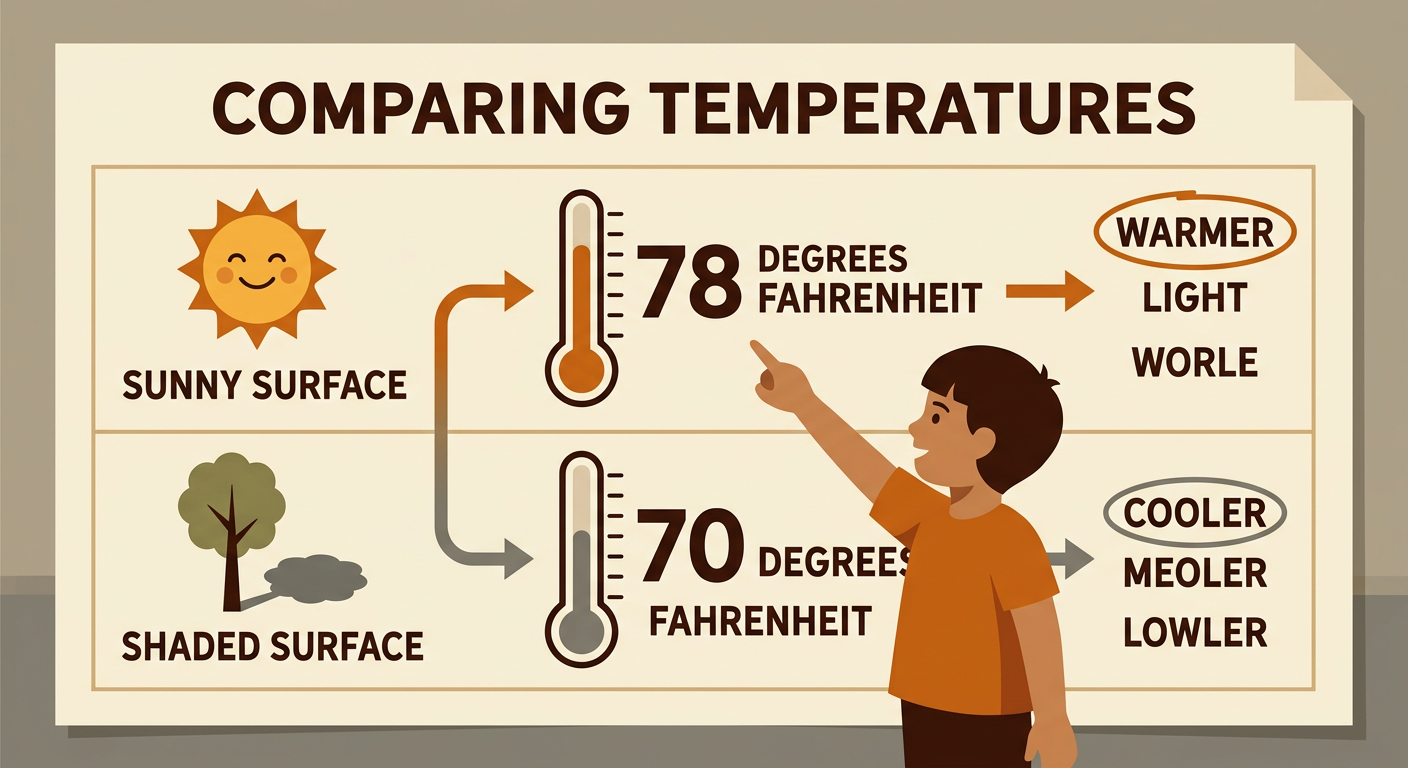
Now collect information safely with your teacher. Never look directly at the Sun, and do not touch metal, playground equipment, or any surface that an adult has not checked. Your teacher can place one classroom thermometer on the sunny sidewalk and a matching thermometer on the shaded sidewalk. Both thermometers should rest for the same amount of time. Then the teacher can hold them up so everyone can observe the readings. A higher temperature means the surface area is warmer. For example, the sunny spot might read 78 degrees Fahrenheit while the shaded spot reads 70 degrees Fahrenheit. If your teacher says a surface is safe to touch, briefly use the back of one finger and stop if it feels hot. Comparing the same material in two places makes the test fairer.

Record Warm and Cool Findings
Scientists record what they observe so they can remember and compare the results. Make a class chart with two rows: sunny surface and shaded surface. Draw a Sun beside the sunny row and a tree shadow beside the shaded row. Add the thermometer readings with your teacher’s help. You can also circle a word that describes each place: warm, warmer, cool, or cooler. For example, record 78 degrees Fahrenheit for the sunny sidewalk and 70 degrees Fahrenheit for the shaded sidewalk. The number 78 is greater than 70, so the sunny sidewalk was warmer in this observation. Look back at your prediction. Did the findings match it? Say, “The sunny surface was warmer than the shaded surface.” Observations can be different on another day or in another place.
Discuss How Sunlight Affects People
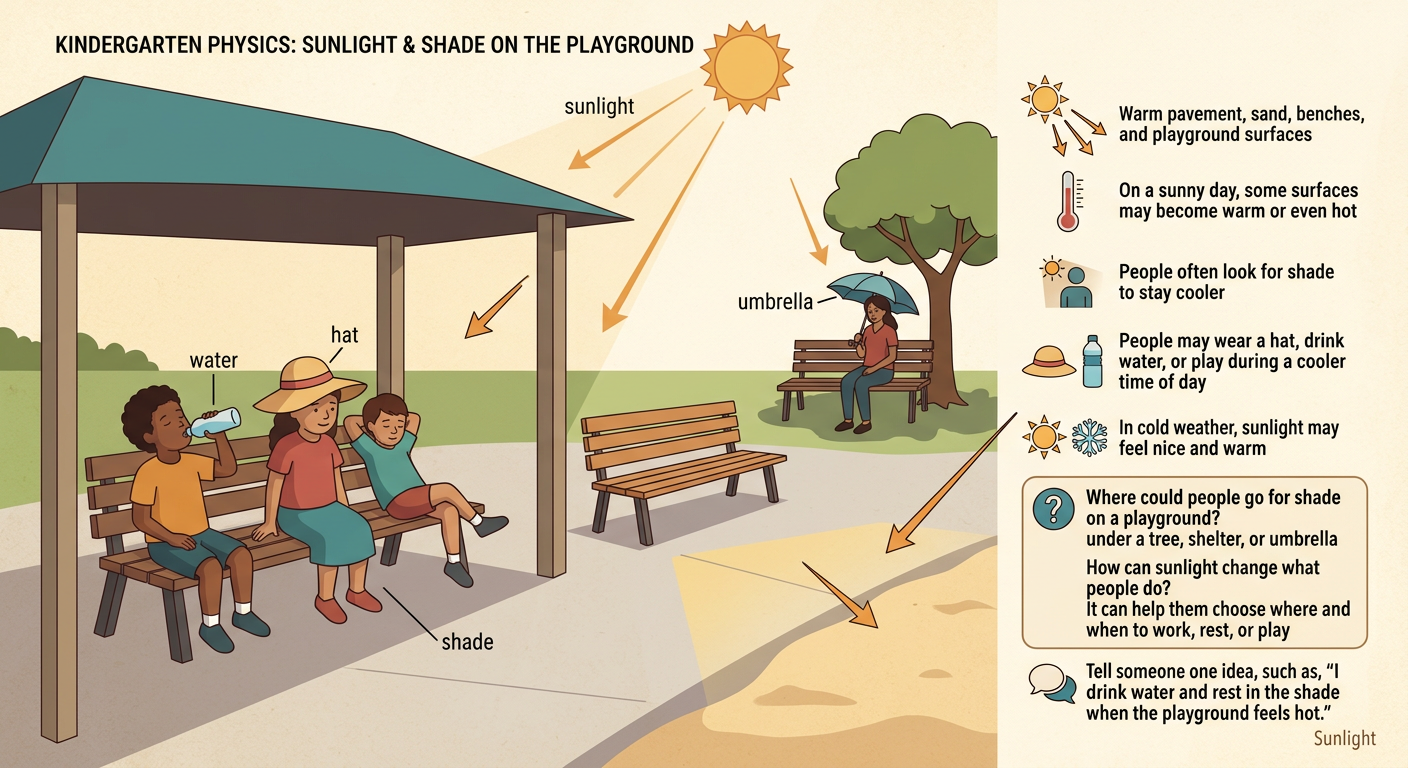
Sunlight warming Earth’s surface affects what people do and how they feel outdoors. On a sunny day, pavement, sand, and playground surfaces can become warm or hot. People may choose a shady tree, shelter, or umbrella to stay cooler. They may wear a hat, drink water, or play at a cooler time of day. In a colder place or season, people may enjoy standing in sunlight because the sunny ground and air nearby can feel warmer. Think about your school playground. Where could people go for shade? Tell a partner one way sunlight affects people there, and listen to your partner’s idea. For example, “We sit under the playground shelter when the sunny benches feel hot.” Sunlight and shade help people decide where and when to work, rest, and play.