
Sunlight Warms Earth's Surfaces
Students compare surfaces in sunlight and shade to discover that sunlight warms Earth's surface.

Illustrations are auto-generated and may be placeholders. They can be refreshed to match the narration.
Sunlight and Shade
Sunlight carries energy from the Sun to Earth. When sunlight reaches the ground, a sidewalk, or another surface, the surface takes in some of that energy and becomes warmer. A surface in shade receives less direct sunlight, so it often stays cooler. Imagine two parts of the same playground. One part of the blacktop is in bright sunlight. Another part is under a large tree. After several minutes, the sunny blacktop may feel warmer than the shaded blacktop. The two places should have the same kind of surface so that sunlight is the main difference. Clouds, wind, and the time of day can also affect warmth. Observing sunny and shaded places helps us discover how sunlight warms Earth's surfaces.
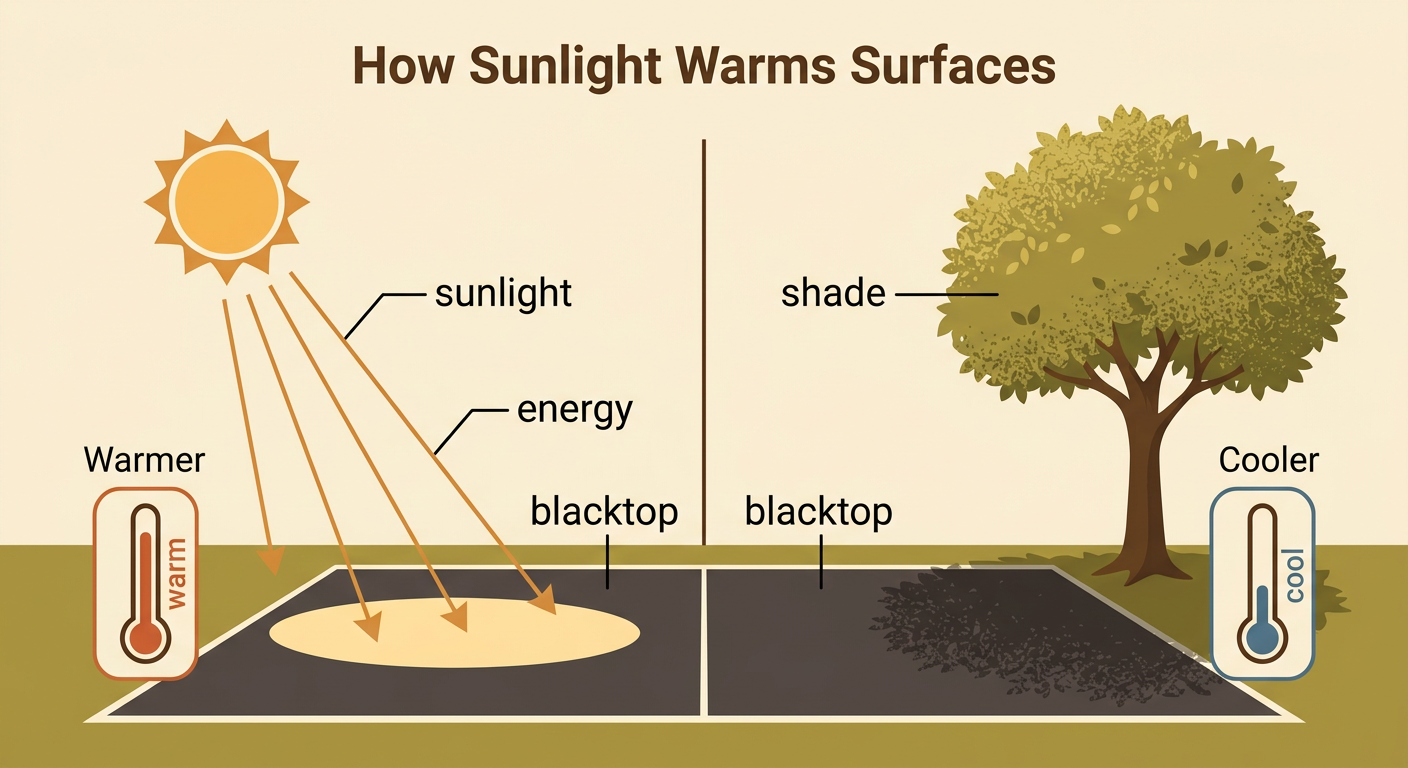
Predict Which Surface Feels Warmer
A prediction is what you think will happen before you observe. You can use what you already know to make a careful prediction. Suppose one concrete square has been in sunlight and another matching concrete square has been in shade. Which one do you think will be warmer? You might predict, “The concrete in sunlight will be warmer because sunlight transfers energy to the surface.” A prediction is not a random guess. It gives a reason that can be tested. Think about your own experiences. A sunny slide may feel hot, while a slide under a roof may feel cooler. Your experience can help you answer the question. It is fine if your prediction is different from the result because observations provide new evidence.

Observe Two Locations
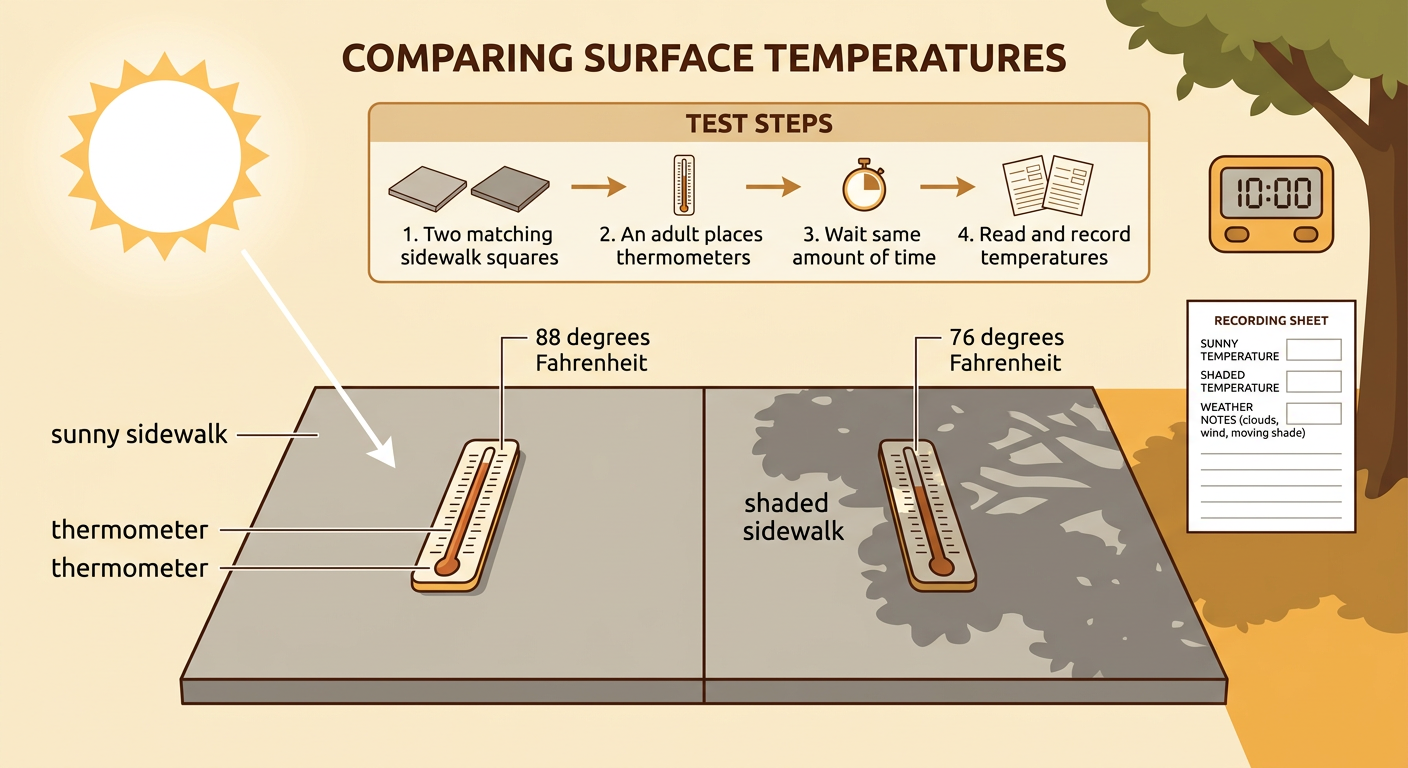
Choose two safe locations with the same kind of surface, such as two concrete sidewalk squares. One square should be in sunlight, and the other should be in shade. Observe both at about the same time. An adult can place one thermometer on each surface and wait the same number of minutes. Then read and record each temperature. If thermometers are not available, hold a hand just above each surface to notice warmth without touching it. Never touch a surface that may be very hot. Also record what you see, such as bright sunlight, tree shade, clouds, or wind. For example, after ten minutes, the sunny sidewalk might measure 88 degrees Fahrenheit, while the shaded sidewalk measures 76 degrees Fahrenheit. Careful observations give evidence for answering the question.
Compare the Results
To compare means to look for what is the same and what is different. Put the two observations next to each other. If the sunny sidewalk was 88 degrees Fahrenheit and the shaded sidewalk was 76 degrees Fahrenheit, the sunny surface was 12 degrees warmer. This result is evidence that sunlight warmed the surface. You can write, “The sidewalk in sunlight was warmer than the sidewalk in shade.” Compare the result with your prediction. Did the evidence support it? One observation does not mean every surface will have exactly the same temperature. Dark soil, light sand, grass, and pavement may warm by different amounts. Repeating the investigation on another day can make the evidence stronger. Use the observations, not just your first idea, to answer the question.

How People Use Shade
Sunlight and shade affect how people live, work, and play in a place. On a hot, sunny day, people may sit under trees, umbrellas, roofs, or bus shelters because shaded surfaces are usually cooler. Playground designers may add a canopy above a slide so the slide does not warm as much in direct sunlight. Families may park under a tree to help keep a car cooler. Farmers and animal caretakers provide shady shelters where animals can rest. In places with many hot, sunny days, buildings may have porches, awnings, or covered walkways. In cooler weather, people might choose a sunny bench because sunlight can warm the seat. For example, a class planning an outdoor reading area could choose a tree-shaded spot to help students stay comfortable during warm weather.
