
Survival Teams: Why Some Animals Live in Groups
Students examine evidence about animals such as wolves, ants, and penguins to explain how living in groups can help animals find food, stay safe, and care for young.

Illustrations are auto-generated and may be placeholders. They can be refreshed to match the narration.
What Is an Animal Group?
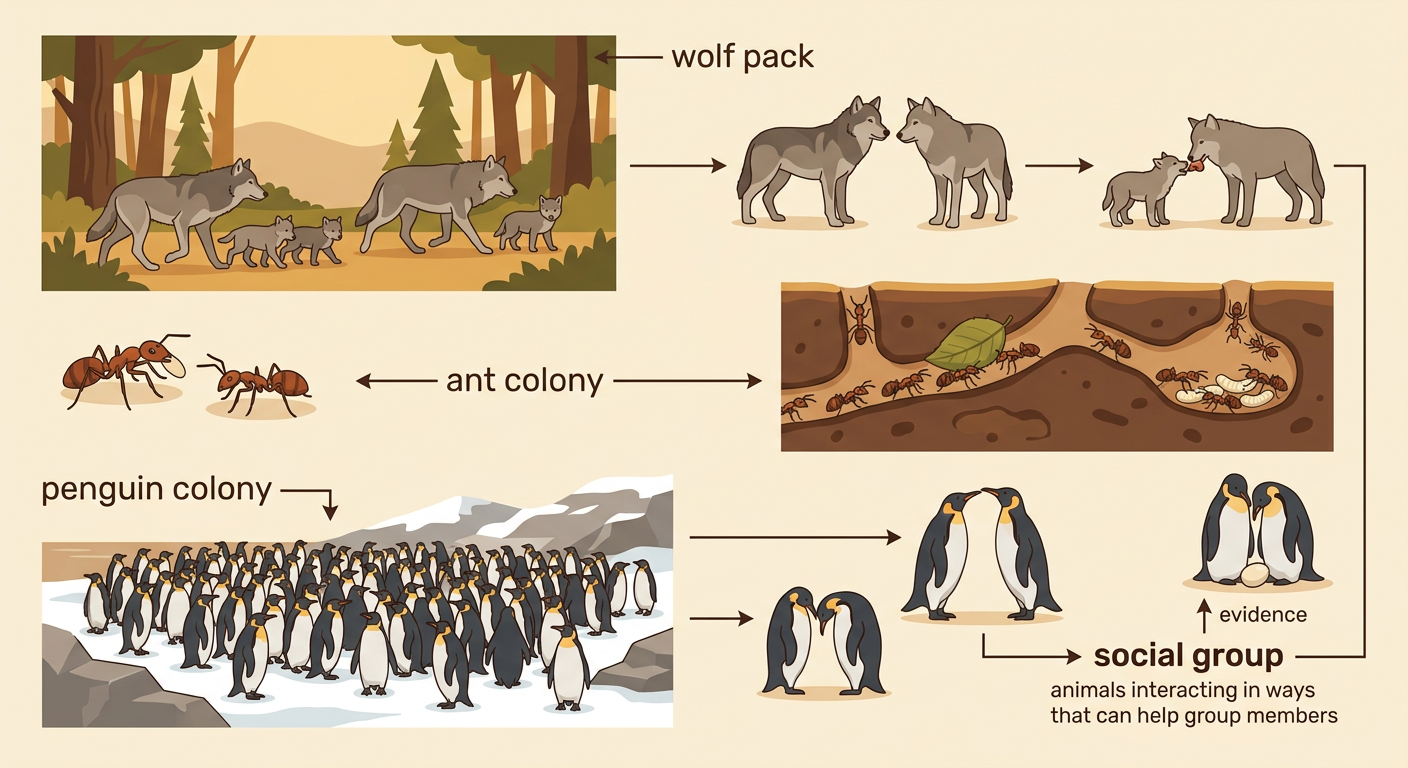
An animal group is made of animals that live, travel, or work together for part or all of their lives. Groups can have different names, such as a wolf pack, an ant colony, or a penguin colony. Members often communicate and respond to one another. For example, a wolf pack is usually a family that includes parents and their young. The wolves may travel together, protect their territory, and share food with young pack members. Living near other animals does not always mean they form a team. Animals in a true social group interact in ways that can help group members. Scientists observe these interactions and gather evidence to learn how group living affects survival.
Ways Groups Help Animals Survive
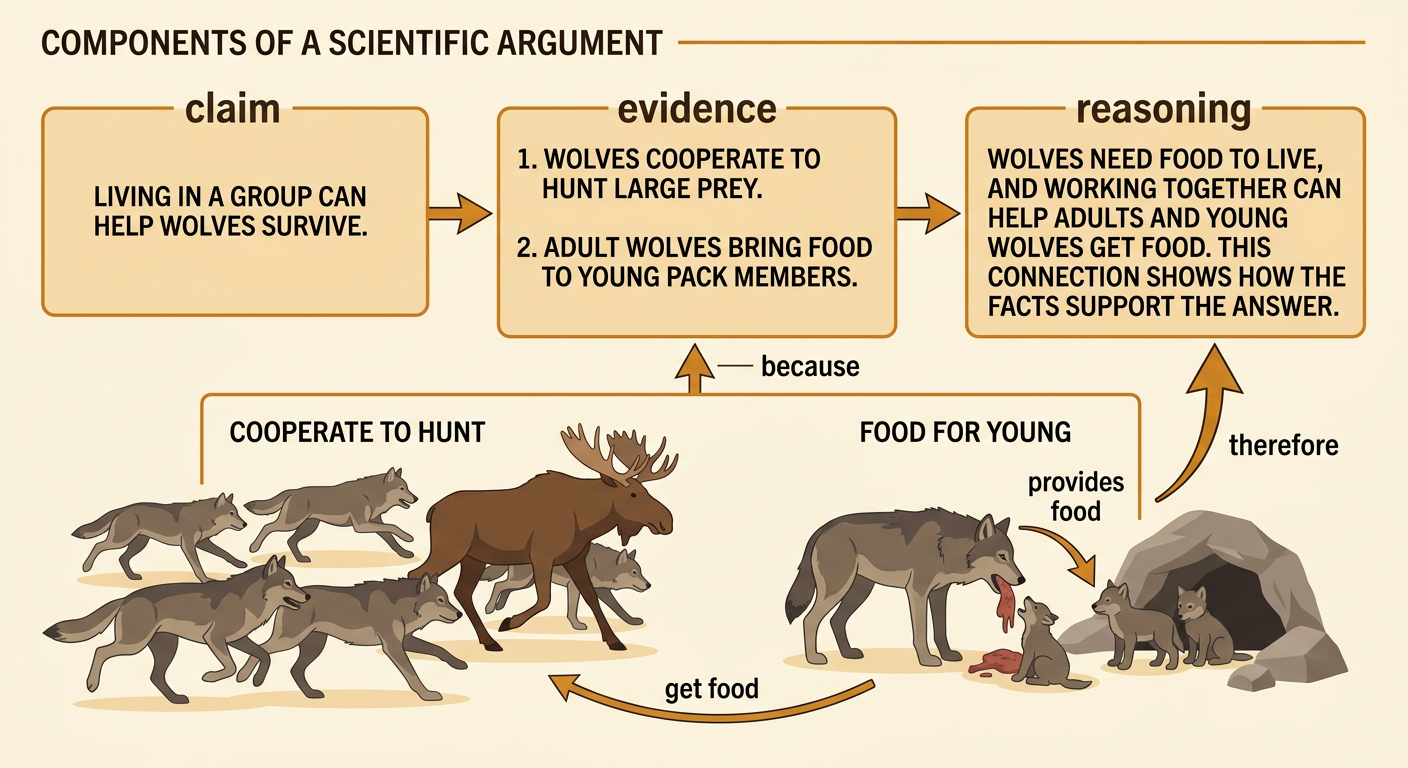
Animal groups can help members find food, stay safe, and care for young. Wolves may hunt together to catch large prey that would be difficult for one wolf to catch. Ant workers can follow scent trails to food and carry it back to the colony. Some ants also defend the nest and care for developing young. Emperor penguins gather closely in a huddle during severe Antarctic weather. Penguins take turns moving between colder outer areas and warmer inner areas of the huddle. Group living does not remove every danger, and members may compete for food or space. However, when animals cooperate, the group can increase each member’s chance of getting resources, avoiding danger, or keeping young animals alive.
Read and Graph the Evidence
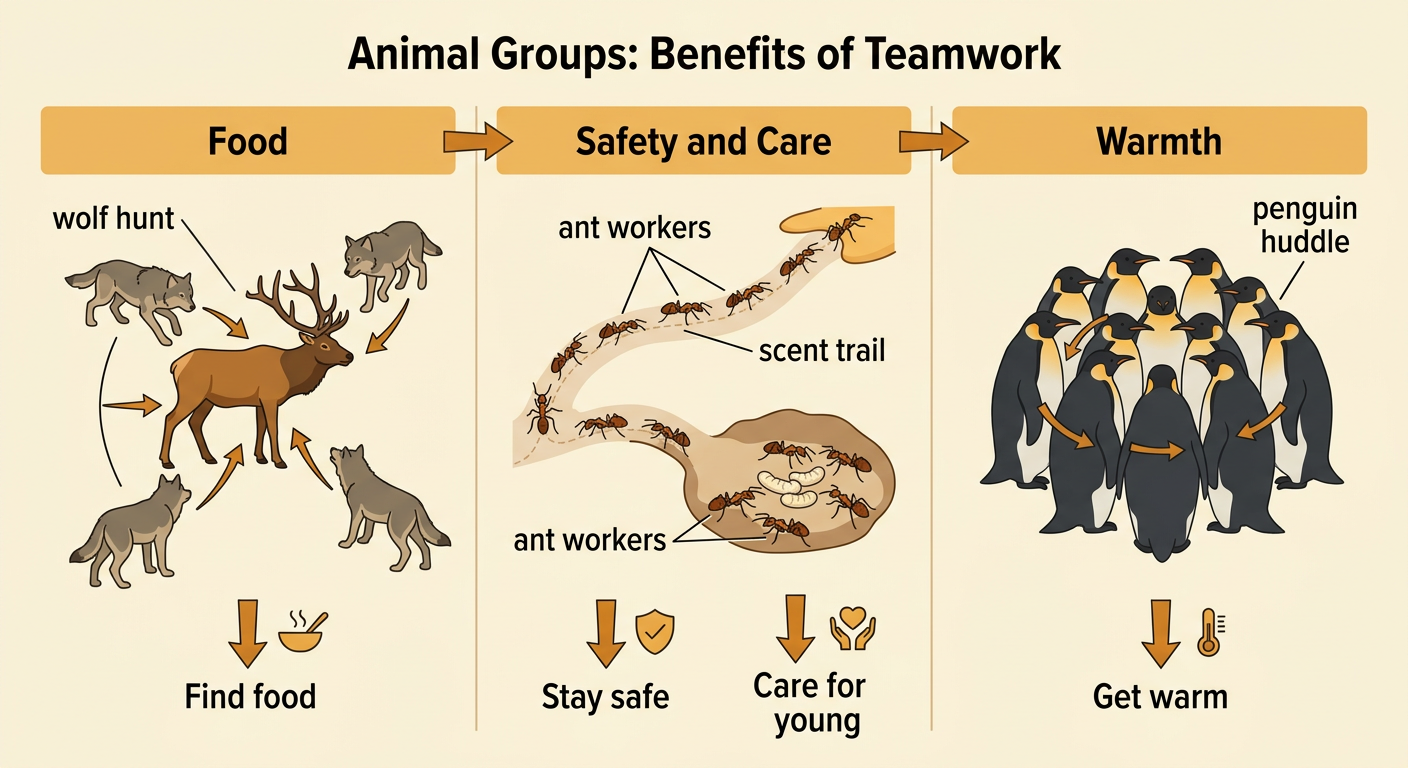
Scientists use numbers and graphs to compare observations. Imagine that a class observes ants for 10 minutes. One ant carries 2 food pieces toward the nest, while a team of four ants carries 8 pieces. On a scaled picture graph, one food symbol can represent 2 pieces. The single-ant row needs 1 symbol because 1 times 2 equals 2. The ant-team row needs 4 symbols because 4 times 2 equals 8. The difference is 6 pieces, so the team moved more food during the observation. This result is evidence that the group collected more food overall, but it does not prove that every group will always succeed. Scientists repeat observations and compare more data before reaching a strong conclusion.
Build a Survival Argument
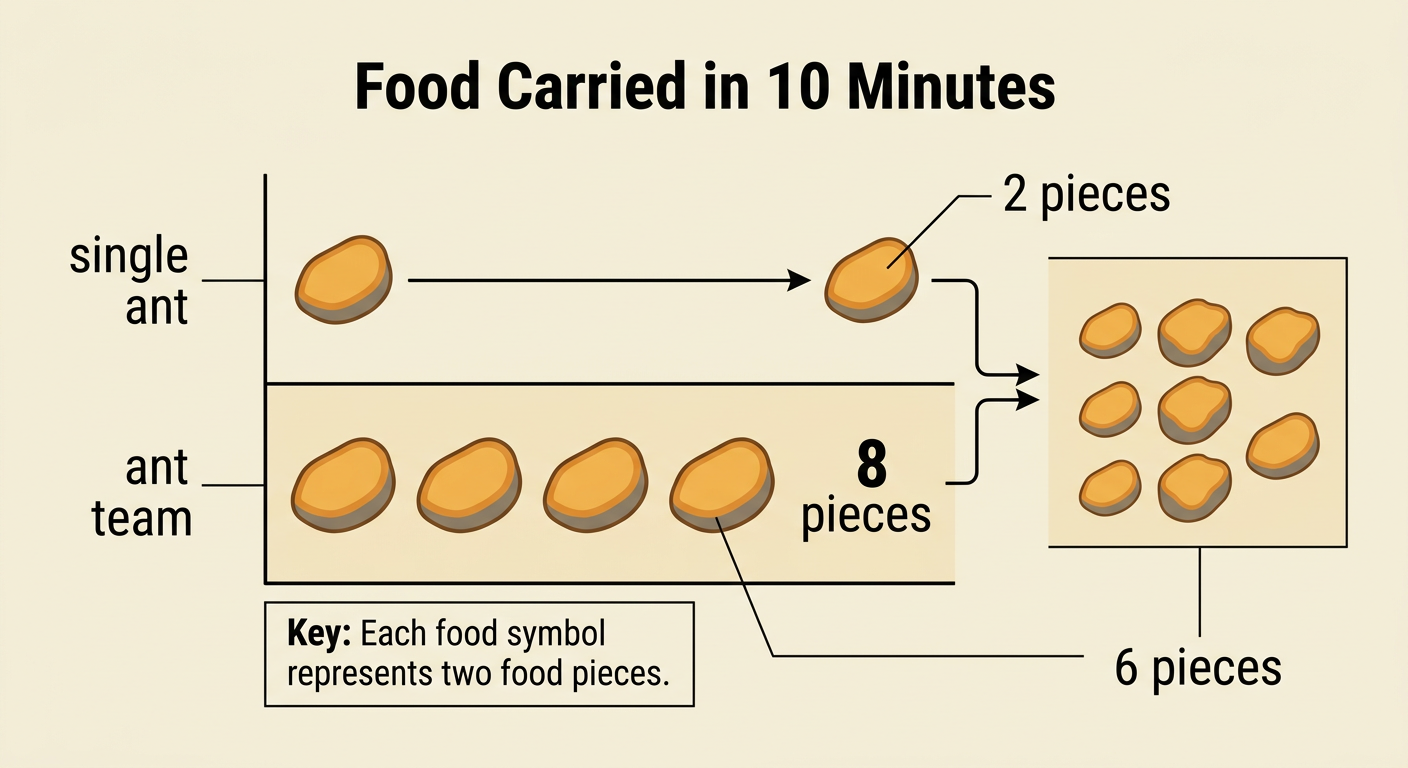
A scientific argument includes a claim, evidence, and reasoning. The claim answers a question. Evidence includes observations, facts, or data. Reasoning explains how the evidence supports the claim. For example, a student might claim, “Living in a group can help wolves survive.” One piece of evidence is that pack members can cooperate when hunting large prey. Another is that adult wolves can bring food to young pack members. The reasoning connects these facts to survival: animals need food, and cooperation can help both adults and young get it. When writing your opinion, clearly state your claim, give at least two relevant reasons, and use linking words such as because, also, and therefore. End by restating the claim without saying that group life is always successful.
Connect Animal and Human Cooperation
People also work in groups to reach shared goals, although human communities make rules and choices in ways animal groups do not. Imagine that a class is creating a school garden. One team prepares the soil, another plants seeds, and another carries water. Dividing the work can help the class finish efficiently and use each person’s strengths. Cooperation can also bring challenges. Group members may disagree, leave tasks unfinished, or talk over one another. The class can respond by assigning fair roles, listening to different ideas, and changing the plan when needed. Like ants carrying food or wolves hunting together, people can benefit from coordinated action. Unlike those animals, people can discuss responsibilities, vote on decisions, and create agreements for solving conflicts.
