
Synthesizing Evidence Across Multiple Media
Students integrate and evaluate information from a written article, an infographic, and a short video to develop a supported response to a shared question.

Illustrations are auto-generated and may be placeholders. They can be refreshed to match the narration.
Introduce the Guiding Question
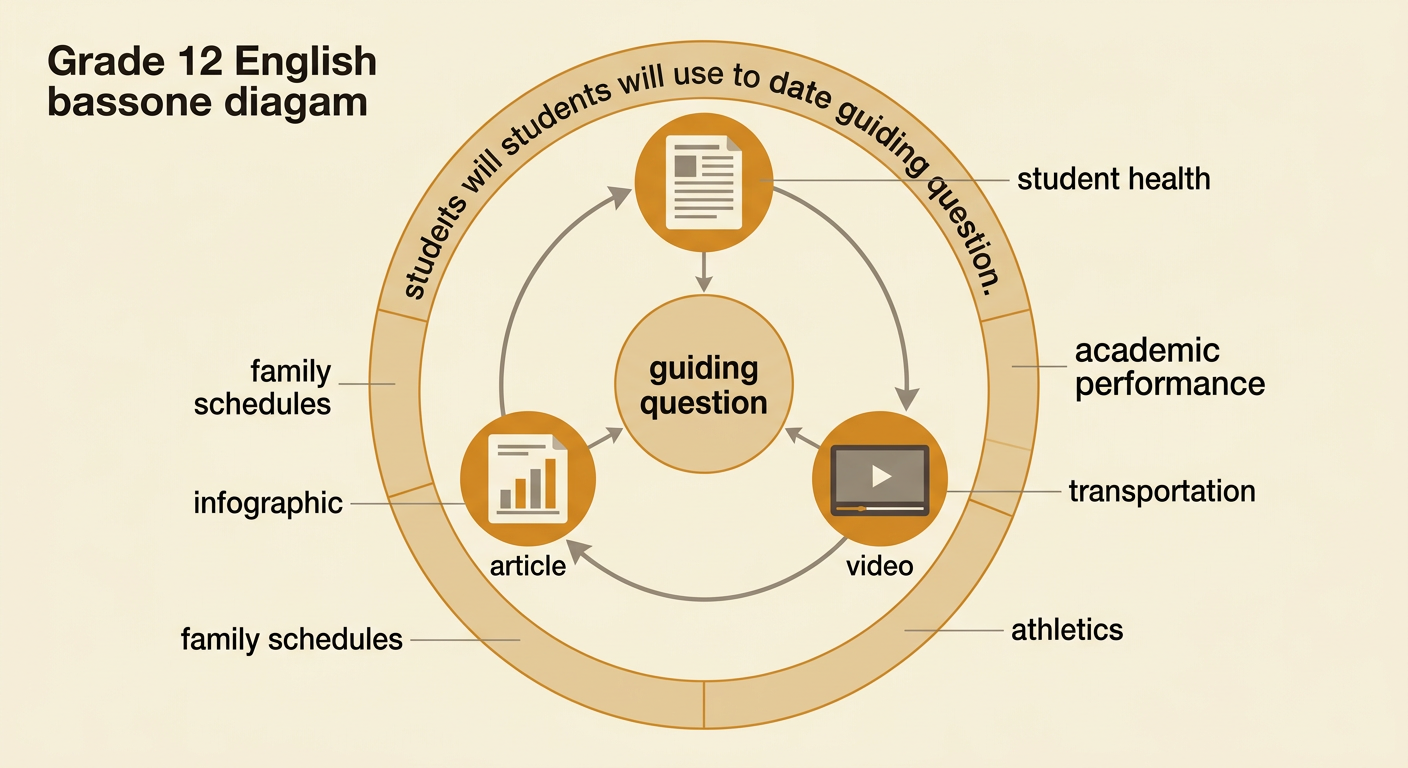
A guiding question gives all sources a shared purpose and keeps your investigation focused. It should be specific enough to answer with evidence but broad enough to invite more than one perspective. For example, imagine that you receive a written article, an infographic, and a short video about school schedules. Your guiding question might be, “Should the high school begin its school day later?” Before examining the sources, identify the decision the question requires and the criteria that matter. Relevant criteria could include student health, academic performance, transportation, athletics, and family schedules. Avoid deciding on an answer immediately. Instead, preview each source and note what kind of information it may contribute. The article may provide research, the infographic may summarize numerical patterns, and the video may show personal experiences or practical concerns.
Identify Each Source’s Central Claim
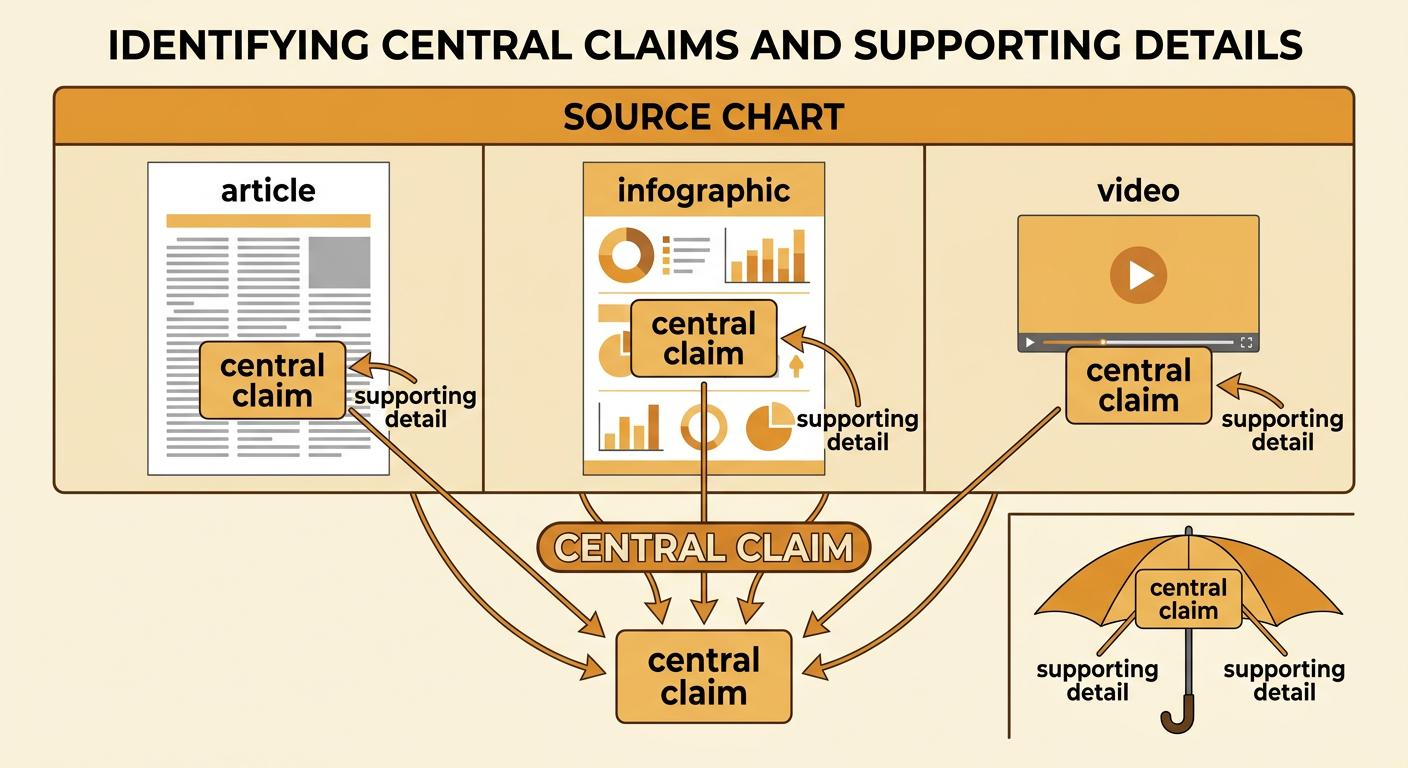
A central claim is the main point a source asks its audience to accept. To identify it, separate the claim from the details used to support it. First, summarize each source in one objective sentence. Suppose the article argues that a later start time would improve student alertness and learning. The infographic’s central claim might be that students reporting more sleep also report fewer late arrivals. The video may argue that changing the schedule has benefits but creates transportation and activity conflicts. Pay attention to differences in purpose and presentation. An article may state its claim in a thesis, while an infographic may communicate it through a title, highlighted statistic, or visual comparison. A video’s claim may emerge from narration, interviews, and editing. Record each central claim without adding your own judgment so that you can compare the sources fairly.
Evaluate Evidence and Source Limitations
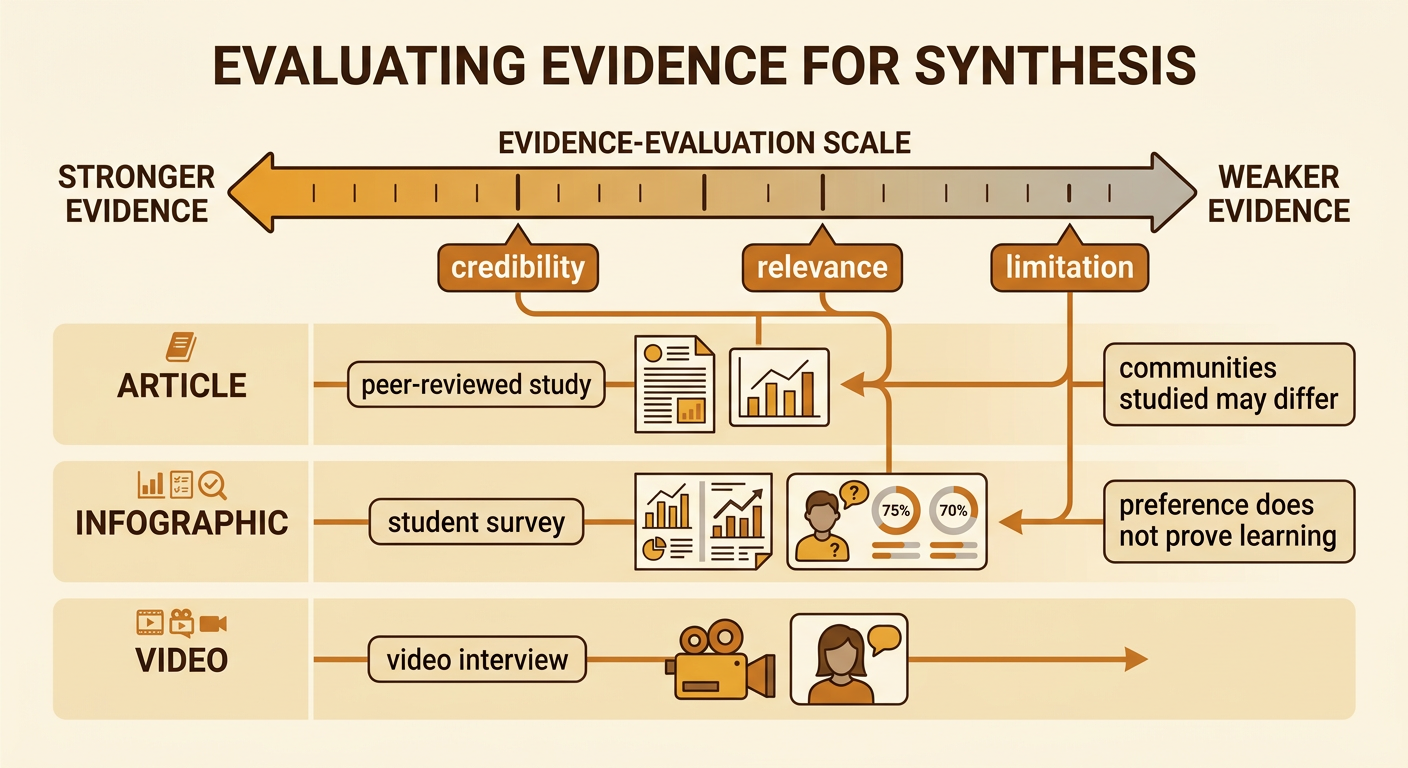
Strong synthesis requires evaluating evidence, not simply collecting it. For each source, ask who created it, when it was produced, what evidence it uses, and whether that evidence directly addresses the guiding question. Suppose the article cites a large peer-reviewed study comparing sleep and attendance before and after schedule changes. That evidence may be relevant and credible, but the communities studied may differ from your school. An infographic may display a student survey showing that 68 percent of respondents prefer a later start. However, preference does not prove improved learning, and the result is weak if the sample size or survey wording is missing. A video interview with a bus coordinator can reveal practical scheduling constraints, but one person’s experience may not represent every district. Note both the value and limitation of each source before deciding how much weight to give it.
Compare Agreements and Contradictions
After evaluating the sources separately, examine how they relate to one another. Sources agree when their claims or evidence point toward the same conclusion. They contradict one another when they make incompatible claims, report different results, or interpret similar evidence differently. They may also address different parts of the question without truly conflicting. For example, the article and infographic may agree that additional sleep is associated with better student outcomes. The video may not dispute that relationship; instead, it may show that a later start could complicate bus routes and after-school activities. That is a difference in focus, not necessarily a contradiction. Use a comparison matrix to place related evidence side by side. When sources genuinely conflict, investigate possible reasons, such as different populations, dates, definitions, methods, or purposes. Do not hide disagreements. Explain them and decide which evidence is more credible and relevant.

Synthesize Evidence in a Written Response
Synthesis combines evidence from multiple sources to create a conclusion that no single source provides by itself. Begin with a direct answer to the guiding question and a qualified thesis that reflects the strongest evidence. For example: “The high school should adopt a later start time because the research and student data suggest meaningful benefits, but the change should include a transportation plan that protects activities and family schedules.” Organize the response by ideas rather than summarizing one source at a time. In one paragraph, connect the article’s research with the infographic’s numerical pattern. In another, use the video’s transportation concerns to qualify your position and propose a solution. Introduce each source clearly, explain how its evidence supports your reasoning, and acknowledge important limitations or contradictions. End by showing why your conclusion follows from the combined evidence. A strong synthesis adds analysis between sources instead of placing quotations and facts next to one another.
