
Synthesizing Information Across Multiple Sources
Students integrate ideas from print, visual, and digital sources to develop a coherent understanding of a shared topic while noting relationships and discrepancies among the sources.
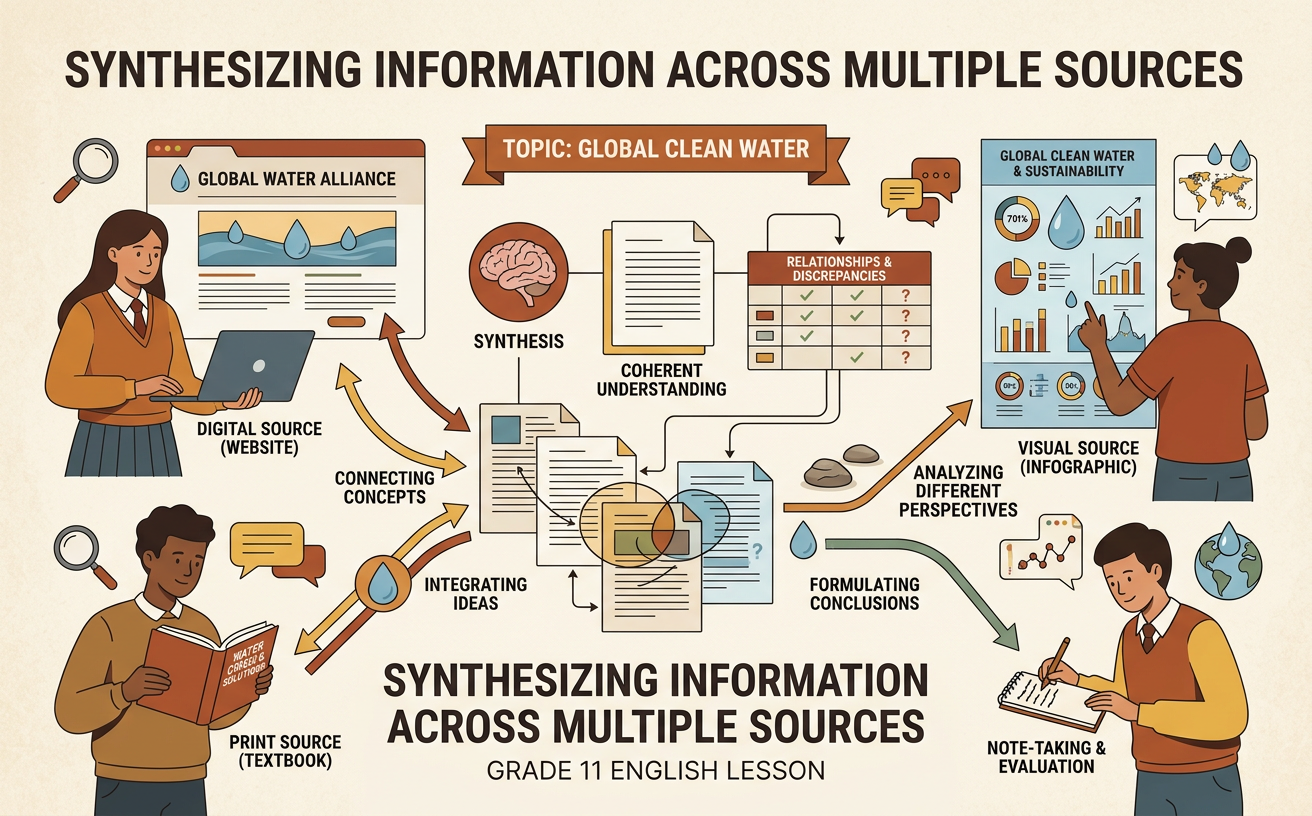
Illustrations are auto-generated and may be placeholders. They can be refreshed to match the narration.
Define Synthesis
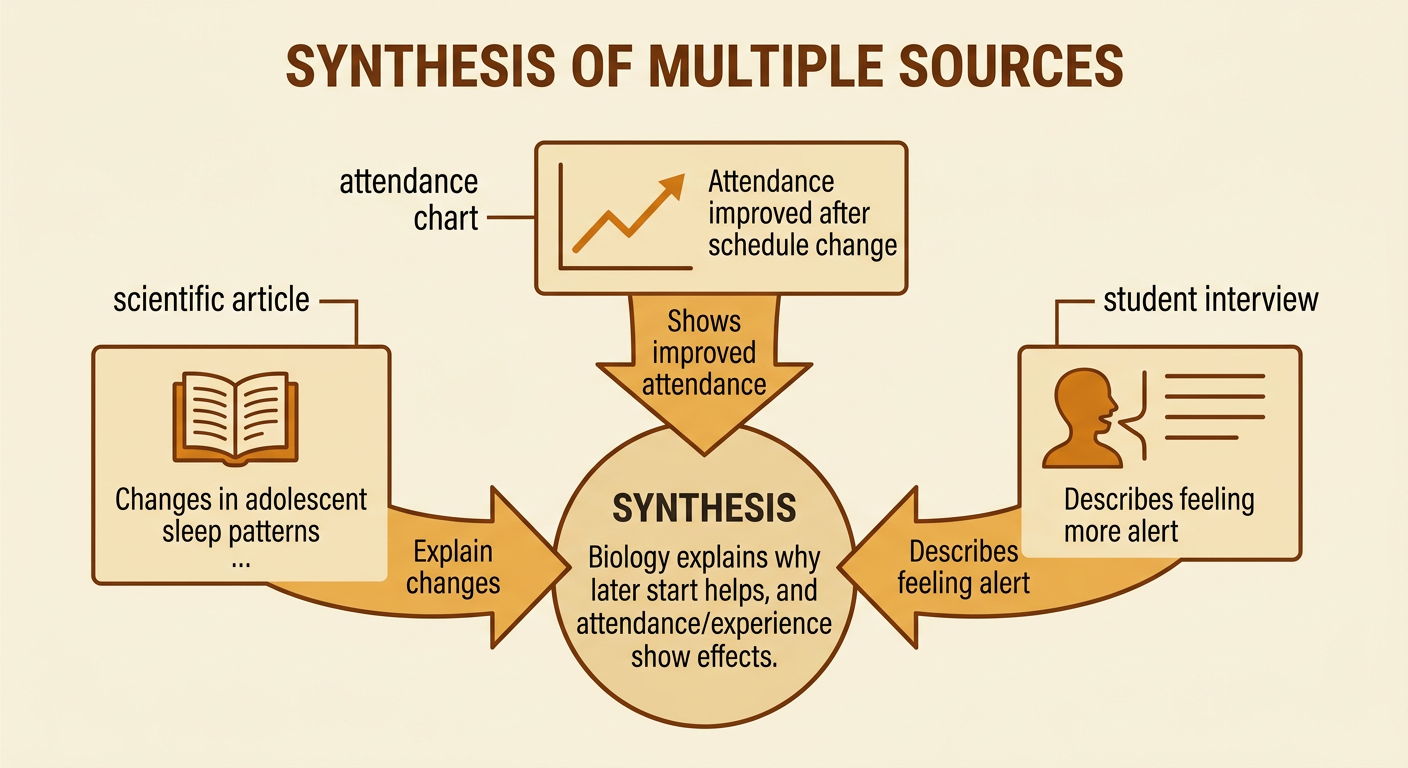
Synthesis means combining information from several sources to form a new, coherent understanding. It is more than summarizing sources one at a time. A synthesis identifies how ideas support, extend, qualify, or challenge one another, then uses those relationships to answer a guiding question. Suppose the question is, “Should high schools begin later in the morning?” A scientific article may explain how adolescent sleep patterns change, a district chart may show attendance rates before and after a schedule change, and a student interview may describe feeling more alert. A strong synthesis connects these details: biological research explains why a later start may help, while attendance data and student experience show possible effects. The resulting understanding comes from the sources working together, not from any single source alone.
Identify Each Source’s Central Ideas
Before connecting sources, determine the central idea and key evidence in each one. Ask what the source mainly claims, which details support that claim, and what perspective or purpose shapes the presentation. Do not treat every detail as equally important. For example, a research article about later school start times may argue that adolescents need more morning sleep because of changes in their sleep cycles. Its key evidence might include findings from a large sleep study. A school district infographic may emphasize improved attendance after start times changed, using percentages from district records. A parent podcast may focus on transportation difficulties created by the new schedule. Recording each central idea separately prevents confusion and makes later comparisons more precise. It also helps distinguish a source’s main point from examples, statistics, or personal reactions.

Connect Ideas Across Formats
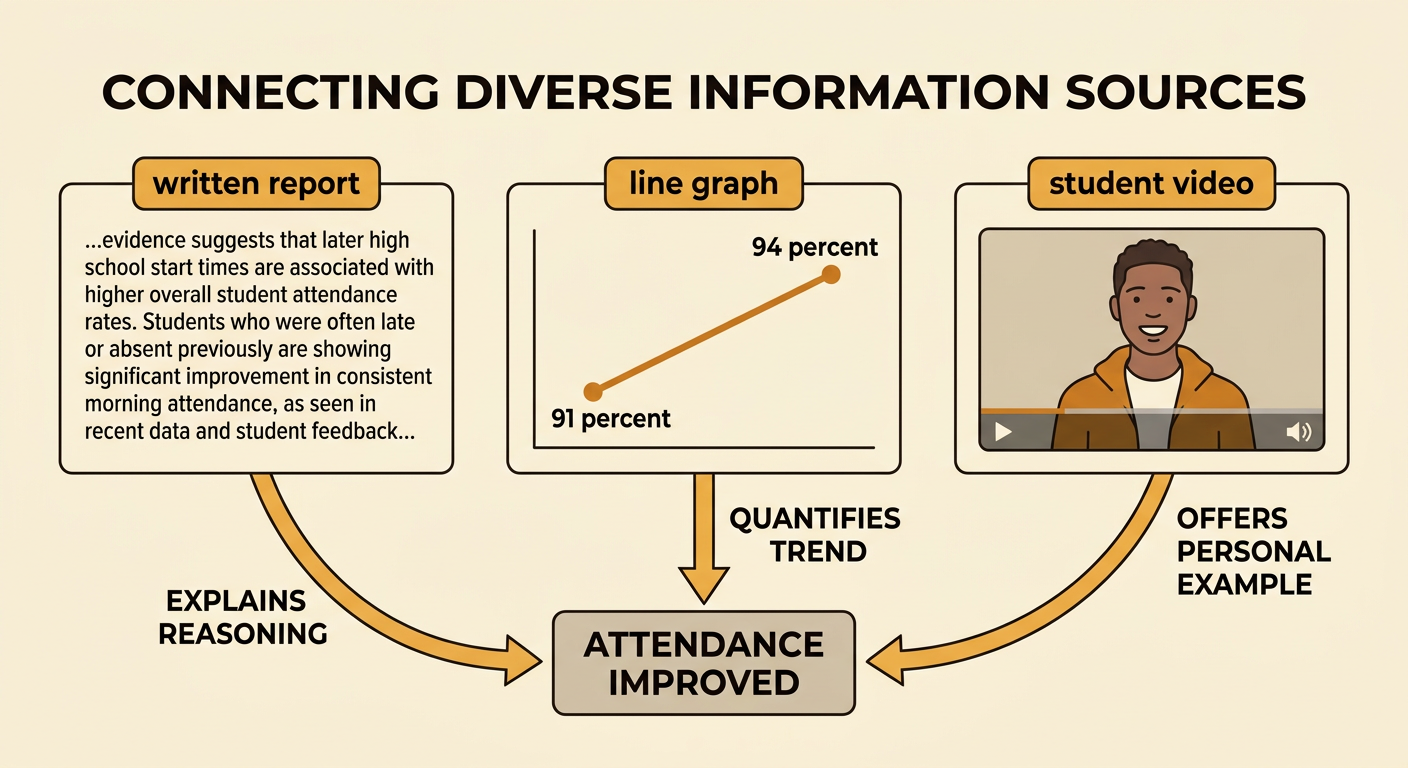
Sources in different formats communicate information in different ways. Print sources often explain reasoning in detail, visuals can reveal patterns quickly, and audio or video sources can convey tone and firsthand experience. To connect them, translate each source into a comparable idea and ask how the ideas relate. For example, a written report may state that later school start times are associated with better attendance. A line graph may show attendance rising from 91 percent to 94 percent after a schedule change. A student video may describe missing fewer first-period classes. These sources reinforce one another because the graph quantifies the report’s claim and the video illustrates how the change affected an individual. However, the interview alone cannot prove a broad trend. Effective synthesis respects what each format contributes and avoids asking one example to support a conclusion beyond its limits.
Reconcile Conflicting Information
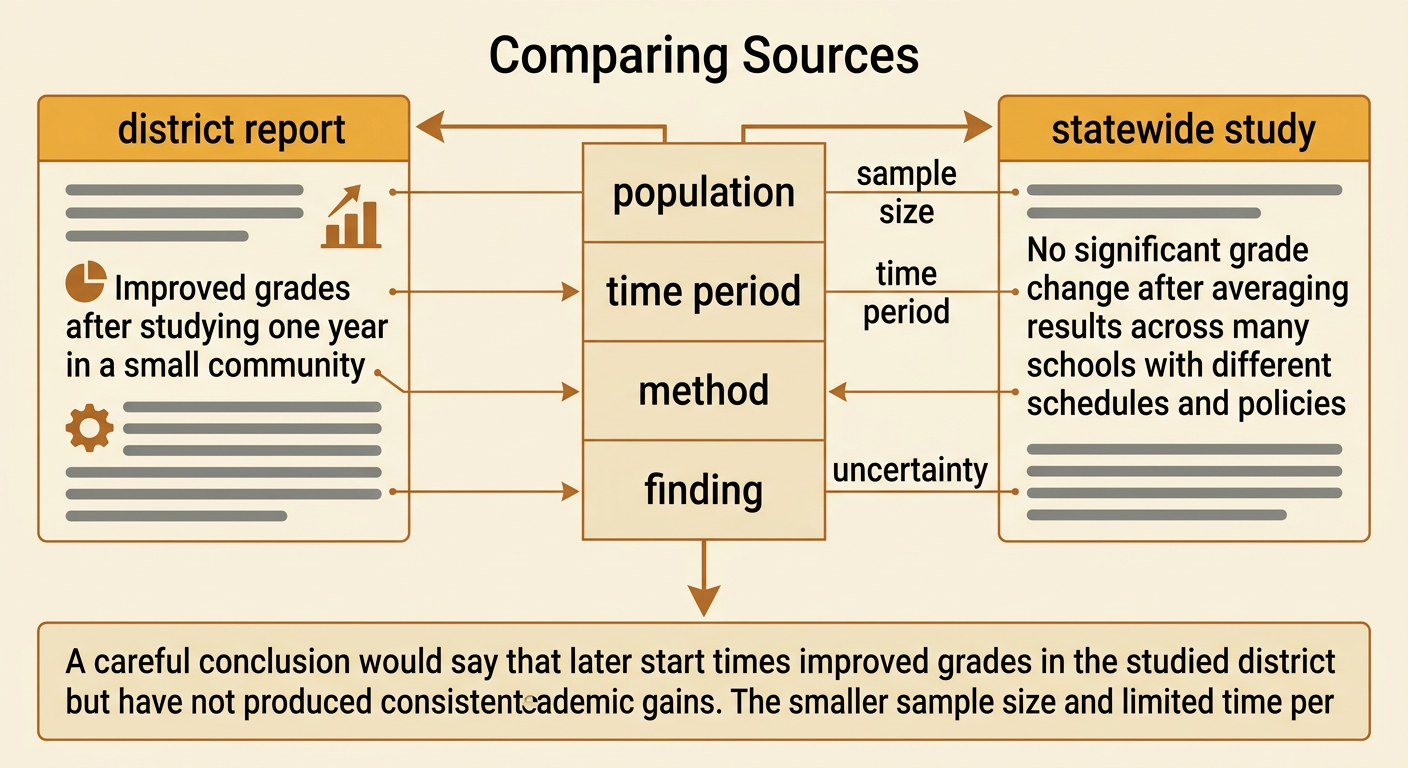
Sources may disagree because they use different methods, time periods, populations, definitions, or purposes. Do not simply choose the source you prefer. First, state the discrepancy accurately. Then investigate each source’s evidence, date, sample size, expertise, and possible limitations. Imagine that one district report links later start times to improved grades, while a statewide study finds no significant grade change. The findings may not be mutually exclusive: the district examined one year in a small community, while the statewide study averaged results across many schools with different schedules and policies. A careful synthesis might conclude that later start times improved grades in the district but have not produced consistent academic gains across the state. If the conflict cannot be resolved, acknowledge the uncertainty. Responsible synthesis explains disagreement rather than hiding it and avoids claiming more certainty than the evidence allows.
Write a Synthesis Statement
A synthesis statement answers the guiding question by expressing a conclusion supported by multiple sources. It should name the main relationship among the sources, include an important qualification when needed, and avoid listing summaries. Begin with your overall answer, then show how different evidence contributes to it. For the school start-time question, a synthesis statement might read: “Research on adolescent sleep, district attendance data, and student interviews together suggest that later high school start times can improve alertness and attendance, although evidence about grade improvement remains mixed and transportation challenges may affect implementation.” This statement integrates scientific explanation, numerical data, and personal experience while recognizing disagreement and practical limits. In a longer response, follow the statement with specific evidence and source attribution. Use transitions such as similarly, however, and taken together to make relationships clear. A precise synthesis statement is arguable, evidence-based, and appropriately qualified.
