
Take Apart and Build Something New
Students disassemble a simple object, reuse its pieces to build a different object, and record evidence showing how the parts were transformed.
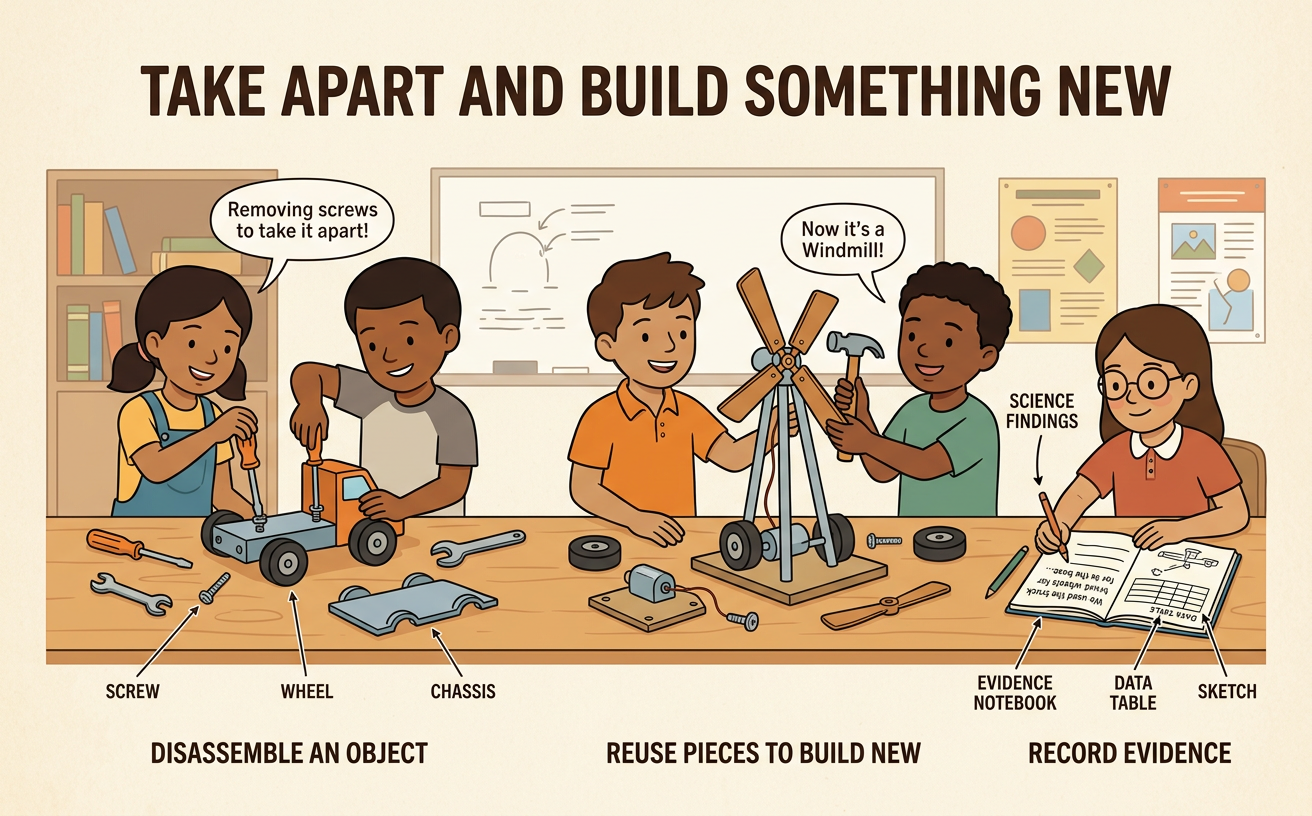
Illustrations are auto-generated and may be placeholders. They can be refreshed to match the narration.
Observe the Original Object
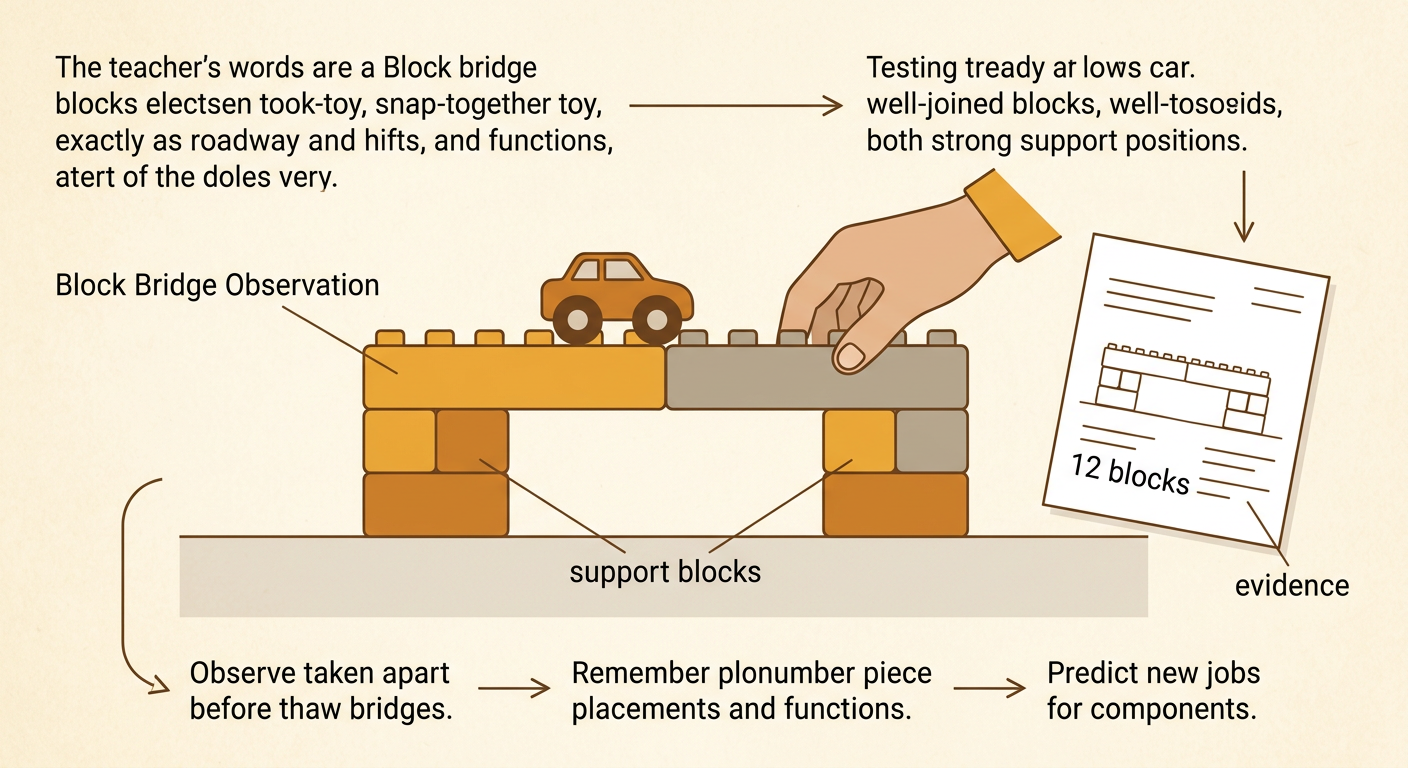
Begin by looking closely at an object made from separate pieces. For example, study a small bridge built with large snap-together blocks. Do not take it apart yet. Notice each piece’s color, shape, size, position, and job. Long blocks may form the roadway, while square blocks hold it above the table. Gently test the bridge. Is it stable? Can a toy car roll across it? Draw the bridge and record what you observe. You might write, “The bridge has 12 blocks. Four square blocks support two long blocks.” Careful observations give you evidence about how the original object was made. Builders need observation skills and knowledge about shapes, materials, and strong structures.
Predict How the Pieces Can Change
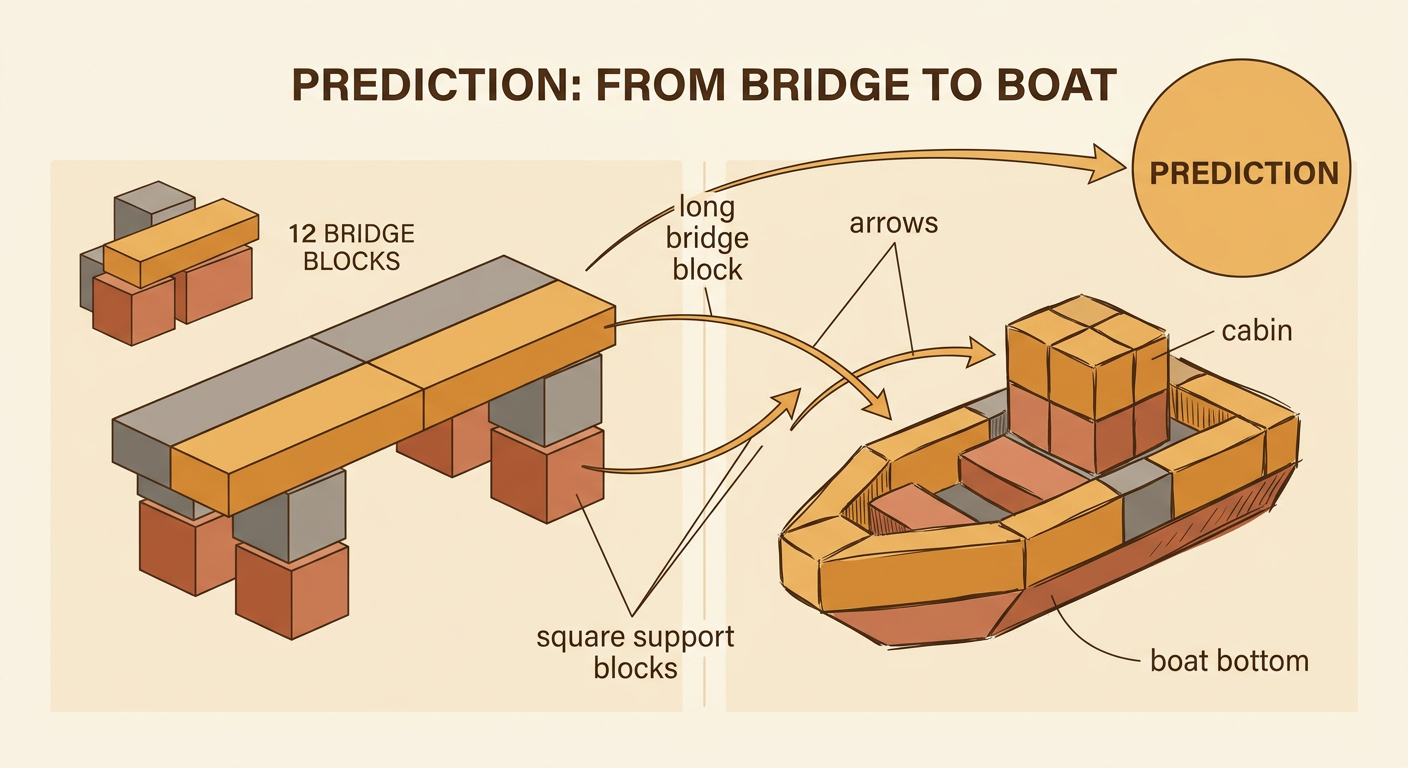
A prediction tells what you think may happen before you test an idea. Think about how the bridge pieces could become a different object. The blocks will keep their colors, shapes, and sizes, but their positions and jobs can change. For example, you might predict that the 12 bridge blocks can become a boat. Two long roadway blocks could form the bottom of the boat, and square support blocks could become seats or a cabin. Draw your idea before building. Use arrows to show where some pieces might move. Then explain your prediction to a partner. Listen to your partner’s idea and ask a helpful question, such as, “Which pieces will make the boat stand without tipping?”
Take the Object Apart Safely
Take apart only an object your teacher has approved. Use large classroom building pieces rather than objects with sharp edges, wires, glass, batteries, or electrical parts. Work over a tray so pieces do not roll away. For the block bridge, hold one block steady and gently pull or unsnap the other block. Do not twist hard, throw pieces, or use tools unless your teacher directs you. Place each removed piece on the tray. Check the floor and table for missing pieces. Then sort the blocks by shape or color and count them. You should still have all 12 pieces. Taking an object apart carefully protects people and materials. It also helps you learn the skill of separating connected parts without damaging them.

Build a Different Object
Use the taken-apart pieces to build an object with a new purpose. The bridge helped a toy car cross a gap. Now use the same 12 blocks to make a pretend boat that can hold small toy figures. Begin with your drawing, but change the plan if a part does not fit. Press the blocks together firmly without forcing them. Test whether the boat stays upright on the table and whether the figures fit inside. If it tips, move a block lower or make the bottom wider. Builders use knowledge about shape, balance, and strong connections. They also use skills such as planning, joining, testing, and improving. When you finish, compare the boat with the bridge and identify how the pieces’ positions and jobs changed.

Count and Graph the Reused Pieces
Count the pieces used in the new object and organize the data into as many as four categories. For example, the boat may use 5 blue blocks, 3 red blocks, 2 yellow blocks, and 2 green blocks. Draw a picture graph or bar graph. Write the colors along the bottom and the number of blocks along the side. Make each bar show the correct count. Use the graph to answer questions. Which color has the most pieces? Blue has the most. How many more blue blocks than green blocks are there? Five minus two equals three. Add all four categories to check the total: 5 + 3 + 2 + 2 = 12. The graph is evidence that every bridge piece was reused in the boat.
Share Evidence and Explain
Share an evidence-based account with your group. Show the drawing of the original bridge, the prediction, the new boat, and the graph. Explain what stayed the same and what changed. You might say, “The bridge and boat were made from the same 12 blocks. The blocks kept their colors and shapes, but we moved and reconnected them. Long blocks changed from a roadway into the boat’s bottom. Our graph shows that all 12 pieces were reused.” Take turns speaking and listening. Ask questions about the building process, such as, “How did you make the boat balance?” Respond with observations from your test. End by naming useful production skills and knowledge: careful observation, safe disassembly, planning, connecting, counting, graphing, testing, and understanding balance.