Taxonomy: How New Evidence Changes Classification
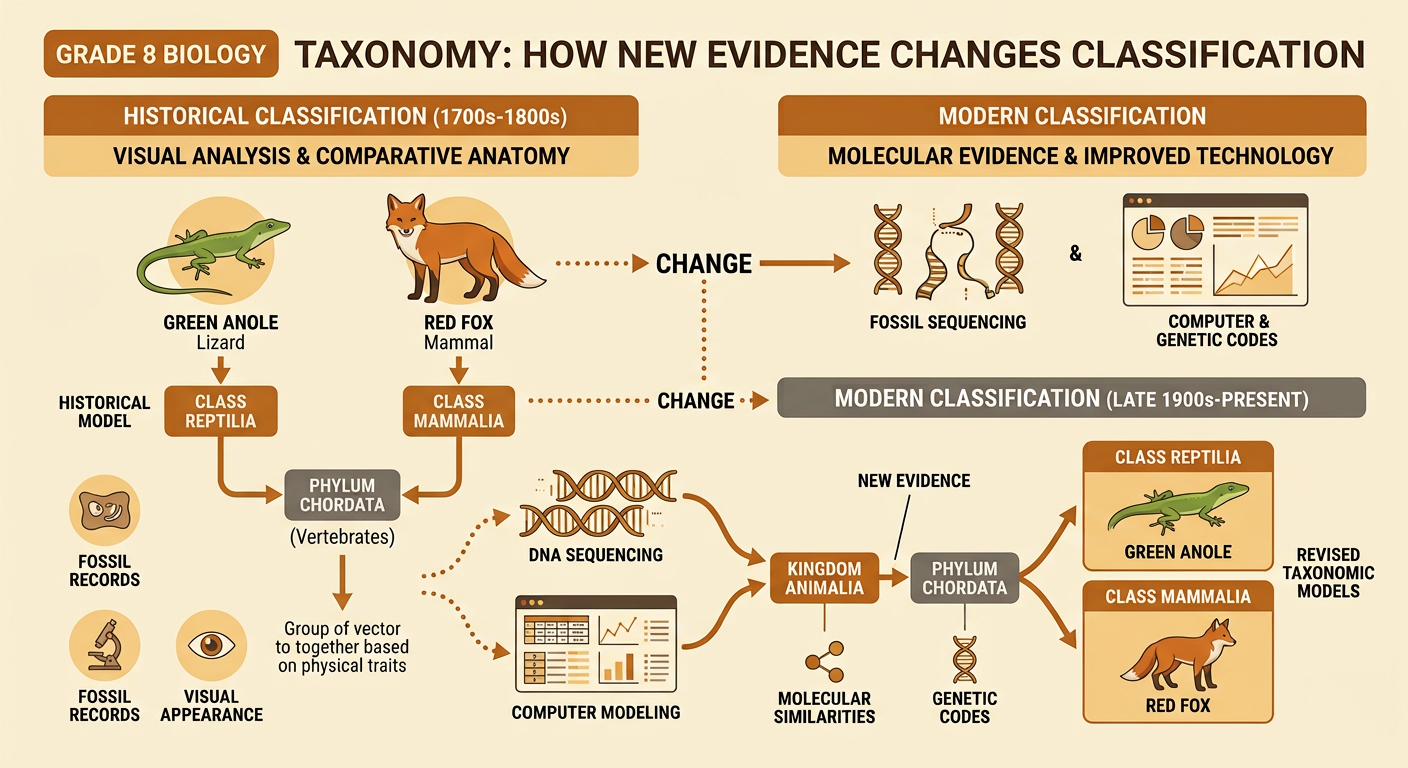
Students compare historical and modern classifications of selected organisms to explain how molecular evidence and improved technology can lead scientists to revise taxonomic models.
Illustrations are auto-generated and may be placeholders. They can be refreshed to match the narration.
Classification Is a Revisable Model
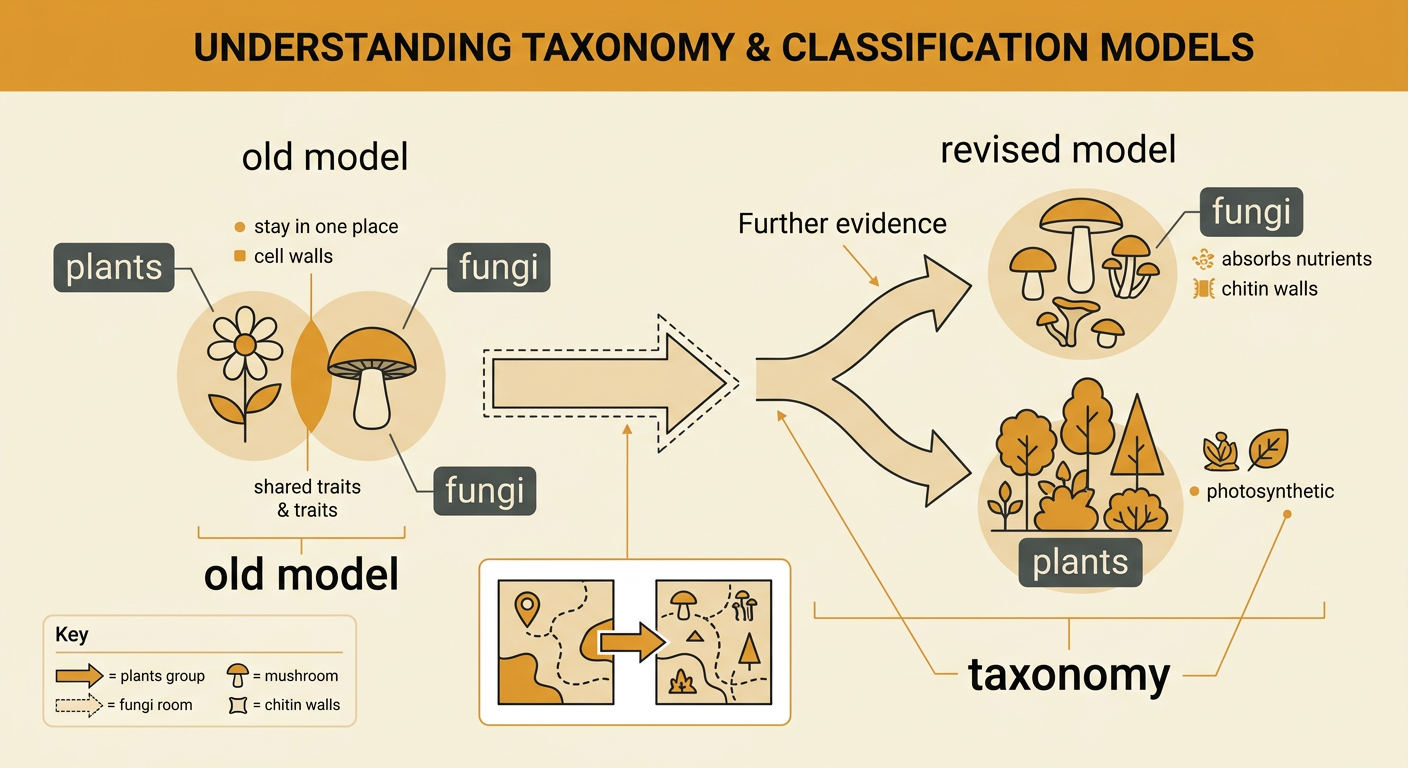
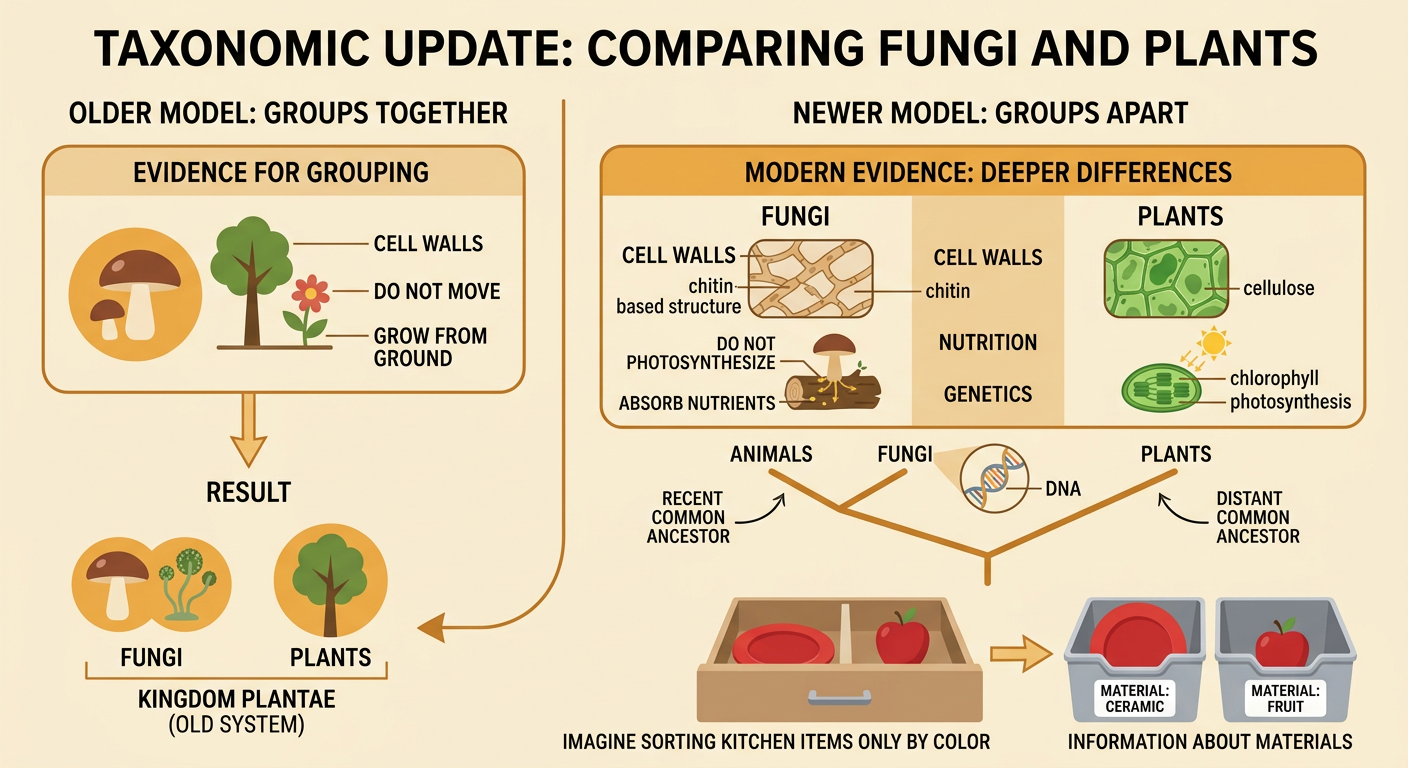
Taxonomy is the system scientists use to name organisms and organize them into groups. A classification is a scientific model: it represents the best explanation supported by available evidence, but it can be revised. Scientists compare body structures, development, fossils, behavior, cells, and DNA. When new evidence reveals a pattern that the old model does not explain well, scientists may redraw relationships or rename groups. For example, fungi were once classified with plants because both usually stay in one place and have cell walls. Later studies showed that fungi absorb nutrients, have cell walls made mainly of chitin, and differ genetically from plants. Fungi are now placed in their own kingdom. This revision did not mean earlier scientists were careless. It showed that additional evidence produced a more useful and accurate model.
Earlier Groupings Based on Visible Traits
Before microscopes, genetic testing, and large fossil databases were available, naturalists depended mainly on traits they could observe. They compared features such as wings, shells, leaves, teeth, body coverings, and numbers of limbs. Shared traits can provide useful evidence, especially when the traits were inherited from a common ancestor. However, unrelated organisms can independently evolve similar features when they face similar environmental challenges. This pattern is called convergent evolution. For example, cactuses of the Americas and many Euphorbia species of Africa both have thick, water-storing stems and spines. These similarities help both groups survive dry environments, but they do not make the plants close relatives. Their flowers and other structures differ, and later genetic evidence confirmed that they belong to separate plant families. Appearance alone can therefore produce a misleading classification.

DNA Reveals Unexpected Relationships
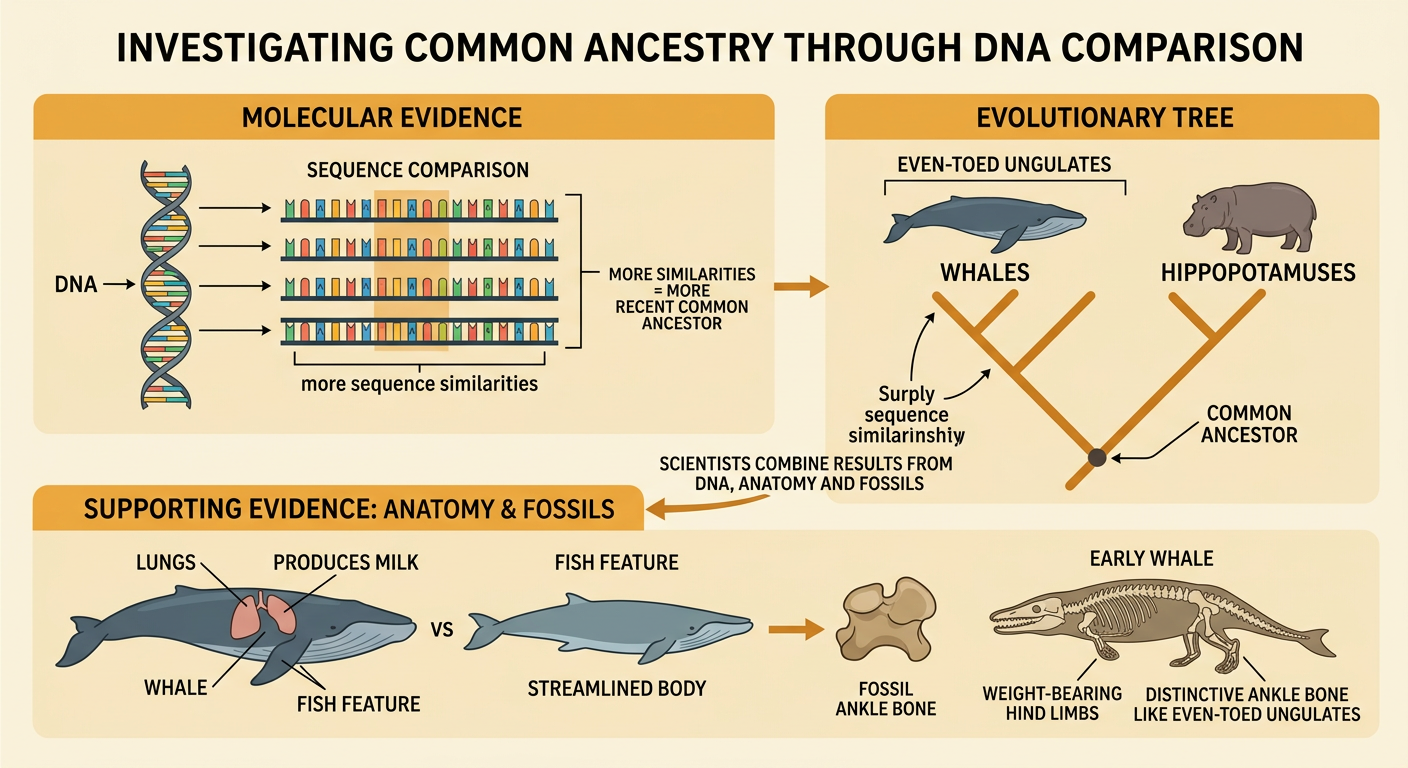
DNA contains inherited information, so scientists can compare DNA sequences to investigate common ancestry. Researchers line up the same gene or other DNA region from several species and count matching and differing bases. In general, organisms with more sequence similarities share a more recent common ancestor, although scientists analyze many DNA regions and combine molecular evidence with fossils and anatomy. Whales provide a striking example. Their streamlined bodies resemble those of fish, but lungs, milk production, and other traits identify them as mammals. Molecular comparisons revealed that whales belong within the even-toed ungulate group and that hippopotamuses are their closest living relatives. Fossils of early whales with weight-bearing hind limbs and distinctive ankle bones support this relationship. DNA did not replace other evidence; it added an independent source of evidence that helped scientists construct a stronger evolutionary tree.
Comparing Historical and Modern Classifications
To understand a taxonomic update, scientists compare the evidence behind an older model with evidence behind a newer one. Consider fungi. In many historical classification systems, mushrooms and molds were grouped with plants because they have cell walls, do not move from place to place, and often grow from the ground. Modern evidence highlights important differences. Plants contain chlorophyll and make sugars through photosynthesis, while fungi absorb nutrients from other organisms or organic material. Plant cell walls contain cellulose, whereas fungal cell walls contain mostly chitin. DNA-based evolutionary trees also indicate that fungi share a more recent common ancestor with animals than with plants. Some observations remained useful, but their interpretation changed when cellular, biochemical, and molecular data became available. Comparing the two models shows both continuity in recorded traits and change in the explanation of relationships.
Explaining Why Taxonomy Changes
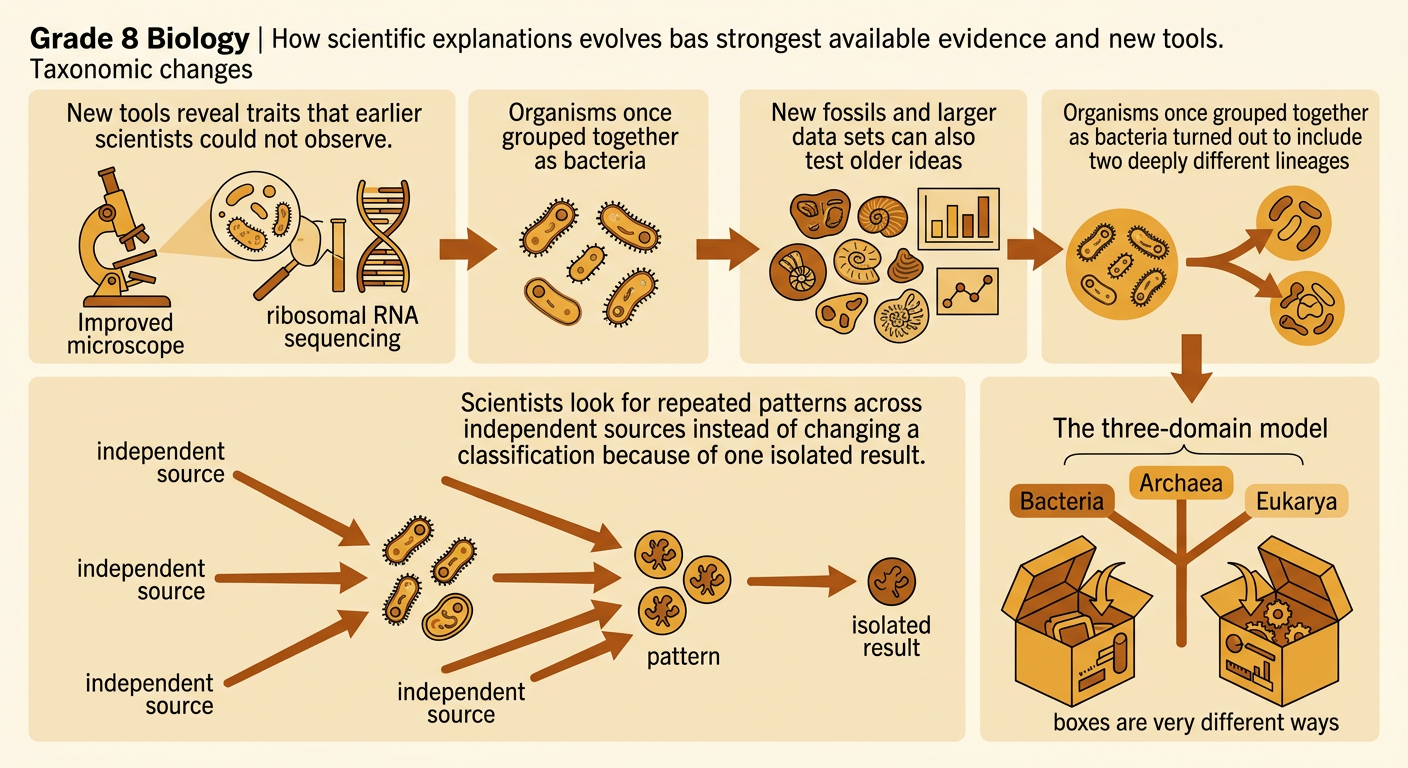
Taxonomy changes because scientific explanations must account for the strongest available evidence. New tools can reveal traits that earlier scientists could not observe, while new fossils or larger data sets can test older ideas. Scientists look for repeated patterns across independent sources rather than changing a classification because of one isolated result. One important update occurred after improved microscopes and ribosomal RNA sequencing allowed researchers to compare microorganisms in greater detail. Organisms once grouped together as bacteria were found to include two deeply different lineages: Bacteria and Archaea. This evidence helped produce the three-domain model of Bacteria, Archaea, and Eukarya. Scientists publish their methods, allow other researchers to repeat analyses, and debate how groups should be named. A revised classification is evidence of scientific progress because the model has become more consistent with observed evolutionary patterns.