
Tell and Write Time to the Hour and Half-Hour
Students use analog and digital clocks to tell and write time to the hour and half-hour.

Illustrations are auto-generated and may be placeholders. They can be refreshed to match the narration.
Parts of a Clock
A clock helps us measure and tell time. An analog clock has a round face with the numbers 1 through 12. The numbers are placed in order around the edge. Two hands turn from the center of the clock. The short hand helps show the hour, and the long hand helps show the minutes. A digital clock shows time with numbers instead of moving hands. A colon separates the hour from the minutes. For example, 4:00 means four o’clock. On an analog clock showing four o’clock, the short hand points to 4 and the long hand points to 12. Look closely at the clock face, numbers, hands, and center. Each part gives you information that helps you tell the time.

The Hour Hand and Minute Hand
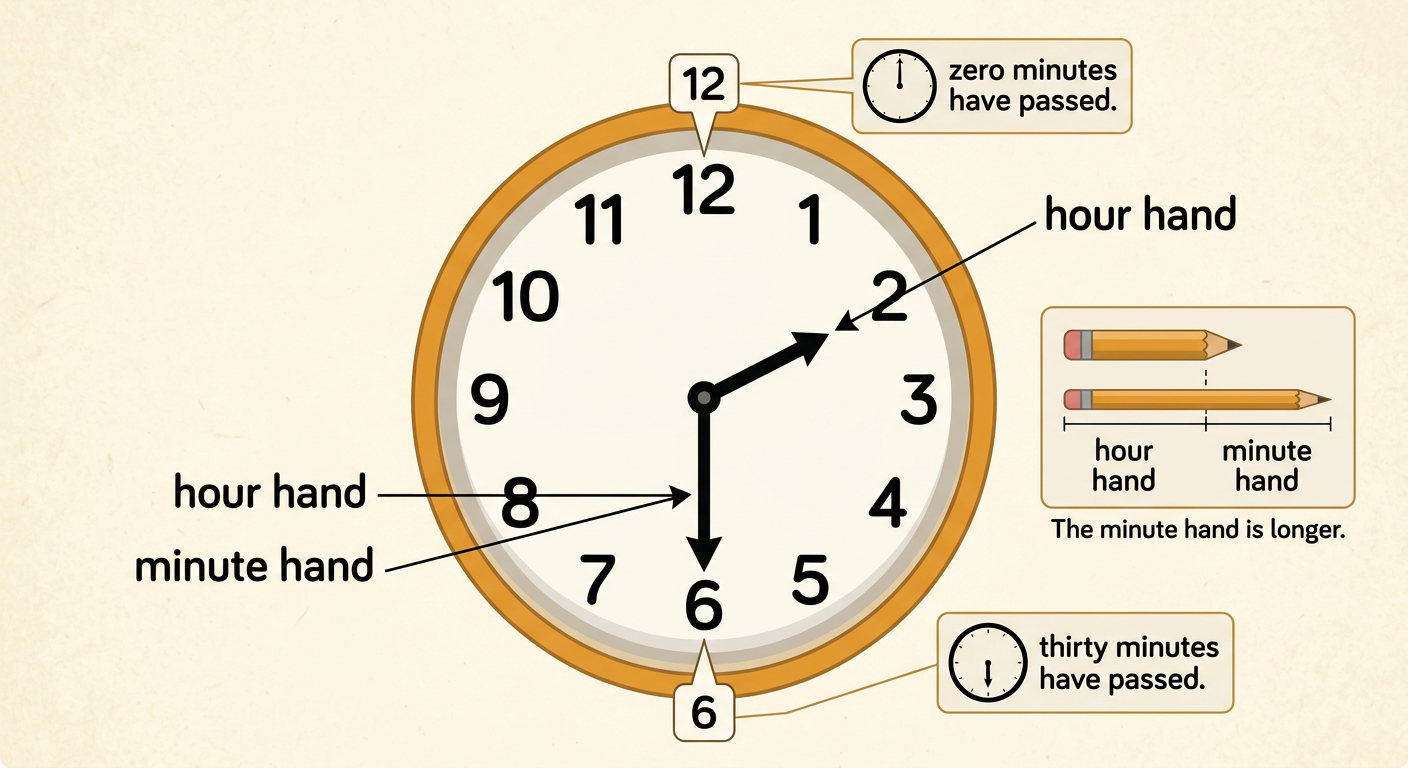
An analog clock has an hour hand and a minute hand. The hour hand is shorter. It points to an hour number or moves between two hour numbers. The minute hand is longer. For time to the hour and half-hour, it points to either 12 or 6. When the minute hand points to 12, zero minutes have passed in the new hour. When it points to 6, thirty minutes have passed. The hands can look similar, so compare their lengths before reading the clock. For example, on a clock showing 2:30, the long minute hand points to 6. The short hour hand sits halfway between 2 and 3 because half of the hour has passed. Always check both hands to tell the complete time.
Time to the Hour
A time is to the hour when no minutes have passed after the hour begins. On an analog clock, the long minute hand points to 12. The short hour hand points directly to the hour number. Read the short hand to name the hour. For example, if the minute hand points to 12 and the hour hand points to 7, the time is seven o’clock. We write this digital time as 7:00. The number before the colon tells the hour. The two zeros after the colon tell us that zero minutes have passed. To check a time to the hour, ask two questions: Is the minute hand on 12? Which number does the hour hand point to? Then say and write the time.

Time to the Half-Hour
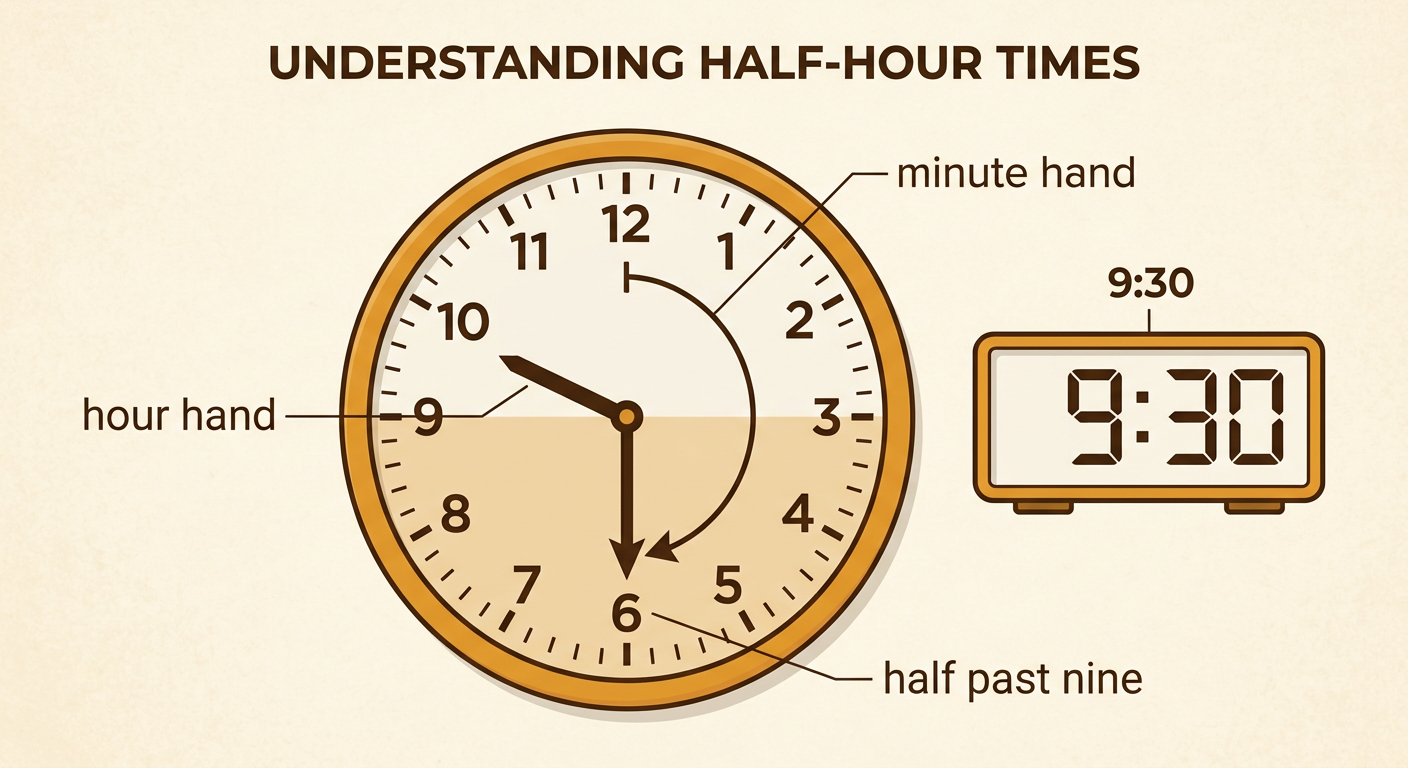
A half-hour means 30 minutes have passed since the hour began. On an analog clock, the long minute hand points to 6 because 6 marks 30 minutes. The short hour hand is halfway between two hour numbers. It has moved past the hour that began, but it has not reached the next hour. For example, at 9:30, the minute hand points to 6. The hour hand is halfway between 9 and 10. Use the number the hour hand has already passed, so the hour is 9. Write the digital time as 9:30. Read it as nine thirty or half past nine. Do not call it 10:30 because the hour hand has not passed 10 yet. Check both hands before naming the time.
Match Analog and Digital Times
Analog and digital clocks can show the same time in different ways. To match them, read the minute hand first. If it points to 12, look for a digital time ending in :00. If it points to 6, look for a digital time ending in :30. Next, read the hour hand. For example, an analog clock has its minute hand on 6 and its hour hand halfway between 4 and 5. The matching digital time is 4:30. It is not 5:30 because the hour hand has only passed 4. Another clock with the minute hand on 12 and the hour hand on 11 matches 11:00. Use both the hour and the minutes when you choose a match. Then say the time aloud to check your thinking.

Independent Time Practice
Now use what you know to practice telling and writing time. For each analog clock, first notice where the long minute hand points. A minute hand on 12 means :00, and a minute hand on 6 means :30. Then look at the short hour hand to find the hour. Try this example: the minute hand points to 12, and the hour hand points to 5. The time is 5:00, or five o’clock. Next, solve these practice clocks: one shows the hour hand on 8 and the minute hand on 12; another shows the hour hand halfway between 1 and 2 and the minute hand on 6. Write each time with a colon. Finally, check that your hour and minute parts match both hands on each clock.
