
Tell and Write Time to the Nearest Five Minutes
Students read analog clocks and write times to the nearest five minutes using a.m. and p.m.
Illustrations are auto-generated and may be placeholders. They can be refreshed to match the narration.
Review the Clock Face
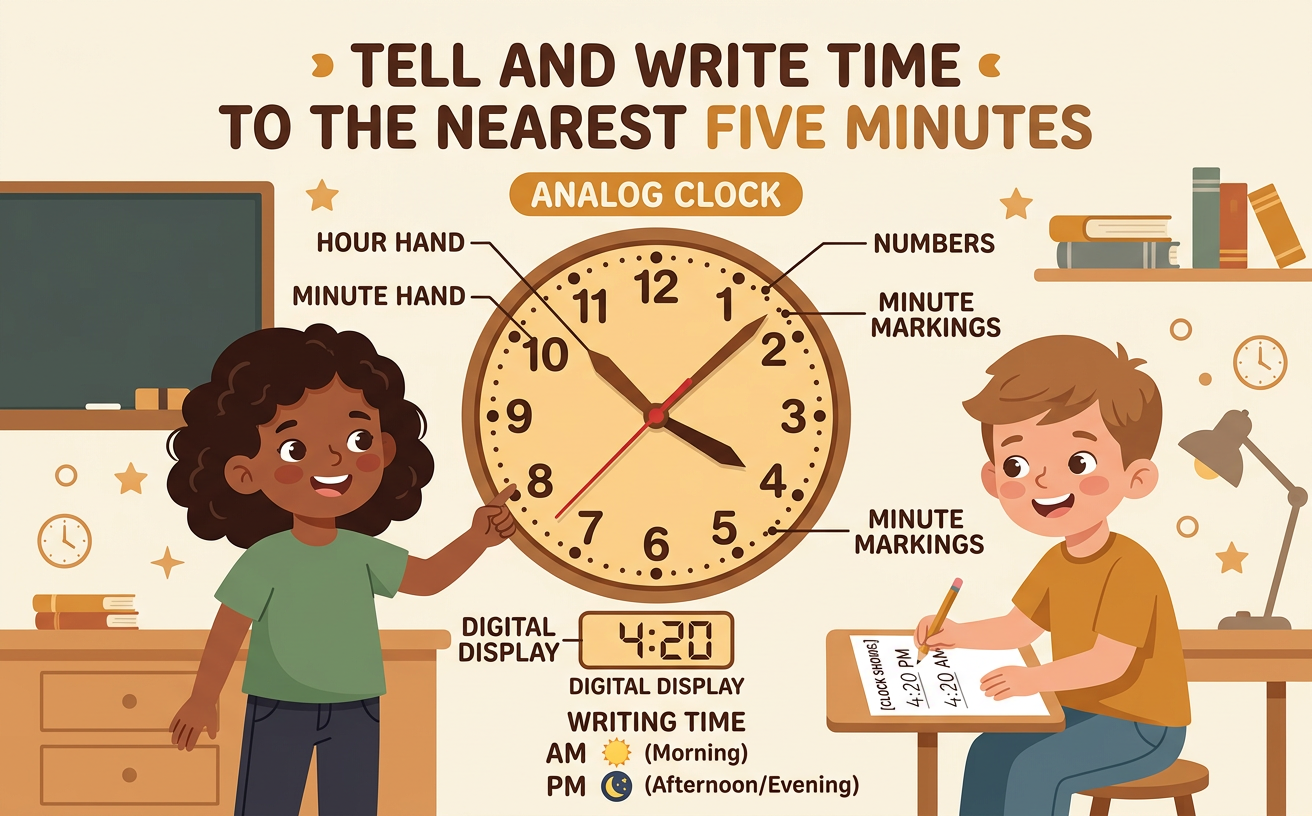
An analog clock has a round face with the numbers 1 through 12. The numbers show hours, but they also help us find minutes. A clock has two main hands. The short hand is the hour hand. The long hand is the minute hand. Both hands turn clockwise, moving in the same direction as the numbers. Small marks around the edge show single minutes. There are 60 minutes in one hour. When the minute hand points to 12, a new hour begins. For example, when the short hand points to 2 and the long hand points to 12, the time is 2:00. Notice which hand is longer before you read the clock.

Count Minutes by Fives
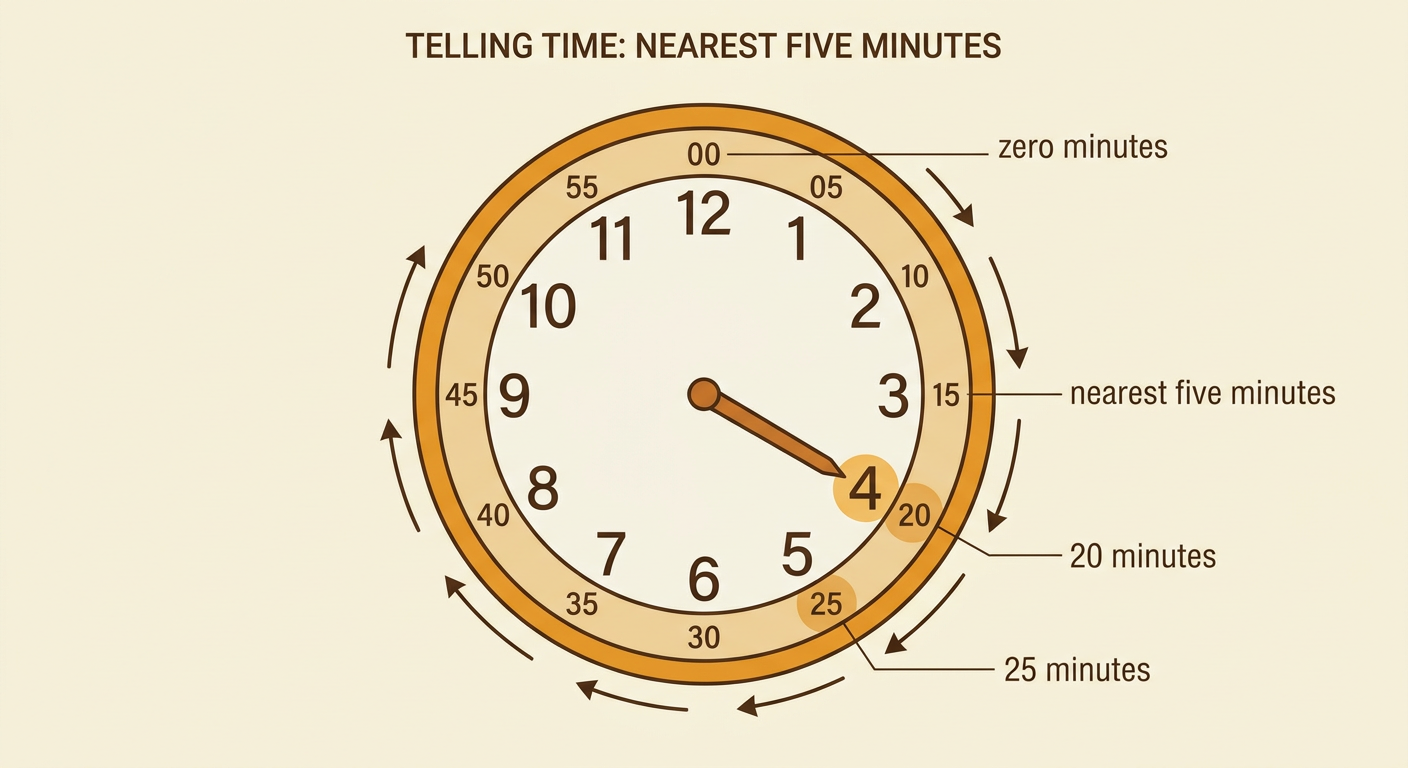
Each number on a clock stands for five minutes when the minute hand points to it. Start at 12 with zero minutes. Then skip-count by fives as you move clockwise: 5, 10, 15, 20, and so on. The 6 means 30 minutes, and the 12 can mean 60 minutes or the start of the next hour. For example, if the minute hand points to 4, count 5, 10, 15, 20. The clock shows 20 minutes after the hour. If a minute hand is between two five-minute points, use the closer point to tell time to the nearest five minutes. A minute hand at about 22 minutes is closer to 20 than to 25.
Read the Hour and Minute Hands
Read the hour hand first. It tells which hour has started. If the short hand is between two numbers, use the number it has already passed. Next, read the long minute hand by counting around the clock by fives. For example, suppose the short hand is a little past 7 and the long hand points to 5. The hour hand has passed 7 but has not reached 8, so the hour is 7. The number 5 stands for 25 minutes because 5 groups of 5 equal 25. The time is 7:25. Remember that the hour hand slowly moves toward the next number as the minutes pass. It does not stay exactly on the hour number.

Write the Time
Write a clock time with the hour first, followed by a colon and the minutes. The colon separates hours from minutes. Always use two digits for the minutes. If the minute hand points to 1, the minutes are written as 05, not just 5. For example, a clock with the hour hand just past 4 and the minute hand pointing to 1 shows 4:05. If the minute hand points to 8, it shows 40 minutes because 8 groups of 5 equal 40. A short hand between 8 and 9 with a long hand on 8 shows 8:40. You can write the same time shown on an analog clock as a digital time.

Use a.m. and p.m.
The letters a.m. and p.m. tell which part of the day a time belongs to. Use a.m. for times from midnight until just before noon. Morning activities, such as waking up and eating breakfast, usually happen in the a.m. Use p.m. for times from noon until just before midnight. Afternoon and evening activities usually happen in the p.m. For example, you might eat breakfast at 7:30 a.m. and eat dinner at 6:00 p.m. The clock hands can show the same numbers for both times, so a.m. or p.m. gives important information. Noon is 12:00 p.m., and midnight is 12:00 a.m. Think about the activity and the time of day before choosing a.m. or p.m.

Practice with Daily Schedules
A daily schedule lists activities and the times when they happen. To read each clock, find the hour, count the minutes by fives, and decide whether the activity happens in the a.m. or p.m. Imagine this schedule: wake up at 7:00 a.m., begin school at 8:15 a.m., play outside at 3:30 p.m., and go to bed at 8:45 p.m. At 8:15, the minute hand points to 3 because three groups of five equal 15. At 3:30, the minute hand points to 6 because six groups of five equal 30. Reading a schedule helps you connect clock times to real events. Check that your chosen a.m. or p.m. makes sense for each activity.
