
Testing and Choosing Materials
Students observe, test, and record properties such as flexibility, hardness, texture, and absorbency to choose the best material for a specific purpose.

Illustrations are auto-generated and may be placeholders. They can be refreshed to match the narration.
Notice Material Properties
Materials are the kinds of matter used to make objects. Each material has properties that you can observe with your senses or simple tools. A sponge may feel soft, rough, and flexible. A craft stick may feel hard, smooth, and stiff. A paper towel can soak up water, so it is absorbent. Wax paper does not soak up much water. Look closely at each sample without tasting it. Gently touch, bend, or press it as your teacher directs. Use property words such as hard, soft, smooth, rough, flexible, stiff, absorbent, and waterproof. Materials can be sorted by shared properties. For example, a sponge and a cotton cloth can go in an absorbent group, while plastic wrap and wax paper can go in a not absorbent group.

Predict the Best Material
Before testing, decide what job the material needs to do. Then make a prediction based on its properties. Suppose your class needs a material to wipe up a small water spill. You may choose from a paper towel, a cotton cloth, and wax paper. Think about which sample is likely to absorb the most water. You might predict, “I think the paper towel will work best because its tiny spaces can hold water.” Record your prediction before the test. A prediction is not a wild guess; it uses what you already know or observe. Listen to your classmates’ ideas, take turns speaking, and ask questions. The class has only a limited number of samples, so plan to use equal-sized pieces and avoid wasting materials.

Test and Observe Samples
Conduct a fair test so the results can be compared. Use equal-sized pieces of paper towel, cotton cloth, and wax paper. Place each piece on a tray. With an eyedropper, add water one drop at a time. Count how many drops each sample absorbs before water pools on top or leaks onto the tray. Use the same dropper, the same kind of water, and the same stopping rule for every sample. Record the number of drops in a table. You can also observe texture and flexibility by gently touching and bending each dry sample. For example, the paper towel may feel rough and bend easily, while wax paper may feel smooth and resist water. Work safely, share tools, and discuss observations without changing recorded results.

Graph the Results
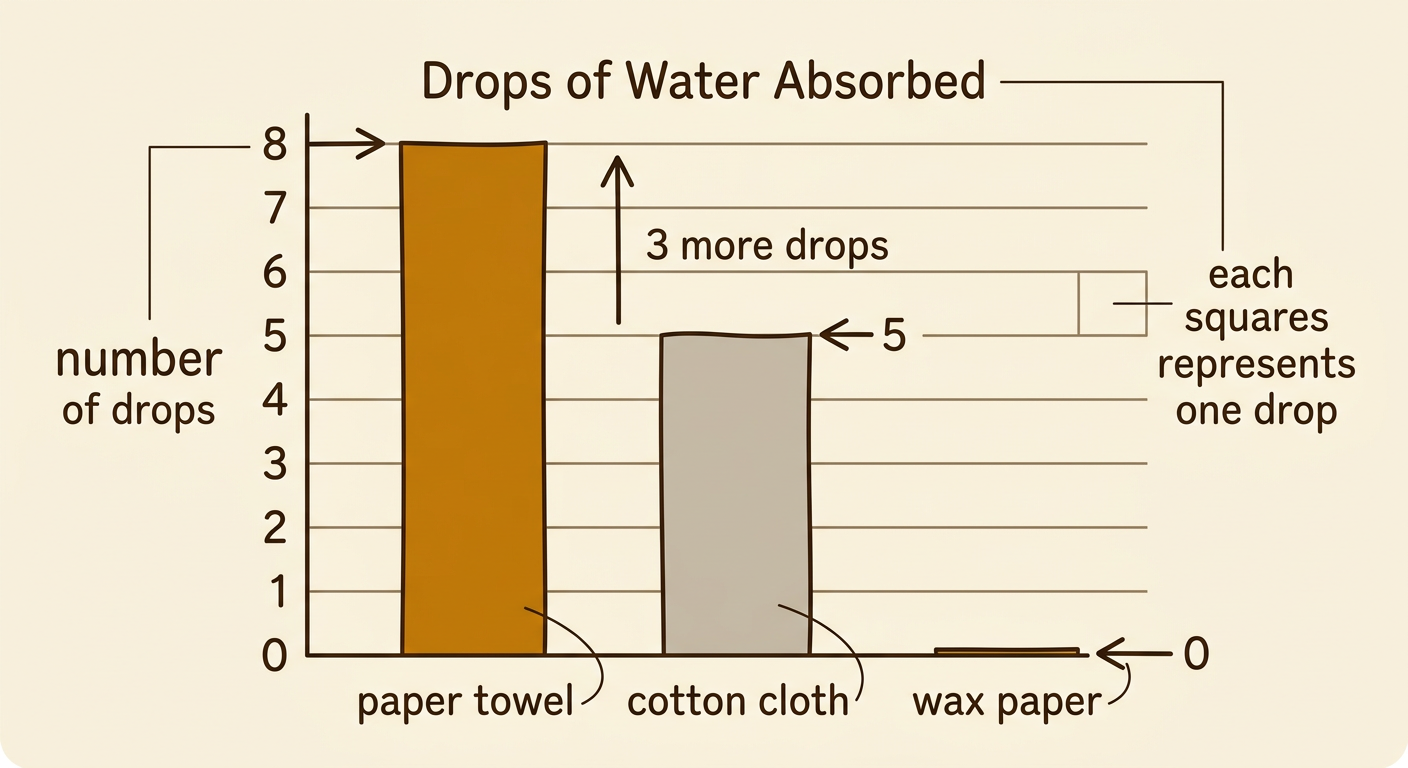
A graph makes test results easy to compare. Suppose the paper towel absorbed 8 drops, the cotton cloth absorbed 5 drops, and the wax paper absorbed 0 drops. Make a bar graph with the material names along the bottom and the number of drops along the side. Let each square represent one drop. Draw each bar to match the recorded number. The paper towel bar should reach 8, the cotton cloth bar should reach 5, and the wax paper bar should stay at 0. Add a title and label both parts of the graph. Then use the graph to answer questions. Which material absorbed the most? How many more drops did the paper towel absorb than the cotton cloth? The graph shows that the difference is 3 drops.
Choose and Explain
Use the test evidence to choose the best material for the job. If the goal is to absorb the most water with one small piece, the paper towel is the best choice in this test because it absorbed 8 drops. Wax paper would not be a good choice for wiping the spill because it absorbed 0 drops. However, people must also think about limited resources. A cotton cloth absorbed only 5 drops, but it can be washed and used again. If the goal is to reduce trash, the cloth may be the better choice. Explain your decision with a complete statement such as, “I choose the cotton cloth because it absorbs water and can be reused.” Different goals can lead to different choices. Share your claim, listen to other evidence, and revise your choice if the results support a better answer.
