The American Revolution: From Protest to Independence
Students examine how taxation, Enlightenment ideas, colonial resistance, and military turning points transformed a political dispute into a war for American independence.
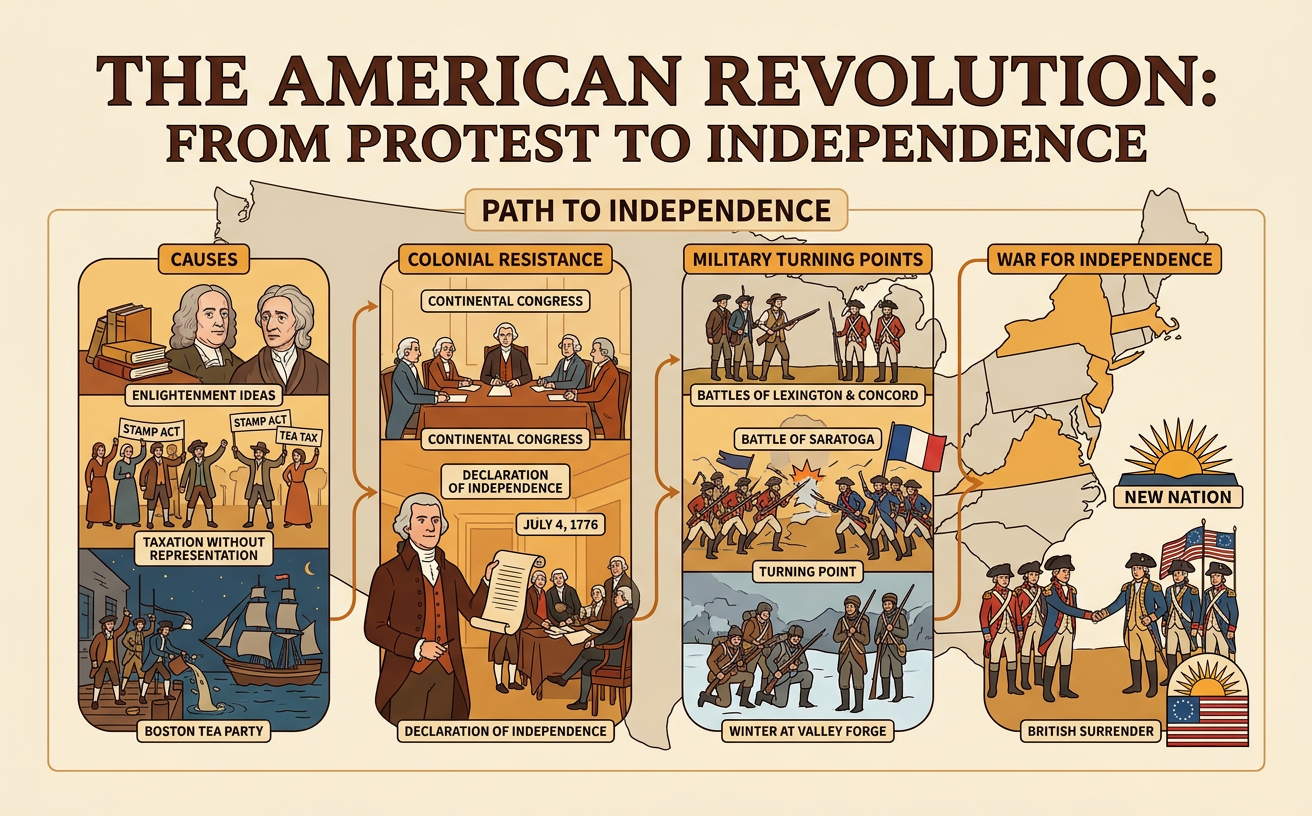
Illustrations are auto-generated and may be placeholders. They can be refreshed to match the narration.
Britain and Its Colonies After 1763
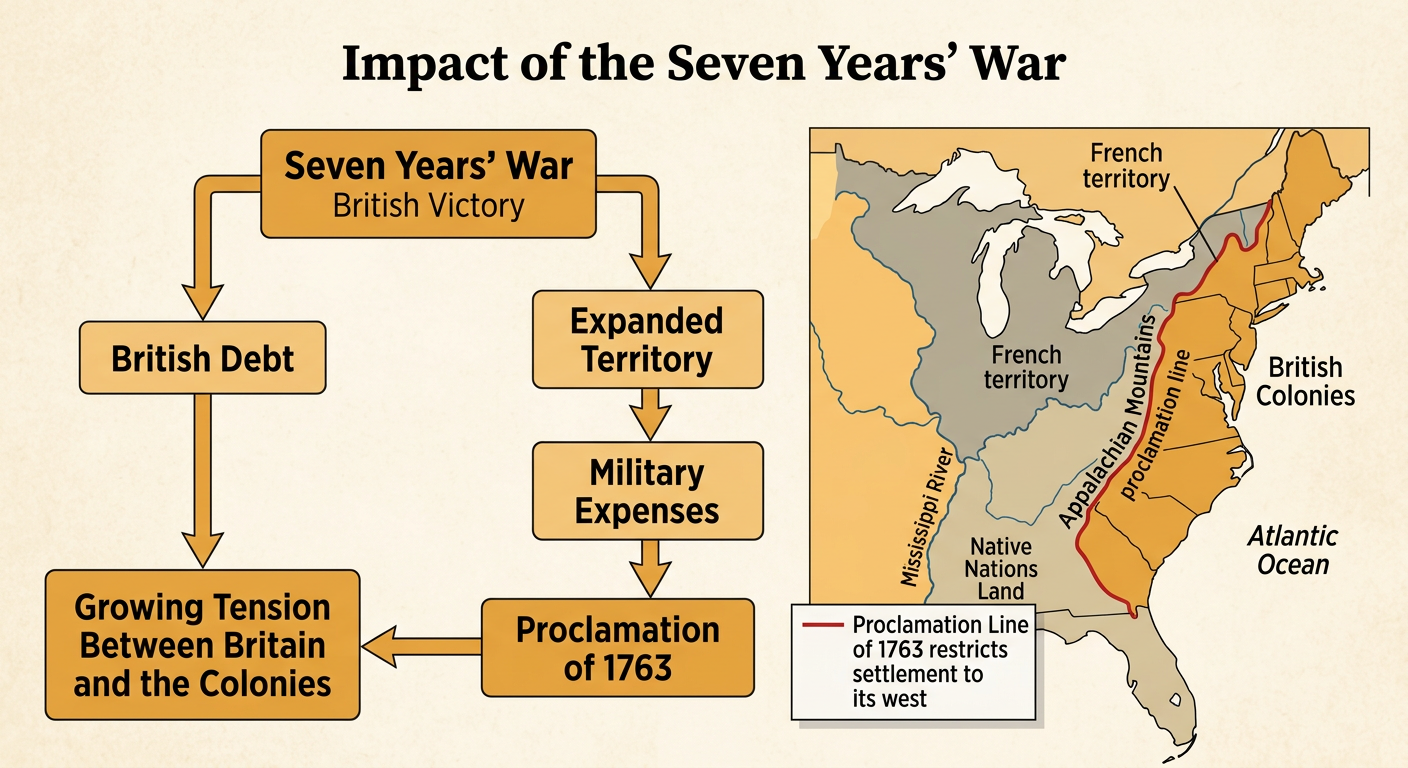
The Seven Years’ War ended in 1763, leaving Britain with a larger empire and heavy debt. In North America, the conflict was called the French and Indian War. Britain gained French territory east of the Mississippi River, but defending this land required soldiers and money. British leaders believed the colonies should help pay the costs. The Proclamation of 1763 also limited settlement west of the Appalachian Mountains to reduce warfare with Native nations. Many colonists objected because they wanted western land and had grown accustomed to managing local affairs. For example, settlers and land speculators crossed or challenged the proclamation line. Britain viewed its new policies as reasonable imperial management, while many colonists saw them as threats to economic opportunity and self-government. This disagreement created the setting for later protests.
Taxation and Colonial Protest
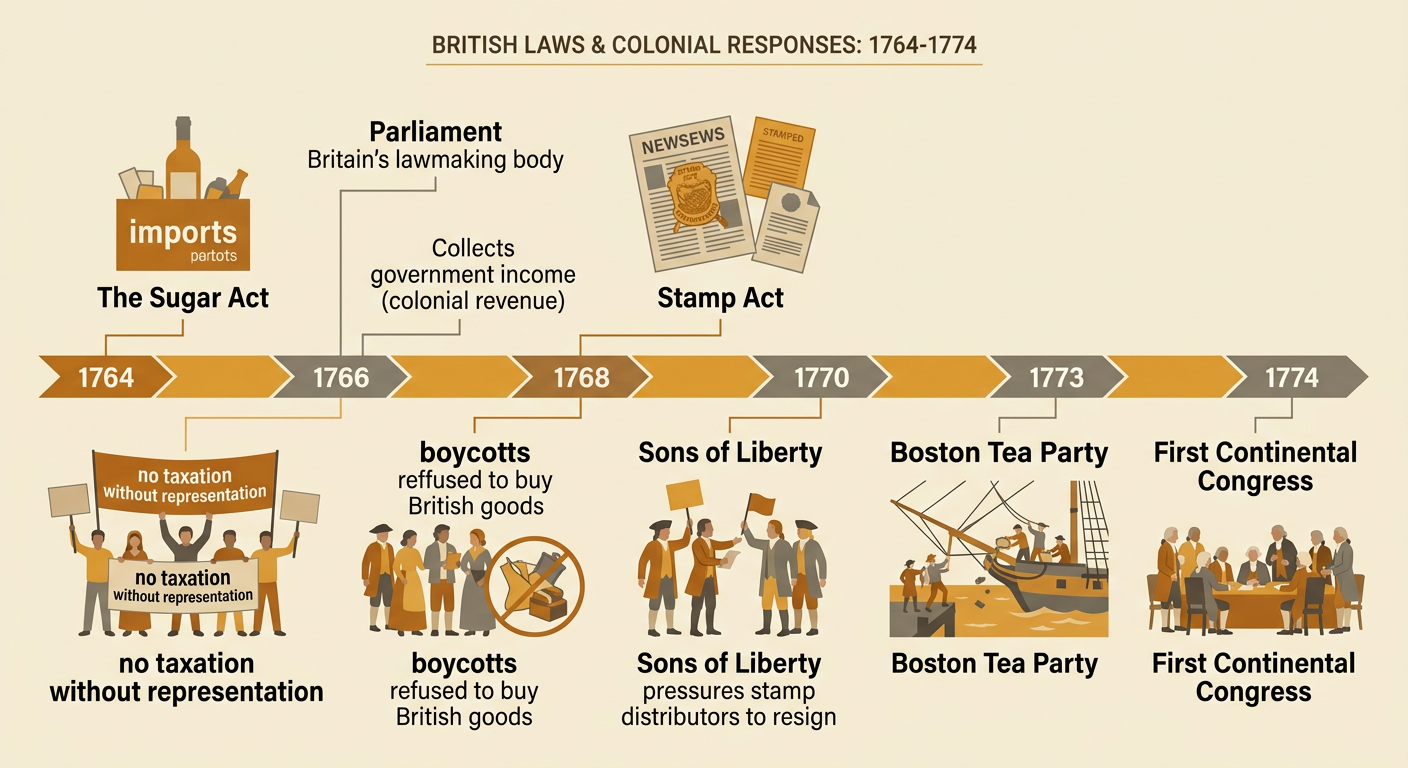
Parliament tried to raise colonial revenue through measures including the Sugar Act of 1764 and the Stamp Act of 1765. The Stamp Act required paid stamps on newspapers, legal papers, and other printed materials. Colonists argued that Parliament could not tax them because they did not elect representatives to it, an objection summarized by the slogan “no taxation without representation.” Protesters organized boycotts, formed the Sons of Liberty, and pressured stamp distributors to resign. Parliament repealed the Stamp Act but later passed the Townshend Acts and Tea Act. In December 1773, colonists dumped East India Company tea into Boston Harbor during the Boston Tea Party. Britain responded with the Coercive Acts, closing Boston’s port and restricting Massachusetts government. These measures encouraged colonies to coordinate resistance through the First Continental Congress in 1774.
Enlightenment Ideas and Independence
Enlightenment thinkers helped colonists explain why resistance could be justified. John Locke argued that people possessed natural rights and that governments received authority through the consent of the governed. If a government violated people’s rights, citizens could change it. Thomas Paine applied similar ideas in Common Sense, published in January 1776. He attacked monarchy and urged the colonies to create an independent republic. The Declaration of Independence, adopted on July 4, 1776, stated that “all men are created equal” and possess rights including “Life, Liberty and the pursuit of Happiness.” It then listed grievances against King George III as evidence that British rule had broken the political agreement with the people. These ideals supported independence, but they were applied unevenly: enslaved people, Native peoples, and women did not receive equal political rights in the new nation.

Lexington, Concord, and the Outbreak of War
On April 19, 1775, about 700 British regulars marched from Boston toward Concord to destroy colonial military supplies. Riders including Paul Revere, William Dawes, and Samuel Prescott helped warn the countryside. At Lexington, British troops met local militia, and an unknown person fired the first shot. Eight colonists were killed. At Concord’s North Bridge, militia members exchanged fire with British soldiers and forced them back. Thousands of militia then attacked the British column during its retreat to Boston. British forces suffered about 273 killed, wounded, or missing, while colonial forces suffered about 95. The fighting changed a political dispute into armed conflict. Soon afterward, the Second Continental Congress created the Continental Army and appointed George Washington commander in chief, even while some delegates still hoped for reconciliation.

Turning Points and Wartime Challenges
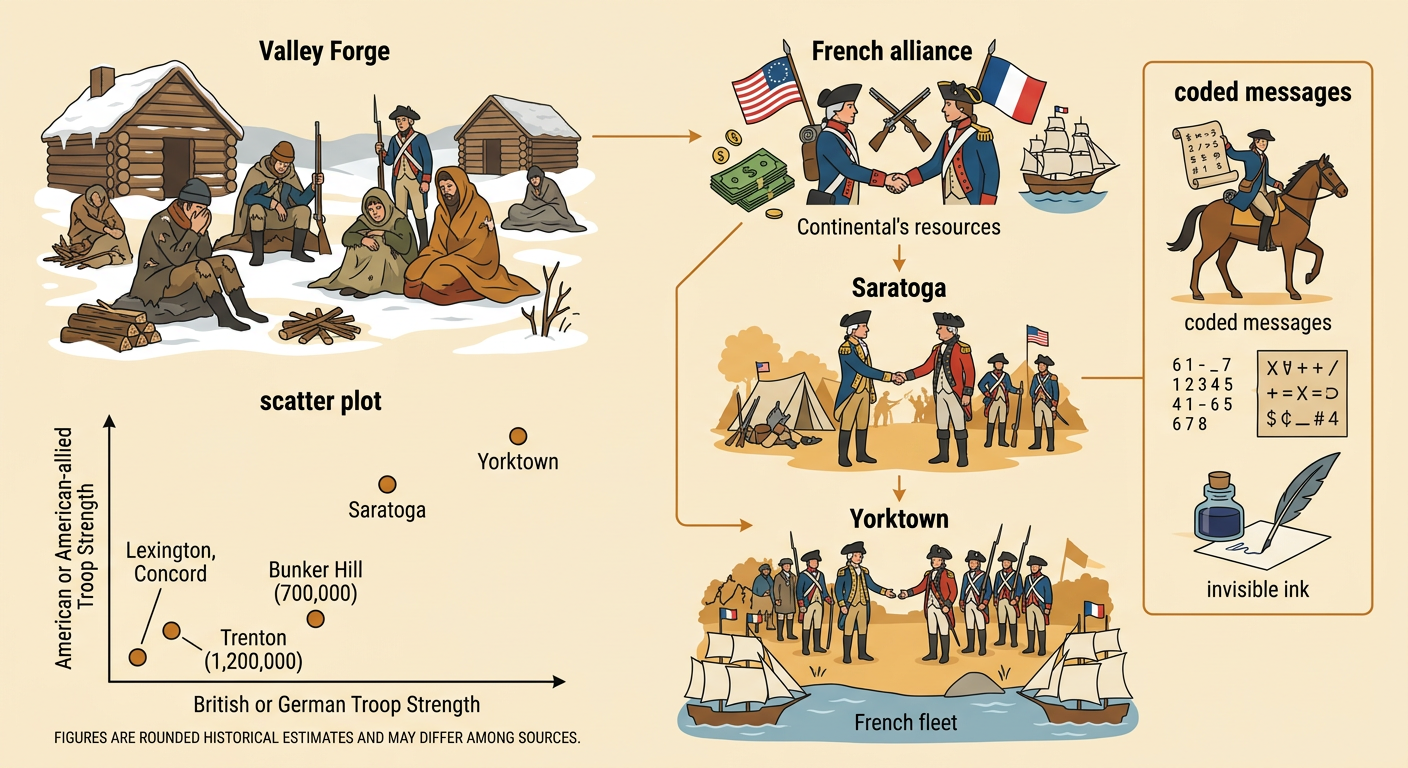
The Continental Army faced shortages of food, clothing, pay, weapons, and trained soldiers. At Valley Forge during the winter of 1777–1778, disease and supply failures caused severe suffering, although Baron von Steuben improved military training. The American victory at Saratoga in October 1777 persuaded France to form an alliance with the United States in 1778. French money, soldiers, weapons, and naval power changed the war. At Yorktown in 1781, American and French forces trapped Lord Cornwallis’s army while a French fleet blocked escape by sea. Wartime communication also presented a design problem: messages had to be accurate, fast, and secret despite long distances, limited materials, and possible interception. Armies used couriers, coded messages, signal flags, and invisible ink. When comparing troop estimates on a scatter plot, students should identify overall patterns while recognizing that historical totals vary by source.
The Treaty of Paris and Revolutionary Consequences
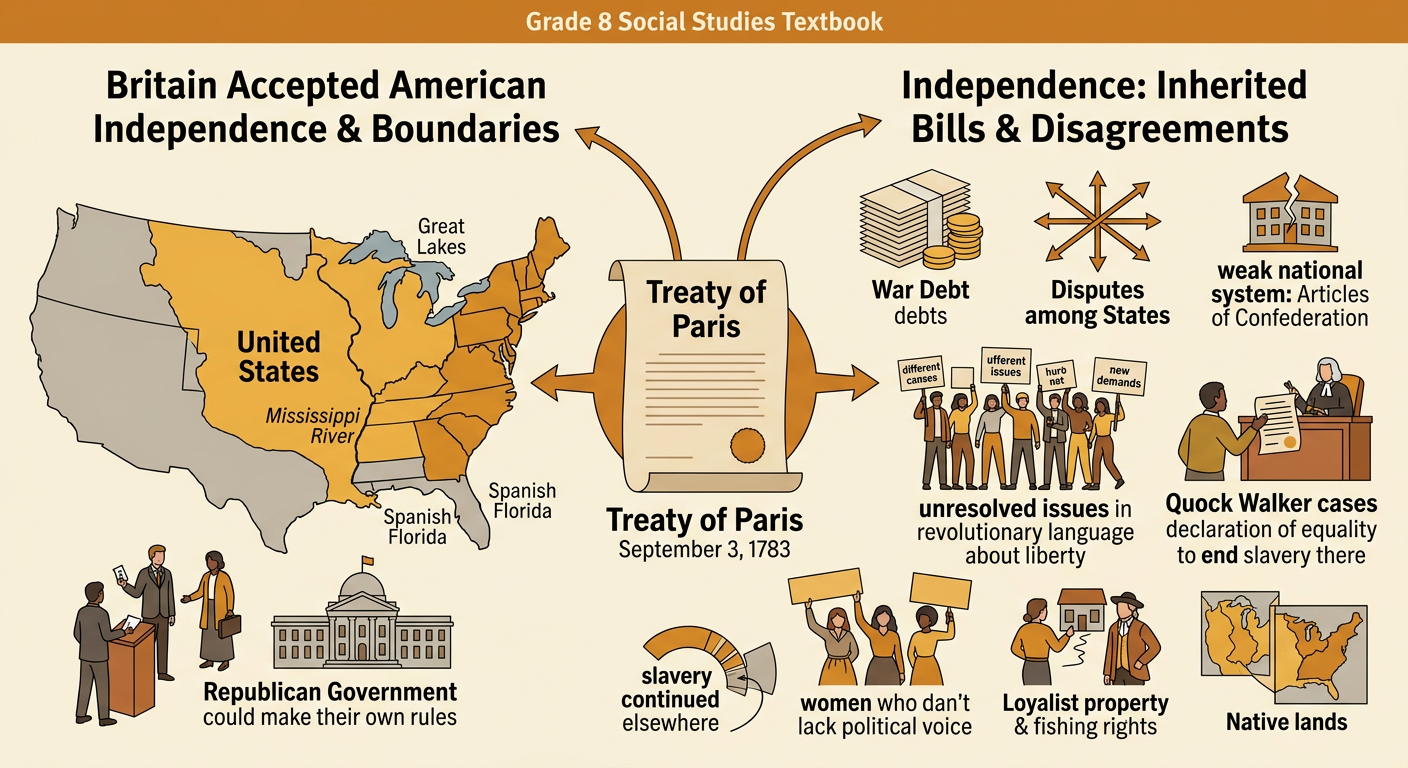
The Treaty of Paris, signed on September 3, 1783, formally ended the war. Britain recognized the independence of the United States and accepted boundaries extending west to the Mississippi River, north to the Great Lakes, and south to Spanish Florida. The treaty also addressed fishing rights, debts, and Loyalist property. Independence allowed Americans to create republican governments, but the new nation faced debt, interstate disagreements, and the weaknesses of the Articles of Confederation. Revolutionary language about liberty encouraged later demands for broader rights. For example, the Quock Walker cases in Massachusetts in 1783 used the state constitution’s declaration of equality to help end slavery there. Yet slavery continued elsewhere, women lacked equal political rights, and Native nations lost land despite not consenting to the treaty. The Revolution therefore produced both major political change and unresolved conflicts over equality and power.