The Atomic Bomb and the End of World War II
Students evaluate historical evidence, casualty estimates, and the science of nuclear fission to assess competing arguments about the United States’ decision to use atomic bombs against Japan.

Illustrations are auto-generated and may be placeholders. They can be refreshed to match the narration.
The Pacific War in 1945
By mid-1945, Japan’s military position had sharply weakened, but its government had not surrendered. U.S. forces had captured Iwo Jima and Okinawa after costly battles, while submarines and aircraft disrupted Japanese shipping and industry. Conventional firebombing, including the March 1945 raid on Tokyo, destroyed large urban areas and killed many civilians. Japan still had millions of troops in its home islands and overseas territories, and some leaders hoped to secure better surrender terms. Meanwhile, the Soviet Union remained formally neutral toward Japan until August 8. For example, the Battle of Okinawa caused more than 12,000 U.S. military deaths and enormous Japanese military and civilian losses. American planners viewed that battle as evidence that an invasion of Japan’s home islands might involve prolonged resistance and heavy casualties.

How Nuclear Fission Releases Energy
Nuclear fission occurs when the nucleus of a heavy atom, such as uranium-235, absorbs a neutron and becomes unstable. The nucleus splits into two smaller nuclei, releases additional neutrons, and converts a small amount of mass into a large amount of energy according to E = mc². If released neutrons strike other fissile nuclei, they can produce a rapidly growing chain reaction. In a nuclear weapon, enough fissile material is brought into a supercritical arrangement so that the chain reaction releases energy almost instantly. Hiroshima’s bomb used uranium-235 in a gun-type design, while Nagasaki’s used plutonium-239 compressed by an implosion design. For example, one fission event releases microscopic energy, but an immense number of nearly simultaneous fissions produces intense blast, heat, and ionizing radiation.

Truman’s Decision
President Harry S. Truman inherited the atomic bomb project after Franklin D. Roosevelt died in April 1945. Truman consulted advisers, but the decision developed through military planning, the Interim Committee’s recommendations, and broader efforts to end the war. On July 26, the United States, Britain, and China issued the Potsdam Declaration demanding Japan’s unconditional surrender and warning of “prompt and utter destruction.” Japan did not accept the demand. The United States bombed Hiroshima on August 6. The Soviet Union declared war on Japan on August 8, and the United States bombed Nagasaki on August 9. Japan announced its acceptance of surrender terms on August 15. For example, historians compare Truman’s later explanations with meeting records and wartime orders because memories written after an event may emphasize different motives than documents created during it.

Casualty Estimates and Evidence
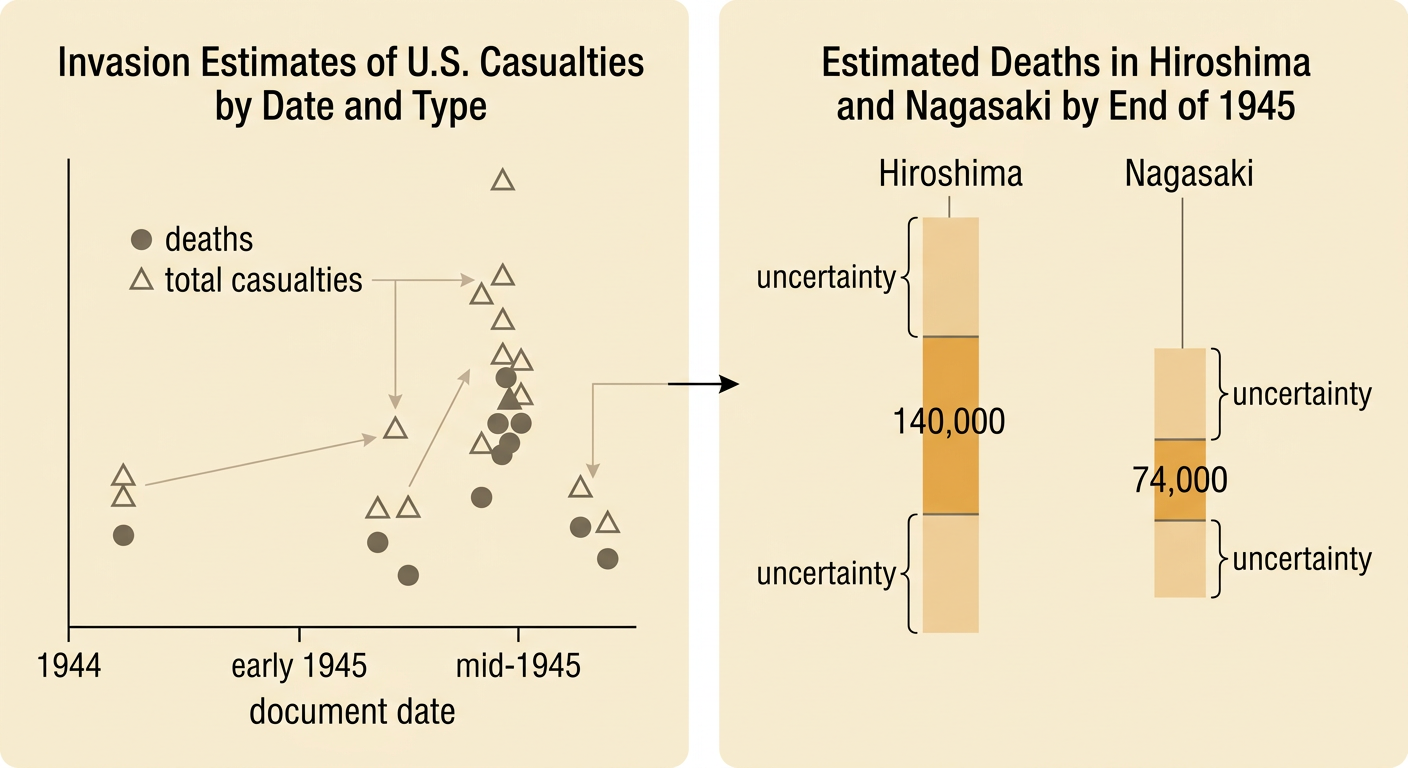
Casualty figures must be interpreted by asking who produced them, when they were produced, and what they count. Wartime invasion estimates varied because planners used different assumptions about invasion locations, Japanese resistance, and the length of combat. Some figures estimated deaths, while others counted total casualties, including wounded and missing personnel. Later public claims sometimes differed from estimates available before the bombings. Atomic bomb casualty totals are also ranges because records were destroyed and radiation caused delayed deaths. Frequently cited estimates place Hiroshima’s deaths by the end of 1945 at about 140,000 and Nagasaki’s at about 74,000, both with substantial uncertainty. For example, a scatterplot of invasion estimates should identify each document’s date and definition; plotting unlike measures together without labels could create a misleading trend or comparison.
Arguments and Alternatives
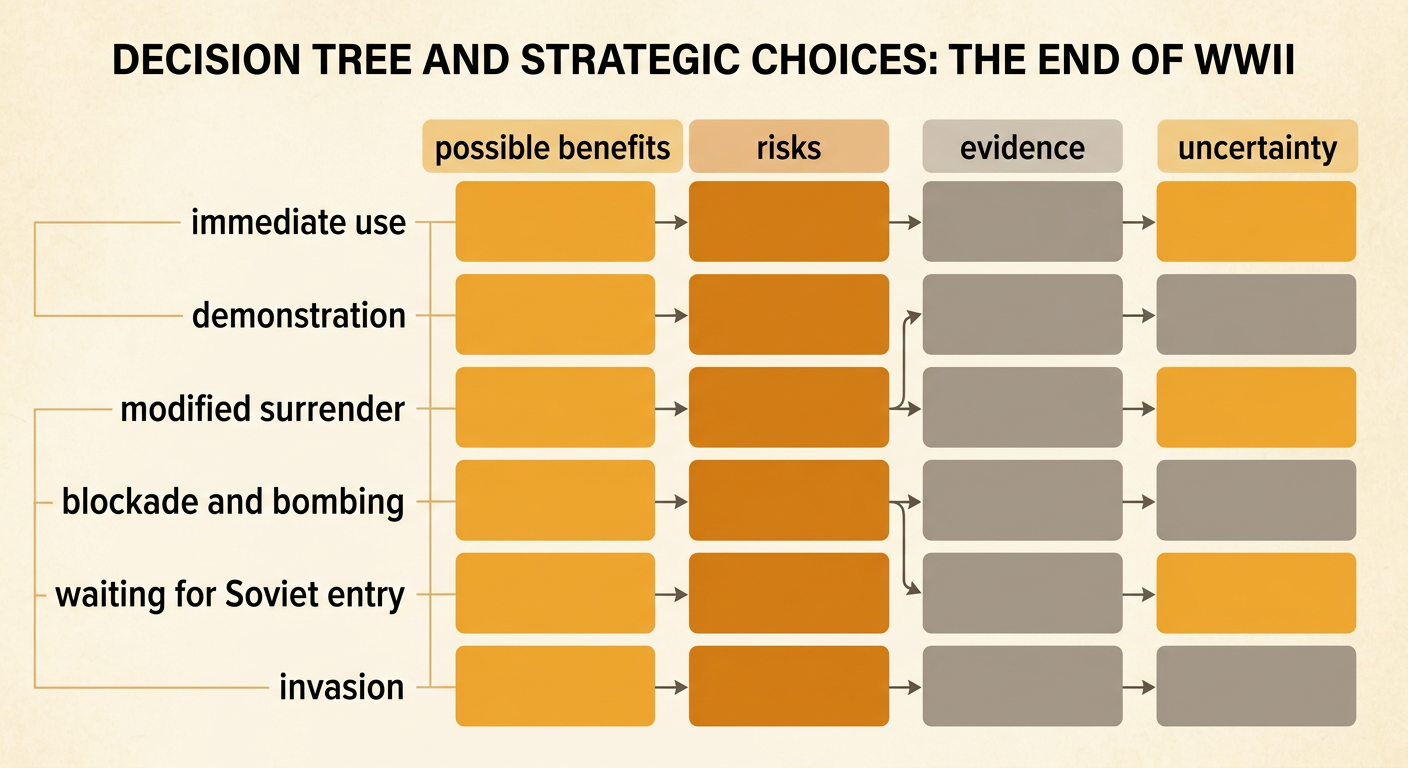
Historians debate whether using the atomic bombs was necessary, justified, or the best available option. Supporters argue that the bombings accelerated surrender, avoided an invasion, ended continuing wartime deaths, and limited further Soviet advances. Critics argue that Japan was already weakened, civilian destruction was disproportionate, and other options deserved more time. Proposed alternatives included demonstrating the bomb on an uninhabited site, modifying surrender terms to preserve the emperor, waiting for Soviet entry, continuing blockade and conventional bombing, or invading. Each alternative carried uncertainty. A demonstration might fail or leave Japanese leaders unconvinced; blockade and bombing would continue civilian suffering; invasion could cause extensive casualties; and delay could change Soviet influence in Asia. For example, evaluating the demonstration option requires evidence about the limited number of available bombs, technical reliability, Japanese decision-making, and whether observers could verify the weapon’s power.
Evidence-Based Historical Judgment
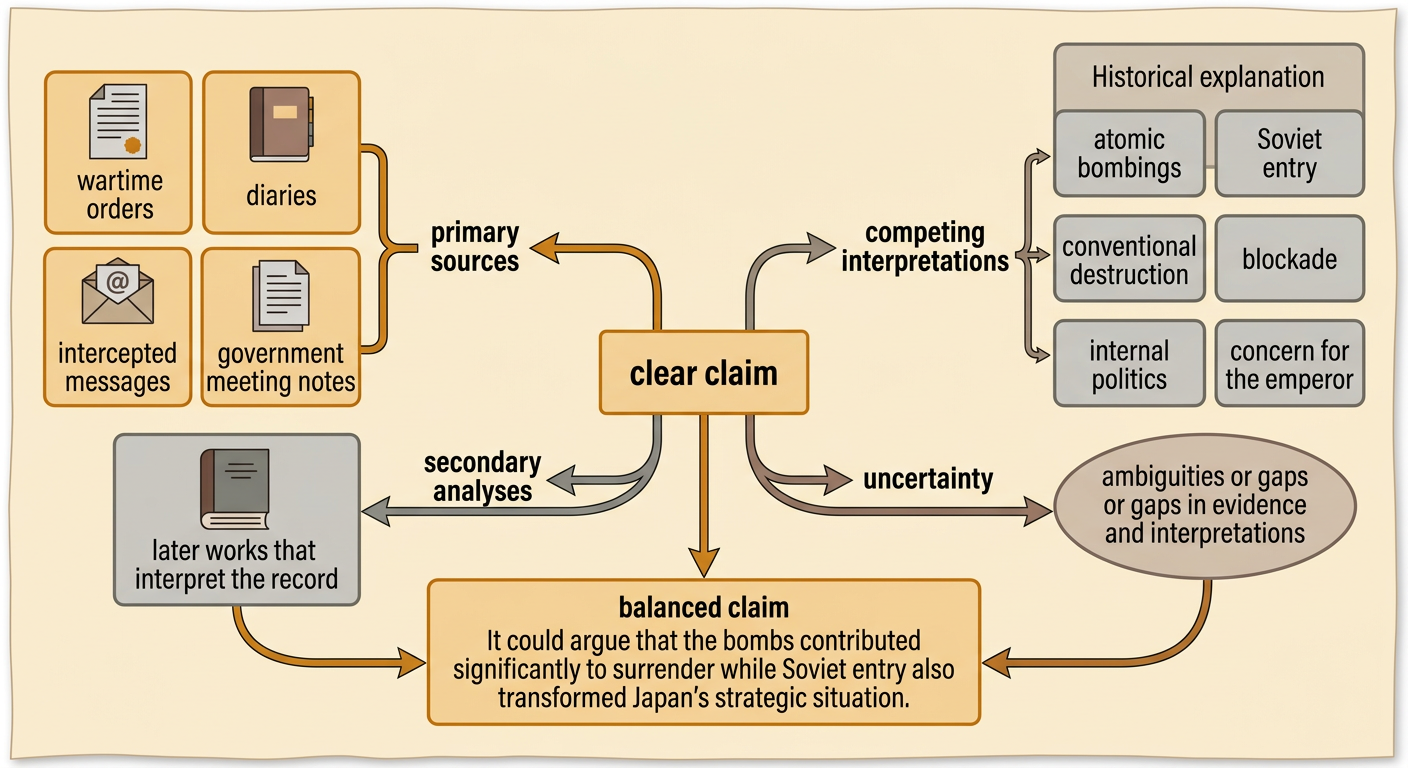
An evidence-based judgment states a clear claim, cites specific sources, addresses competing interpretations, and explains uncertainty. Students should distinguish primary sources, such as wartime orders, diaries, intercepted messages, and government meeting notes, from secondary analyses written later. They should also examine origin, purpose, audience, and context. No single event fully explains Japan’s surrender: the atomic bombings, Soviet entry, conventional destruction, blockade, internal politics, and concern for the emperor all influenced decisions. For example, a strong argument might claim that the bombs contributed significantly to surrender but that Soviet entry also changed Japan’s strategic situation. It would cite dated Japanese leadership records, Truman administration documents, casualty data, and reputable historical scholarship, then acknowledge gaps in the evidence. Historical judgment does not require certainty; it requires a conclusion proportional to the strongest available evidence.