
The Black Death and the Transformation of Medieval Europe
Students analyze how disease, trade routes, and social conditions contributed to the Black Death and evaluate its effects on European population, labor, and social structures.

Illustrations are auto-generated and may be placeholders. They can be refreshed to match the narration.
Europe Before the Plague
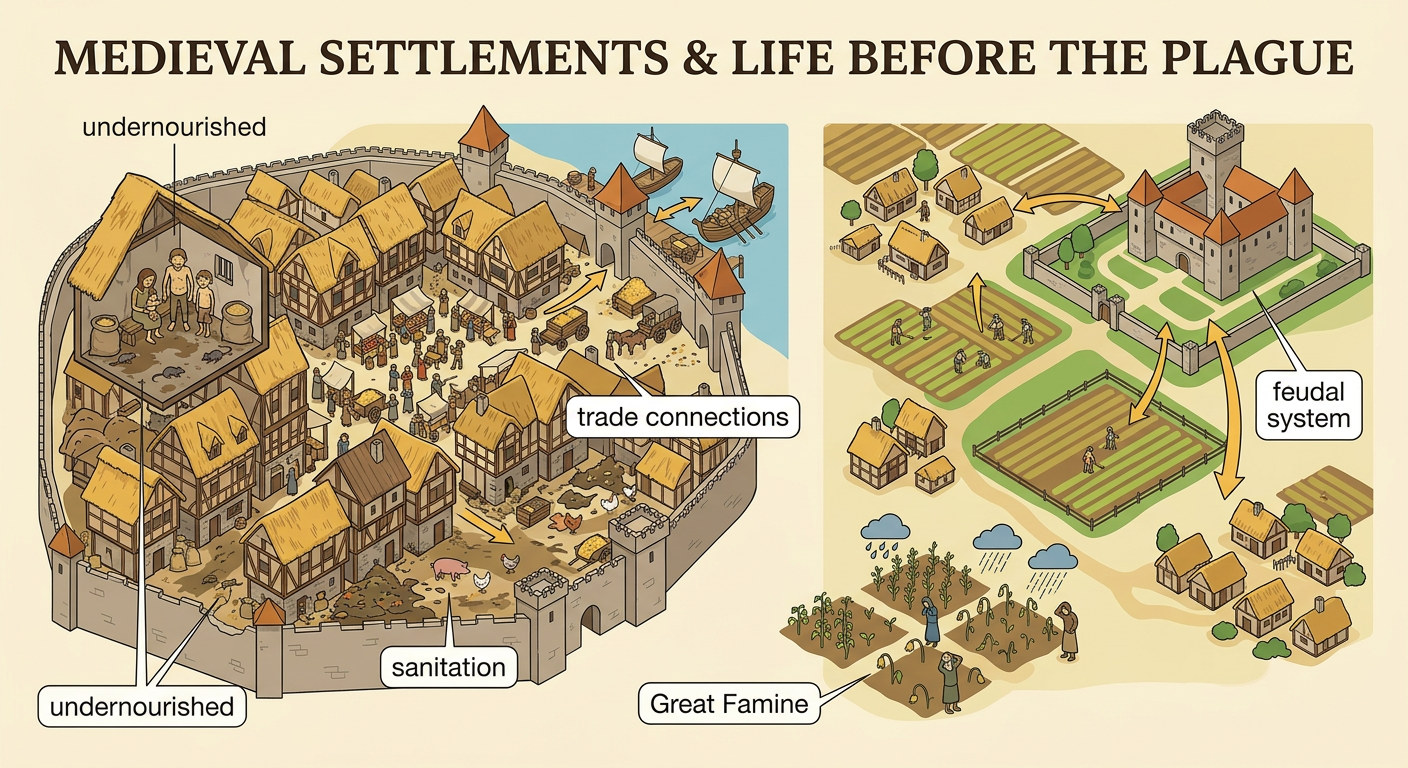
Before the Black Death, most Europeans lived in farming villages under a feudal system. Peasants worked land controlled by nobles, while towns grew as trade expanded. By the early 1300s, Europe’s population had increased greatly, placing pressure on available farmland and food supplies. Poor harvests and the Great Famine of 1315–1317 left many people undernourished. Medieval towns were crowded, sanitation was limited, and rats and other animals lived near people and stored food. These conditions did not cause the plague, but they made communities vulnerable to disease. For example, a family weakened by hunger and living in a crowded town had fewer resources to avoid infection or recover from illness. Europe’s connected trade network also meant that a disease entering one port could reach many distant communities.
How the Disease Spread
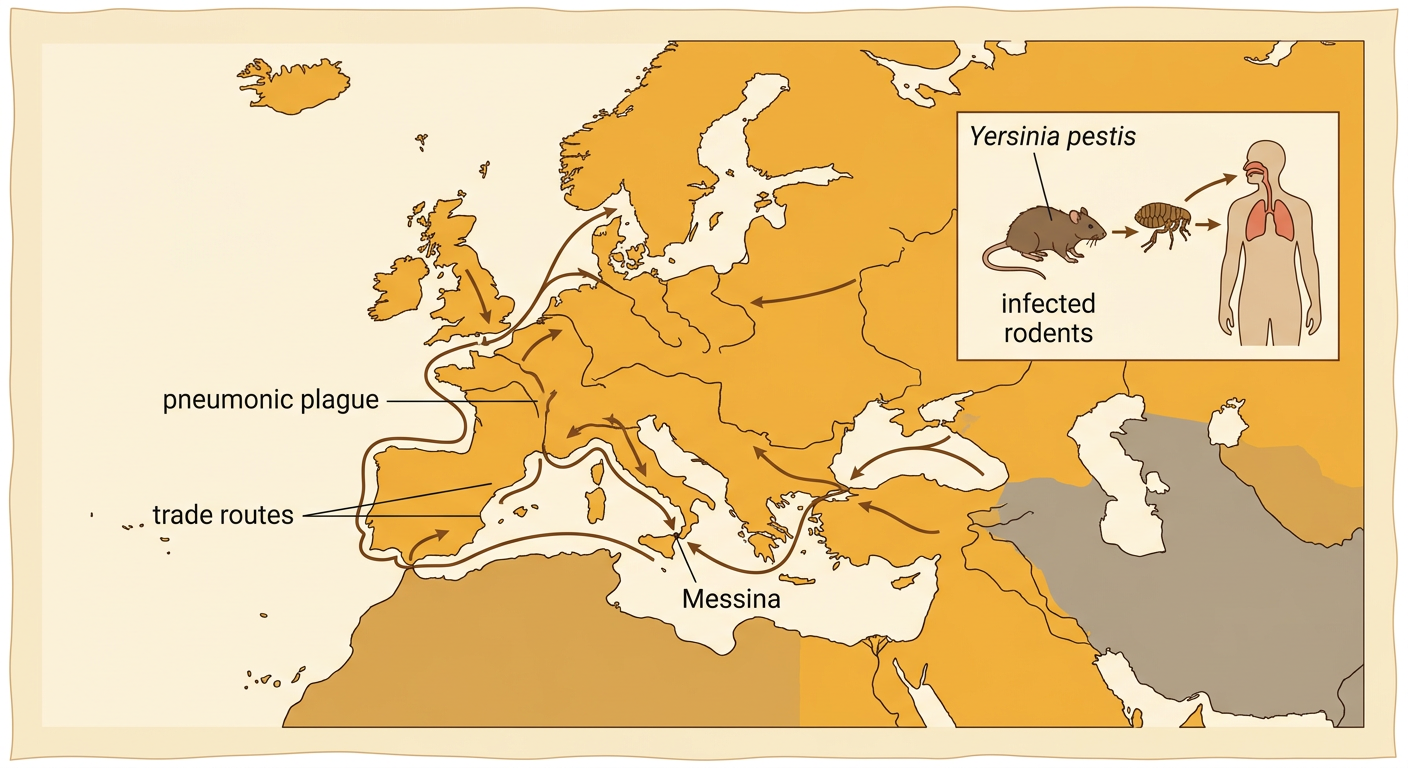
The Black Death was caused mainly by the bacterium Yersinia pestis. It reached Europe in 1347 and spread rapidly along land and sea trade routes. Fleas living on infected rodents likely transmitted many cases of plague, although direct person-to-person transmission could occur in the pneumonic form. Merchant ships carried people, goods, rodents, and fleas between ports. From Mediterranean ports such as Messina, the disease moved into towns and then along roads and rivers into the countryside. Trade did not create the bacterium, but it connected populations and helped the disease travel farther and faster. For example, ships crossing the Black Sea and Mediterranean could bring infection to a busy port; merchants and travelers leaving that port could then carry the disease toward inland markets. This shows how a biological change in an ecosystem can sharply affect human populations.
Evidence from Medieval Sources
Historians use primary sources created during the plague and secondary sources written after researchers compare many kinds of evidence. The Italian writer Giovanni Boccaccio described sickness, fear, abandoned homes, and disrupted burial customs in Florence. Government records list deaths, wages, taxes, and property transfers. Archaeologists and scientists also study mass graves and ancient DNA, which has identified Yersinia pestis in plague victims. Each source has limits. Boccaccio witnessed the crisis, but his dramatic writing may not describe every community. A tax record may provide numbers while leaving out poor people who were never recorded. Students should cite exact details and compare sources before making a claim. For example, a historian could combine a burial register showing unusually frequent deaths with DNA evidence from remains to argue that plague caused a local population collapse.

Population and Labor Changes
Between 1347 and 1351, the Black Death killed a very large share of Europe’s population, although estimates differ by region. Many historians estimate that roughly one-third to one-half of Europeans died. Farms, workshops, and estates suddenly had fewer workers. Because labor was scarce, surviving workers could sometimes demand higher wages, shorter service, or better access to land. Landowners attempted to protect their income by limiting wages and requiring old labor duties. In England, the 1351 Statute of Laborers tried to hold wages near pre-plague levels, showing that employers feared rising labor costs. The effects were uneven: some workers gained choices, while others faced strict laws, conflict, or continued poverty. Population loss also reduced demand for some goods and left farmland unused. Thus, one demographic change produced connected economic effects on wages, production, land use, and bargaining power.

Long-Term Social Effects
The Black Death did not end feudalism by itself, but it helped accelerate changes already underway. Repeated outbreaks kept populations low for generations, weakening some landowners’ ability to demand unpaid labor from peasants. In parts of western Europe, more peasants rented land, moved for work, or earned cash wages. Town workers and merchants could also gain opportunities as labor remained scarce. At the same time, elites resisted these changes, and tensions contributed to uprisings such as the English Peasants’ Revolt of 1381. The plague also produced harmful social reactions. Frightened communities blamed outsiders, and Jewish communities faced false accusations, persecution, and massacres. Religious practices, art, and attitudes toward death changed as people tried to understand the disaster. The results differed across Europe, so historians describe the plague as one major cause among several that transformed medieval society.
