
The Civil Rights Movement: Protest, Law, and Environmental Justice
Students examine how civil rights activists used evidence, protest, court action, and public policy to challenge segregation and unequal environmental conditions.
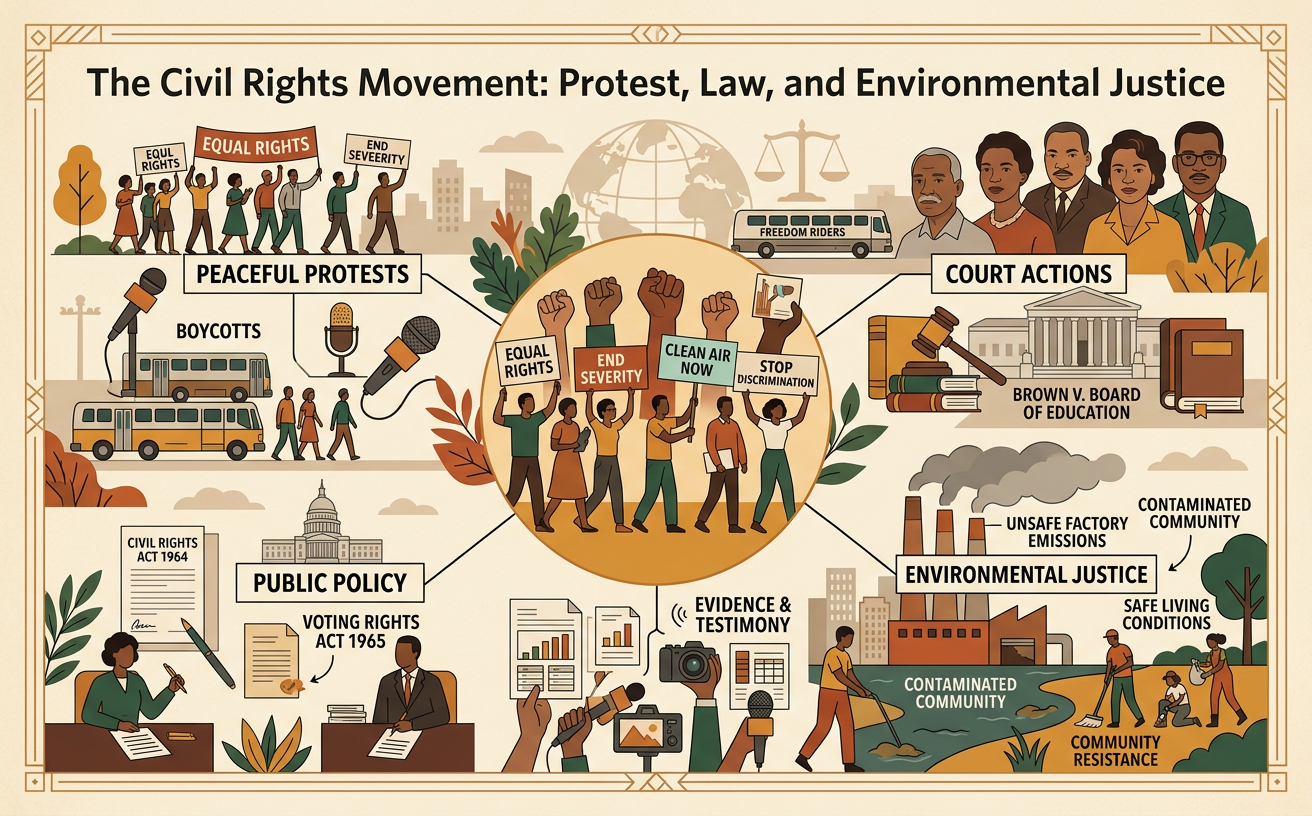
Illustrations are auto-generated and may be placeholders. They can be refreshed to match the narration.
Segregation and Unequal Citizenship
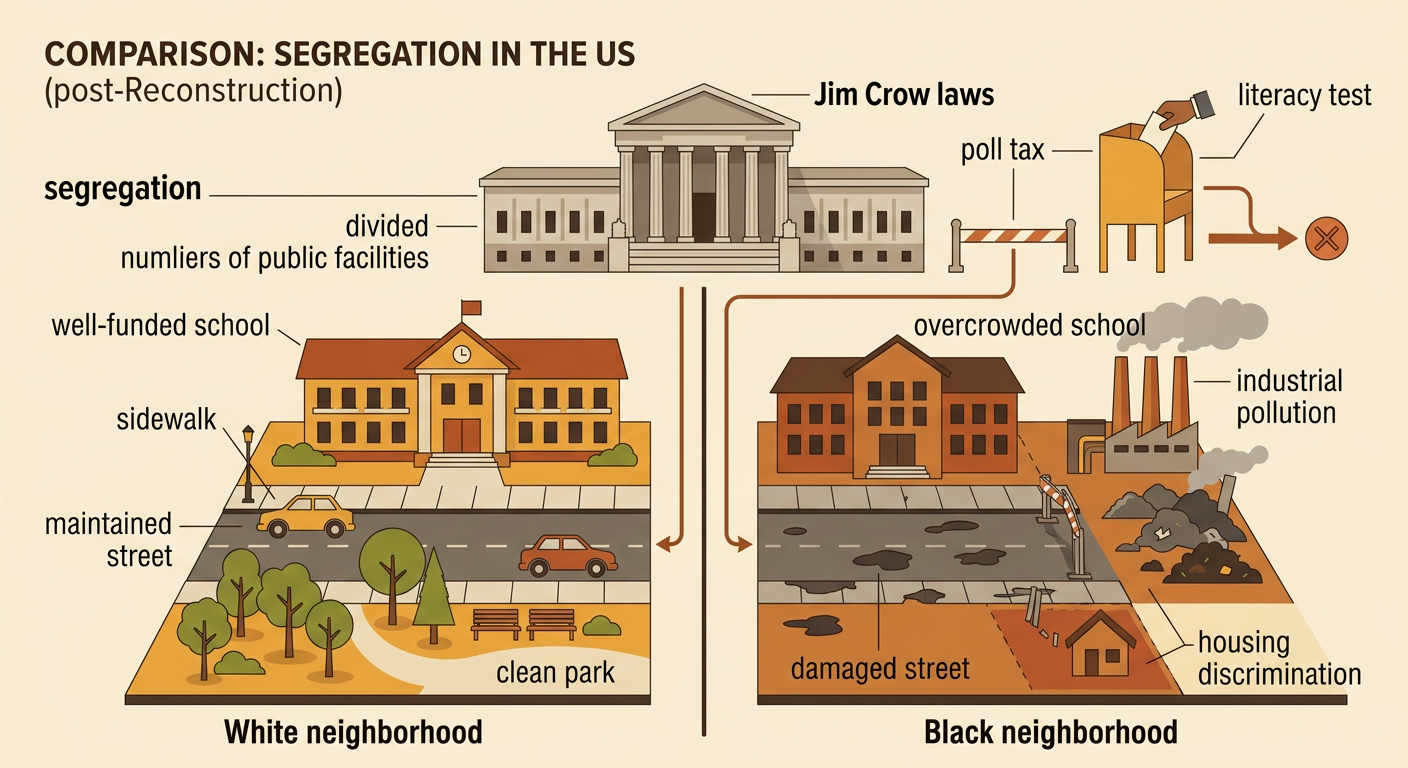
After Reconstruction, state and local governments—especially in the South—created Jim Crow laws that separated people by race. Black Americans attended underfunded schools, used separate public facilities, and faced discrimination in housing and employment. Poll taxes, literacy tests, intimidation, and violence prevented many Black citizens from voting. These practices contradicted democratic principles such as equality under the law and representative government. Segregation also shaped environmental conditions. Housing discrimination often confined Black families to neighborhoods near landfills, factories, or poorly maintained infrastructure. For example, discriminatory housing policies made it difficult for families to move or receive fair home loans. When analyzing a source about segregation, students should identify the author, date, purpose, and specific words or facts that demonstrate unequal treatment.
Strategies of the Civil Rights Movement
Civil rights activists used several connected strategies to challenge injustice. They organized boycotts, marches, sit-ins, voter-registration drives, court cases, and public information campaigns. Nonviolent protest exposed unfair laws and encouraged wider public support. During the 1955–1956 Montgomery Bus Boycott, Black residents refused to ride segregated city buses after Rosa Parks was arrested. Community members organized carpools and walked to work for more than a year. Lawyers also challenged bus segregation in federal court, and the Supreme Court affirmed a ruling that the practice was unconstitutional. Activists gathered testimony, photographs, petitions, and records to support their claims. These actions demonstrate civic virtues such as courage, cooperation, and persistence. Participants had different personal interests and perspectives, but they worked toward democratic principles including equal protection, freedom of assembly, and fair participation in government.

Landmark Laws and Court Decisions
Court decisions and federal laws turned movement demands into enforceable public policy. In Brown v. Board of Education of Topeka, the Supreme Court ruled in 1954 that racial segregation in public schools violated the Equal Protection Clause of the Fourteenth Amendment. The decision overturned the principle of separate public schools, but many districts resisted integration. The Civil Rights Act of 1964 prohibited discrimination in public accommodations and employment and strengthened federal action against school segregation. The Voting Rights Act of 1965 targeted racial barriers to voting, including discriminatory literacy tests, and allowed federal oversight in certain jurisdictions. These measures expanded legal protections, although laws alone did not immediately end discrimination. A strong historical analysis should quote or cite specific language from a decision, statute, speech, or reliable secondary source and explain how that evidence supports a conclusion about change.

The Memphis Sanitation Strike
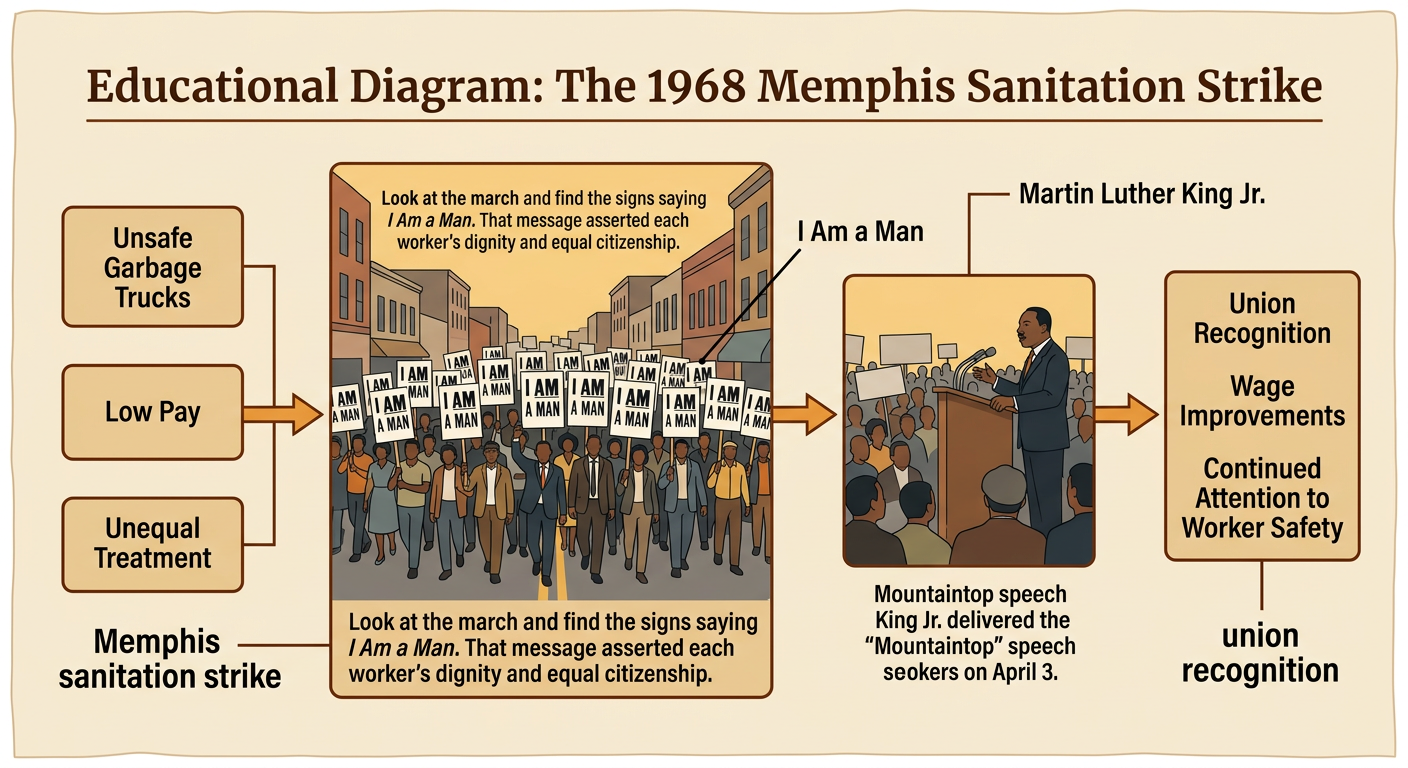
The 1968 Memphis sanitation strike connected civil rights, worker safety, and environmental services. Black sanitation workers faced low pay, unsafe equipment, and unequal treatment by the city. On February 1, workers Echol Cole and Robert Walker were killed when a garbage truck malfunctioned. Their deaths intensified demands for safer conditions and union recognition. Workers marched with signs stating, “I Am a Man,” asserting their dignity and equal citizenship. Local organizers, union members, clergy, and residents supported the strike through marches and boycotts. Martin Luther King Jr. traveled to Memphis to support the workers and delivered his “Mountaintop” speech on April 3. He was assassinated the next day. The city later recognized the union and approved wage improvements. The strike shows how personal safety concerns can become public issues addressed through collective action and government negotiation.
Environmental Justice and Public Policy
Environmental justice means that all people deserve meaningful participation in environmental decisions and fair protection from pollution and hazards. Communities with less political or economic power have often faced greater exposure to landfills, industrial emissions, unsafe water, flooding, or neglected waste services. Evidence is essential for showing whether burdens are unequal. For example, students could design a neighborhood air-quality study by placing the same type of particle sensor at several locations near and far from a busy highway. They would collect readings at the same times, record weather conditions, compare averages, and map the results. To minimize harm, a policy might limit truck traffic near schools, plant protective vegetation, improve public transit, or require stronger emissions controls. Residents, scientists, businesses, and officials may have different interests, so a fair process should include public data, community testimony, accessible meetings, and equal enforcement.

Evaluating Change and Continuing Challenges
The Civil Rights Movement achieved major legal and political change, but evaluating progress requires more than listing laws. Students should compare evidence from different times and ask whether policies changed people’s daily experiences. Voting registration records, school enrollment data, pollution measurements, court opinions, photographs, and oral histories can reveal both progress and continuing inequality. For example, a city may adopt equal housing rules while some neighborhoods still experience higher flood risk or greater exposure to industrial pollution because of earlier development decisions. Researchers should examine who collected each source, what it measures, and what information may be missing. Democratic problem-solving also requires listening to residents whose health, homes, jobs, or neighborhoods are affected. Citizens can attend hearings, submit evidence, vote, organize, and propose monitoring plans. Continuing civic participation helps ensure that legal rights are enforced and environmental policies serve all communities.
